
A Manusmriti verse appears in your family group, a campus debate, or a political speech. Within minutes, you are expected either to defend it as eternal Hindu law or denounce it as the essence of Hindu civilization. That forced choice is the first mistake.
You can read Manusmriti seriously without treating every rule as binding, and you can reject an unjust rule without rejecting Dharma. The practical task is to identify what kind of authority a passage once had, establish what it actually means, and decide whether its principle belongs in constitutional India.
Begin with the right category of text
Manusmriti, also called the Mānava-Dharmaśāstra, belongs to the Dharmashastra corpus. It is Smriti: remembered tradition composed and transmitted by human beings. It is not Shruti, the category associated with revealed Vedic authority. That distinction does not make Manusmriti unimportant. It tells you what kind of importance it has.
Tradition associates the work with Manu, the archetypal lawgiver. Textual scholarship generally places its central layers between the final centuries BCE and the first centuries CE. Its composition and redaction occurred across time, and multiple recensions now contain approximately 2,700 verses arranged in twelve chapters. A disputed sentence therefore cannot be treated as though it arrived as an isolated, timeless command with a self-evident application.
Smriti works through context. Place, time, established custom, the conduct of learned people, and the needs of an actual community all mattered to Dharmashastra reasoning. Local custom, family usage, professional rules, guild practice, royal edicts, other Smritis, juristic digests, and commentaries could affect the result. The legal culture was an extended argument about Dharma, not a single book mechanically applied to every person in Bharat.
This is visible in the interpretive tradition itself. Medhātithi, Govindarāja, and Kullūka Bhaṭṭa did more than paraphrase difficult Sanskrit. Commentators selected among possible meanings, reconciled conflicting rules, established priorities, and applied inherited norms to different circumstances. Yājñavalkya Smriti, Nārada Smriti, the Mitākṣarā of Vijñāneśvara, and numerous nibandhas also shaped jurisprudential reasoning. Manusmriti was influential, but it was never the solitary statute book of all Hindus.
Key takeaways
- Manusmriti is historically significant Smriti literature, not revealed Shruti and not the current law of India.
- A verse must be checked in its chapter, recension, translation, commentarial history, and wider Dharmashastra setting.
- Historical explanation is not moral approval. Context can clarify a rule without making that rule acceptable now.
- Constitutional dignity, equality, and freedom of conscience set the modern legal and ethical boundary.
- Universal duties such as truthfulness, compassion, restraint, generosity, and cleanliness can be retained without importing birth- or gender-based hierarchy.
Do not confuse historical influence with current legal force
The belief that Manusmriti once operated as one uniform code owes much to colonial administration. Sir William Jones’s 1794 English translation helped British courts elevate one Sanskrit work as the principal representation of Hindu law. That move made administration easier, but it compressed a plural legal world into Anglo-Hindu law. Regional usages and living customs received less attention, while selected texts and elite commentaries acquired an artificial uniformity.
Independent India changed the legal centre of gravity. The Constitution, enacted statutes, and binding judicial decisions govern legal rights. The Hindu Marriage Act of 1955, the Hindu Succession Act of 1956 as amended in 2005, and related legislation regulate fields once discussed through Dharmashastra. These laws also apply within their statutory scope to Hindus, Buddhists, Jains, and Sikhs. Manusmriti may help explain legal history, but it cannot override constitutional guarantees or binding legislation.
When someone calls a Manusmriti verse the law of India, ask which kind of claim is being made:
- A textual claim asks what a particular Sanskrit passage says.
- A historical claim asks how jurists, rulers, communities, or courts understood and used it at a certain time.
- A religious claim asks what authority a community gives it within a tradition.
- A legal claim asks what rule an Indian court may enforce now.
- A moral claim asks whether the rule is just and worthy of practice.
These questions require different evidence. Showing that a verse exists does not prove that every Hindu obeyed it, that every court enforced it, that it binds anyone now, or that it deserves moral approval. Equally, showing that a rule is unconstitutional now does not prove that the passage has no historical value.
If you face an actual dispute involving marriage, inheritance, discrimination, property, or another legal right, work from current legislation and qualified legal advice. A Sanskrit quotation circulating online is not a safe basis for making an irreversible legal or financial decision.
Audit a disputed verse before you repeat it
You do not need to become a Sanskrit jurist before discussing Manusmriti. You do need a standard higher than a cropped image. Use this six-step audit whenever a sensational verse enters the conversation.
- Demand an exact location. Ask for the chapter, verse number, Sanskrit text, edition, and translator. If the claimant supplies only an English sentence without a traceable location, treat it as unverified. Do not build an argument around it and do not forward it.
- Check what the key words can mean. A translated English term may compress several Sanskrit possibilities. Grammar, technical usage, and the surrounding legal vocabulary matter. Compare a reliable critical translation, such as one by Patrick Olivelle, rather than choosing whichever rendering best serves your side.
- Read the surrounding passage. Determine who is being addressed, what institution is under discussion, and whether the verse describes an ideal duty, a household arrangement, a legal procedure, a penalty, or an exception. Context can narrow a claim substantially, although it cannot automatically make an unjust rule just.
- Check textual uncertainty honestly. Manusmriti has multiple recensions and a long history of redaction. Some widely circulated lines are mistranslated, detached from context, or associated with disputed textual layers. But interpolation must be demonstrated; it is not a label to attach to every uncomfortable verse.
- Consult the interpretive ecosystem. Look at major commentaries and parallel treatment in Yājñavalkya Smriti, Nārada Smriti, juristic digests, regional practice, and relevant custom. P. V. Kane, Robert Lingat, and J. D. M. Derrett offer useful scholarly orientation to the larger legal tradition. A rule that appears absolute in one place may have been qualified, displaced, or applied differently elsewhere.
- Write two separate verdicts. First state the best historical meaning you can establish. Then state whether the rule is morally and legally acceptable in modern India. Never alter the first verdict to protect the second, and never allow the first to dictate the second.
This method prevents two symmetrical failures. Polemical critics cannot make one severe sentence stand for the whole Hindu tradition. Apologists cannot turn textual complexity into a blanket acquittal. Precision is more faithful to Dharma than either reflex.
Face the passages on women and caste without evasion
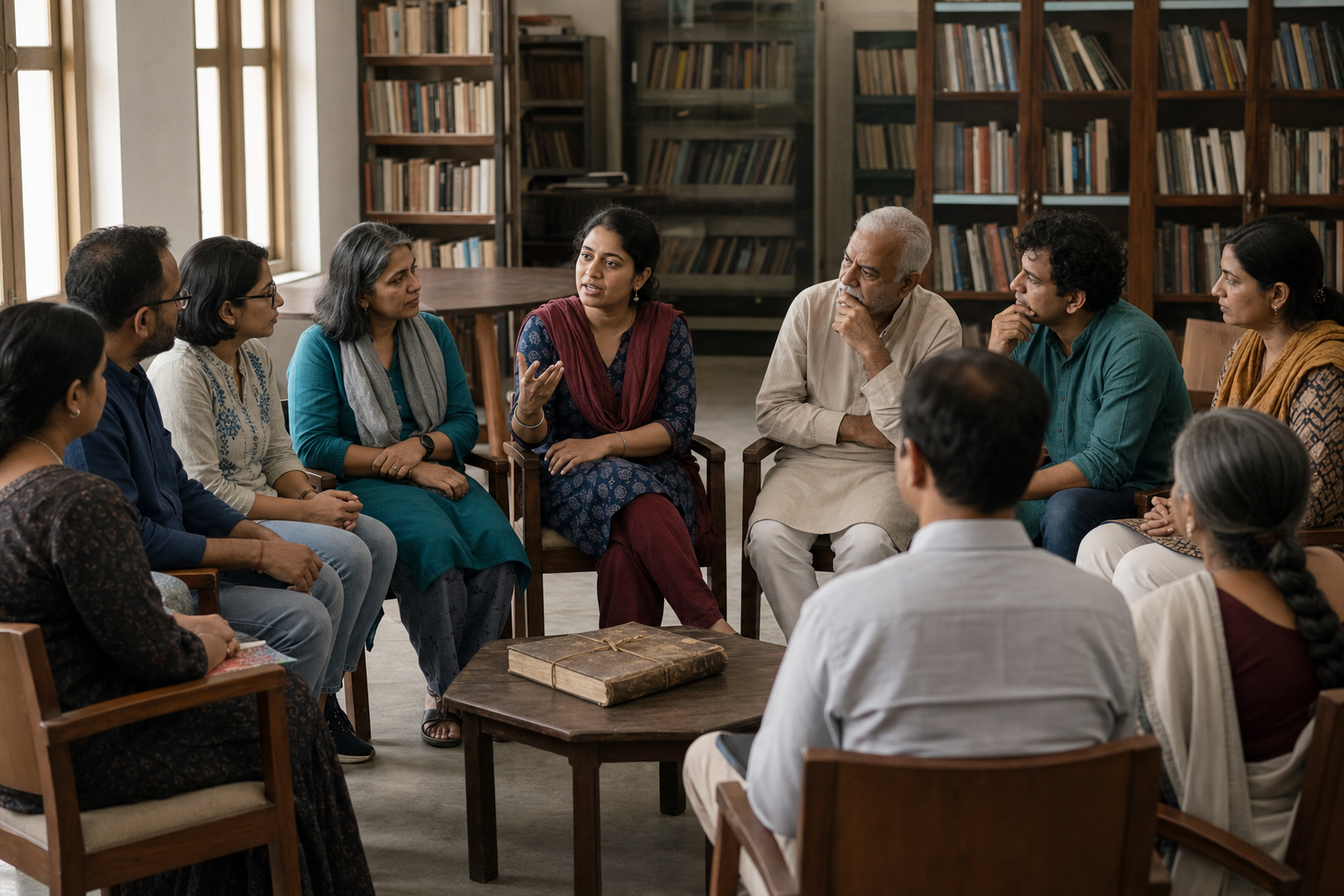
The most difficult discussions usually concern women and inherited social rank. Here, responsible interpretation requires both historical proportion and moral candour. You should neither erase the older social setting nor ask a modern person to surrender equal dignity to it.
Guardianship language does not settle women’s status
The line pitā rakṣati kaumāre bhartā rakṣati yauvane, putrā rakṣanti vṛddhake is commonly presented as proof that a woman must remain under male control throughout life. The key term rakṣā can cover protection, guardianship, maintenance, and welfare obligations within older household, property, marriage, and succession arrangements. That range matters because protection and control are not identical concepts.
But semantic range must not become an escape route. The passage still comes from a social order structured by male guardianship. Recognizing duties of maintenance does not erase limits on women’s agency. Conversely, acknowledging those limits should not erase strīdhan, the recognized category of women’s property comprising certain gifts and inheritances, or the later juristic work that refined it.
Use four questions when you assess such a rule: What material protection did it create in its historical setting? What freedom did it restrict? Who was permitted to make the decisive choice? What does equal personhood require now? The answer may preserve a reciprocal duty of care while rejecting compulsory guardianship. Modern law and Dharmic ethics should protect a woman’s safety, property, inheritance, consent, education, and public participation without making her agency conditional on a male relative.
Varna theory is not a licence for caste discrimination
Manusmriti sets out varna-specific duties and classifications of mixed lineage. These categories belong to an ancient normative taxonomy. Varna theory and the thousands of lived jati communities did not map neatly onto one another. Occupations changed, communities moved, regional exceptions developed, and local practice could differ from textual schemes. Colonial gazetteers and courtroom classifications later pushed diverse identities toward more rigid administrative categories.
That complexity corrects bad history; it does not excuse humiliation or exclusion. Birth-based discrimination is incompatible with constitutional equality. It also conflicts with the moral direction supplied by ahimsa, compassion, service, and the dignity of human beings. If an interpretation requires another person to accept inherited inferiority, the problem is not cured by calling the hierarchy traditional.
The wider Dharmic family offers useful checks. Hindu teaching gives universal weight to virtues such as satya, dayā, dama, dāna, and śauca. Buddhist and Jain traditions deepen the demands of non-harm and compassion. Jain anekāntavāda trains the mind to recognize partial viewpoints without pretending that all conclusions are equally sound. Sikh seva and sarbat da bhala place disciplined service and the welfare of all at the centre of community life. These traditions are not interchangeable, but their ethical conversation gives modern India strong Dharmic grounds for opposing inherited degradation.
Retain the method and virtues, not every social rule
A responsible reading need not end with either canonization or cancellation. Manusmriti can still help you think about the relation between rights, duties, custom, institutional power, and social order. The useful inheritance lies less in reproducing an ancient hierarchy than in recovering a disciplined way to ask who owes what to whom.
Constitutional rights establish a non-negotiable floor. A responsibility-centred Dharma vocabulary can strengthen the conduct built above that floor. Rights protect a student from discrimination; duty asks a teacher to mentor fairly. Rights protect authorship; satya requires honest attribution. Rules constrain official power; dama asks the official to exercise restraint even when supervision is weak. Property law punishes theft; dāna asks those with resources to share. Environmental regulation sets minimum obligations; Dharma asks a community to consider the more-than-human world before damage becomes a lawsuit.
That complement works only when duties are reciprocal. Invoking duty solely to demand obedience from women, workers, younger people, or subordinated communities turns Dharma into an instrument of power. Begin with the responsibility of the stronger party: the ruler before the subject, the institution before the applicant, the employer before the worker, and the guardian before the dependent.
For a school, temple trust, university committee, professional association, or family council, use a three-part decision rule:
- Retain principles that can apply to every person, including truthfulness, non-harm, generosity, self-restraint, responsible stewardship, care for dependants, and accountability in office.
- Adapt context-bound duties into reciprocal and voluntary responsibilities. A historical guardianship duty, for example, can become a gender-neutral obligation to support children, elders, and vulnerable family members while respecting their legal agency.
- Reject or archive rules that assign unequal dignity, opportunity, punishment, or civic standing by birth or gender. Preserve them for historical study when useful, but do not convert description of the past into policy for the present.
When turning a Dharmic value into an institutional rule, express it in terms every affected person can understand and challenge. Do not say only that Manu requires integrity. Specify that records must be accurate, conflicts of interest disclosed, accusations heard fairly, decisions documented, personal data protected, and appeal routes available. The classical vocabulary supplies moral depth; clear procedures prevent that vocabulary from becoming arbitrary authority.
The next time a Manusmriti verse is used to provoke a quick allegiance test, slow the exchange down. Ask for the exact passage, establish its textual and historical setting, consult the wider interpretive tradition, separate past practice from present law, and apply the dignity test openly. If a principle survives all five steps, put it to constructive use. If it fails, say precisely why and leave the failed rule in history without surrendering the civilization that learned to debate it.