
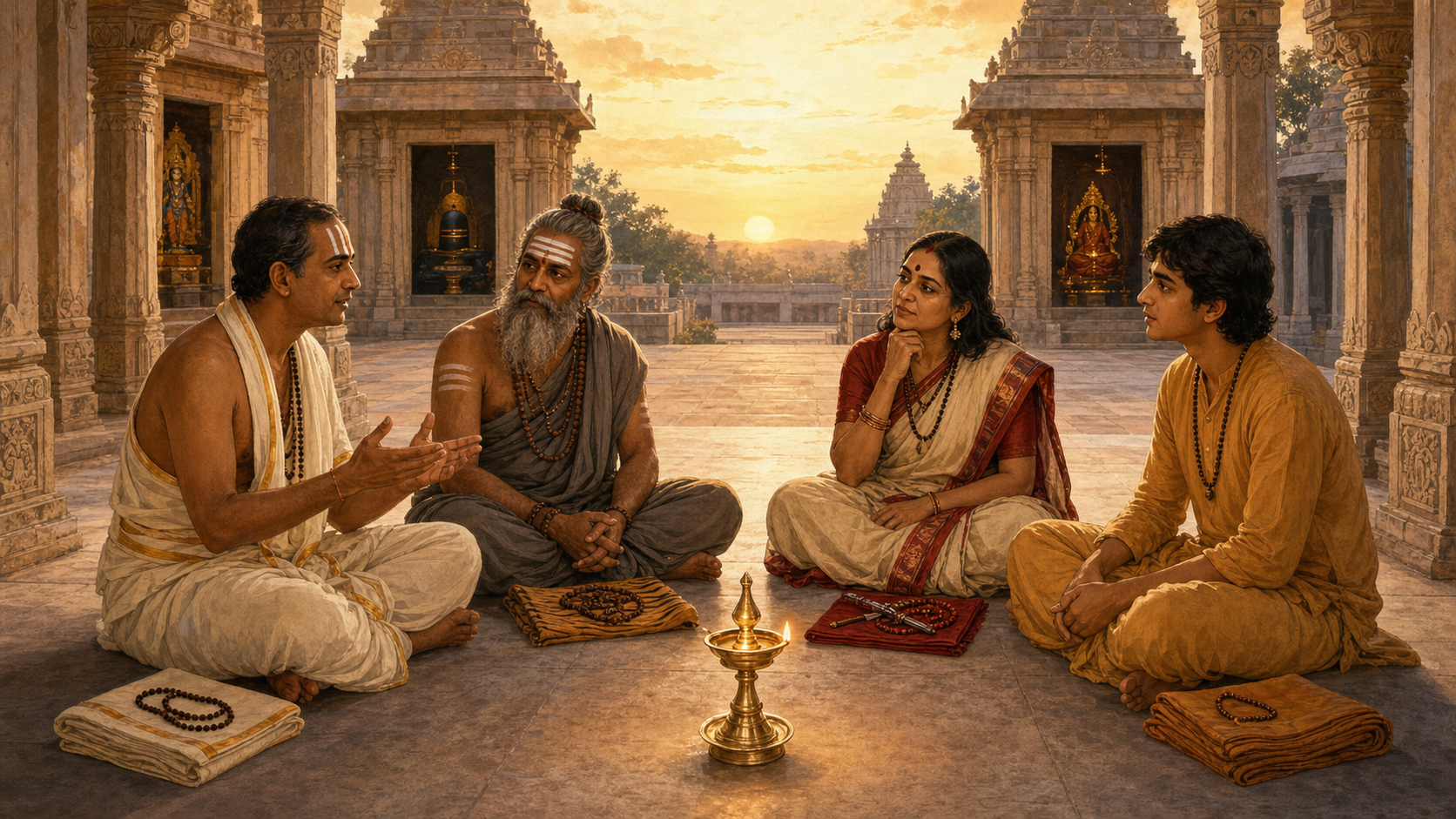
You may love your iṣṭa-devatā deeply and still wonder what to do with a Vedāntin who describes the Divine in radically different terms. If Brahman is nondual, how can the devotee remain eternally distinct from the Lord? If one answer is true, must the other path be dismissed?
You do not have to choose between conviction and generosity. A mature Dharmic response does two things at once: it states real philosophical differences without disguise, and it refuses to turn those differences into contempt. That combination gives you an inclusive vision of the Divine without weakening your own sādhana.
Inclusion does not require metaphysical sameness
Advaita and Dvaita do not merely use different words for an identical conclusion. Advaita teaches that the true Self is nondual Brahman. Dvaita teaches that the individual self and the Supreme remain irreducibly distinct. Those propositions cannot both function as the final conclusion of the same philosophical system.
That does not make respect impossible. It makes precision necessary. Vedāntic inclusion is not the assertion that every doctrine means the same thing. It is the recognition that a person may approach the Divine through a coherent lineage, disciplined practice and sincere devotion even when another lineage disputes that person’s metaphysical conclusion.
Keep three levels separate when you assess another path:
- Doctrinal truth: What does the school claim about Brahman, the jīva, the world and mokṣa? Differences at this level should be stated honestly.
- Spiritual method: What does its sādhana train the practitioner to do? Inquiry, worship, meditation, remembrance and service can produce discipline even when schools explain their purpose differently.
- Dharmic conduct: How should practitioners treat one another? Philosophical disagreement never requires mockery, coercion or hostility.
The Rig Veda’s ekam sat viprā bahudhā vadanti presents truth as one while sages speak of it in many ways. Bhagavad Gītā 4.11 adds that the Divine responds to people in accordance with the ways they approach. These statements support a theology spacious enough for different devotional dispositions and spiritual capacities. They do not require you to pretend that every later interpretation is logically interchangeable.
Your iṣṭa therefore gives your devotion a centre, not a border around the Infinite. You can worship Viṣṇu, Śiva, Devī or another chosen form with complete loyalty without concluding that the Divine has no valid relationship with anyone outside your own sampradāya.
Map the actual Vedāntic differences before debating them
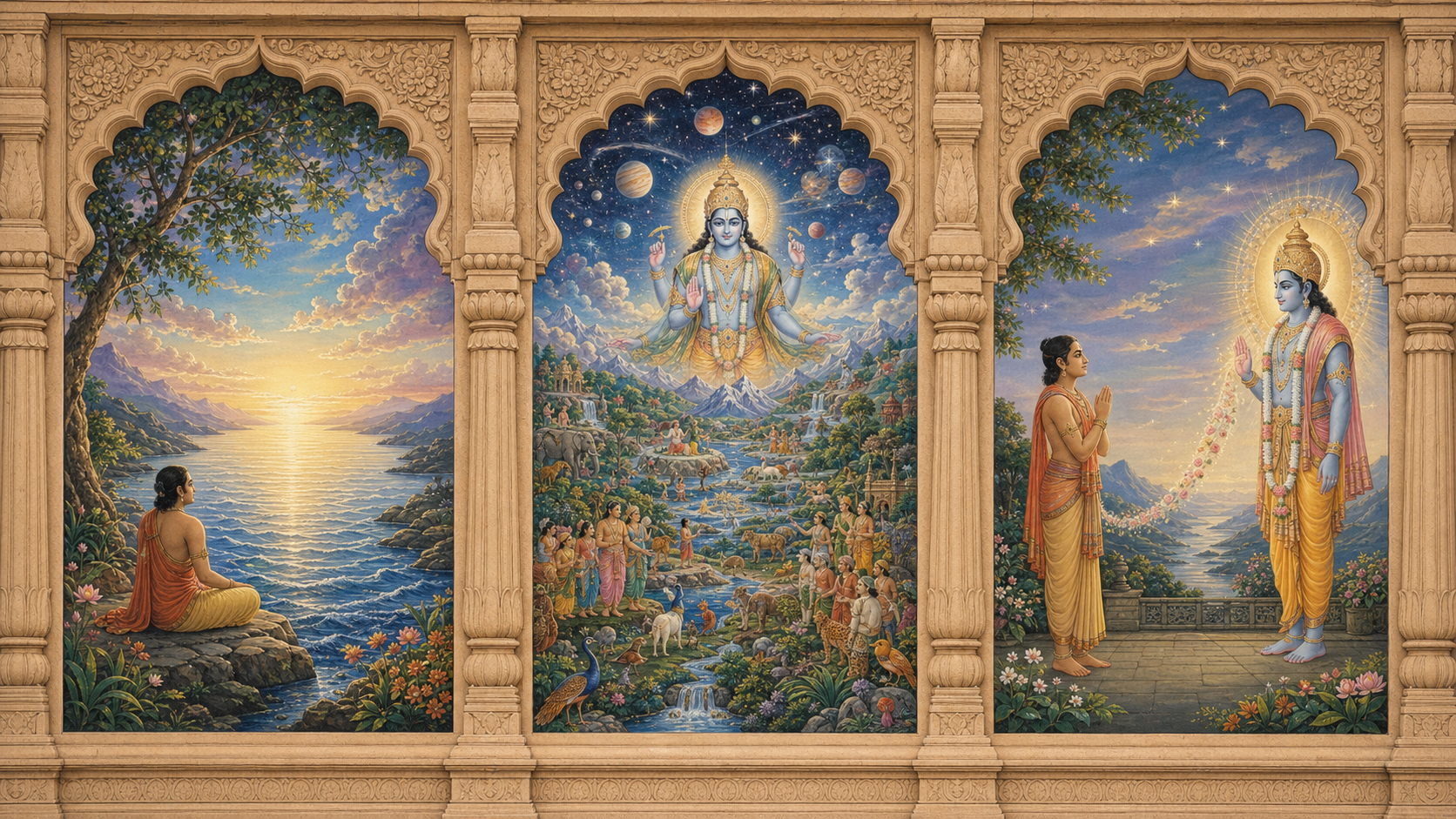
Vedānta draws upon the Upaniṣads, Bhagavad Gītā and Brahma Sūtras, commonly called the Prasthāna-trayī. Shared scripture does not guarantee a shared interpretation. Advaita gives final weight to passages of non-difference, while Dvaita interprets non-difference in ways that preserve the real distinction between the Lord and the individual self. Their disagreement concerns the purport of revelation, not whether revelation matters.
| Question | Advaita Vedānta | Dvaita Vedānta |
|---|---|---|
| What is ultimate reality? | Nirguṇa Brahman, beyond limiting attributes, is ultimate. Īśvara is the omniscient Lord within empirical experience. | Viṣṇu or Nārāyaṇa is the eternally personal, independent and supreme Lord. |
| What is the self? | The true Ātman is nondual Brahman. Ignorance makes individuality appear ultimately separate. | Each jīva is real and remains eternally distinct from the Supreme. |
| What is the world? | The world is mithyā: dependently and empirically real, but not absolute or independently self-existent. | The world, its plurality and its relations are real under the sovereignty of the Lord. |
| What is bondage? | Avidyā, or ignorance of one’s true nature, sustains mistaken identification and separation. | The finite self remains dependent upon the Lord and requires right knowledge, devotion and grace. |
| What is liberation? | Knowledge removes ignorance and reveals the ever-free Self; this makes jīvanmukti, freedom while embodied, intelligible. | Mokṣa is blissful communion with the Lord without erasing the devotee’s distinct identity, usually described as fully attained beyond embodied life. |
| What is emphasized in practice? | Discernment, dispassion, hearing the teaching, reflection and sustained contemplation, supported by devotion and ethical discipline. | Bhakti, remembrance of the Lord, dharmic conduct, surrender and divine grace. |
These are not minor variations. Madhva’s pañca-bheda identifies five real kinds of difference: between the Lord and the jīva, the Lord and nature, one jīva and another, the jīva and nature, and entities within nature. Advaita instead distinguishes illusory, empirical and absolute standpoints, allowing experienced plurality to operate meaningfully while denying it absolute status. The contrast concerns the status of difference itself.
Viśiṣṭādvaita supplies another configuration. It affirms a qualified nonduality in which beings and the world are real modes of the Divine. Unity is preserved, but plurality is not dismissed as merely provisional. This should warn you against reducing the entire Vedāntic landscape to a simple contest between an impersonal absolute and a personal God.
Before arguing about a verse or teaching, ask four questions:
- Is this claim being made from an empirical standpoint or as the final truth?
- What does the speaker mean by real: independently existent, dependently existent, or never subject to sublation?
- Does the school consider devotion preparatory to knowledge, part of knowledge, or the everlasting character of liberation?
- What does the school say remains of the devotee in mokṣa?
Those questions locate the disagreement. Without them, debates usually trade slogans: one person says the world is unreal, another says difference is obvious, and neither has engaged the other’s definitions.
Four common errors distort both difference and inclusion
First, mithyā does not mean that nothing matters. Advaita does not treat ordinary life as sheer nonexistence. It grants the world empirical validity, and it gives ethics, devotion, worship and mental purification indispensable roles in preparing the seeker for liberating knowledge. If someone invokes nonduality to excuse cruelty, evade duty or dismiss another person’s suffering, the problem is not excess Advaita but a failure to follow its disciplined account of levels of reality.
Second, Dvaita is not an elementary stage waiting to become Advaita. Dvaita deliberately rejects the claim that the Lord-devotee relation is finally sublated. Loving service is not merely a provisional exercise for a mind that has not yet discovered identity with Brahman. It belongs to the fulfilment Dvaita seeks. Treating every Dvaitin as an undeveloped nondualist is philosophical condescension, not inclusion.
Third, devotion is not owned by one school. Advaita includes worship, mantra-japa and contemplation of Īśvara as powerful disciplines of purification. Dvaita gives bhakti an ultimate relational meaning, but an Advaitin’s devotion need not be emotionally shallow or insincere. The real distinction lies in how each school finally understands the worshipper, the worshipped and their relation.
Fourth, inclusion does not suspend discrimination. Dharmic openness is not an obligation to accept every assertion, teacher or experience as authoritative. Śruti, yukti and anubhava – scriptural testimony, reasoned examination and direct realization – provide checks against arbitrary certainty. The traditions disagree about how these means of knowledge are interpreted and weighted, but none of them makes careless belief a virtue.
Apply the same caution to contemplative experience. A period in which the subject-object boundary becomes quiet may be spiritually important, but the experience alone does not settle every metaphysical question. An Advaitin and a Dvaitin may interpret profound stillness differently. Do not turn a passing state into a universal decree before testing its interpretation through sustained practice, reasoning and instruction.
Build an inclusive vision into your own sādhana

An inclusive outlook becomes reliable only when it changes how you practise. It should make your path clearer, not leave you collecting attractive phrases from incompatible systems without understanding any of them.
- Name your present orientation. Write one sentence describing the relation you are practising: identity with Brahman, dependence upon the Lord, or real belonging within divine unity. Call it your working orientation, not a verdict on every seeker.
- Choose an iṣṭa and an iṣṭa-mārga. A chosen form and chosen way let affection, attention and discipline deepen. Inclusivity does not require a different theology every morning. If you have received formal instruction in a sampradāya, follow its sequence and terminology rather than presenting a personal mixture as that lineage’s teaching.
- Know what each practice is doing. Ask whether japa is cultivating remembrance, purifying attention or expressing an eternal relation with the Lord. Ask whether meditation is observing the mind, contemplating the Self or dwelling upon the Divine form. Similar outward actions can serve different philosophical purposes.
- Use the yogas without turning them into rival camps. Jñāna, bhakti, karma and rāja yoga address knowledge, devotion, action and contemplative discipline. Their relative emphasis can follow your disposition and capacity, while ethical conduct remains non-negotiable.
- Test your interpretation by its fruit. Notice whether practice reduces the urge to demean others, strengthens responsibility, steadies attention and makes service less self-centred. Sectarian pride wearing sacred vocabulary is still pride.
Sevā is a particularly honest test. Metaphysical language can be manipulated to protect the ego; serving without demanding status exposes that habit. A nondualist can serve because the apparent other is not outside the Self. A Dvaitin can serve the beings and world that belong to the Lord. A Viśiṣṭādvaitin can serve lives understood within divine unity. The explanations remain different while the discipline becomes concrete.
Do not use inclusion to avoid commitment. A river needs banks to acquire direction. Your lineage, mantra, teacher and daily discipline can provide those banks. The mistake begins only when you identify the banks with the full extent of the ocean.
Speak across Dharmic paths without absorbing them into yours
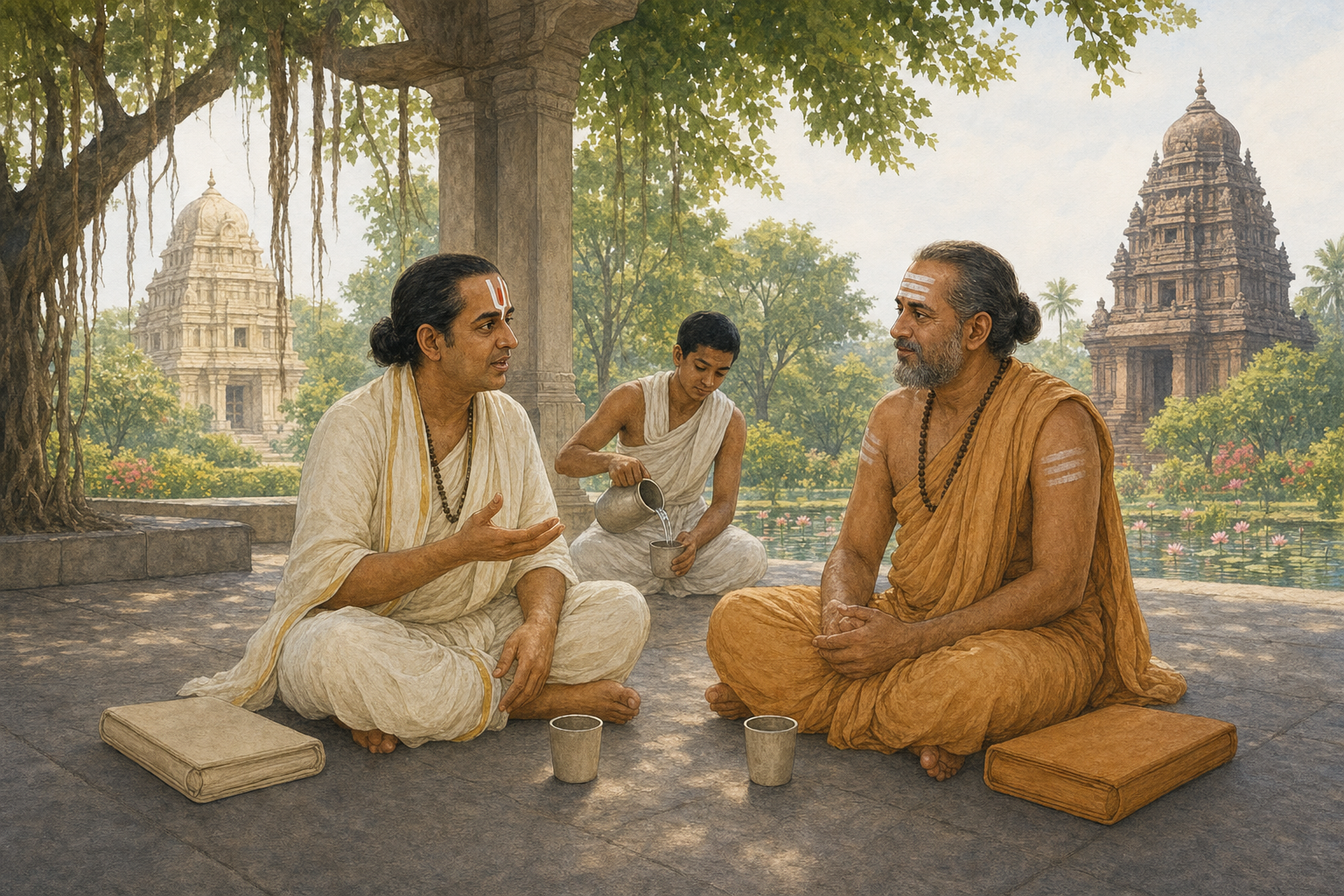
Good dialogue begins when the other person can recognize their position in your description of it. Before responding, restate the claim and ask whether you have understood it. Then identify the exact point of difference.
These questions are more useful than asking which school is simply higher:
- Do you regard the difference between the jīva and the Lord as ultimate or operative only within empirical experience?
- When you say Brahman has no attributes, are you denying the Divine or denying that finite concepts can contain the Divine?
- Is bhakti a means to another realization, an expression of realization, or the everlasting form of liberated life?
- Which scriptural passages control your interpretation of passages that appear to say the opposite?
- What practice follows from your doctrine when another person needs help?
You can then state disagreement without issuing a spiritual verdict: We disagree about whether personal distinction remains in mokṣa; we agree that ego, negligence and hostility are obstacles to disciplined spiritual life. That sentence protects the difference while keeping the person inside the moral field of respect.
The same discipline matters across the wider Dharmic family. Vedāntic Ātman-Brahman language, Buddhist śūnyatā and anātman, Jain teachings about the jīva and many-sided reality, and the Sikh affirmation of Ik Onkar should not be translated automatically into synonyms. Calling everything Brahman may sound hospitable to a Hindu, yet it can erase what another tradition is actually claiming.
Jain anekāntavāda offers a practical restraint: a proposition may disclose a genuine aspect of reality without exhausting it. Its associated discipline of qualified predication encourages you to say, in effect, from this standpoint or in this respect. That is not relativism. It is a refusal to make a standpoint-bound judgment larger than its warrant.
Buddhist upāya similarly keeps a teaching connected to its liberating function rather than turning every formulation into an object of attachment. Sikh devotion joins the oneness expressed by Ik Onkar with remembrance and sevā, while langar gives equality an institutional form. These different Dharmic approaches meet most honestly in disciplined conduct and service, not in a forced declaration that their metaphysics are identical.
When dialogue becomes heated, use one sentence from anekāntic discipline before defending your view: From the standpoint of my sampradāya, this claim is true because… That opening marks the location of your conviction. It leaves room for serious argument without pretending that your present standpoint is the only angle from which reality has ever been encountered.
Key takeaways
- Advaita, Dvaita and Viśiṣṭādvaita make genuinely different claims about the Divine, the self, the world and liberation.
- Respect does not require you to merge those claims or conceal their contradictions.
- Mithyā means dependent, empirically valid reality in Advaita; it does not mean that ethics and suffering are irrelevant.
- Dvaita treats the distinction between the Lord and the devotee as eternally real, not as a lower lesson awaiting nondual correction.
- Your iṣṭa should concentrate devotion without becoming a reason to restrict the Divine’s reach.
- Use scripture, reasoning, sustained practice and ethical fruit to examine claims; do not mistake openness for credulity.
- Across Dharmic traditions, cooperate in service while allowing Ātman, śūnyatā, jīva and Ik Onkar to retain their distinct meanings.
At your next pūjā, meditation or scriptural reading, make one small correction: affirm your chosen relation to the Divine without adding a judgment about those who approach differently. Then carry that discipline into one real conversation or act of sevā. A vision becomes inclusive not when it says less, but when it sees more without losing clarity.
References
- DharmaRenaissance Blog – Beyond Sectarianism: Dharmic Wisdom for an Inclusive, Boundless Vision of the Divine
- DharmaRenaissance Blog – Dvaita vs Advaita in Hinduism: A Clear, Compassionate, Research-Backed Guide to Vedanta