
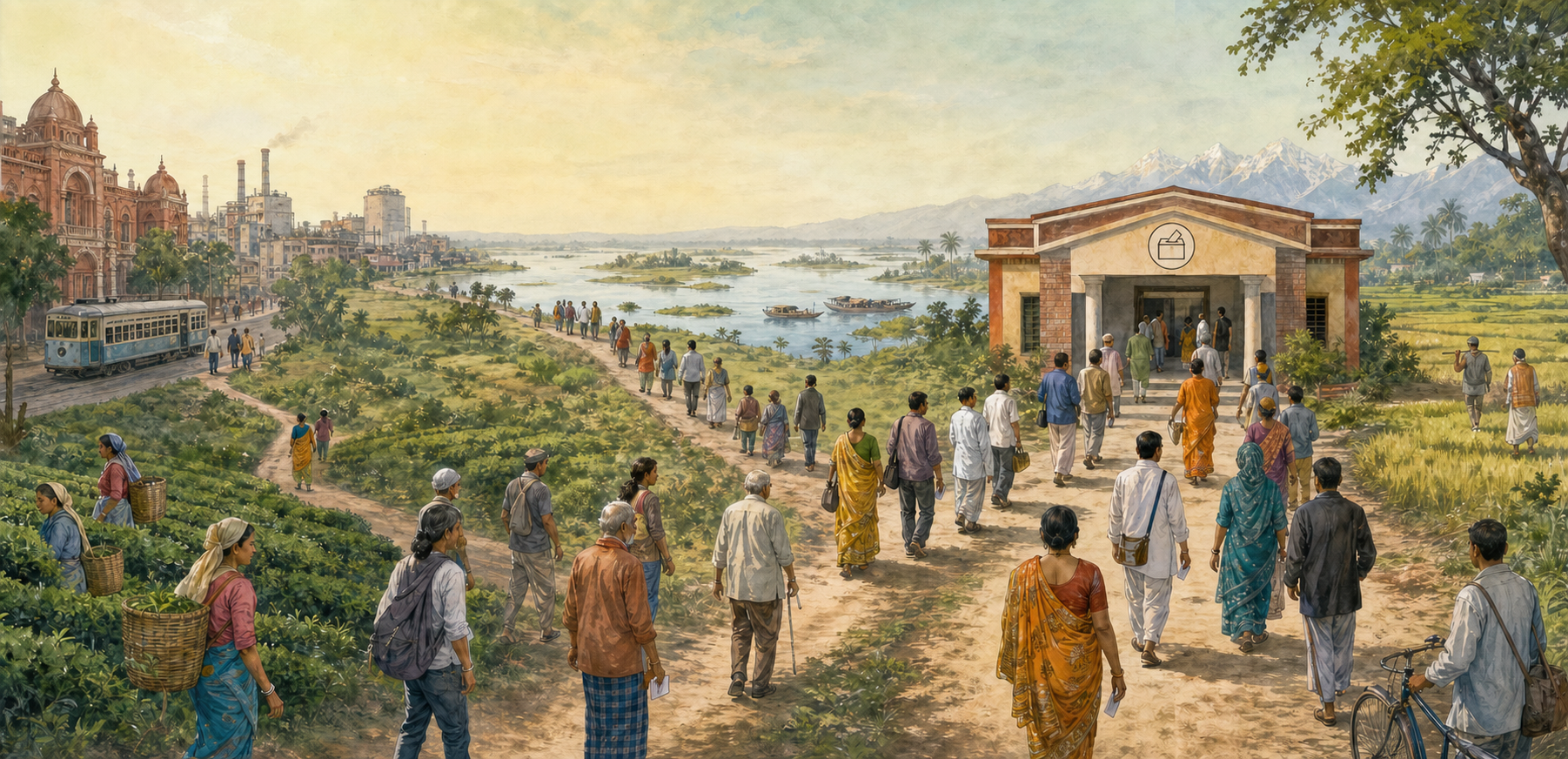
You may be looking at the BJP’s rise in West Bengal and asking a deceptively simple question: has the Hindu vote actually consolidated, or has the party merely built a larger but capped opposition base? Both can be true. Consolidation has already changed the contest, but it has not made victory automatic.
To judge what is happening, you have to look below the statewide vote share. West Bengal’s decisive contests turn on which Hindu communities align, where their votes are located, whether supporters reach the booth, which government receives credit for household benefits, and whether the candidate is trusted locally. That constituency-level view is more useful than any sweeping claim that Bengal has either embraced or rejected Hindutva.
Start with the electoral arithmetic, not the slogan

Hindu vote consolidation does not mean that every Hindu votes for one party. It means that a sufficiently large share of a socially diverse Hindu electorate begins choosing the same party often enough to alter seat outcomes. Under India’s first-past-the-post system, that change can be much more important than its statewide size suggests.
A party does not receive seats in proportion to its statewide vote. It wins each constituency separately. A five-point gain spread thinly across seats that remain unwinnable may produce little. The same gain concentrated in constituencies with narrow margins can produce a major seat increase. Consolidation therefore has two dimensions: the number of voters joining the coalition and the geographical efficiency with which those votes are distributed.
| Election | BJP performance | What you can reasonably conclude |
|---|---|---|
| 2016 Assembly | Roughly one-tenth of the statewide vote | The party was still a limited Assembly force. |
| 2019 Lok Sabha | 18 of 42 seats | The expanded coalition could convert support into a parliamentary breakthrough. |
| 2021 Assembly | About 38 percent of the vote and 77 seats | The BJP became a serious statewide challenger, but its consolidation remained insufficient for government. |
| 2024 Lok Sabha | 12 of 42 seats | The party remained the principal opposition force, while the setback showed that consolidation does not move in only one direction. |
Do not turn these four elections into a simple trend line. Assembly and Lok Sabha contests place different weight on candidates, local governance, state leadership and national leadership. The defensible conclusion is narrower: the BJP moved from Bengal’s margins into a durable competitive position, and Hindu consolidation was central to that change. The results do not establish that the coalition is complete, permanent or equally strong everywhere.
The smallest margins deserve the closest attention. In some constituencies, movements of roughly 1,500 to 5,000 votes have been decisive. In tightly contested regions, the number of seats gained per point of vote movement can exceed three to one. That is not a statewide rule. It is a reminder that turnout, candidate selection and booth organization matter most where the underlying contest is already close.
Bengal’s Hindu electorate is a coalition, not a single bloc
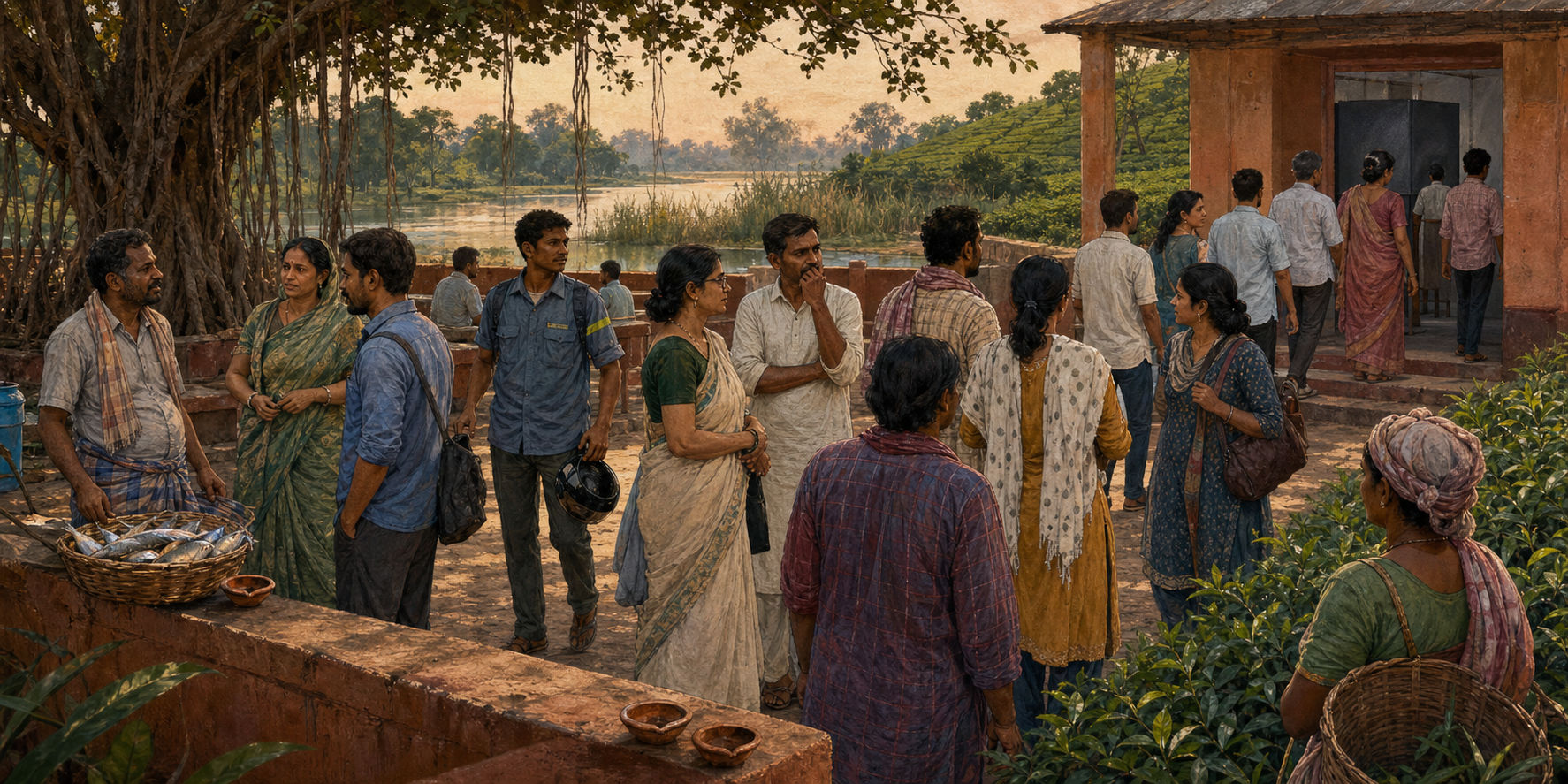
The phrase “Hindu vote” can conceal more than it reveals. A Rajbanshi voter in the north, a Matua household with a history of displacement, a tribal voter in Jangalmahal, an urban professional near Kolkata and a working-class family in a peri-urban municipality do not necessarily rank issues in the same order. Shared civilizational identity may connect them, but it does not erase caste, region, language, livelihood or local experience.
The BJP’s expansion became electorally significant when it reached beyond its earlier support and attracted Namasudra and Matua segments, Rajbanshis, and several Scheduled Caste and Scheduled Tribe communities, alongside established upper-caste support. This is the crucial mechanism. Consolidation grows when communities with different social histories decide that security, dignity, mobility, welfare or cultural recognition can be pursued through the same electoral vehicle.
The Matua case shows why identity cannot be separated from administration. Citizenship concerns arise from histories of cross-border displacement, documentation and belonging. The notification of Citizenship Amendment Act rules in March 2024 clarified the policy route and changed expectations among affected groups. It did not determine every Matua vote. A policy may carry civilizational meaning while voters still judge whether its procedures are clear, accessible and implemented with dignity.
This gives you a practical test for any claim of consolidation: ask whether several Hindu communities are moving together for their own intelligible reasons. If the explanation depends on treating them as culturally interchangeable, it is probably too crude. A durable coalition must translate a shared identity into answers to distinct local concerns.
It is also a mistake to assume that cultural identification automatically outranks the household economy. Voters can want recognition of Hindu heritage and still make their final choice around ration access, farm income, cooking fuel, pensions, policing, prices or the responsiveness of a local representative. Consolidation becomes durable only when identity and material confidence reinforce each other.
The map and the booth decide whether sympathy becomes seats

The BJP’s strongest advances appeared along the northern arc of Cooch Behar, Alipurduar, Jalpaiguri and parts of Darjeeling, as well as the Jangalmahal belt around Jhargram, Bankura and Purulia. The southern, metropolitan and riverine belts proved more resistant. Demography matters, but it is not a complete explanation. Incumbent networks, Bengali regional identity, welfare delivery and the density of local organization also shape the map.
This is why a statewide percentage can mislead you. Imagine two parties each gaining the same number of votes. One gains them in constituencies it was already winning comfortably. The other gains them across a dozen seats decided by narrow margins. Only the second gain substantially changes the Assembly. When you assess consolidation, first locate it; only then count it.
Organization supplies the conversion mechanism. The BJP developed a structure running from the state level to mandals, Shakti Kendras and booths, supported by panna pramukhs, volunteers and parts of the wider RSS-linked social ecosystem. Door-to-door contact, micro-meetings, beneficiary verification and clustered digital outreach helped turn general approval into identified, contacted and mobilized voters.
WhatsApp, Telegram and local Facebook pages can distribute information quickly, but digital visibility is not the same as electoral capacity. A forwarded message cannot resolve a documentation problem, repair a quarrel inside a booth committee or compensate for an unknown nominee. The relevant question is whether the online network connects to a trusted person who can answer a voter, correct false information and maintain contact after the rally has ended.
Candidate quality is the final link. Consolidated sentiment loses force when a nomination arrives late, local factions remain unreconciled or the nominee has little record of constituency service. It gains force when the candidate is recognizable, accessible and integrated into the booth network. A party can possess a persuasive statewide message and still surrender marginal seats through weak local choices.
Booth results can help you detect geographic patterns, especially when compared across nearby areas and successive elections. They cannot reveal how every individual or community voted; the ballot is secret, and a booth contains mixed voters. Treat booth-level estimates as evidence of a pattern, not as a licence to assign political behaviour to every member of a caste or faith.
The winning threshold runs through welfare and Bengali legitimacy
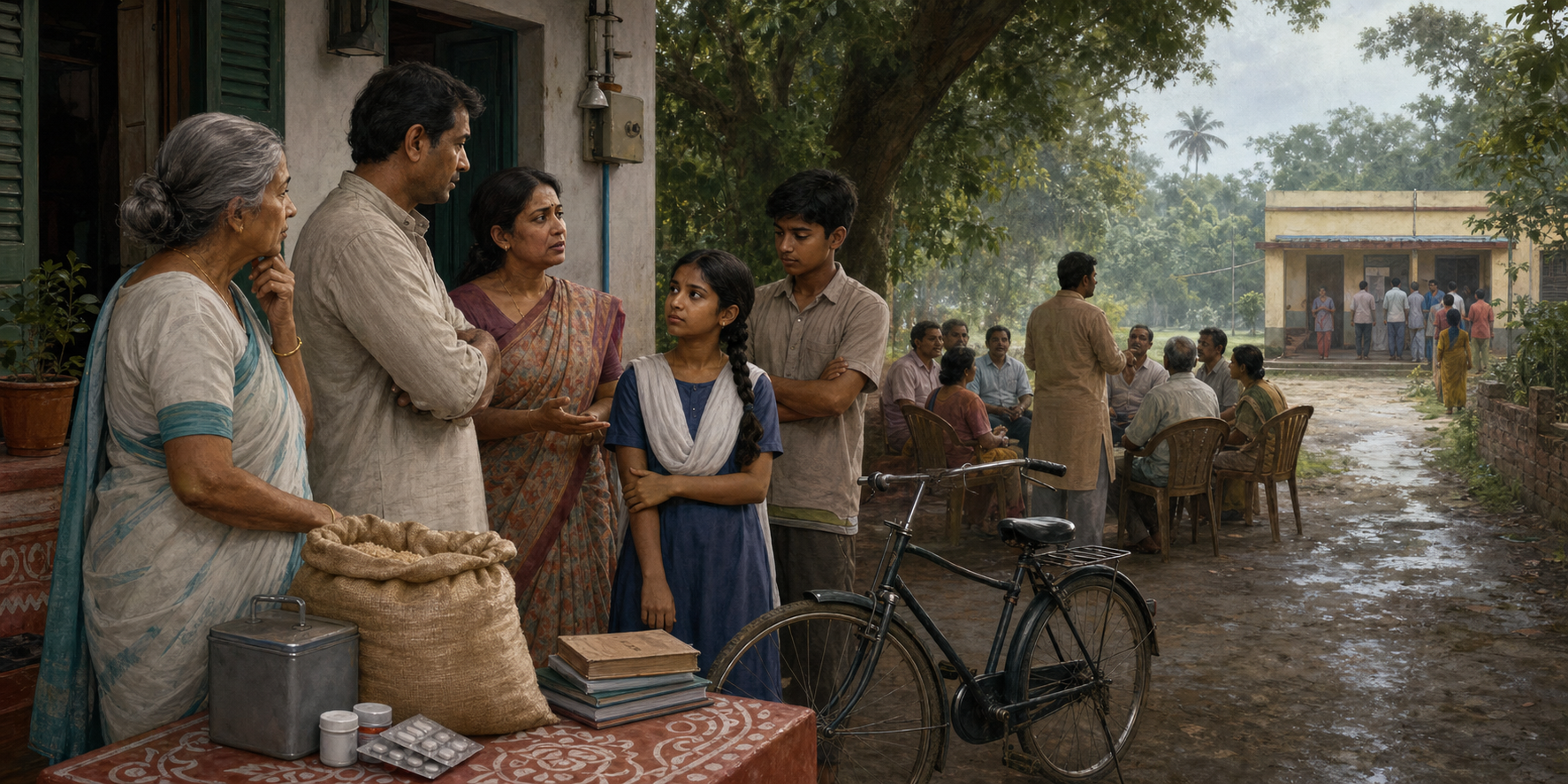
The TMC’s strongest defence has not rested on one message. Its advantage has combined a localized party network, state welfare, constituency-level mediation and a Bengali cultural narrative that portrays centralizing political forces as outsiders. Duare Sarkar and Lakshmir Bhandar gave that defence a household-level form, particularly where women and families credited the state government for visible support.
The BJP has answered with national welfare programs, including PM Ujjwala Yojana, PM-Kisan, Jan Dhan, Ayushman Bharat and free ration programs. This produces a beneficiary-versus-beneficiary contest rather than a clean division between identity voters and welfare voters. The same household may value a national scheme, depend on a state benefit and feel culturally aligned with a Hindu civilizational message. The decisive issue is often which level of government receives credit and which local network solves the immediate problem.
If you are trying to understand women’s voting, do not reduce it to a generic gender category. Ask which benefit is regular, who helps when payment or documentation fails, whether the household feels secure, and whether the candidate is present between elections. A cultural appeal that ignores these questions leaves an opening for the better-organized welfare network.
Bengali identity should not be treated as the opposite of Hindu identity. Bengal’s language, literature, festivals, temples and local traditions are themselves vehicles of Hindu civilizational continuity. The practical challenge is whether a pro-Hindu movement speaks through Bengal’s cultural vocabulary and produces credible Bengali leadership, rather than appearing to place a generic national template over the state.
The same discipline applies to border and security concerns. In border districts, voters may reasonably care about lawful migration, documentation, livelihoods, policing and administrative integrity. The effective constitutional case is directed at rules and institutions, not at collective hostility toward a community. That distinction protects social peace and keeps political accountability focused on what a government can actually do.
A dharmic political appeal is strongest when it offers positive civilizational confidence: protection of festivals and heritage, dignity for historically marginalized Hindu communities, equal application of law, clean administration and space for Hindu, Buddhist, Jain and Sikh traditions within a shared civilizational family. Antagonism toward minorities is neither required for consolidation nor a substitute for governance.
A six-part scorecard for judging real consolidation
You do not need to accept a party’s preferred narrative to evaluate its electoral position. Use the same questions for every constituency and separate measurable strength from campaign atmosphere.
Key takeaways
- Retention: Is support holding in the northern and western clusters where the BJP previously built its strongest base? Compare like with like where possible; an Assembly result and a Lok Sabha result are not interchangeable.
- Geographic efficiency: Are additional votes appearing in marginal constituencies, or merely enlarging leads and reducing defeats in seats whose outcome was already clear? A statewide gain matters only when it changes enough local contests.
- Coalition breadth: Are Matua, Rajbanshi, Namasudra, other Scheduled Caste, Scheduled Tribe and established Hindu support bases aligning at the same time? Symbolic outreach to one community is not evidence of a statewide bloc.
- Household credit: Which party receives practical credit for ration, income support, health access, cooking fuel, pensions and grievance resolution? The scheme’s formal sponsor and the political beneficiary are not always the same.
- Local conversion: Does the constituency have a credible candidate, stable booth committees, year-round contact and volunteers who can solve routine problems? Rally attendance and social-media traffic cannot answer this question.
- Cultural and constitutional fit: Does the campaign express Hindu civilizational confidence through Bengali language and local traditions while defending equal citizenship and rule of law? That combination is more durable than borrowed rhetoric or communal provocation.
For any seat you care about, make a one-page constituency sheet. Record the previous relevant margin, the movement in turnout, the continuity of the candidate, the strongest state and national welfare channels, the communities capable of shifting the contest, and whether the campaign has a functioning booth network. That simple discipline will tell you more than a statewide slogan or one crowded public meeting.
The central question is no longer whether Hindu consolidation can make the BJP competitive in West Bengal; the electoral record shows that it can. The question you should now test seat by seat is whether civilizational affinity has become trusted local representation. Watch where cultural confidence, household delivery, Bengali legitimacy and booth discipline meet. That is where consolidation stops being a mood and starts becoming governing capacity.