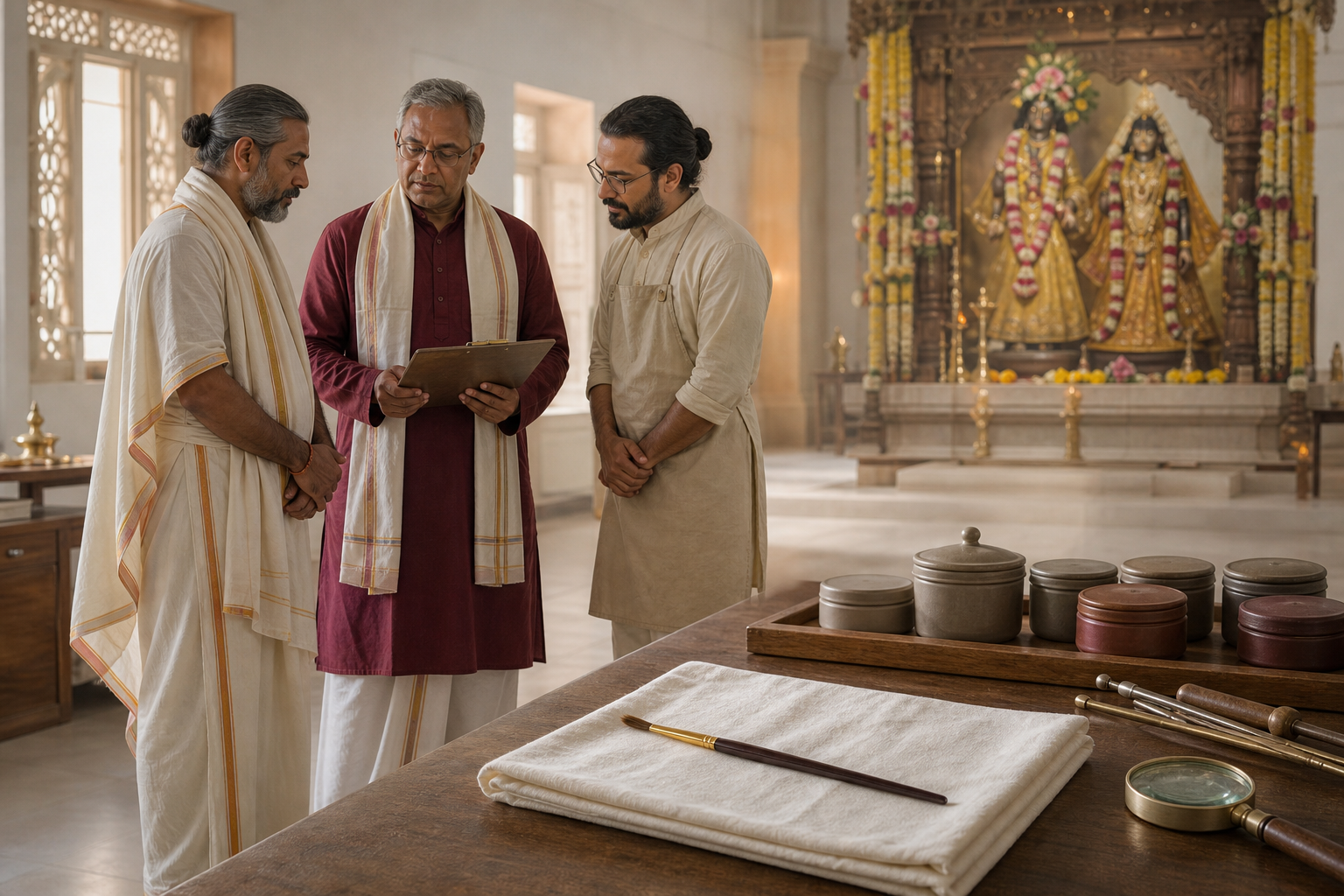
If you have been asked to repaint a faded eye line, renew a complexion, or correct a hand gesture on Radha-Krishna Deities, the first question is not whether you can handle a brush. It is whether you have the authority, guidance, and material knowledge to touch the murti at all.
Anga-Raga can look like a small artistic task. In temple life, it is a consequential seva: color affects form, form carries theology, and an unsuitable coating can damage the surface entrusted to your care. Srila Prabhupada’s practical instruction gives you a reliable way to approach the work without confusing devotion with improvisation.
What the Hamburg lesson changes about the task
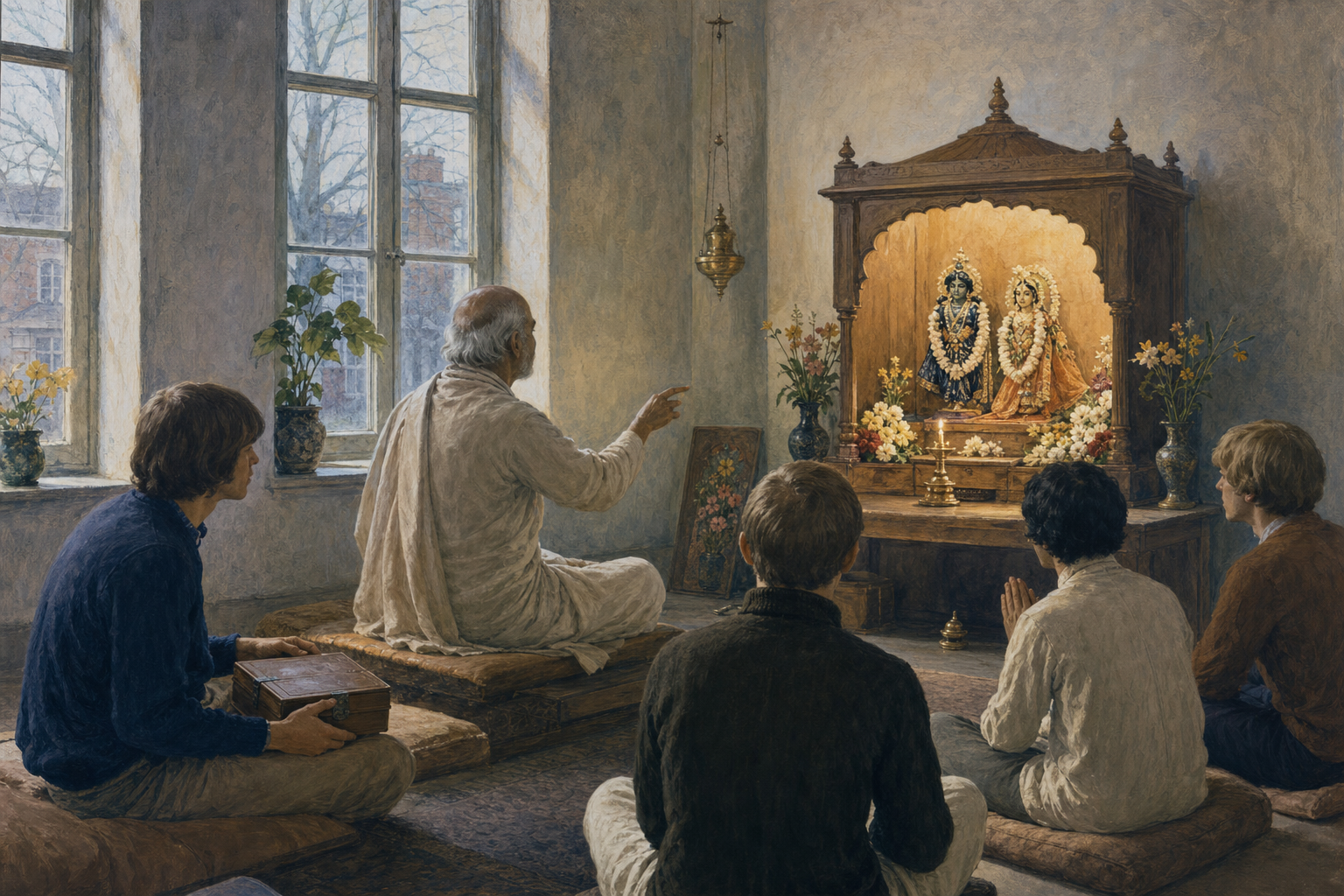
When Radha-Krishna Deities were being prepared for installation in Hamburg, Srila Prabhupada asked Yamuna Devi to paint them. She hesitated because she did not consider herself an artist. He responded by placing the Deities on a small desk and demonstrating the procedure himself, stroke by stroke.
That exchange corrects two opposite mistakes. Lack of professional status does not automatically disqualify a devotee whom the guru has instructed. Yet devotional enthusiasm does not automatically qualify someone who has not received instruction. The decisive factor is accountable service under guidance, not artistic pride or insecurity.
Prabhupada identified the procedure as Anga-Raga: anga refers to the body, while raga here refers to its painting. In the broader practice of alankara, the work serves the transcendental personality of the Deity and prepares the form for darshan. It is therefore different from decorating a religious object according to personal taste. The painter receives a form to serve, not a blank surface on which to announce a style.
This distinction should govern your first decision. If the temple’s pujaris, spiritual authorities, and qualified artisans have not agreed on what is to be done, do not begin. A pause protects both the murti and the integrity of the seva.
Key takeaways
- Obtain explicit guidance before touching the murti; sincerity is not a substitute for authorization.
- Treat complexion, eyes, markings, and mudra as parts of an established sacred form, not opportunities for personal redesign.
- Use only stable, non-toxic media known to be compatible with the Deity’s substrate and existing surface.
- Prefer restrained maintenance and minimal intervention to an ambitious repainting that erases sound earlier work.
- Record the materials and changes so the next caretaker does not have to guess what was applied.
Color, expression, and gesture all carry meaning
A three-color palette disciplines the eye
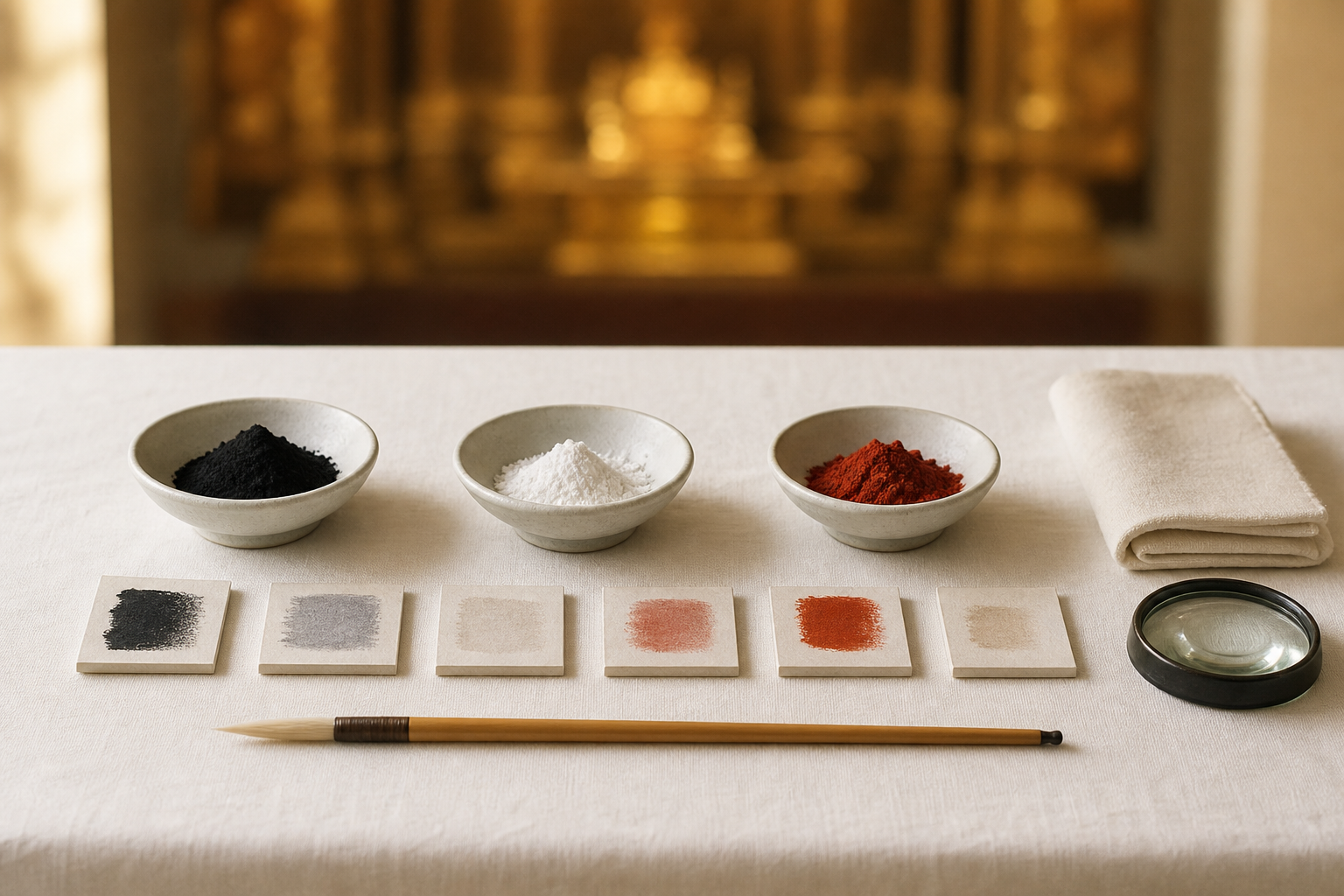
Prabhupada requested black, white, and red for the Hamburg work. The limitation was not a sign that the task lacked sophistication. A restricted palette makes the painter attend closely to line, proportion, contrast, and expression.
Within Vaishnava visual language, black can articulate Krishna’s shyama tonality and define fine features. White can clarify the eyes, highlights, and auspicious markings. Red can give warmth and auspicious vitality to the lips, palms, and soles. Each application has a visual function; none should become color added merely because an area appears empty.
Do not turn the Hamburg palette into a universal formula detached from lineage and locality. It records a particular guru-guided service. If the authorized standard for your Deities differs, follow that standard. The transferable principle is restraint: resolve the form before multiplying colors.
The smallest facial change can alter the bhava
Eyes, brows, lips, and facial modeling do more than make a murti appear polished. They establish the direction of the glance and the emotional character presented in darshan. Even a very small deviation in an ocular line or facial proportion can change the perceived rasa.
Before correcting a feature, compare it with the approved iconographic reference for that specific Deity. Then look at the whole face rather than judging the new line at brush distance. Ask whether the expression remains clear, serene, and inwardly radiant. A technically crisp line that introduces severity, theatricality, or caricature is not an improvement.
A mudra is not an anatomical detail to be tidied up
Prabhupada specifically observed that Srimati Radharani’s forefinger and thumb could be joined in a mudra. He also used the same gesture while emphasizing philosophical points. The placement of two fingers can therefore participate in communication, contemplation, and bhava.
This is part of a wider Dharmic visual grammar. Buddhist images use gestures such as Dharmachakra, Bhumisparsha, and Abhaya to communicate teaching, awakening, or refuge. Jain iconography employs meditative forms such as dhyana and kayotsarga to convey equipoise and renunciation. Sikh sacred art follows a different theological approach to images while communicating through symbols such as the Khanda and through narrative painting. These traditions are not interchangeable, but they share an understanding that visual form can carry disciplined meaning.
If a hand position appears unusual, do not reshape or repaint it merely to make it look more natural. First determine whether the gesture is intentional and what the applicable iconographic standard requires. In sacred art, an apparently minor correction can remove the very meaning the form was meant to preserve.
A safe workflow before any paint touches the murti
The following sequence turns reverence into practical accountability. If you cannot complete one step, stop there rather than compensating with confidence at the next.
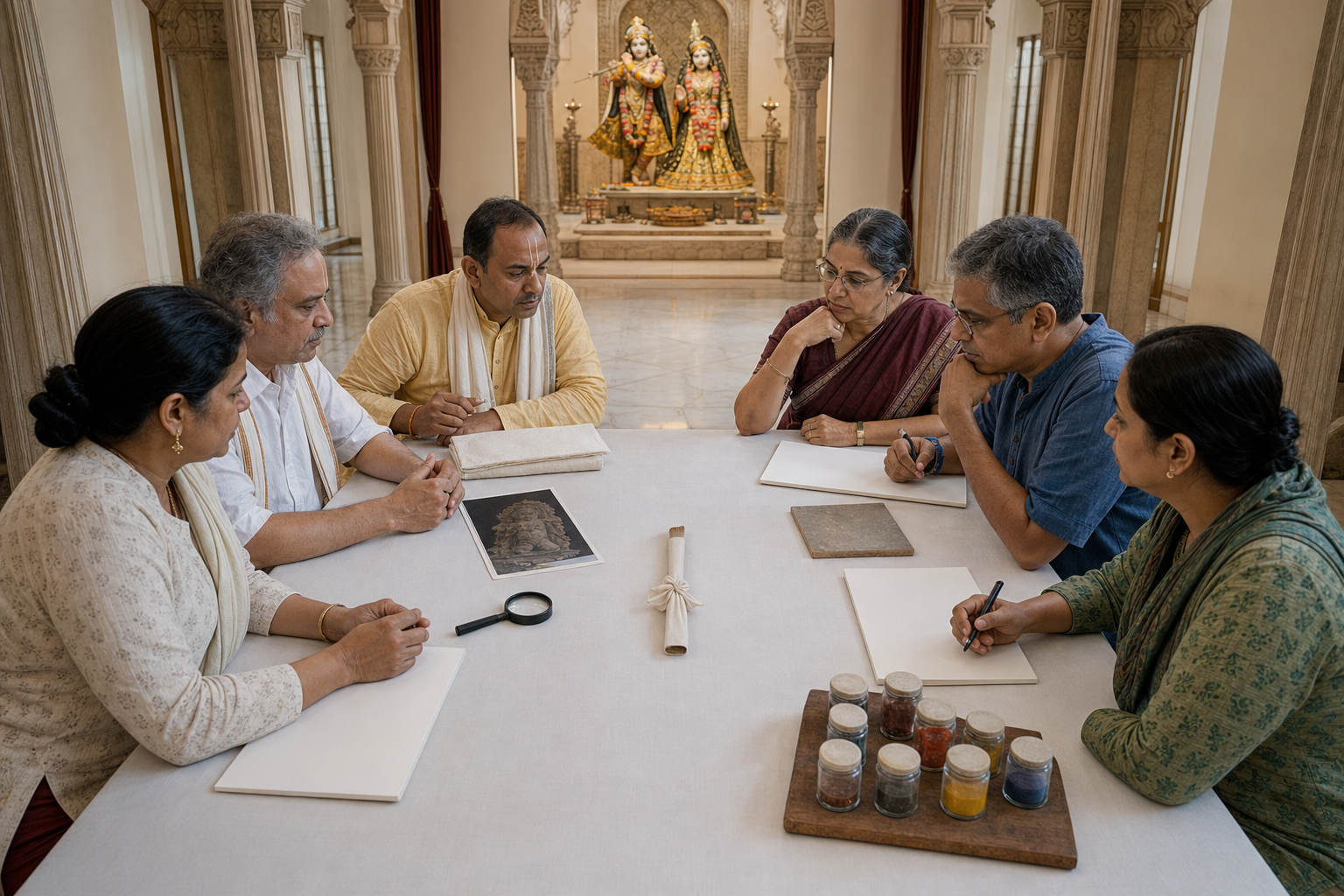
- Establish who is responsible. Consult the relevant guru or authorized spiritual authority, the temple’s pujaris, and a qualified shilpi or conservator where the material condition requires one. Identify who approves the design and who accepts responsibility for the intervention.
- Define the actual scope. State whether the need is routine maintenance, a small touch-up, renewed Anga-Raga, or treatment of a deteriorating surface. Do not let a limited correction expand informally into a complete repainting.
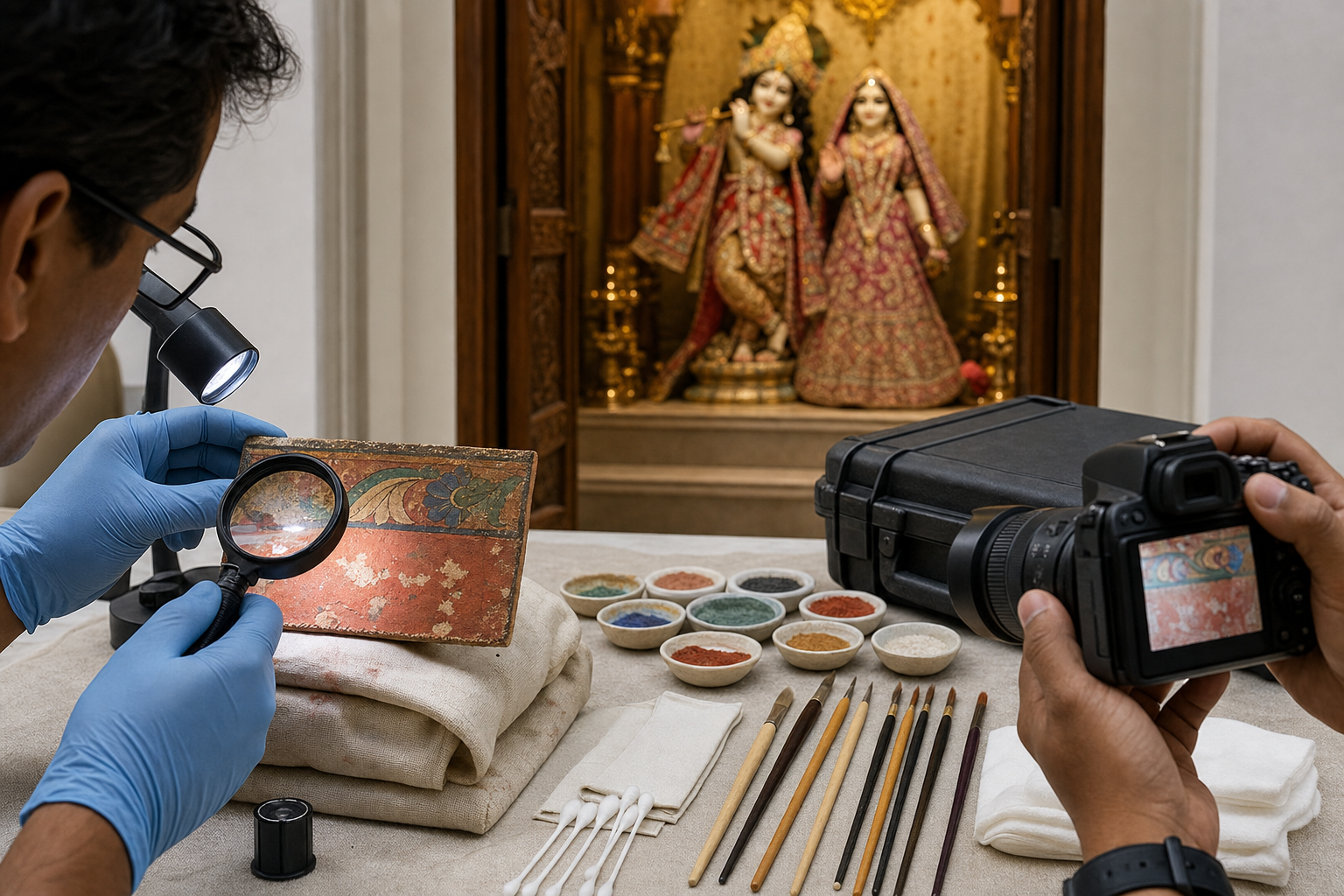
- Document the starting condition. Record clear images and written notes before work begins. Mark areas of fading, cracking, lifting, staining, or earlier alteration without assuming that every irregularity must be removed.
- Identify the substrate and existing layers. A murti may be stone, wood, metal, resin, or marble, and the suitable preparation and medium will differ accordingly. If the substrate, coating, or earlier pigment is unknown, do not experiment with household paint, cleaners, or solvents. The wrong material can stain the surface, lift an earlier layer, or create a coating that cannot be safely removed.
- Approve an iconographic brief. Agree on complexion, eye lines, tilaka and other markings, lips, palms, soles, Radha’s gesture, and the desired overall expression. Include approved visual references rather than relying on memory once the work has started.
- Approve the medium and method. Choose stable, non-toxic materials compatible with both the substrate and any existing layer. Favor archival pigments where appropriate, reversibility where feasible, sound surface preparation, and the least intervention needed to achieve the authorized result.
- Record the completed work. Note what was cleaned, prepared, painted, or left untouched; identify every material used; and preserve final images. This record becomes part of responsible future care.
Traditional workshops have used lampblack, conch-derived whites, and plant or mineral reds, while contemporary work may use archival-quality pigments. Those names are historical context, not a shopping list. A material does not become suitable merely because it is traditional, modern, expensive, or labeled non-toxic. Suitability depends on the particular murti, its existing layers, the ritual environment, and informed approval.
Plan for worship as well as appearance. Anga-Raga has to coexist with garments, ornaments, daily arati, cleaning, and the temple’s approach to abhishekam. A beautiful finish that cannot tolerate the authorized ritual routine creates a maintenance problem rather than completing the seva. This is why gentle care and routine maintenance should be preferred to drastic repainting.
Judge the result by darshan, not artistic novelty
A finished surface can be smooth and still be wrong for the Deity. Before accepting the work, review it with the authorized caretakers and ask five concrete questions:
- Does Krishna’s complexion and does Sri Radha’s form remain consistent with the sampradaya’s approved iconography?
- Do the eyes, mouth, posture, wrist, and fingers communicate the intended grace and bhava without exaggeration?
- Do black, white, red, and any other authorized colors support a clear focal order rather than competing for attention?
- Does the Anga-Raga harmonize with the Deities’ garments, ornaments, markings, and established cycle of worship?
- Could a future caretaker identify exactly what was done and which materials were used?
Local artistic character need not disappear. Sacred traditions have long worked through regional forms. The boundary is theological and liturgical: local style may enrich the presentation, but it should not obscure the identity, expression, or siddhanta carried by Radha-Krishna’s form. The goal is not to make the painter invisible through blandness. It is to keep artistic ability subordinate to seva.
Your next step should come before the purchase of pigment. Prepare a short service brief naming the approving authority, the scope, the substrate, the intended features, the proposed materials, the ritual conditions, and the documentation plan. Have the responsible people review it together. If one of those lines cannot yet be completed, leave the murti untouched until it can. In Anga-Raga, a disciplined pause may protect darshan more faithfully than a confident stroke.