

You may approach Bhuridakshinaya Bhairava because you want protection, relief from scarcity, or a proper way to express gratitude. Then the practical questions arrive: What should you offer? Who should receive it? How much is enough? And how do you keep sacred giving from becoming a bargain with the divine?
The answer begins with a demanding principle: dakshina is not a fee paid to obtain grace. It is the ethical completion of a relationship. Your worship remains incomplete if the lamp is lit but the teacher is underpaid, the temple worker is ignored, the hungry being at the threshold is unseen, or the donor uses generosity to purchase status and control.
The name changes the question from wealth to right relationship
The name Bhuridakshinaya contains several meanings that should be held together. Bhuri means abundant or copious. Dakshina can mean a ritual offering or honorarium, while the related dakshina also points to the south, the right hand, propriety, and skillful action. The ending -aya gives the liturgical sense of offering homage unto the one so named. The salutation therefore evokes abundant giving, proper completion, and Bhairava’s protective relation to the southern quarter.
That abundance cannot be reduced to a large transfer of money. The forms of sacred giving include coins, cloth, grain, knowledge, time, and service. The abundance bestowed by Bhairava likewise includes courage, discernment, discipline, protection, and the capacity to fulfil dharma. A person with modest means can therefore give abundantly through reliable service, while a wealthy person can give a large sum badly if it is careless, coercive, or designed chiefly for display.
This distinction matters because devotional language can hide a commercial expectation. You give something, perform a rite, and wait for protection or prosperity in return. Bhuridakshinaya reverses that logic. The gift is not leverage over Bhairava. It trains you to participate in a moral order in which received resources circulate toward worthy people, institutions, animals, and obligations. Prasada is not proof that a bargain succeeded; it is grace received with a renewed responsibility to act well.
The southern meaning deepens that responsibility. South is associated with Yama, the ancestral realm, mortality, and dissolution. Lists of the eight Bhairavas vary in their directional assignments, and some traditions associate the southern quarter with Chanda Bhairava or Kalabhairava. Bhuridakshinaya should therefore not be presented as the one universally fixed southern Bhairava. Nor does Bhairava displace Yama as the classical guardian of the south. The theological layers coexist: Yama retains his place, while Bhairava guards thresholds and enforces the integrity of the sacred precinct.
For you as a giver, the directional symbolism supplies a useful test. Imagine the gift viewed from the threshold of death, where reputation and display have lost their force. Would its purpose still be honest? Did it discharge a real debt of gratitude? Did it protect something worth transmitting? Did it relieve a need without creating dependence on your approval? Southward symbolism turns generosity toward sobriety.
The same ethic appears across the Dharmic family without making the traditions identical. Buddhism develops dana paramita, the perfection of giving. Jain lay ethics gives dana an important place among disciplined obligations. Sikh practice joins dasvandh, the contribution of a share of earnings, with seva. These practices have distinct doctrines and institutions, but they share a civilizational refusal to treat possession as morally self-justifying. What comes to you also places a claim upon you.
Use five tests before calling a gift sacred
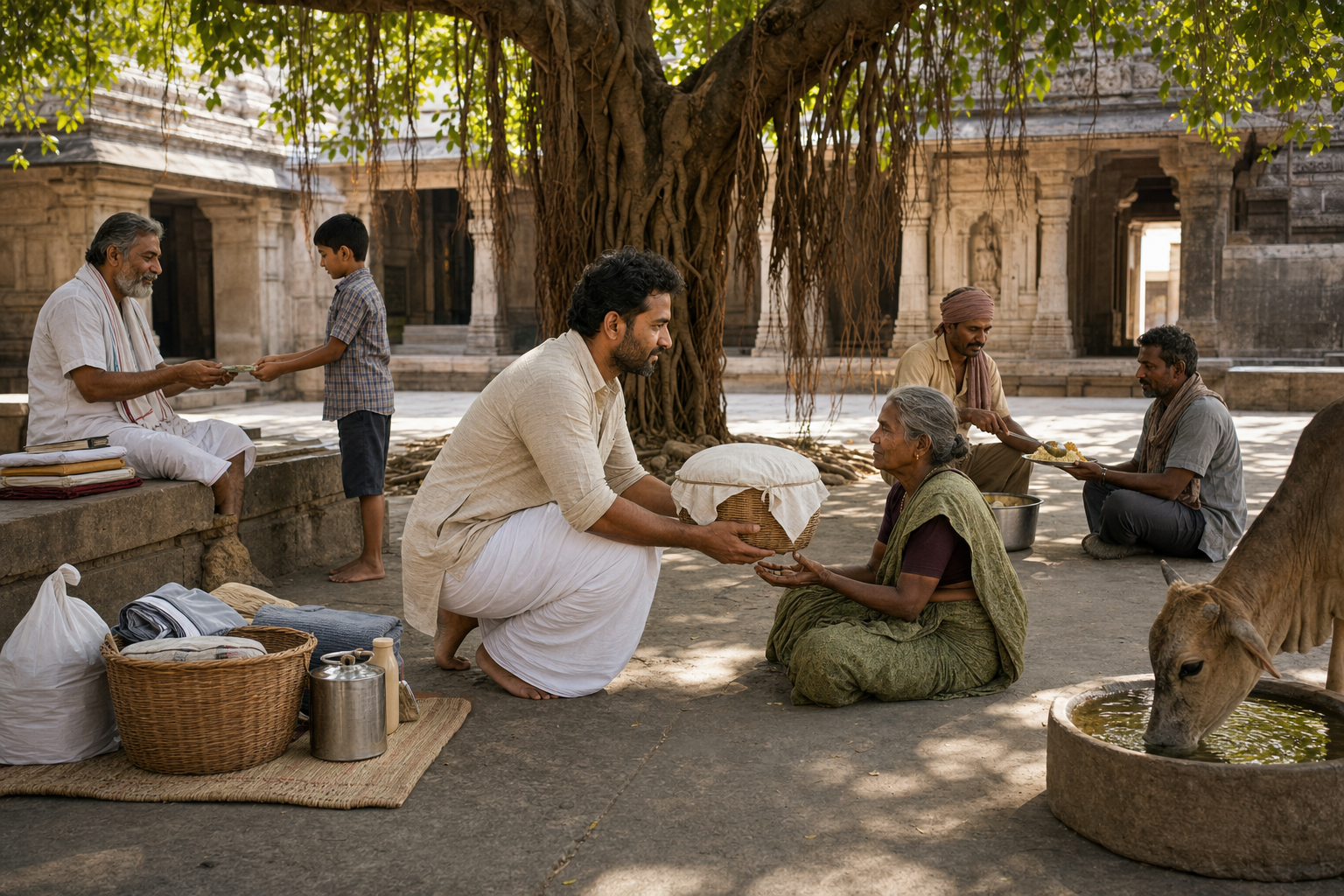
Several actions can look similar from the outside while carrying different obligations. Keeping the terms distinct prevents spiritual language from excusing underpayment or concealing control.
| Form | Its ethical function | The question to ask |
|---|---|---|
| Dakshina | An offering or honorarium that completes a rite, teaching, or sacred service | Have the people and lineage that made this possible been properly honored? |
| Dana | A voluntary gift directed toward another’s benefit | Can the recipient use it without owing you obedience, access, or praise? |
| Seva | A gift of useful time, attention, or labor | Is the service wanted, competent, and freely given? |
| Upachara or naivedya | An offering made within worship | Does it follow the temple, family, or lineage practice governing that worship? |
| Prasada | The offering returned through grace and shared participation | What responsibility will you carry outward after receiving it? |
If a priest, teacher, artisan, musician, or worker is owed an agreed payment, settle that obligation fully. Do not rename unpaid labor as seva, and do not call an inadequate fee dana merely because the work occurred in a religious setting. Dakshina can honor sacred service, but sacred vocabulary does not cancel ordinary fairness.
- The completion test. Identify what the gift completes. It may acknowledge instruction, fulfil a vow, support a temple, sustain a knowledge lineage, or express gratitude for protection already received. If you can describe only the result you want to buy, the act is still a transaction in devotional clothing.
- The usefulness test. Choose a form the recipient can genuinely use. Money may be appropriate, but so may grain, cloth, professional skill, transport, teaching, maintenance work, or dependable time. A convenient donation that burdens the recipient is not made better by your intention.
- The capacity test. Bhuri means abundant, not reckless. Do not enlarge a sacred gift by taking on harmful debt, neglecting dependants, or leaving basic household obligations unmet. If money is constrained, give a bounded amount of time or useful service that you can actually deliver. A smaller completed promise is more truthful than an impressive promise abandoned halfway.
- The freedom test. The recipient should not have to surrender independence in exchange for your generosity. Do not attach an unspoken demand for publicity, personal access, doctrinal agreement, influence over appointments, or perpetual gratitude. If conditions are necessary, state them before the gift and make sure they serve the stated purpose rather than your prestige.
- The accountability test. Ask where the gift is going and what responsible use would look like. Accountability is not suspicion; Bhairava is a guardian of boundaries. For an informal gift, clarity may require only a direct conversation. For recurring or institutional support, choose a purpose you understand and review whether your contribution is reaching it. If the answer remains persistently vague, pause rather than allowing sacred language to silence reasonable judgement.
These tests also apply to non-material giving. Knowledge can liberate, but unsolicited instruction can become domination. Time can be generous, but unreliable volunteering can create more work for others. Service becomes sacred through fitness, consent, and completion, not merely because you intended it as seva.
Turn Bhairava worship into a repeatable practice of giving

You do not need an elaborate public ceremony to begin aligning devotion with dakshina. You do need a clear intention, an appropriate recipient, and follow-through. Keep advanced ritual elements such as nyasa or lineage-specific procedures within the tradition that authorizes and teaches them.
- Name what you have received. Be specific: instruction, ritual assistance, protection, food, income, care, access to a temple, preservation of a text, or help through a difficult transition. Gratitude becomes actionable when its object is named.
- Identify the human or living network behind it. A sacred benefit rarely reaches you without priests, teachers, cleaners, cooks, musicians, donors, translators, animal carers, family members, or volunteers. Choose a recipient whose work is connected to the good you want to sustain.
- Select one fitting form. Use money when money is needed. Use material goods when they have been requested. Offer skill or time only when you can meet the required standard and schedule. Feeding dogs is a cherished Bhairava observance because the dog is his vahana; where direct feeding is unsuitable, supporting responsible care preserves the compassionate intention without creating a local problem.
- Set the boundary before worship. Decide what you can give without injuring your existing responsibilities. Also decide whether it is a one-time gift, a recurring commitment, or the fulfilment of a vow. This keeps emotion during ritual from producing a promise you cannot sustain.
- Make the devotional offering according to your tradition. The concise invocation Om Bhuridakshinaya Namah can accompany prayer or archana. Common offerings associated with Bhairava include a sesame-oil lamp, black sesame, curd rice, seasonal fruit, and water, but regional sampradayas and temple rules determine what is appropriate. Ask rather than assuming. Abhishekam should likewise follow Agamic and local norms.
- Transfer the outward gift promptly. Do not leave dakshina as an inward sentiment or a future intention. Pay the honorarium, deliver the requested goods, perform the promised service, or make the contribution while the commitment is still clear.
- Carry prasada into conduct. Choose one behavior that continues the offering: tell the truth in a difficult matter, complete neglected work, maintain a boundary, protect a vulnerable being, or return regularly to the service you undertook. Bhairava’s gifts of courage and discernment become meaningful when used in the world.
Kalashtami, the eighth lunar day of the dark fortnight, is commonly observed for Bhairava and can provide a recurring time for this practice. It is an opportunity to examine the previous commitment before making another one. Did you give what you promised? Was it useful? Did the gift become a performance? What should change this time? The observance then becomes a discipline of accountability rather than a monthly request for favors.
Cleanliness, ahimsa, and satya belong inside this practice, not beside it. A polished ritual cannot purify money obtained dishonestly, service performed coercively, or a donation used to humiliate its recipient. If you discover such a contradiction, correct the conduct first. Bhairava’s grace does not provide an exemption from dharma.
Bhairava’s fierceness protects both giver and gift

Bhairava is often shown with the skull-bowl, trident, drum, sword, noose, garland of skulls, and dog. His fierce appearance places devotion under the realities of time, consequence, vigilance, and mortality. This is why the abundant giver is also the guardian. Generosity without boundaries can feed manipulation; boundaries without generosity can harden into indifference. Bhuridakshinaya holds the two together.
His shrines commonly occupy gateways or outer temple precincts, where entry, intention, and accountability meet. In the devotional life of Kashi, Kalabhairava is remembered as the city’s Kotwal, or chief guardian, and pilgrims commonly acknowledge him in relation to approaching Vishwanath. The spatial lesson is practical: access to sanctity passes through a threshold of accountability.
Apply that threshold whenever someone asks for a gift in the name of religion. Pause if you encounter pressure based on fear, secrecy, personal loyalty, or guaranteed supernatural returns. Ask what the contribution supports, whether the person collecting it is authorized, and whether the stated use is consistent with the institution or tradition invoked. Refusing an opaque demand is not a failure of faith. It can be an expression of Bhairava’s boundary-keeping intelligence.
- Do not use giving to purchase immunity from consequences. Dakshina does not erase dishonest conduct, broken commitments, or harm done to another person.
- Do not confuse visibility with merit. Public acknowledgment may sometimes serve legitimate accountability, but the desire for recognition should not determine the recipient or inflate the amount.
- Do not make the recipient your dependent. A gift that requires continuing submission has moved away from dana and toward control.
- Do not copy specialized ritual from a different lineage. Offerings, mantras, abhishekam, and directional arrangements vary. Use simple devotion when you lack instruction, and consult the relevant temple or teacher for specific practice.
- Do not substitute ritual for repair. When you owe an apology, payment, returned property, completed work, or changed behavior, make that repair directly. An offering may accompany correction; it cannot replace it.
There is also an inward boundary to notice. Kashmir Shaiva readings of Bhairava can point beyond the external form to awakened, undivided awareness in which fear is confronted at its root. From that perspective, generosity is not self-erasure. It is an exercise in seeing beyond the cramped identity that must possess, dominate, or be praised. You give without pretending that discernment has become unnecessary.
This is fierce compassion in practice. It protects the recipient from your ego, protects you from manipulation, and protects the gift from being diverted away from its dharmic purpose. The result may include prosperity, but the first sign of sacred abundance is better judgement about what prosperity is for.
Key takeaways
- Bhuridakshinaya joins abundance with proper offering, directional guardianship, and ethical completion; it is not merely a promise of material wealth.
- Dakshina honors and completes sacred service, while dana and seva have related but distinct functions. None of them should conceal unpaid obligations.
- Test a gift for completion, usefulness, capacity, freedom, and accountability before calling it sacred.
- Follow local temple, family, or lineage rules for Bhairava offerings and abhishekam; directional and ritual details are not identical across traditions.
- Give within your real capacity, deliver what you promise promptly, and do not attach covert demands for access, influence, praise, or obedience.
- Treat prasada as a responsibility to carry protection, truthfulness, courage, and disciplined generosity into ordinary life.
Before your next Bhairava worship, write down five things: what you received, whom you will support, what form the gift will take, the boundary that keeps it sustainable, and when you will complete it. If one answer remains vague, wait and clarify it. When all five are clear, make the offering quietly and let your follow-through become part of the worship.