
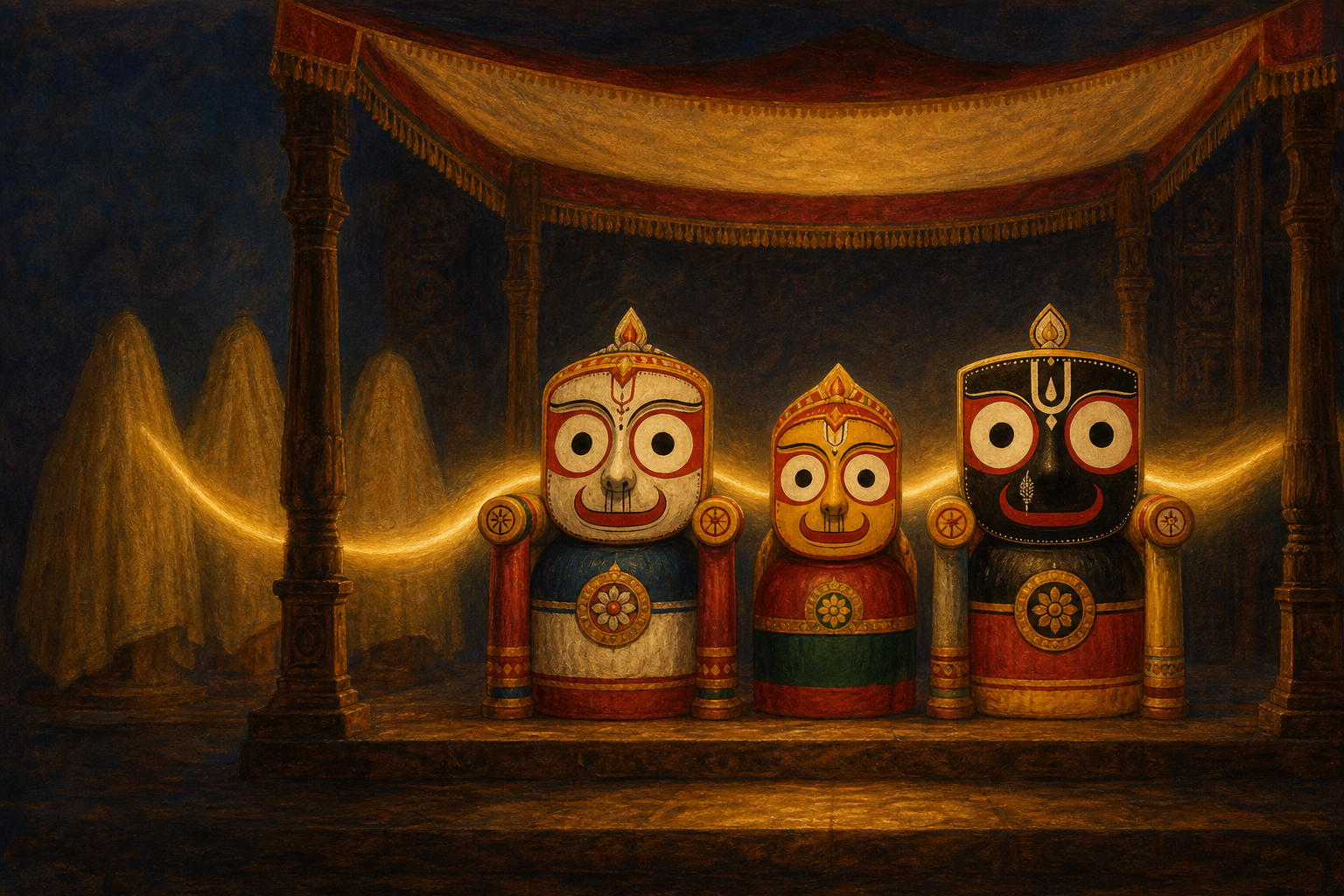
If you have heard that Nabakalebara replaces Jagannath’s “old idol,” that language will mislead you. The rite is not chiefly an exchange of one religious object for another. It confronts a deeper question: when a sacred body changes, what remains continuous?
The answer opens the heart of Jagannath theology. The wooden forms are renewed, but the divine presence is not treated as disposable. A hidden essence is transferred under strict ritual discipline, teaching you to distinguish form from presence, secrecy from superstition, and renewal from rupture.
Nabakalebara begins with the difference between body and presence
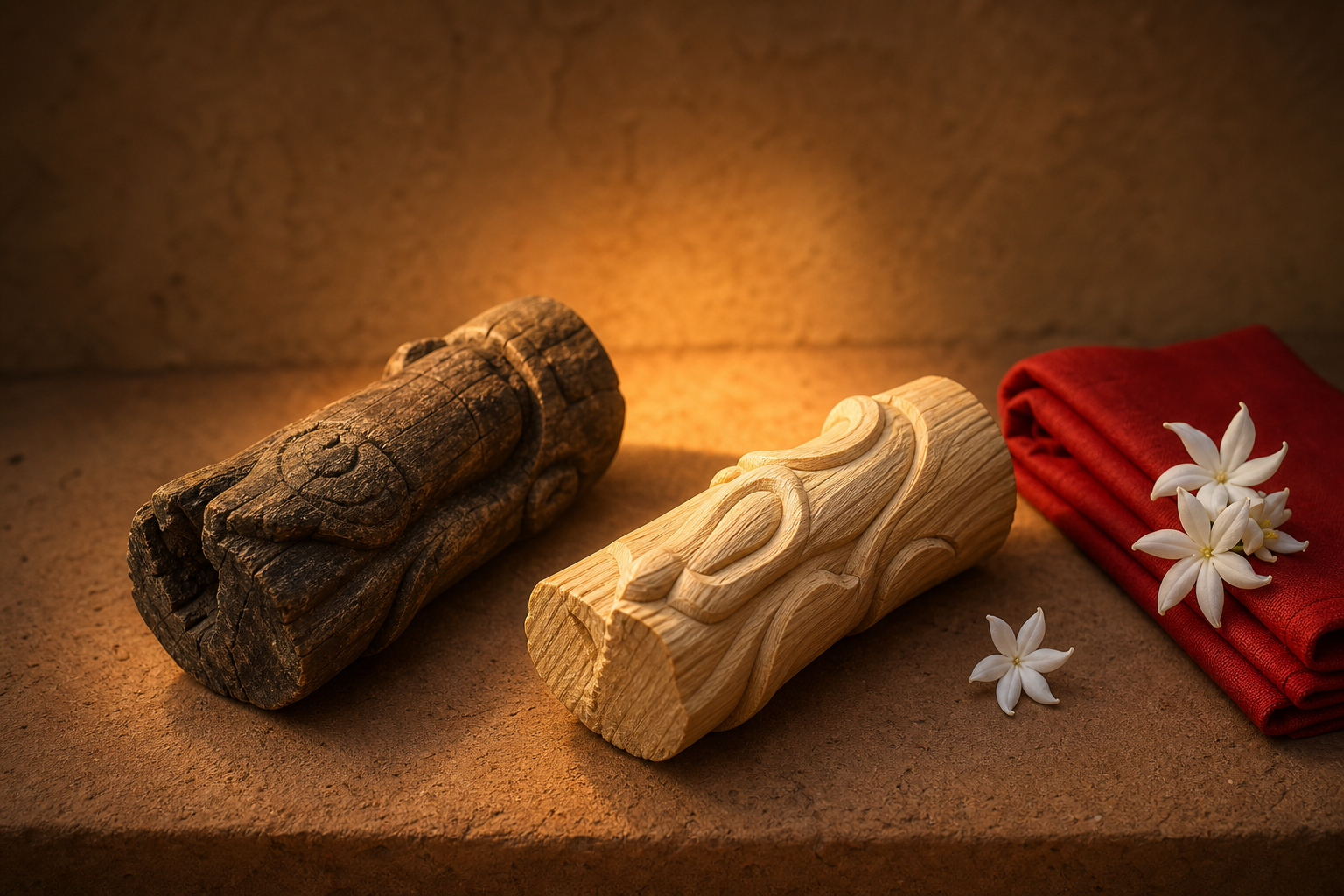
Nabakalebara means “new body.” The name matters. It describes the renewal of an embodied form, not the manufacture of a replacement object. Jagannath, Balabhadra, and Subhadra remain the divine triad of the Ratnavedi even though their wooden bodies are periodically remade.
Three truths therefore have to be held together. The murtis are materially made of wood. Wood belongs to the changing world and cannot be preserved indefinitely. Yet the Lord’s presence is understood as continuous because the transition from one body to another is ritually transmitted rather than casually declared.
Calling Nabakalebara a restoration is imprecise because restoration normally tries to retain the original material. Calling it a replacement is worse because replacement implies that the former presence has ended and an unrelated object has taken its place. “Renewal of the divine body” preserves the theology carried by the rite.
This also prevents a common calendar mistake. Nabakalebara is not another name for the annual Ratha Yatra. It takes place in a year marked by Adhika Ashadha, an intercalary lunar month. Ratha Yatra belongs to Puri’s recurring ritual year; Nabakalebara occurs only under the required calendrical condition.
Jagannath’s wooden embodiment is therefore not an embarrassment that the tradition must overcome. It is the teaching medium. An unchanging divine reality accepts a body that can age and be renewed. You are invited to recognize continuity without pretending that material form is permanent.
Krishna’s heart is a theological claim guarded by silence
The sacred narrative begins after Sri Krishna’s withdrawal from the visible world. A divinely charged log reaches the eastern shore, and King Indradyumna, guided by visions of Nila Madhava and by sages, establishes the sanctuary at Puri. The forms of Jagannath, Balabhadra, and Subhadra become bearers of a concealed divine essence.
The living temple tradition widely identifies that essence with Krishna’s heart. It is spoken of as the Brahma Padartha, Brahma bija, or Daru Brahma. These expressions approach the same mystery from different angles: an ineffable center, a seed of continuity, and divine presence associated with the wooden body.
“Krishna’s heart” should not be reduced to a claim about an anatomical specimen available for inspection. It is sacred language for the compassionate presence of Krishna continuing in Jagannath during Kali Yuga. The heart signifies what remains intimate, living, and merciful after royal power, armies, and earthly biography have passed away.
Responsible language matters precisely because the Brahma Padartha is not publicly exhibited. An outsider cannot honestly claim to have verified its physical composition. You can say that the tradition reveres a hidden essence and identifies it with Krishna’s heart. You should not turn ritual testimony into a laboratory description that the tradition itself neither supplies nor seeks.
Its secrecy is not a missing piece that curiosity is entitled to recover. Daitapati sevayats preserve the inherited rites, and the transfer is performed with covered hands and blindfolded eyes. Those restrictions express a theological boundary: the deepest presence is entrusted through consecrated responsibility, not possessed through sight.
This is why sensational demands for a photograph, material identification, or public demonstration miss the point. If the Brahma Padartha were treated as an exhibit, the mystery would be converted into an object of consumption. The refusal to expose it protects the difference between darshan and surveillance. In darshan, you present yourself to the divine gaze; you do not demand mastery over everything sacred.
The ritual sequence carries the meaning of continuity
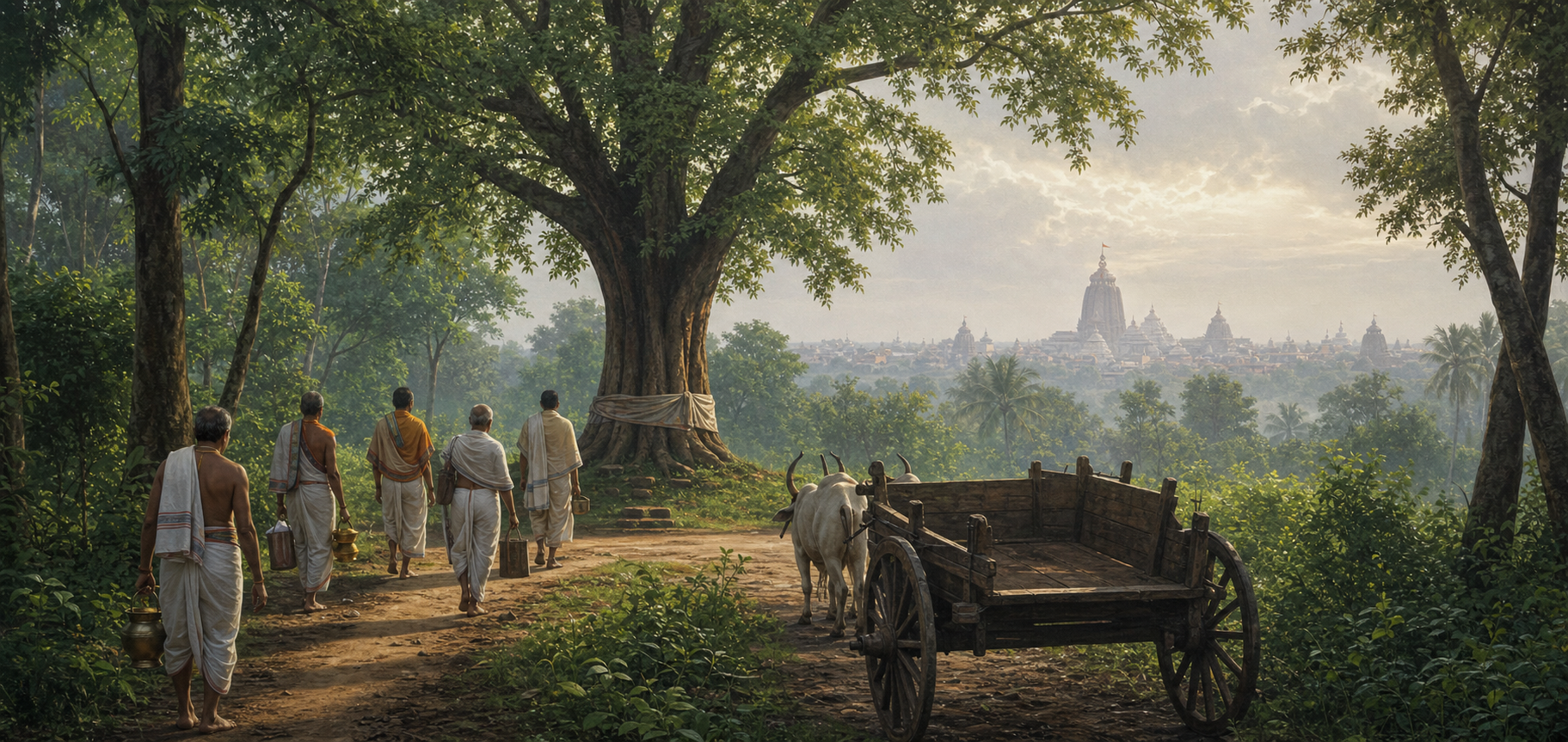
Nabakalebara is not completed by carving visually recognizable figures. Every stage establishes ritual fitness for the transition. The sequence matters because continuity depends upon authorized service, sacred time, suitable wood, consecration, and the guarded transfer of the inner essence.
- The calendar establishes the sacred occasion. The presence of Adhika Ashadha marks the year in which the renewal may occur. Devotional enthusiasm alone cannot create a Nabakalebara year.
- Banajaga Yatra begins the forest search. Daitapati servitors seek sacred neem trees bearing particular signs preserved in inherited oral-ritual canons. The trees are not selected merely because their wood is available or visually attractive.
- The chosen wood becomes a consecrated body. Ritual preparation and carving shape the new forms of Jagannath, Balabhadra, and Subhadra. Craft is indispensable, but craftsmanship by itself does not complete the transition.
- Brahma Parivartana transmits the hidden continuity. At night, under severe restrictions, the Brahma Padartha is moved from the former body into the new one. The rite’s secrecy protects its sanctity rather than advertising privileged knowledge.
- The renewed forms resume the public relationship. What was handled in concealment becomes the basis of darshan, worship, prasada, and festival. Hidden continuity makes public accessibility possible.
The technical signs sought during Banajaga should not be treated as a scavenger hunt for spectators. Their authority comes from a ritual inheritance carried by the responsible sevayats. A circulating checklist may describe fragments of that inheritance, but it cannot authorize a tree or reproduce the rite outside its living context.
The same restraint applies to Brahma Parivartana. Its importance does not depend on outsiders discovering what the servitors touch. The decisive fact within the tradition is that the transition is performed, not that it is made visible. This reverses a modern habit of assuming that publicity creates authenticity.
You can now see why “new body” does not mean “new deity.” If nothing material changed, there would be no need for Nabakalebara. If nothing continued, there would be no need for Brahma Parivartana. The rite exists because change and continuity are both real, and neither is allowed to erase the other.
Puri’s ritual year explains what the new body is for
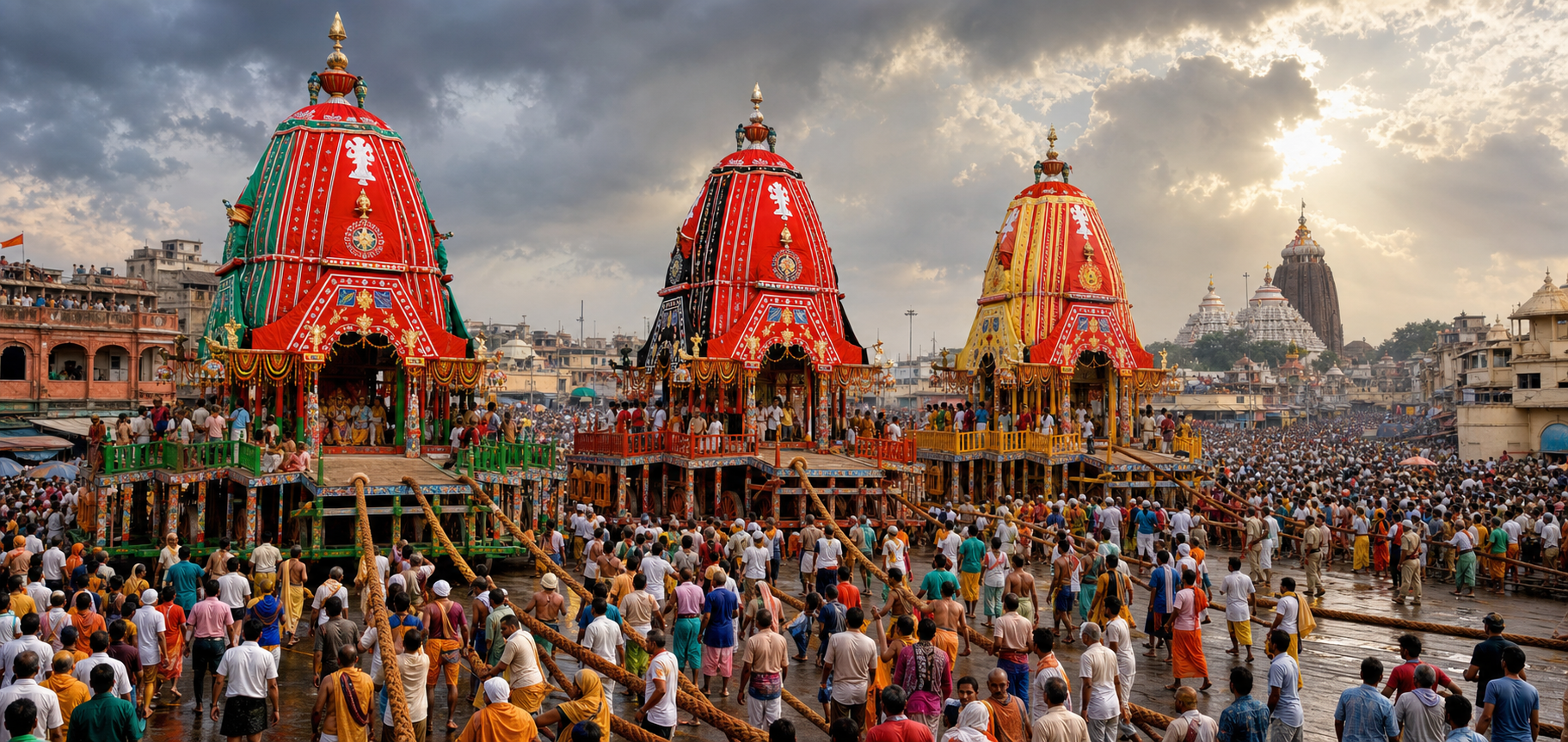
Nabakalebara becomes clearer when you read it beside the rest of Puri’s ritual cycle. The body is bathed, secluded, cared for, seen, fed, and carried into public space. These are not disconnected observances. Together they show that Jagannath’s embodiment exists for relationship.
Care comes before spectacle. On Snana Purnima, the deities receive a ceremonial bath. During the Anasara period that follows, they remain secluded and are tended as if convalescing. Devotees do not demand uninterrupted visual access. They accept a temporary absence and allow service to take precedence over their desire to see.
The divine gaze returns before the procession. Netrotsava marks the reopening of the eyes. Jagannath’s immense eyes are not simply an unusual artistic feature; they embody the experience of a Lord who sees every pilgrim. Darshan is reciprocal in this theology. You do not merely inspect Jagannath. You stand where Jagannath sees you.
Food turns equality into a practice. Mahaprasad shared in Anandabazar enacts an ideal of non-separation. The teaching is concrete: grace is received as food and shared rather than held as private spiritual status. A claim that Jagannath belongs to all becomes credible when people are asked to partake of the Lord’s prasada together.
The Lord moves toward the public. During Ratha Yatra, Jagannath rides Nandighosha, Balabhadra rides Taladhwaja, and Subhadra rides Darpadalana along the Bada Danda toward Gundicha Temple. The sanctuary’s Lord becomes visible in the street. Accessibility is not left as an abstract doctrine; it is placed on wheels.
Rank bends before seva. In Chhera Pahanra, the Gajapati King sweeps the chariots. The action does not deny his office. It places that office below service to the Lord. If even the king’s ceremonial role culminates in sweeping, a devotee has little ground for turning status into spiritual superiority.
The Purushottama-khanda of the Skanda Purana locates this accessibility within the conditions of Kali Yuga. Purushottama-kshetra becomes a refuge in which darshan, nama-sankirtana, and prasada offer dependable approaches to the Supreme. Sri Chaitanya Mahaprabhu’s devotion at Puri further intensifies this bhakti language of song, rasa, longing, and grace.
Jagannath’s titles complete the pattern. As “Lord of the Universe,” he cannot be contained by a narrow social constituency. As Sarvadevamaya, he is understood as the One in whom all divine forms are present. As Patitapaban, he is the rescuer of those considered fallen, excluded, or unworthy. The theology moves consistently outward.
How to approach Nabakalebara without turning mystery into spectacle
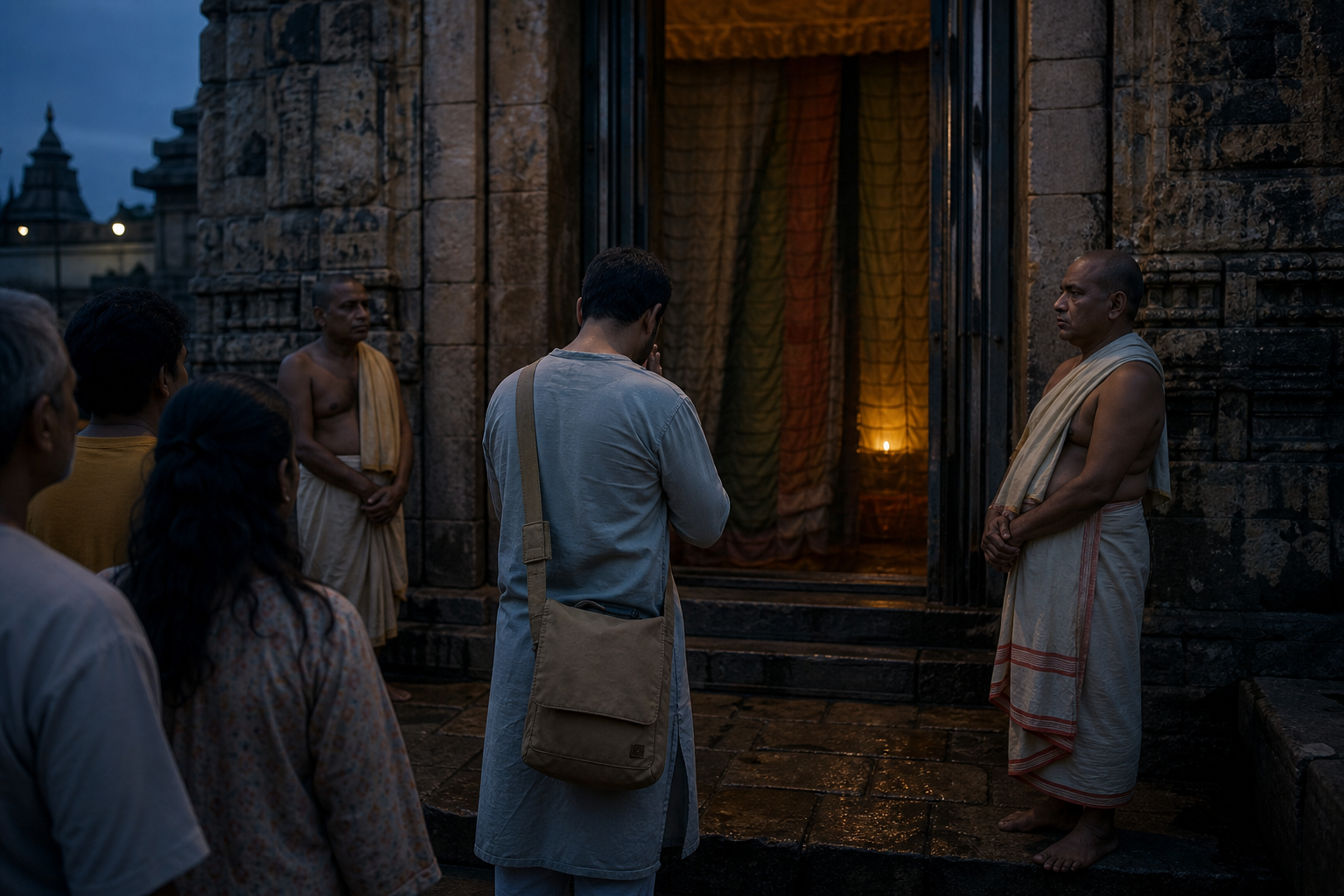
A useful encounter with Nabakalebara requires more than collecting unusual details. It asks you to adopt the same order that the ritual protects: understand the body, honor the hidden presence, and let the result appear in seva.
Key takeaways
- Say “renewal,” not mere replacement. The wooden bodies change while Jagannath’s presence is ritually understood to continue.
- Separate devotional identification from physical speculation. The tradition reveres the Brahma Padartha as Krishna’s heart without exposing it for public verification.
- Do not confuse Nabakalebara with every Ratha Yatra. Nabakalebara requires a year containing Adhika Ashadha.
- Respect inherited ritual authority. Banajaga and Brahma Parivartana belong to the disciplined service of the Daitapati sevayats, not to spectators seeking privileged access.
- Read the mystery through its public fruits. Darshan, Mahaprasad, Ratha Yatra, and Chhera Pahanra turn continuity into accessibility, equality, and service.
That approach also helps you handle Jagannath’s many Dharmic resonances without flattening them. The memory of Nila Madhava honors an indigenous and adivasi strand within the sacred geography of the region. Jagannath’s compassionate embrace resonates with Buddhist karuna, while his capacity to hold several perspectives recalls the Jain discipline of anekantavada. Sikh Janamsakhi traditions remember Guru Nanak visiting Puri, with devotional singing expressing the shared dignity of bhakti and seva.
These convergences do not prove that Hinduism, Buddhism, Jainism, and Sikhism are doctrinally interchangeable. Nor do they require each path to surrender its distinctive practices. They reveal a Dharmic family resemblance: compassion, disciplined service, non-violence, humility before truth, and resistance to spiritual exclusion.
Jagannath’s unity is therefore not uniformity. His wide embrace can include different communities because inclusion is structured around shared approach to the sacred, not enforced sameness. You can honor a Buddhist reading of compassion, a Jain concern for many-sided truth, a Sikh emphasis on equality and seva, and a Vaishnava recognition of Krishna without pretending those readings are identical.
This gives Nabakalebara an ethical consequence beyond Puri. Your body, institutions, and inherited customs all pass through change. The tradition does not tell you to resist every alteration. It asks you to identify the living center that must be transmitted, choose trustworthy custodians, renew the form with discipline, and judge the result by whether it serves more faithfully.
The next time Nabakalebara is described as a mysterious idol replacement, ask three questions: What body is being renewed? What presence is being guarded? What duty follows from that continuity? Then let Jagannath’s answer shape your conduct: protect what must not be objectified, approach darshan without demanding possession, share grace rather than hoard status, and allow rank to bend before seva.