
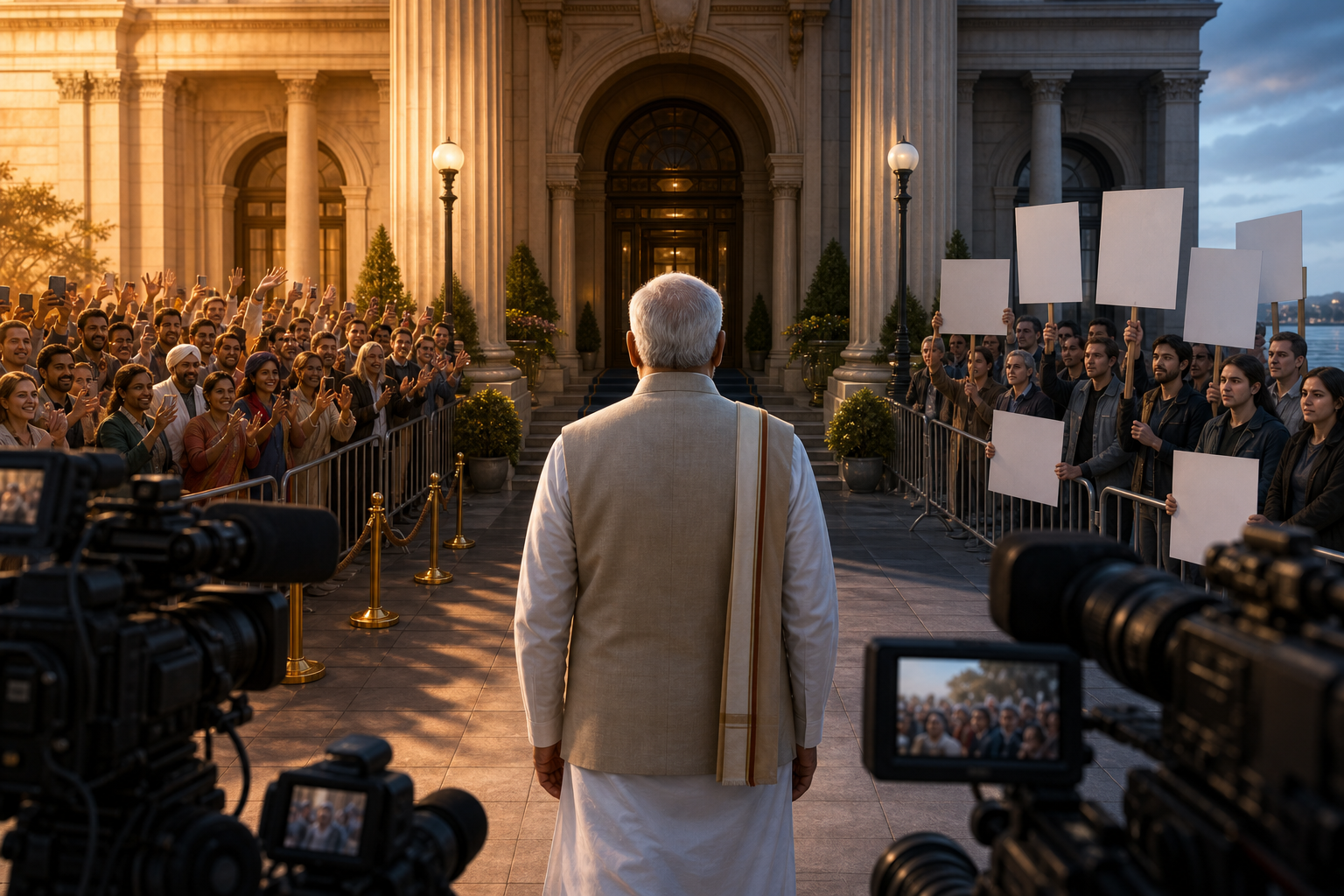
You may be looking at two seemingly incompatible pictures of Narendra Modi’s Australia visit: an enthusiastic public welcome on one side, and protests and human-rights criticism on the other. You do not have to accept either picture as the whole story.
The useful question is not whether the coverage felt friendly or hostile. It is whether each claim was properly classified, supported and placed in proportion. Once you separate the diplomatic visit, the diaspora gathering, the protests and the advocacy campaign, much of the apparent contradiction disappears.
The visit became several different stories at once
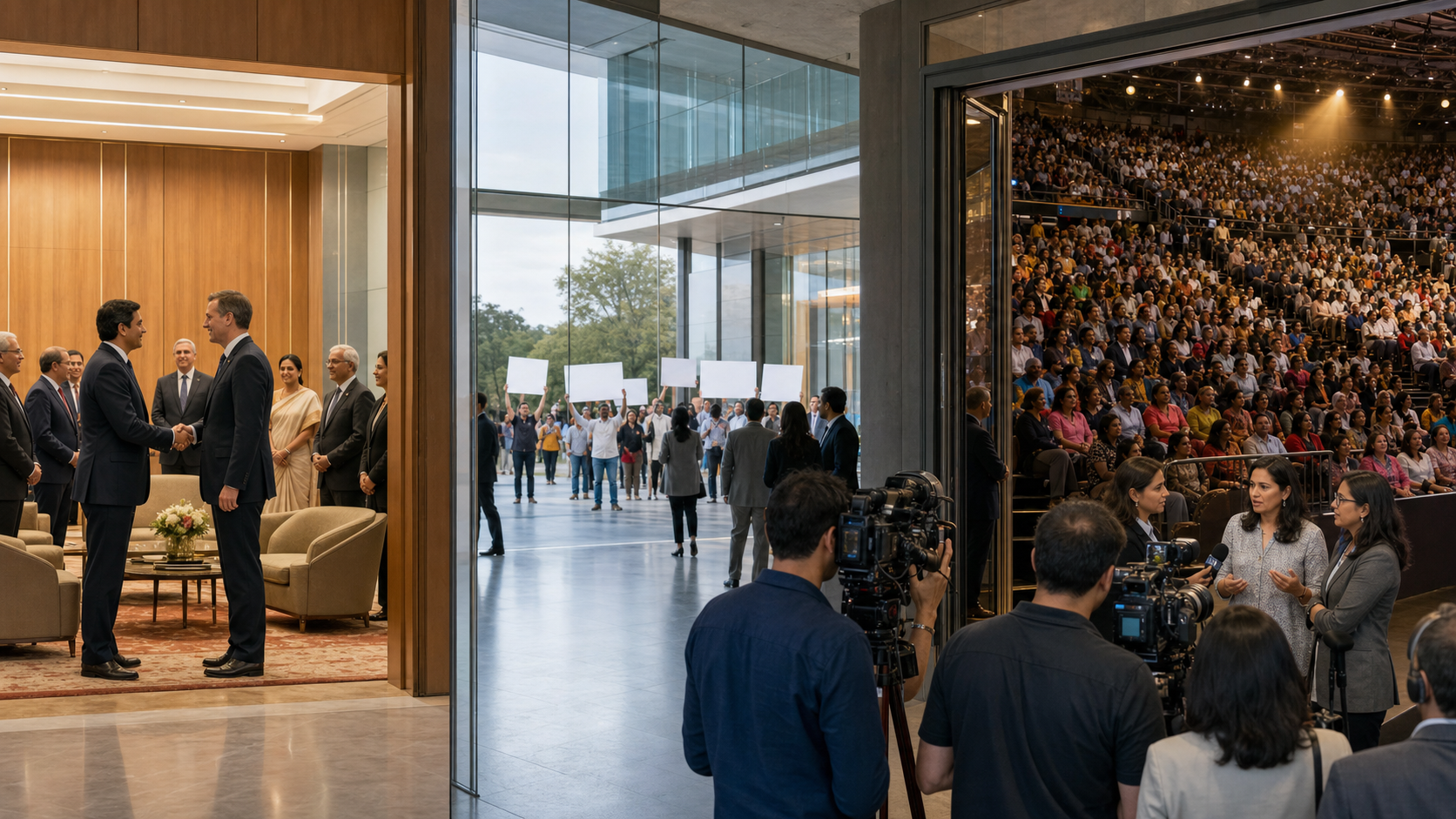
Modi’s tour covered Australia and New Zealand, but public controversy concentrated heavily on the reception and protests surrounding his Australian appearance. A rally at Marvel Stadium in Melbourne’s suburbs became a particularly visible stage on which supporters, opponents and media organisations could each construct a different account of the visit.
- The diplomatic story concerns what the governments discussed, agreed or left unresolved. Crowd photographs and protest placards cannot answer those questions.
- The diaspora story concerns the ability of Modi’s supporters to organise an enthusiastic welcome. A successful rally demonstrates mobilisation, but it is not an opinion poll of Australia, its Indian-origin population or every Hindu living there.
- The protest story concerns who demonstrated outside the venue, what they demanded and how representative they were. The existence of a protest establishes organised opposition; it does not establish the truth of every allegation made there.
- The advocacy story includes Amnesty International urging governments to raise alleged human-rights and minority-treatment concerns with Modi. That intervention is advocacy, not a judicial finding. It deserves neither automatic acceptance nor automatic dismissal.
These stories can all exist simultaneously. A warm welcome does not disprove the presence of dissent. A protest does not erase the welcome. Neither tells you, by itself, whether the official visit advanced Bharat’s interests. When you see one of these elements being used to stand in for the entire trip, you are looking at a framing choice rather than a complete assessment.
How framing can distort without inventing a fact
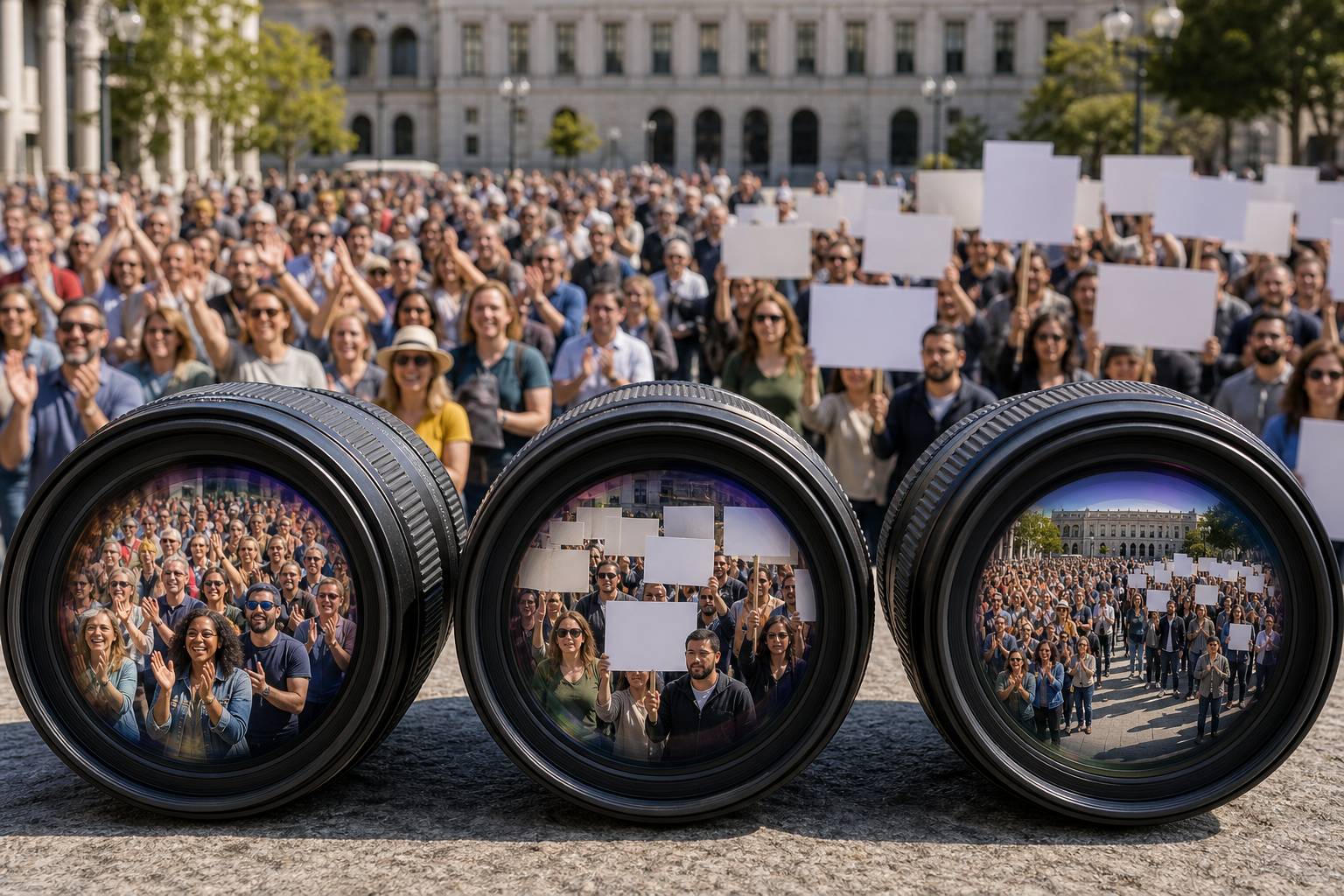
Media framing usually works through selection, placement and repetition. Every individual sentence can be literally defensible while the total presentation leaves a misleading impression. A protest may be real, for example, while its prominence in a headline makes it appear more representative or consequential than the available evidence supports.
Readers encountered the deliberate contrast of a "rock star welcome" with human-rights protests. Muslim and Khalistani protests outside the venue also received substantial attention. Those descriptions should be treated as claims about identifiable participants and demands, not as self-explanatory labels. You still need to ask who organised the demonstration, what its participants actually said, and what evidence connects them to the label being used.
Watch for these recurring framing moves:
- Salience substitution: the most dramatic image is treated as the most important development. Ask whether the image represents the diplomatic substance of the trip or merely the easiest moment to package.
- Scale without a denominator: words such as "major," "widespread" or "large" appear without a credible comparison. The presence of protesters, the number of people present and their share of the wider public are three different claims.
- Category inflation: criticism of Modi, his government, the BJP, Bharat, Hindu society and Hindus abroad is blurred into one category. These objects of criticism overlap in political rhetoric, but they are not interchangeable.
- The specificity gap: a broad phrase such as "human-rights concerns" is repeated without identifying the alleged act, the affected people, the applicable institution or the government’s response. An umbrella label cannot be evaluated until it is broken into precise claims.
- Unequal scrutiny: allegations against one side are presented with confident language, while responses from that side are surrounded by sceptical qualifiers. Bias is easier to demonstrate through repeated asymmetry than through a single adjective you dislike.
- Repetition mistaken for corroboration: several outlets repeat the same advocacy claim, creating the appearance of multiple confirmations. Check whether they independently verified it or merely relied on the same organisation, statement or protest organiser.
None of these patterns proves malicious intent on its own. Editors also choose conflict because it is immediate, visual and easy to summarise. The stronger criticism is therefore not "this coverage offended us." It is "this presentation elevated one documented element beyond what the evidence can support." That is a claim you can test and defend.
Test each claim before choosing a camp

You can assess a hostile or celebratory account with the same method. The symmetry matters: if you demand evidence for allegations against Bharat, you should also demand evidence before declaring that multiple organisations coordinated a campaign against Bharat.
- Rewrite the claim without its adjectives. Replace "massive backlash" with "a protest occurred outside the venue." Replace "historic triumph" with the specific diplomatic or public event being claimed as a success.
- Classify the statement. Is it an observable event, an allegation, an inference about motives, a judgement about importance or a prediction about consequences? Each category requires different evidence.
- Identify the claimant. A protest organiser, an advocacy organisation, a government, a journalist and an eyewitness occupy different roles. Naming the claimant does not settle the issue, but it prevents an allegation from quietly turning into an established fact.
- Ask what would verify it. The occurrence of a protest needs reliable evidence from the scene. A claim about scale needs credible estimates and context. A human-rights allegation needs a precise accusation, supporting records and the response of the accused party. A claim of media coordination needs evidence of coordination, not merely similar headlines.
- Look for the denominator. If someone says the protest defined the visit, compare its scale and duration with the wider programme. If someone says the rally represented the diaspora, ask how attendance relates to the much larger and internally diverse community.
- Separate omission from falsehood. A report may contain no fabricated statement yet still omit diplomatic outcomes, the scale of the welcome or the contested status of an allegation. State exactly what was missing and why that omission changes the reader’s understanding.
- Reach a provisional conclusion. If the necessary evidence is unavailable, say that the claim remains unproved. Refusing premature certainty is not weakness; it prevents your own side from becoming dependent on slogans.
A few evidence matches will keep your judgement disciplined. To establish that protesters were present, look for dated material from the location and independent confirmation. To establish that they dominated public sentiment, you need comparative evidence, not a close camera angle. To establish that allegations were credible, you need the allegations in specific form and an opportunity to examine competing accounts. To establish a media pattern, compare headlines, placement, sourcing and language across equivalent cases.
This method also exposes a common error in arguments about "hitjobs." Similar negative coverage may reflect shared assumptions, reliance on the same advocacy network, editorial imitation or actual coordination. Those explanations are not equivalent. Do not claim the strongest one until you have evidence that distinguishes it from the others.
What Bharat’s supporters should do with hostile coverage

A pro-Bharat response is strongest when it is more precise than the framing it challenges. Anger can draw attention to unfair treatment, but evidence is what persuades a reader who does not already agree with you.
- Preserve the exact claim. Save the headline, relevant wording, publication date and link. Do not rely on a cropped screenshot that hides qualifications or context.
- Keep allegations labelled as allegations. If Amnesty International urged governments to raise a concern, say exactly that. Do not silently upgrade advocacy into proof, and do not downgrade it into irrelevance merely because the organisation has taken a critical position.
- Correct one distortion at a time. If the problem is disproportionate emphasis on protests, demonstrate the disproportion. If the problem is a false factual assertion, rebut that assertion. A broad accusation of anti-India bias cannot substitute for either task.
- Distinguish political targets. Criticism of Modi is not automatically hostility to Hindus. Criticism crosses a different line when it assigns collective guilt to Hindus, treats Hindu identity as inherently suspect or applies a standard that is withheld from comparable groups.
- Name separatism precisely. A protest described as Khalistani concerns a particular separatist cause. It does not, without further evidence, represent Australian public opinion, the entire Sikh community or every critic of the Indian government.
- Describe demands, not just identities. Calling participants "Muslim protesters" says less than explaining what they demanded and on whose behalf they claimed to speak. Religious identity is relevant only when it helps explain the political claim.
- Avoid collective accusations. Advocacy organisations, editors, protesters and governments are separate actors unless evidence shows cooperation. Collapsing them into a single hostile force makes a forceful slogan, but it weakens factual analysis.
- Answer the strongest version of the criticism. Acknowledge what is documented, mark what remains alleged, supply missing context and explain why the distinction changes the conclusion.
This discipline protects more than Modi’s reputation. It protects the credibility of pro-Hindu and pro-Bharat commentary. If every criticism is called anti-Hindu, the term loses its ability to identify genuine hostility. If every coordinated-looking narrative is declared a conspiracy without evidence, documented patterns of selective treatment become easier to dismiss.
The better standard is consistent scrutiny. Ask whether Bharat receives the same presumption of complexity, the same care with contested claims and the same separation between a government and a civilisation that Western coverage commonly grants to other societies. Then document the answer with comparable examples rather than assuming it in advance.
Key takeaways
- An enthusiastic welcome and organised protests can both be real; neither is a complete account of the visit.
- The existence, scale, representativeness and validity of a protest are separate questions requiring separate evidence.
- An advocacy organisation’s intervention establishes that a concern was raised, not that the underlying allegation was proved.
- Media bias is best demonstrated through selection, omission, sourcing and unequal standards, not through offended reaction to an unfriendly headline.
- Supporters of Bharat serve their case by distinguishing anti-Modi criticism, anti-India positioning and anti-Hindu hostility instead of treating them as synonyms.
The next time a provocative clip or headline from the visit reaches you, do not share it with only a verdict attached. Write down its exact claim, mark the evidence level, identify the missing context and link to the full material. That small act turns reactive outrage into an argument another reader can actually verify.