
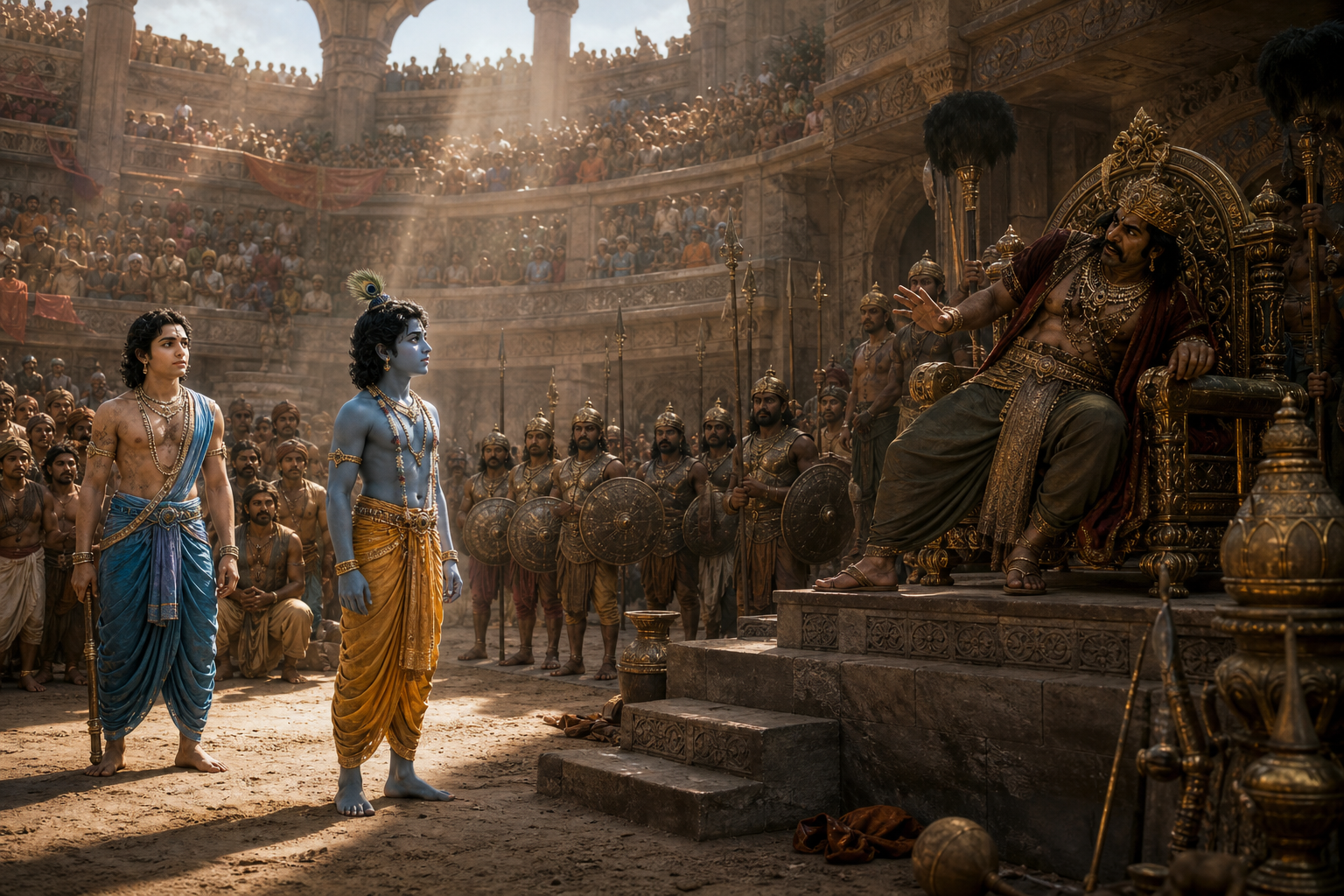
You may know how Kamsa dies, yet the more revealing question is why Krishna confronts him in a packed royal arena rather than in the privacy of the palace. Kamsa had made his fear into public policy. The answer to that policy also had to become visible to Mathura.
If you want more than a simple victory story, watch what each man does with power. Kamsa attacks kinship, counsel, lawful authority, and public confidence. Krishna breaks the machinery of intimidation, faces its enforcers openly, and leaves the throne to a restored ruler. That sequence gives you a practical dharmic test for distinguishing legitimate authority from domination.
Kamsa’s tyranny was a system, not a single cruel act
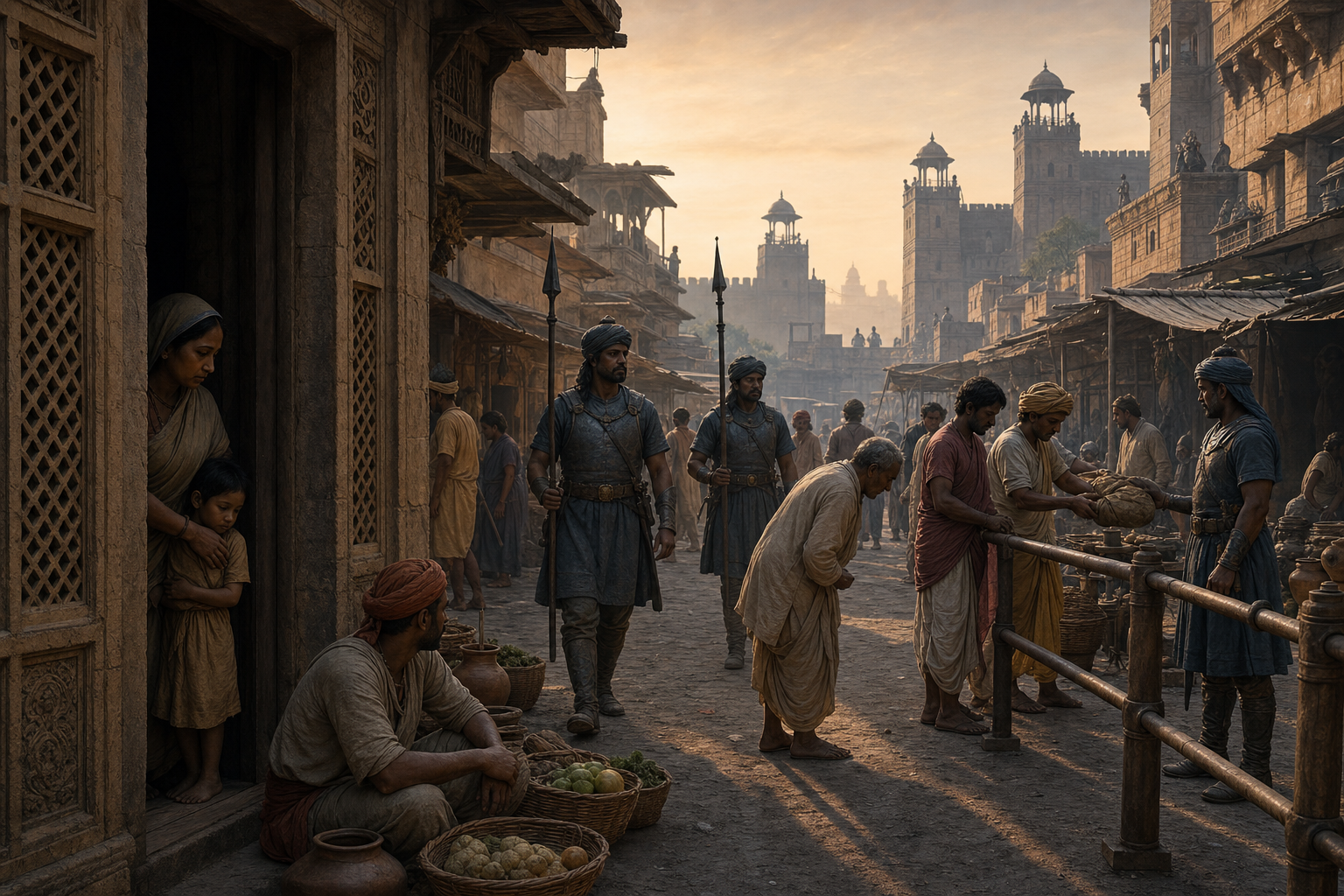
Begin with the political texture of Mathura. Tradition remembers Ugrasena as its ruler, but his kingship existed within the wider life of the Bhojas, Vrishnis, Andhakas, and other Yadava groups. Clan elders and assemblies, often associated with the Sudharma, represented a layer of counsel that stood between royal will and civic life. This should not be mistaken for a modern parliamentary constitution. It is better understood as a mixed order in which lineage, custom, deliberation, and rulership constrained one another.
The distinction between memory and recoverable history matters. The Bhagavata Purana, Vishnu Purana, Harivamsa, and the wider Mahabharata tradition are sacred narratives, not surviving municipal records. Archaeological horizons around Mathura, including early coinage, Northern Black Polished Ware, and important artistic production, establish a sophisticated urban setting capable of complex governance; they do not prove the precise membership or procedures of a particular assembly. You can therefore take the political pattern of kingship, clans, counsel, and usurpation seriously without pretending that every institutional detail is historically settled.
Kamsa’s defining act was the seizure of authority from his father, Ugrasena. The prophecy heard at Devaki’s wedding—that her eighth child would kill him—then exposed the moral character of the new ruler. Prophecy did not compel Kamsa to imprison Devaki and Vasudeva or kill their newborn children. It presented him with fear, and he repeatedly chose cruelty as his answer.
This is an important correction to a common reading. The oracle is not an excuse for fatalism, as though everyone merely performs a predetermined script. Kamsa remains accountable because he converts knowledge of a possible future into violence against innocent people in the present. His attempts to escape death become the very conduct by which he forfeits moral legitimacy.
- He captures the lawful centre: Ugrasena is displaced, allowing personal command to replace inherited and consultative legitimacy.
- He turns family into a security problem: a sister and brother-in-law become prisoners, and children become targets because kinship no longer restrains the ruler.
- He replaces counsel with fear: elders, clan networks, and customary limits lose their capacity to check the throne.
- He borrows strength from an external patron: Kamsa’s marriages to Asti and Prapti, daughters of Jarasandha of Magadha, bind his regime to a formidable military ally.
- He distributes coercion through agents: wrestlers, guards, and other functionaries turn a ruler’s private dread into an organized apparatus of intimidation.
That progression is more instructive than the label tyrant. A ruler does not become adharmic merely by being strong. Under the custodial ideal of rajadharma found in the Shanti Parva, authority exists to protect subjects, uphold truth, and defend the vulnerable. Kamsa reverses every part of that standard: the vulnerable become threats, relatives become hostages, civic ceremony becomes a weapon, and the state serves the ruler’s survival rather than the people’s welfare.
When you assess any claim to authority—political, religious, or communal—look first at how it treats restraints. Does it accept counsel when the counsel is inconvenient? Does it preserve protections for people it fears? Does it keep public institutions distinct from the leader’s personal survival? Kamsa’s Mathura fails all three tests before Krishna ever enters the arena.
Why the confrontation had to happen in the arena
Kamsa’s wrestling festival was not neutral entertainment. It was a royal spectacle arranged within a strategy of elimination. Drums, banners, dignitaries, wrestlers, and an assembled population gave state violence the appearance of civic order. The ruler wanted intimidation to look ceremonial and murder to look like sport.
The movement into the arena unfolds through a deliberate escalation:
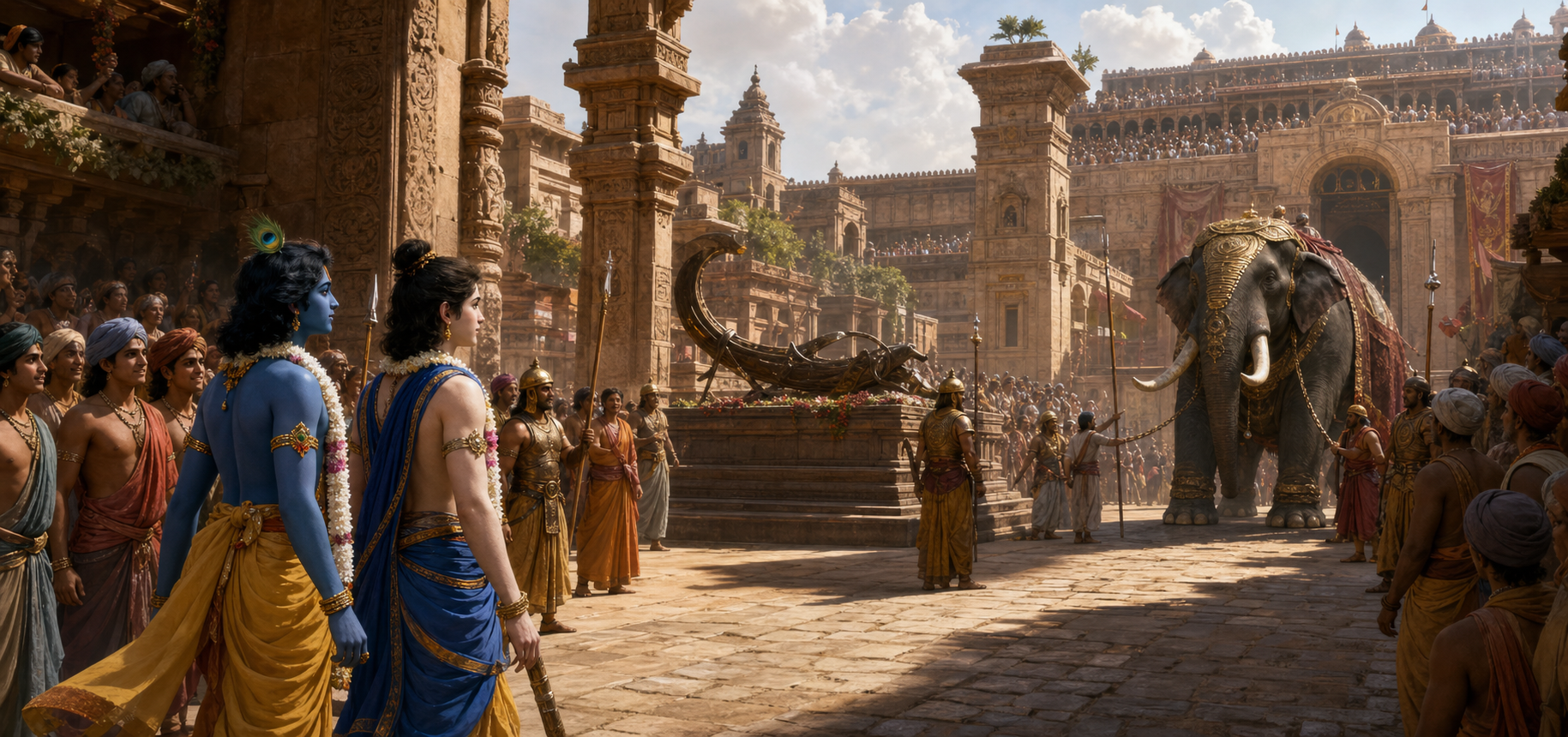
- Krishna and Balarama arrive in Mathura within the setting of Kamsa’s Dhanur-yajna festivities.
- Kuvalayapida, the formidable elephant stationed against them, makes the approach itself a planned point of destruction.
- After overcoming that threat, the brothers enter the royal amphitheatre rather than withdrawing from the confrontation.
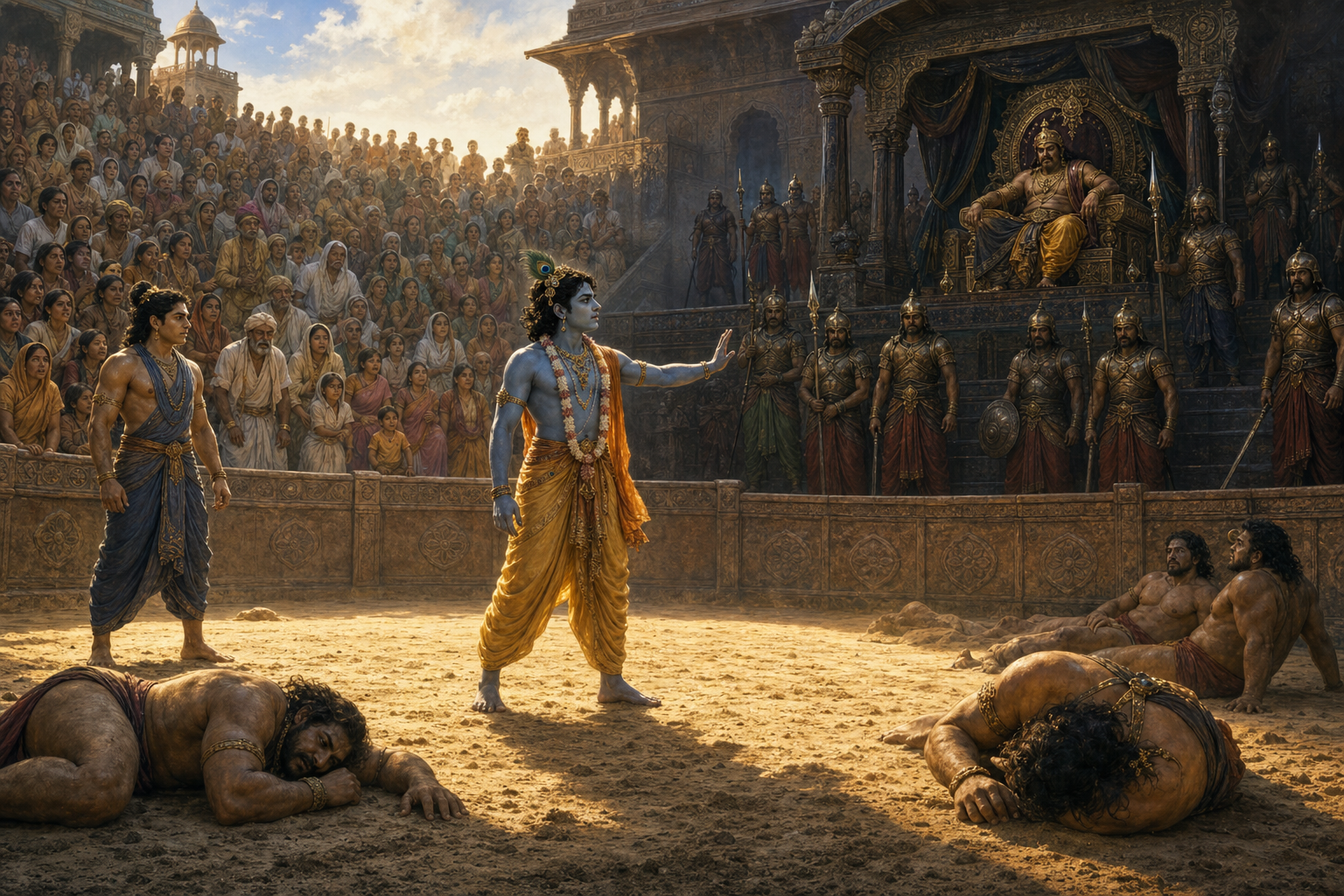
- Chanura and Mushtika await as highly trained wrestlers whose ability has been placed at the service of Kamsa’s design.
- The spectacle meant to demonstrate the regime’s control becomes the place where that control is exposed and broken.
This sequence turns the royal arena into a place of public moral judgment. Kamsa had tried to hide predation inside pageantry. Krishna refuses the disguise. By passing through each staged threat and standing before the assembled city, he makes the conflict legible: this is not an unruly youth disrupting lawful sport, but a threatened regime using civic forms to carry out unlawful violence.
The public setting accomplishes three things. It denies Kamsa secrecy, gives frightened citizens visible evidence that the regime can be resisted, and places the final reckoning before the community whose life Kamsa has distorted. Krishna’s courage is therefore accountable courage. It does not operate through a hidden apparatus resembling the one it opposes.
Balarama’s presence also matters. Krishna does not enter Mathura as an isolated strongman seeking a throne for himself. The brothers face the royal enforcers together, supported by relationships formed outside Kamsa’s court. The pastoral world of the cowherds—grounded in mutual protection, work, and local obligation—stands in sharp contrast to a palace that has reduced every relationship to fear and utility.
When you encounter a public spectacle of power, do not judge it by its ceremonial surface. Ask who designed the event, who controls its rules, which threat is being disguised, and what happens to anyone who refuses the script. Kamsa’s banners and drums do not confer dharma on his plan. Ritual form cannot sanctify an unjust purpose.
The crowd sees Krishna through the condition of its own heart
At Srimad Bhagavatam 10.43.17, and in the celebrated sequence it opens, one Krishna enters the arena but is not perceived in only one way. The wrestlers see an overwhelming opponent. Ordinary citizens recognize a defender. His relatives behold someone intimately their own. Devotional and saintly observers recognize the Supreme. Those captivated by beauty encounter beauty. The impious see danger, while Kamsa sees the death he has spent years trying to escape.
These perceptions are neither identical nor equally complete. Each discloses something about Krishna, but each also reveals the disposition of the observer. Professional conditioning narrows the wrestlers’ vision to combat. Affection opens another form of knowledge for the Yadavas. Devotion recognizes a reality that political calculation cannot contain. Kamsa’s fear is especially revealing: he can perceive that Krishna is his doom, yet he cannot see why his own conduct has made that reckoning just.
This plurality should not be reduced to the modern slogan that everyone has their own truth. The arena contains real actions, real victims, and a real difference between aggression and protection. The deeper point is that your habits, loyalties, fears, and cultivated qualities affect how much of reality you are prepared to recognize.
The scene also works through rasa. Heroic energy appears to the combatants; fear hangs over Kamsa and his allies; wonder rises among those watching the brothers; familial affection, friendship, beauty, and devotion disclose still other dimensions. Krishna is not exhausted by any one political or emotional category. He is simultaneously the cowherds’ intimate companion, the Yadavas’ kinsman, the opponent of the wrestlers, the answer to the citizens’ fear, and the Supreme Reality encountered according to each person’s capacity.
You can use this episode as a discipline of perception whenever a conflict seems morally obvious to you. Make three passes before reaching a judgment:
- Describe what happened before assigning motives. Separate observable conduct from the story your loyalties immediately place around it.
- Name the role from which you are looking. A courtier, combatant, relative, frightened citizen, and spiritual practitioner will notice different things.
- Test your perception against dharma. Ask which interpretation best accounts for truth, protection of the vulnerable, restraint of harm, and responsibility for consequences.
The third pass prevents introspection from collapsing into indecision. Self-examination is not a substitute for moral judgment. It clears the fear, pride, and group loyalty that can make adharma appear normal—or make righteous restraint look like weakness.
Dharmic courage restrains violence rather than worshipping it
Two opposite misreadings empty the confrontation of its ethical force. One treats Krishna’s victory as proof that strength creates right. The other assumes that any use of force must be incompatible with spiritual discipline. Neither fits the moral structure of the episode.
Kamsa has already usurped lawful authority, imprisoned innocent relatives, killed children, suppressed restraints, and arranged further lethal attacks. Chanura and Mushtika are not merely athletes who happen to disagree with Krishna; their skill has been absorbed into a programme of state coercion. Force appears in response to an established and continuing machinery of harm, not as a first response to criticism or rivalry.
The relevant dharmic question is therefore not whether power is used, but what governs its use. A disciplined reading asks:
- Is there concrete harm to be stopped, or only wounded pride and speculative fear?
- Have ordinary restraints been destroyed or captured by the aggressor?
- Is the response directed at the machinery of harm rather than at an entire population?
- Does the action remain tied to protection, necessity, and proportion?
- After the threat is removed, is lawful order restored, or does the victor simply inherit the tyrant’s privileges?
Krishna’s Mathura confrontation satisfies this narrative logic because it targets a particular regime and its active enforcers, culminates in Kamsa’s removal, and is followed by Ugrasena’s restoration. The victory is not presented as permission for indiscriminate vengeance. Its purpose is the re-establishment of moral and civic order.
Related principles appear across the dharmic family without becoming doctrinally interchangeable. Hindu thought places protection and disciplined force within rajadharma and dharma-yuddha. Buddhist Right Action joins conduct to wisdom and compassion. Jain ahimsa places an exacting burden on every claim that harm is necessary and refuses the casual normalization of violence. Sikh dharam yudh joins courage to the defence of people facing oppression. Read beside one another, these traditions do not offer a slogan; they demand intention, restraint, responsibility, and care for those who bear the consequences.
For you, this is a standard for judging conduct, not a licence to designate a contemporary opponent as Kamsa and imitate sacred combat. In ordinary civic life, lawful and nonviolent remedies come first. Calling someone a demon before testing evidence, necessity, and proportion disables the very self-scrutiny that separates dharmic courage from self-righteous aggression. The target must be adharma and concrete harm, not a caricature created to make hatred feel holy.
The test of victory begins after the tyrant falls
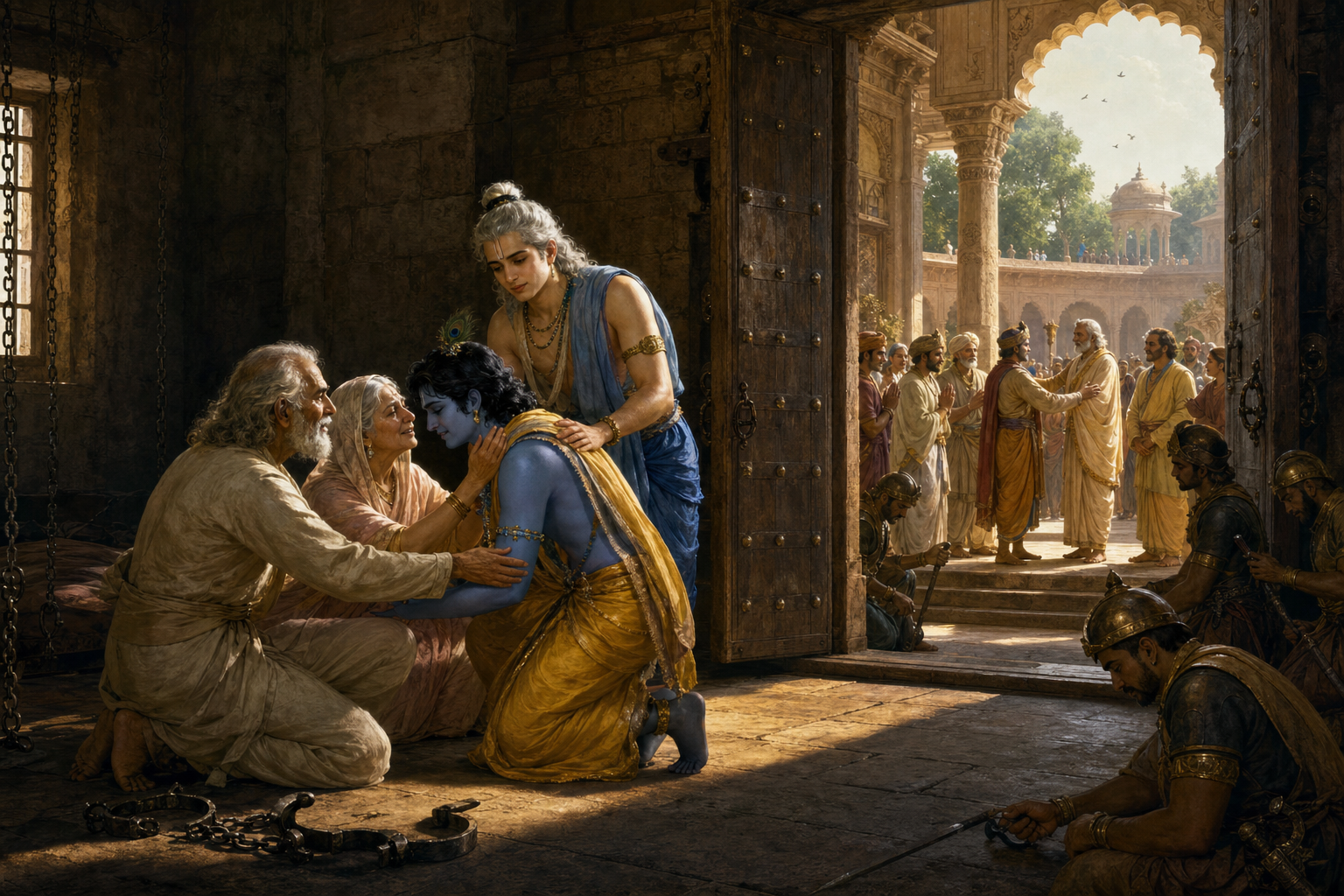
Kamsa’s death ends his immediate rule, but it does not instantly make Mathura secure. Ugrasena is reinstated, showing that the confrontation aims at restoration rather than Krishna’s personal enthronement. Yet Kamsa’s alliance with Jarasandha survives him. Jarasandha’s repeated attacks force the Yadavas to confront the geopolitical consequences of regime change.
This aftermath exposes the weakness hidden inside Kamsa’s borrowed strength. Magadhan support had helped him intimidate Mathura’s clans and institutions, but it also made the city vulnerable to an external patron’s retaliation. Removing the local tyrant did not remove the wider network that had sustained him.
The eventual movement to Dvaraka, remembered as a maritime fortress-city, should not be mistaken for simple flight. It preserves the Yadava community under conditions in which holding Mathura had become dangerously costly. Tradition’s warm memory of the Sudharma assembly at Dvaraka suggests that institutional memory could travel even when a vulnerable capital could not be retained. A city may be lost without surrendering the habits of counsel that gave the community its civic form.
That distinction is useful for any community rebuilding after coercive leadership. Do not measure recovery only by whether the abusive leader is gone. Check whether legitimate offices have been restored, whether frightened people can speak again, whether external dependencies remain dangerous, and whether decision-making procedures can survive another crisis. Replacing a person without repairing the restraints around power merely prepares the next usurpation.
Key takeaways
- Kamsa becomes a tyrant by converting personal fear into institutions of coercion.
- The prophecy reveals his insecurity but does not remove his responsibility for the choices that follow.
- The arena matters because Kamsa’s disguised violence is exposed and answered before the community.
- The spectators’ different visions of Krishna show how training, affection, devotion, ambition, and fear shape perception.
- Dharmic force is judged by necessity, protection, restraint, proportion, and what the victor restores afterward.
- Ugrasena’s reinstatement and the later preservation of Yadava life show that defeating a ruler is only the first stage of repairing order.
On your next reading of Canto 10, Chapter 43, keep two columns. In one, record every way Kamsa turns a relationship, institution, or ceremony into an instrument of fear. In the other, record how Krishna and Balarama answer each instrument and what they do not claim for themselves afterward. That close reading will help you recognize the line between power that protects dharma and power that merely dresses itself in sacred language.
References
- DharmaRenaissance Blog — When a Republic Fell: Kamsa’s Coup, Mathura’s Sudharma, and the Price of Lost Dharma
- Dandavats — Krishna’s Awe-Inspiring Arena Entry: The Definitive SB 10.43.17 Guide to Dharmic Valor