
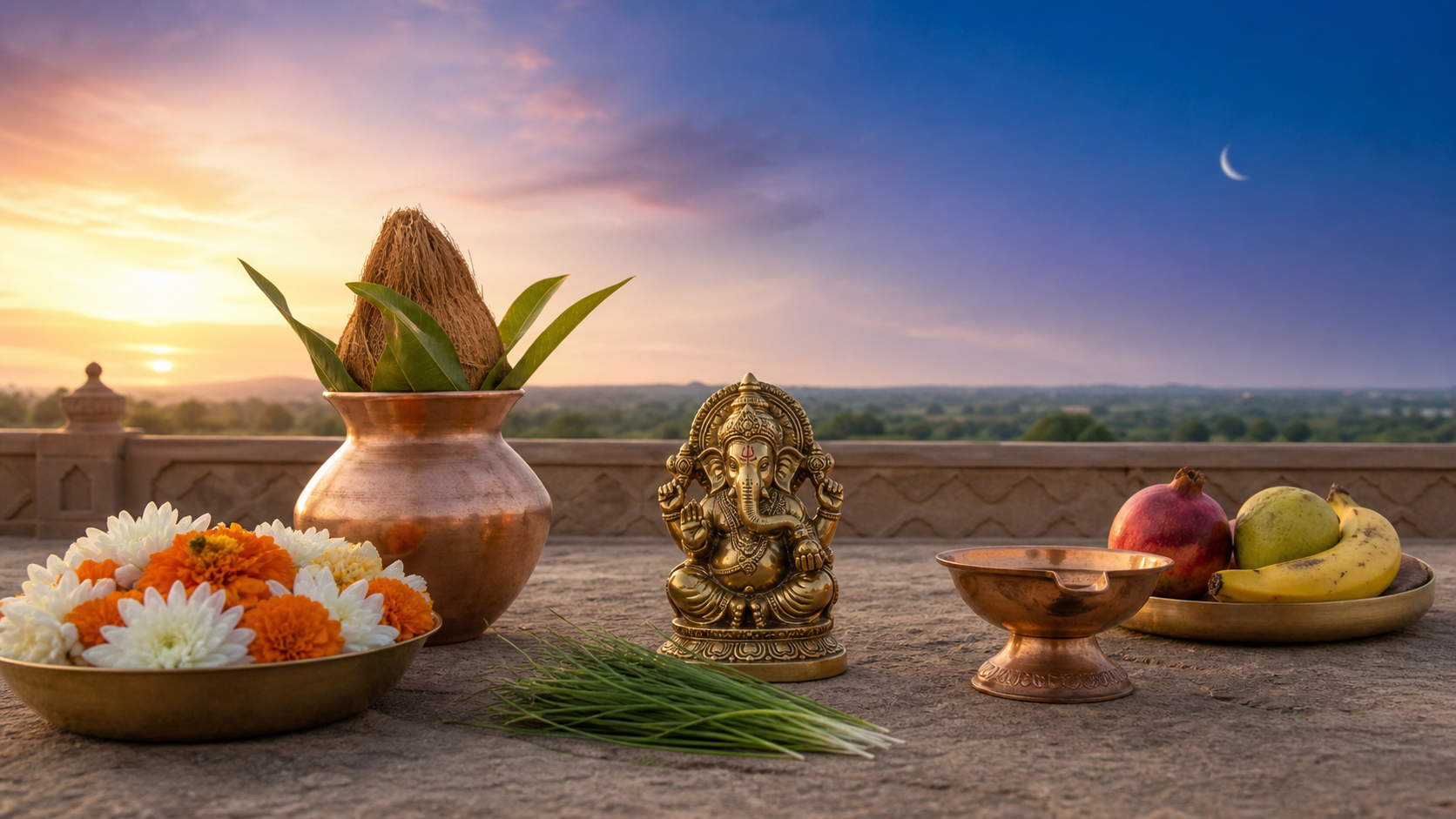
If you are deciding when to begin a course, make a commitment, perform puja, give dana, or take the first step in an important project on May 19, the day gives you two distinct periods to work with. The practical question is not whether the entire date is auspicious or inauspicious. It is which part of the day suits the act you have in mind.
For most regions, Shukla Paksha Tritiya continues until about 6:19 PM on Tuesday, May 19, 2026, and Shukla Paksha Chaturthi follows. Use the Tritiya portion for constructive beginnings and the Chaturthi portion for Ganesha worship, reflection, and removal of obstacles. Treat 6:19 PM as a broad planning marker, however, because your exact local Panchang must govern the final schedule.
May 19 at a glance
The periods below are different layers of Panchang time, so some of them overlap. Brahma Muhurta and Abhijit Muhurta are daily windows calculated from local solar conditions; Tritiya and Chaturthi are lunar-day divisions; Rahu Kalam, Yamaganda, and Gulika are weekday-based intervals derived from the local span of daylight.
| Period | Panchang condition | Best practical use | What to verify |
|---|---|---|---|
| Roughly 1.5 to 2 hours before local sunrise | Brahma Muhurta | Meditation, pranayama, japa, and scriptural recitation | Your local sunrise time rather than a generic national time |
| Daylight before the local tithi transition | Shukla Paksha Tritiya | Learning, dana, a new discipline, and constructive work intended to grow steadily | The local Tritiya end time and the day’s Rahu Kalam, Yamaganda, and Gulika periods |
| Around local solar noon | Abhijit Muhurta | A short sankalpa, the opening of a study session, brief worship, or another purposeful first act | The locally calculated Abhijit interval; ordinary 12:00 noon is not always the same as solar noon |
| After the local tithi transition, about 6:19 PM in most regions | Shukla Paksha Chaturthi | Ganesha worship, identifying obstructions, clearing overdue work, and preparing a cleaner next step | Your location’s displayed transition time, especially when time zones or daylight-saving rules apply |
Tuesday is Mangalavara, traditionally associated with Mangala and therefore with initiative, courage, discipline, and sustained effort. That makes the daytime combination especially suitable for a measured start: act decisively, but do not confuse speed with auspicious timing.
A practical plan for the two tithis

You do not need to turn the whole day into an elaborate observance. Give each period one clear function and let the transition shape the sequence.
- Set your location before reading any clock time. Select the actual city where the act will occur, not a distant hometown, temple, or capital city. Confirm the time zone and any daylight-saving adjustment.
- Use the quiet before sunrise for inward work. If your routine allows it, reserve the locally calculated Brahma Muhurta for meditation, pranayama, japa, or recitation. This is preparation, not a requirement that every external undertaking must begin before dawn.
- Place a constructive beginning in the Tritiya portion. Choose one identifiable first act: write and affirm a sankalpa, begin the first lesson, open the first working session, or make the intended act of dana. You do not have to finish the entire undertaking before Tritiya ends; the relevant moment is its deliberate initiation.
- Remove the prohibited intervals before committing to a time. A period can fall within Tritiya and still overlap Rahu Kalam, Yamaganda, or Gulika. Check all three locally rather than assuming that the tithi alone settles the choice.
- Change emphasis after Chaturthi begins. Light a diya according to your household practice, offer a simple prayer to Ganesha, recite Om Gam Ganapataye Namah, and name the obstruction that requires attention. Follow the prayer with one practical act, such as clearing an overdue obligation or writing the next step for the following day.
For an ordinary study plan, personal discipline, or modest household undertaking, this framework is usually enough to make the day meaningful. A wedding rite, property transaction, major journey, or other consequential ceremony requires more than a general daily reading. In that case, have the full local Panchang and the participants’ relevant traditions assessed by a knowledgeable purohit or jyotisha practitioner before fixing the time.
How to find a usable muhurta in your location
A clock time copied from another city can be wrong even when the calendar date is right. Local sunrise and sunset determine the daylight divisions used for Rahu Kalam, Yamaganda, and Gulika. Solar noon also shifts by place, so Abhijit Muhurta should not be reduced automatically to 12:00 PM.
On Tuesday, Rahu Kalam occupies the seventh of eight equal daylight segments. If local sunrise is represented by S, local sunset by T, and one segment has duration D = (T – S) / 8, the Tuesday Rahu interval runs from S + 6D to S + 7D. This explains why a remembered fixed range can drift across seasons and cities. Use your local Panchang for the displayed result and for Yamaganda and Gulika rather than trying to import their clock times from elsewhere.
- Enter the city where the activity will take place.
- Confirm local sunrise, sunset, and the end of Tritiya.
- Mark Rahu Kalam, Yamaganda, and Gulika as intervals to avoid for a new beginning.
- Locate Brahma Muhurta or Abhijit Muhurta if either suits the intended act.
- Check Nakshatra, Yoga, Karana, and the Moon’s Rashi before a consequential ceremony.
- Choose a window that satisfies the relevant checks and leaves enough ordinary time to act without rushing.
Why 6:19 PM is not a portable deadline
A tithi changes when the longitudinal angular separation between the Moon and Sun crosses the next 12-degree boundary. The celestial motion is continuous, while a calendar displays that transition through a particular location’s civil clock and date. Local sunrise, time zone, daylight-saving rules, and regional almanac conventions therefore matter when you translate the transition into a household schedule.
If your correctly configured local Panchang shows a time different from 6:19 PM, follow the local calculation. Do not move a ceremony merely to preserve the general reference time.
Do not infer Nakshatra or Rashi from the tithi
Tithi tells you the changing angular relationship between the Sun and Moon. Nakshatra identifies the Moon’s position within one of 27 lunar mansions, each spanning 13 degrees and 20 minutes. The Moon’s Rashi provides another layer, while Yoga comes from the combined longitudes of the Sun and Moon and Karana divides a tithi into halves.
These are independent Panchang factors and can change at their own times. Knowing that May 19 contains Tritiya and Chaturthi does not reveal the day’s Nakshatra, Yoga, Karana, or Moon Rashi. A complete decision therefore uses all five classical limbs: Vara, Tithi, Nakshatra, Yoga, and Karana. This matters most when the proposed act is difficult to reverse or carries substantial family and ritual importance.
What the Tritiya-to-Chaturthi shift asks you to change

Shukla Paksha is the waxing half of the lunar cycle and is traditionally read through the language of increase, clarity, and development. Tritiya gives that movement a gentle, constructive quality. It suits work that benefits from patient accumulation rather than spectacle: learning a subject, establishing a disciplined routine, giving dana, or beginning a project whose results will mature over time.
Make that symbolism concrete. State the purpose in one sentence, take the first meaningful step, and leave a record of what comes next. A sankalpa without an action remains a wish; an action without a clear sankalpa can scatter Tuesday’s force in too many directions.
Chaturthi changes the question from what should grow to what is blocking growth. Its connection with Vighna-nashaka Ganesha makes the evening suitable for obstacle-focused worship. You might identify one inner impediment, such as avoidance or resentment, and one outer impediment, such as an unfinished obligation. Recite the Ganesha mantra with attention, then address the part that is actually within your control.
Do not interpret the arrival of Chaturthi as a declaration that the evening is simply bad. Its value lies in a different kind of work: diagnosis, purification, completion, and preparation. If an important new venture can wait, use the evening to remove friction and begin it during a later verified muhurta. Routine responsibilities do not need to stop merely because the tithi has changed.
Families across Dharmic traditions may relate to lunar time differently. Hindu households commonly use the Panchang directly; Jain vratas and Buddhist Uposatha observances also attend to lunar rhythms, while Sikh families may follow the Nanakshahi calendar for gurpurabs and retain regional calendar customs at home. Follow the discipline of your own sampradaya or family rather than treating one household pattern as obligatory for everyone.
Key takeaways
- May 19, 2026 is Tuesday, or Mangalavara, and combines disciplined initiative with a mid-evening tithi transition in most regions.
- Shukla Paksha Tritiya lasts until about 6:19 PM in the general reference and favors learning, dana, steady beginnings, and constructive commitments.
- Shukla Paksha Chaturthi follows and is better directed toward Ganesha worship, obstacle removal, overdue work, and preparation.
- Brahma Muhurta is roughly 1.5 to 2 hours before local sunrise; Abhijit Muhurta is centered on local solar noon. Neither should be assigned a universal clock time.
- Exclude locally calculated Rahu Kalam, Yamaganda, and Gulika before choosing a new-venture window.
- For an important ceremony, confirm Nakshatra, Moon Rashi, Yoga, and Karana as well as the tithi; a daily headline is not a complete electional muhurta.
Before May 19 arrives, set your Panchang to the exact place where you will act and mark the local Tritiya boundary and dosha intervals. Then choose one beginning for the daytime and one obstruction to address after Chaturthi begins. That small amount of preparation will make the calendar serve your dharma instead of turning it into another source of uncertainty.