
You may know the principle that ought to govern a decision and still fail to act dharmically. You can speak the truth without tact, make a noble promise without the power to fulfil it, restrain anger because you are afraid, or achieve a useful result through conduct that cannot be defended.
Rama’s sixteen lakshanas reveal why isolated virtue is not enough. They present Dharma as an unbroken alignment of understanding, character, speech, self-command, concern for living beings and effective action. Their practical value is not that they give you sixteen compliments to admire. They show you exactly where a seemingly righteous decision can fracture.
The opening question is a test, not a search for a hero
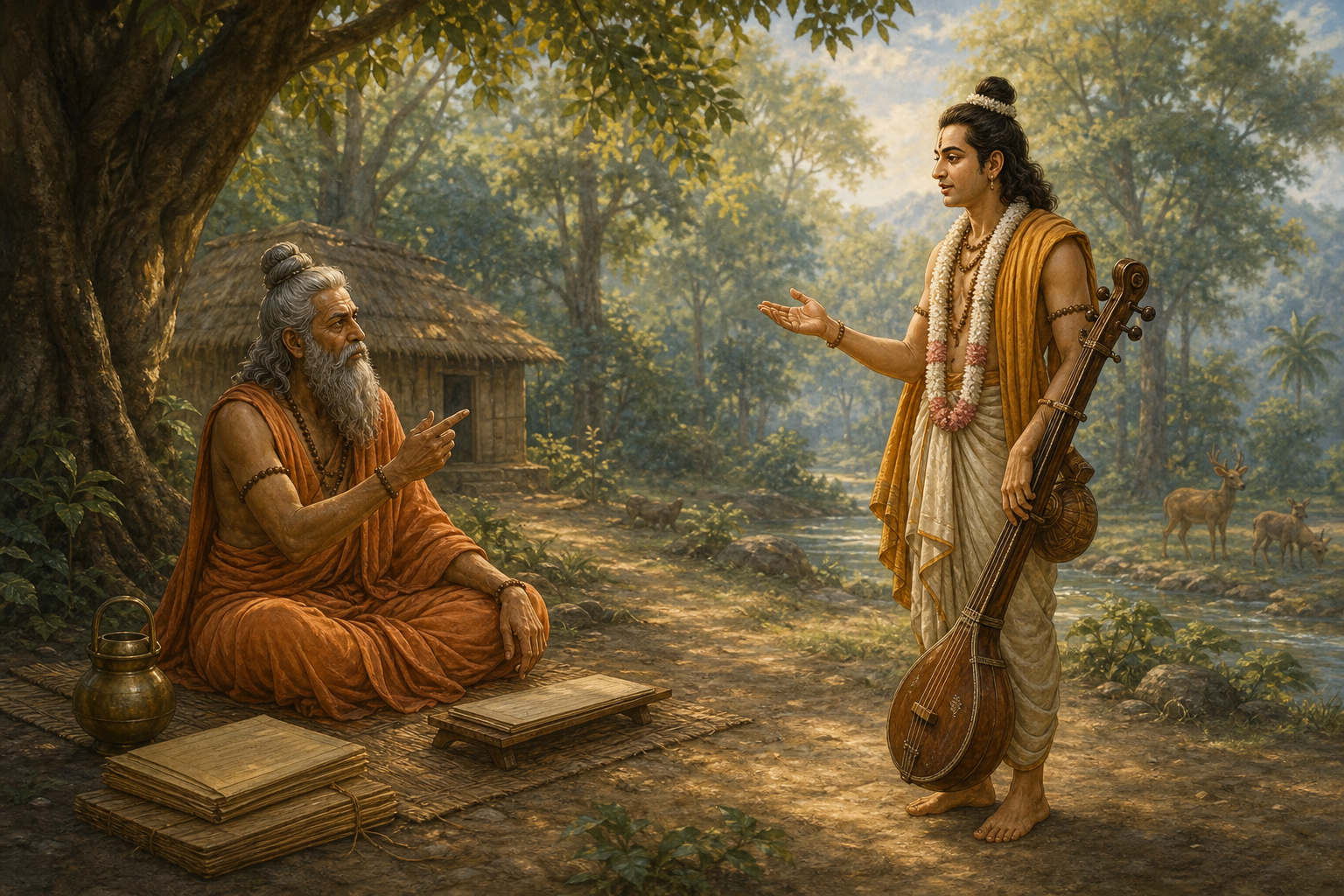
At the opening of the Valmiki Ramayana, Valmiki asks Narada whether there is, in the world at that time, a person in whom sixteen demanding qualifications coexist. He is not asking who is famous, successful, agreeable or generally well intentioned. He is asking whether Dharma can be present in a human life without being contradicted in any important domain.
The qualifications of the two participants matter. Valmiki approaches the inquiry as a prepared muni, while Narada is described as devoted to tapas and svadhyaya and as foremost among those who know authoritative speech. The question is therefore not casual speculation. It is a disciplined inquiry by a qualified questioner addressed to someone grounded in shastra.
This order matters whenever you face a dharmic choice. Within the Mimamsa framework, the senses can show you an act and its visible results, while inference can help you anticipate consequences. Neither, by itself, establishes what ought to be done. Dharma is known through authoritative shabda, with the Veda serving as the foundational pramana. Results can inform a decision, but a favourable result cannot retroactively turn adharma into Dharma.
- If an action succeeded, you know that it succeeded. You do not yet know that it was dharmic.
- If an action felt sincere, you know something about your internal state. You do not yet know whether your understanding, words and conduct were rightly aligned.
- If an admired person acted in a certain way, you have an example to examine. Admiration alone does not establish the governing principle.
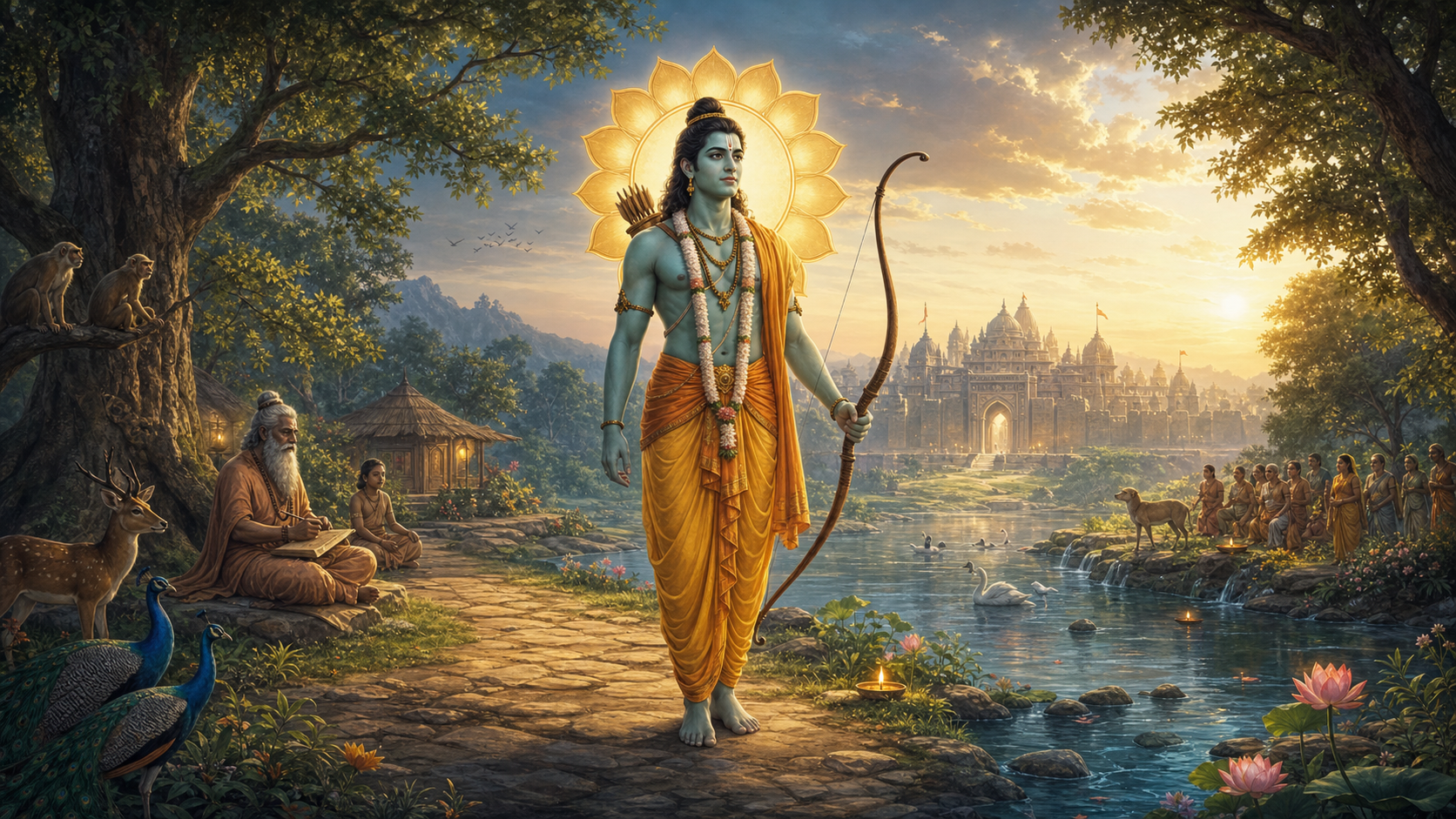
The traditional expression Ramo vigrahavan dharmah does not merely call Rama virtuous. It identifies Rama as Dharma made perceptible in a complete life. His knowledge does not remain theoretical, his speech does not depart from what he knows, and his action does not betray what he says.
The sixteen lakshanas and the failure each one prevents
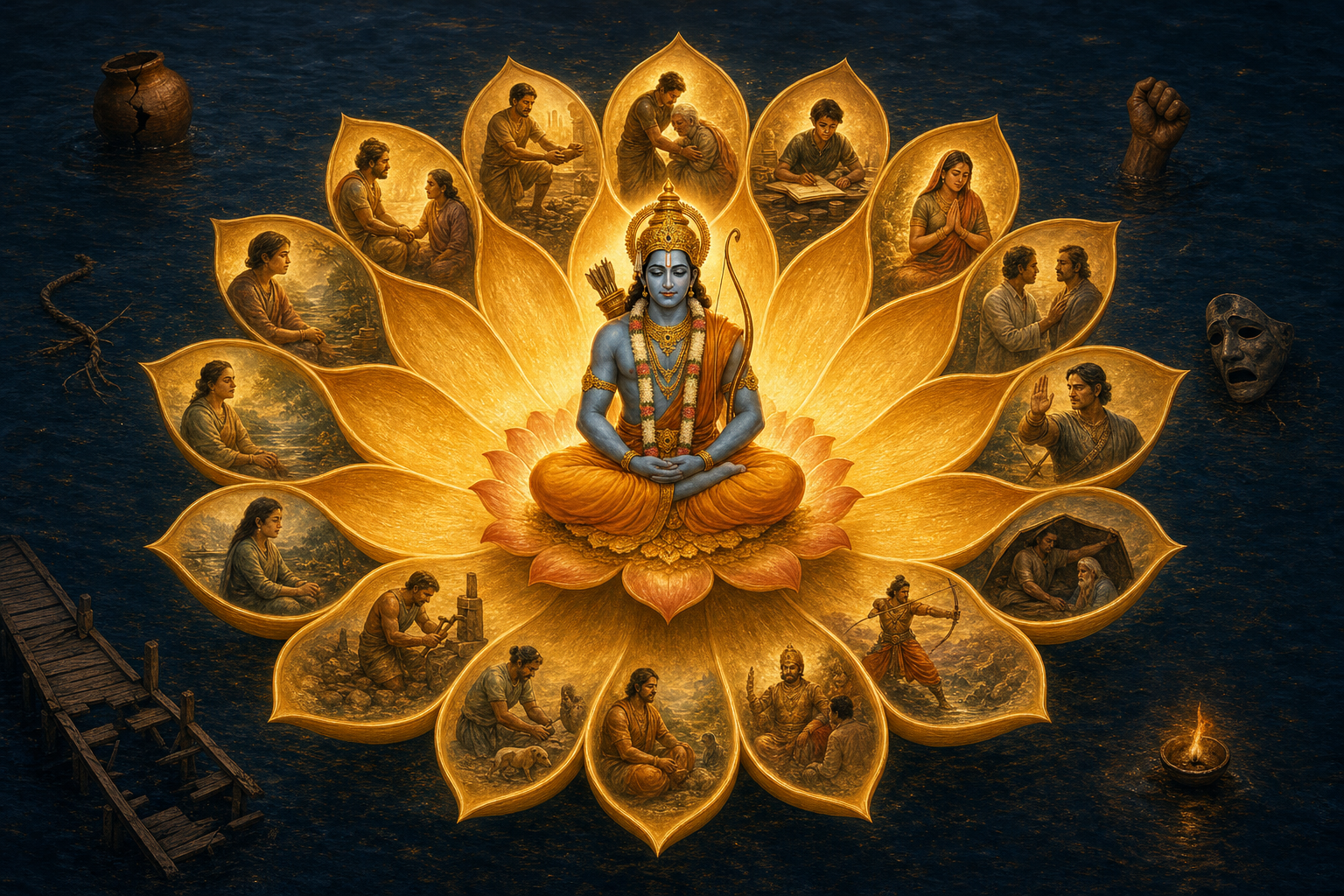
A lakshana is more exacting than an attractive personality trait. In this reading, each quality is a necessary condition of embodied Dharma. Every one blocks a distinct failure: ignorance, distortion, ingratitude, inconsistency, incapacity, uncontrolled reaction or the projection of faults onto another person.
The English glosses below are deliberately compact. Sanskrit terms carry ranges of meaning that no one-word translation can exhaust. The practical questions are not substitute definitions; they help you notice what each lakshana demands in an actual decision.
| Lakshana | What it safeguards | A practical question |
|---|---|---|
| Gunavan | Integrated excellence of character | Am I using one conspicuous strength to excuse a serious defect elsewhere? |
| Viryavan | Courage, vigour and the power to act | Can I bear the difficulty of doing what I claim is right? |
| Dharmajnah | Knowledge of Dharma | What valid dharmic authority grounds this choice, rather than my preference alone? |
| Kritajnah | Recognition of what has been done, received or owed | Whose act, trust, service or sacrifice must I remember before deciding? |
| Satyavakyah | Truthfulness in speech | Can I explain my reason without a strategic omission, distortion or double meaning? |
| Dridhavratah | Firmness in a worthy resolve | Will this commitment survive inconvenience, delay and social pressure? |
| Charitrena yuktah | Conduct consistent with character | Does my ordinary behaviour support the standard I am invoking now? |
| Sarvabhuteshu hitah | Concern for the welfare of all beings | Who will bear the cost of this decision, especially among those not present to object? |
| Vidvan | Learning and discernment | Do I understand the relevant distinctions, or am I acting from a slogan? |
| Samarthah | Practical ability to accomplish what is undertaken | Have I matched my promise to the means and follow-through required to complete it? |
| Eka-priyadarshanah | A singularly pleasing and approachable presence | Does my manner invite rightful trust, or make Dharma needlessly repellent? |
| Atmavan | Self-possession | Is a disciplined self governing this decision, or is an appetite, fear or injury governing it? |
| Jitakrodhah | Mastery of anger | Has anger revealed a wrong that needs attention, or has it seized control of my judgement? |
| Dyutiman | Radiance arising from integrated character | Does my conduct make integrity visible without depending on self-advertisement? |
| Anasuyakah | Freedom from envy and fault-projection | Am I identifying a real fault, or inventing one because I resent the person who stands before me? |
| Formidable when wrath arises in battle | Decisive power in necessary confrontation | When protection requires action, can I confront the wrong instead of disguising weakness as calmness? |
Do not turn this table into sixteen independent scores. A high mark in courage cannot compensate for false speech. Learning cannot cancel ingratitude. Concern for others cannot excuse incompetence when your promise places them at risk. The central demand is simultaneity: all sixteen must govern the same person and the same life.
Completeness becomes visible where the qualities pull together
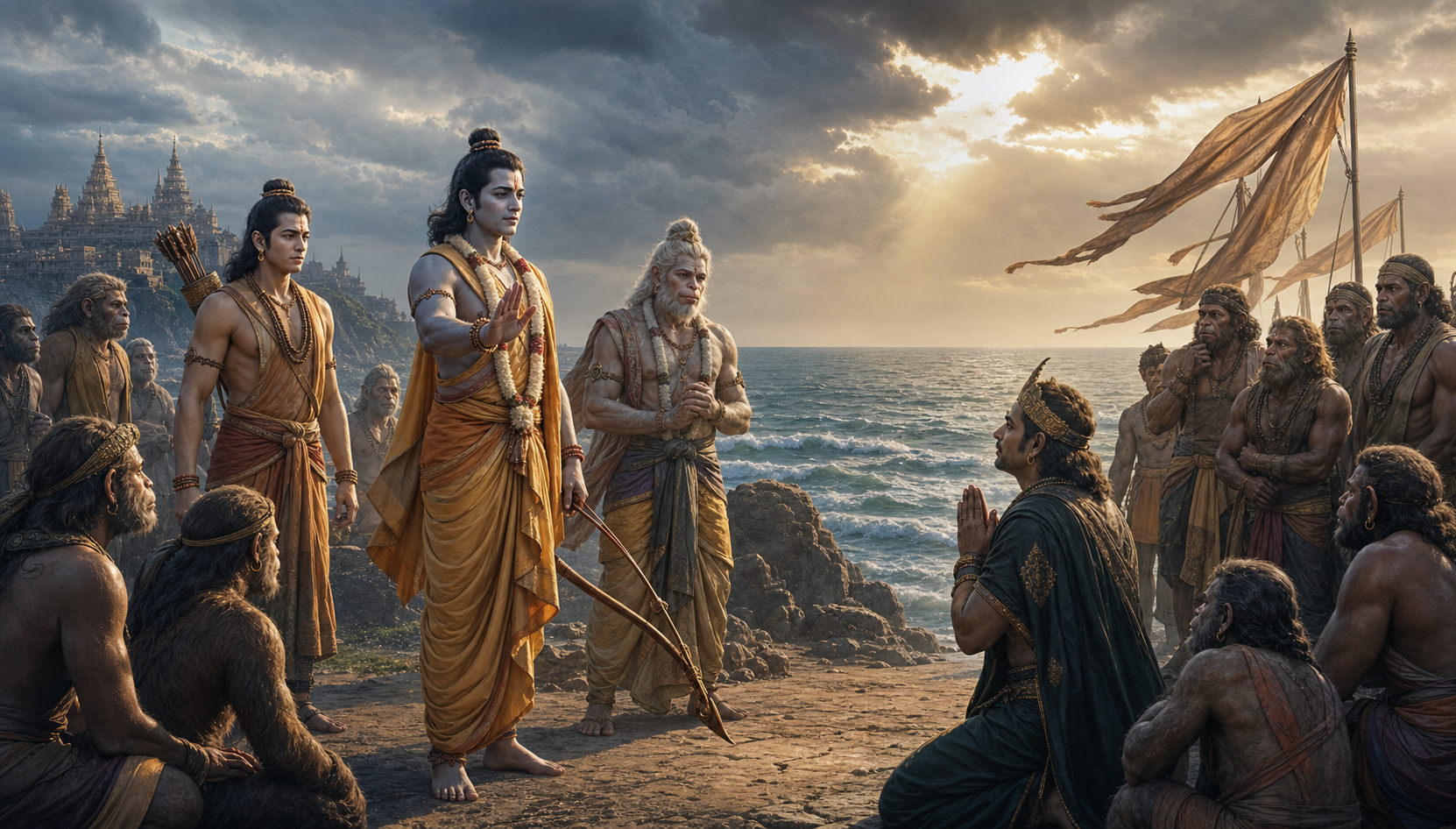
The most illuminating parts of the list are its apparent tensions. They prevent us from shrinking Dharma into the virtue we already find easiest.
- Knowledge must become competent action. Dharmajnah and vidvan prevent blind action, but viryavan and samarthah prevent knowledge from becoming an alibi for passivity. You have not embodied a duty merely because you can explain it. You must be capable of carrying it through.
- Truth must remain true across time. Satyavakyah governs the truth of speech now; dridhavratah governs continuity under later pressure. A convenient promise followed by quiet abandonment breaks the alignment even if the original words sounded noble.
- Self-command must coexist with formidable strength. Jitakrodhah does not describe someone incapable of anger, and the final question does not praise habitual rage. Together they distinguish governed force from reactive force. Anger must not rule the person, but the person must still be able to act decisively when a real confrontation arises.
- Power must remain ordered toward welfare. Virya and samarthya make action effective; sarvabhuteshu hitah prevents effectiveness from becoming predatory. Anasuyakah further prevents resentment and envy from masquerading as moral judgement.
- Inner integrity must become publicly legible. Atmavan concerns self-possession, while charitra, dyuti and priyadarshana concern the character others actually encounter. Private claims of purity cannot substitute for conduct that can be seen, trusted and lived with.
Treating the sixteen as a fixed, non-redundant condition-set is a rigorous interpretive claim. Its force lies in the failure exposed when any one condition is removed. Without dharmajnana, strength has no reliable direction. Without truthfulness, knowledge is corrupted in transmission. Without firmness, truth expires when circumstances change. Without capacity, a rightful intention remains unfinished. Without mastery of anger, reaction overrides judgement. Without freedom from envy, another person’s supposed defect may be manufactured by the observer.
This is why the sixteen concern transmission integrity. Dharma must pass from authoritative knowledge into a human being without being altered by the mind, falsified by speech or abandoned in action. Manas, vak and karma are the three practical loci to watch: what you understand and intend, what you say, and what you actually do.
As a practical map, dharmajnana and vidya establish right understanding. Atmavan, jitakrodhah and anasuyakah protect the mind from inner distortion. Satyavakyah protects articulation. Charitra, virya, samarthya and dridhavrata carry the principle into sustained action. The remaining qualities ensure that this integration is beneficial, trustworthy and visible in relationship with the world. These are overlapping functions, not rigid compartments, because a whole person cannot be divided as neatly as a diagram.
Use a six-question audit before a difficult decision
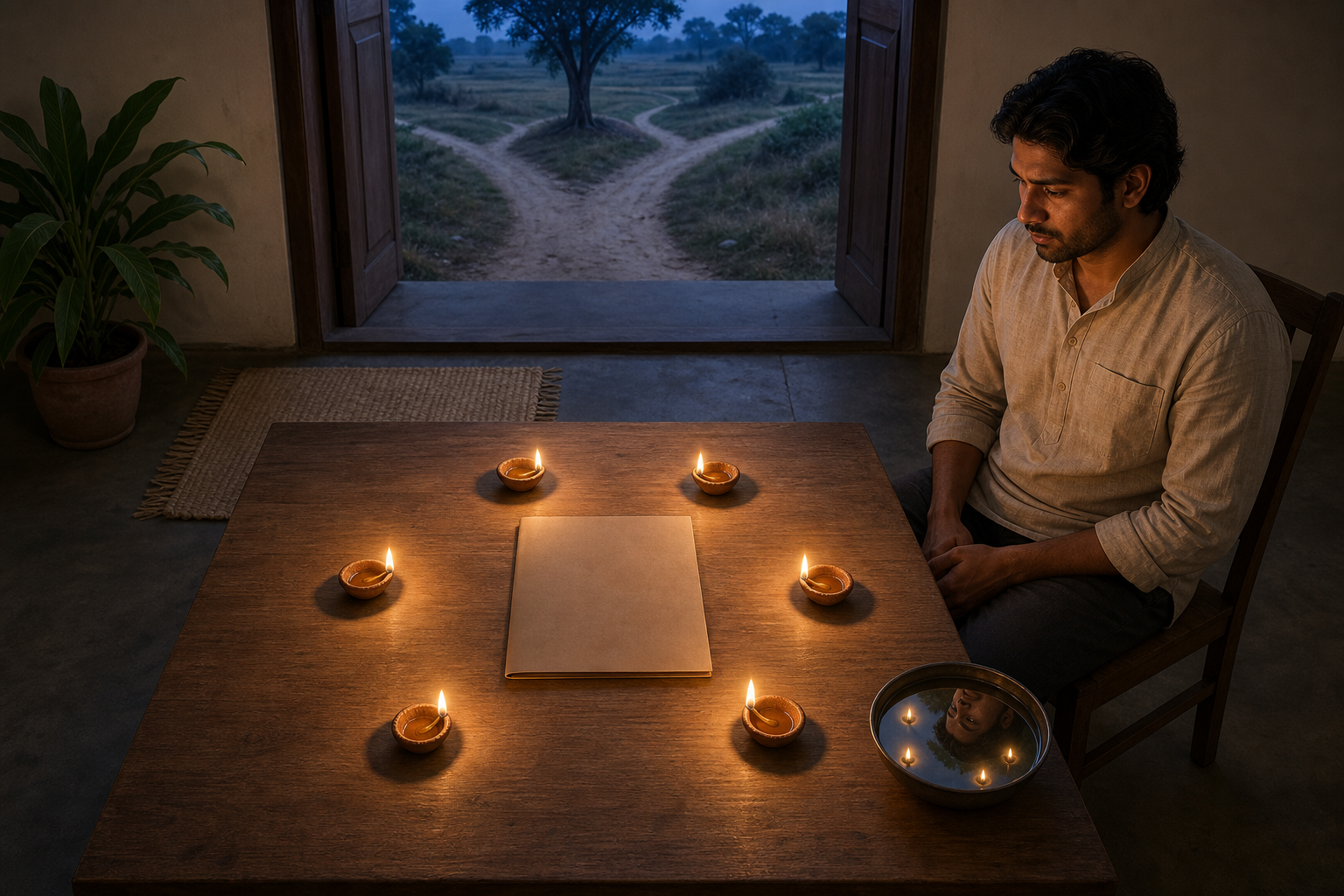
You can use the lakshanas without pretending that a private checklist has become a new pramana. The audit below does something narrower and more honest: it reveals the point at which your understanding, speech, motive or capacity has not yet met the standard you are claiming.
- What is the dharmic demand before you consider your preferred result? Write it in one sentence. Then identify whether it is grounded in shastra and a properly understood duty, or whether it is merely a custom, personal preference, fear or desired outcome. If you cannot distinguish those, the decision is not ready.
- What facts, commitments and received benefits must be remembered? Record what happened, what you promised, what others entrusted to you and what you owe. This brings kritajnata and satyavakya into the same examination. If your explanation changes with the audience, find the concealed fact before proceeding.
- What is happening in your own mind? Name the strongest appetite, fear, anger and resentment involved. Then ask whether you would judge the same conduct in the same way if the person were an ally rather than an opponent. A change in judgement is a warning that krodha or asuya may be rewriting the case.
- Whose welfare have you left outside the frame? List the beings directly affected, those indirectly affected and those who cannot speak in the room. Sarvabhuteshu hitah does not mean that every difficult choice will please everyone. It means you do not erase another being merely because acknowledging the cost would complicate your preferred answer.
- Can you actually complete what you are about to undertake? Name the first action, the means required, the completion condition and the pressure most likely to break your resolve. Virya begins the difficult action, samarthya makes completion possible, and dridhavrata keeps the undertaking from dissolving over time.
- Do manas, vak and karma give the same answer? Compare what you believe, what you are prepared to say openly and what you will actually do. If your mind depends on a fact your speech conceals, or your speech promises an action you cannot perform, the three loci are misaligned. Resolve that contradiction before claiming the decision as dharmic.
For a grave or genuinely obscure question, the audit should lead you back to shastra and a qualified teacher, not make you more certain of an unsupported private opinion. Valmiki’s example is instructive: seriousness is shown not by answering everything alone, but by taking a properly formed question to one qualified to answer it.
Key takeaways
- Rama embodies Dharma because knowledge, character, speech and action do not contradict one another in him.
- The sixteen lakshanas work as simultaneous safeguards, not as optional virtues from which you select a favourite few.
- A good outcome, sincere feeling or admired example cannot by itself establish that an action is dharmic.
- Jitakrodhah means mastery of anger, not helplessness; the final martial qualification preserves the capacity for decisive confrontation under disciplined rule.
- The quickest practical test is to compare manas, vak and karma: what you understand, what you say and what you do.
Take one decision that is presently asking something of you and run it through all six questions. When one answer is weak, do not cover the gap with louder moral language. Name the missing condition and repair it. Rama’s standard begins precisely where knowing the right thing is required to become truthful speech, governed strength and completed action.