

You may be looking at threatening messages, vandalism outside a mandir, or harassment aimed at a Hindu family and wondering whether it is serious enough to report. The first question is simpler: is anyone in danger right now? The second is whether you can preserve a clear record without putting anyone at further risk.
You do not have to decide whether the conduct legally qualifies as a hate crime before contacting authorities. Your job is to get to safety, record what happened accurately, explain the signs of anti-Hindu bias, and use the appropriate local reporting channel. Police and prosecutors make the later legal decisions.
Key takeaways
- Contact local emergency services when a threat is active, someone is injured, an intruder is present, or remaining at the scene is unsafe. Move to safety rather than staying behind to record more evidence.
- Use a non-emergency or designated bias-reporting channel when there is no immediate danger. Local procedures differ, so verify the correct channel with your police department.
- Report observable facts and the reasons you suspect anti-Hindu bias. Do not rely on the label hate crime as a substitute for describing the conduct.
- Preserve original photographs, messages, links, timestamps, witness information, and exact words or symbols. Keep interpretation separate from what you directly saw or heard.
- Ask for an incident number, a follow-up contact, language assistance when needed, and information about victim-support services.
- Prepare your mandir before a crisis by maintaining verified contacts, a simple incident-recording process, and working relationships with local officials.
Choose the right channel without trying to be the prosecutor
Use the emergency channel for an immediate threat
An active assault, a person making a credible and immediate threat, an intruder, a fire, a serious injury, or another unfolding danger belongs on your local emergency channel. Give the location first. Then state what is happening, whether anyone is injured, what immediate risk remains, and any safe observations that could help responders identify the person or direction of travel.
Do not confront or pursue a suspected offender. Do not remain in danger to obtain a better photograph. If an object appears suspicious, keep people away from it and tell emergency personnel what you observed rather than handling it. Medical and physical safety take priority over preserving a perfect record.
Use a non-emergency channel when the danger has passed
Past vandalism, an already-delivered hostile message, or harassment with no present threat may fit a police non-emergency line, an online reporting form, or a local bias-incident channel. The available routes vary by jurisdiction. If the conduct resumes or the risk escalates while you are waiting, reassess the situation and use the emergency channel.
A hate crime generally involves an alleged criminal act together with evidence of a bias motive. A hate-motivated incident may display hostility without satisfying the local elements of a crime. That distinction does not require you to stay silent. During a Hindu community safety session in San Jose, police representatives distinguished the two categories and explained that apparently minor reports can still help authorities identify patterns, consider early intervention, and direct resources.
A report is an allegation and an initial record. It is not a criminal charge, a finding of guilt, or proof that bias caused the conduct. You can say: I want to report conduct that may have been motivated by anti-Hindu bias, and I do not know its legal classification. Then describe what made the possible motive visible.
Do not report only that something felt Hinduphobic. Identify the words, symbols, timing, location, target, or repeated conduct behind that conclusion. A slur spoken while property is damaged is evidence to describe. So is a message that names Hindu identity while threatening a temple. Avoid guessing about a suspect’s religion, ethnicity, politics, or affiliations unless you directly observed something relevant and can explain exactly what it was.
Build a record that can survive every handoff
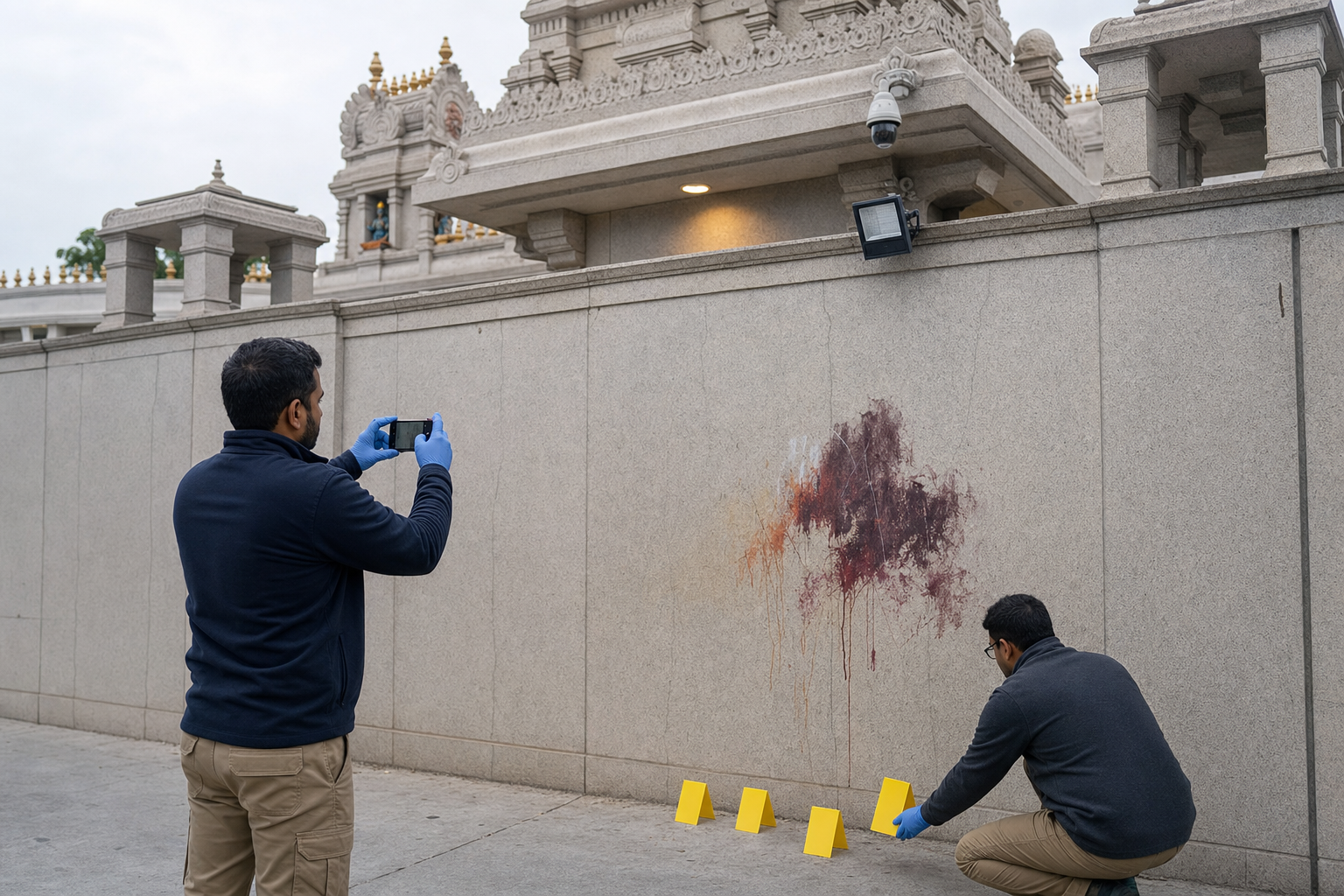
Your account may pass from a community volunteer to a police intake officer, then to an investigator and possibly a prosecutor. Each person needs to understand the event without relying on rumor or unstated cultural knowledge. Start your notes as soon as it is safe, while separating direct observation from later interpretation.
- Record the date, time, time zone, exact location, and the sequence in which events occurred.
- Write down the exact words you heard or read. If you cannot remember the wording precisely, say that it is a paraphrase rather than placing uncertain words in quotation marks.
- Describe people, vehicles, objects, and movements using observable details. Do not fill gaps with assumptions.
- Explain the possible bias indicators: references to Hindus, a deity, a mandir, Hindu practices, Bharat, a sacred symbol, or the victim’s perceived identity.
- Preserve original photographs, video, voicemail, email, direct messages, envelopes, and other material. Keep the unedited original even if you also make a cropped or annotated copy for explanation.
- For online conduct, retain the account name, profile link, post or message link, the surrounding thread, date, time, and any indication that content was edited or removed.
- List witnesses separately and obtain their permission before sharing private contact details. Encourage each witness to record an independent recollection rather than producing a group version.
- Record any injury, property damage, disruption, or protective action without exaggeration. Seek appropriate medical attention when someone is hurt; evidence collection should not delay care.
- Note every report submitted, the receiving organization, the incident or confirmation number, and the person assigned to follow up.
When a sacred Swastika is involved, name it accurately and supply the relevant Hindu context. A police officer or platform reviewer may not know whether the symbol was part of the temple’s established religious display, was defaced, or was added by an offender with a different meaning. The misunderstanding surrounding the sacred Swastika has already emerged as a community-safety concern. Cultural explanation is therefore part of a usable report, not an optional lecture.
Keep that explanation factual. State where the symbol normally appears, what it means in the relevant Hindu setting, what was altered or added, and why the alteration appears targeted. Do not edit the only copy of an image to make the point clearer. Preserve the original and, if useful, create a separate marked copy.
Use a consistent incident record
A mandir or community organization can use the following fields for its internal intake record. Store the record securely, restrict access to people who need it, and ask the affected person before circulating private information outside the reporting process.
- Reporter and affected person, with preferred and safe contact methods
- Date, time, time zone, and exact location
- Immediate safety status and any continuing threat
- Factual sequence of events
- Exact language, markings, or symbols connected to possible bias
- Names of original evidence files and where they are securely stored
- Independent witness names and contact permissions
- Injuries, damage, disruption, and support requested
- Police, platform, school, employer, or institutional report numbers
- Assigned follow-up person and the next agreed action
An internal community record does not replace an official report. It prevents details from disappearing when leadership changes or when several volunteers handle the same event. It also helps the affected person avoid repeatedly reconstructing the entire episode from memory.
Know what happens after you make the report

The person taking your report may record an initial category, ask for evidence, and refer the matter for investigation. Investigators can seek additional information and determine whether there is evidence of an underlying offense and a bias motive. If the matter is referred onward, prosecutors assess whether the available evidence supports charges under the law of that jurisdiction.
This process explains why the first description must contain facts rather than only a conclusion. It also explains why you should retain your own confirmation number and evidence copies. A prosecutor’s decision is separate from the act of reporting, and a decision not to charge does not erase the value of an accurate incident record.
Before ending the first contact, ask practical questions:
- What is the incident or report number?
- How has the matter been classified at intake, and can that classification change after review?
- Who is the follow-up contact, and when should the reporter use the emergency channel instead?
- How should additional photographs, messages, or witness details be submitted?
- How can an error or omission in the initial report be corrected?
- What language assistance or interpretation is available?
- What victim-services office can explain support options, safety planning, and any applicable compensation process?
At the reported San Jose session, police representatives said translation services and multilingual officers were available and that immigration status did not determine access to police assistance. Representatives of the Santa Clara County District Attorney’s Office also discussed its Victim Services Unit and the California Victim Compensation Board. Those statements concern that local setting. If you live elsewhere, ask your agency to confirm its own language-access, immigration, victim-support, and eligibility policies rather than assuming that another jurisdiction’s practice applies.
Support should not depend entirely on whether prosecutors eventually file charges. A family may need help understanding the process, managing a safety concern, replacing damaged property, obtaining care, or communicating in a preferred language. Ask early which services can be considered and who determines eligibility. Do not treat this general framework as legal advice for a particular case; consult a qualified local lawyer when rights, deadlines, liability, or possible litigation are at stake.
Make the mandir ready before the next incident
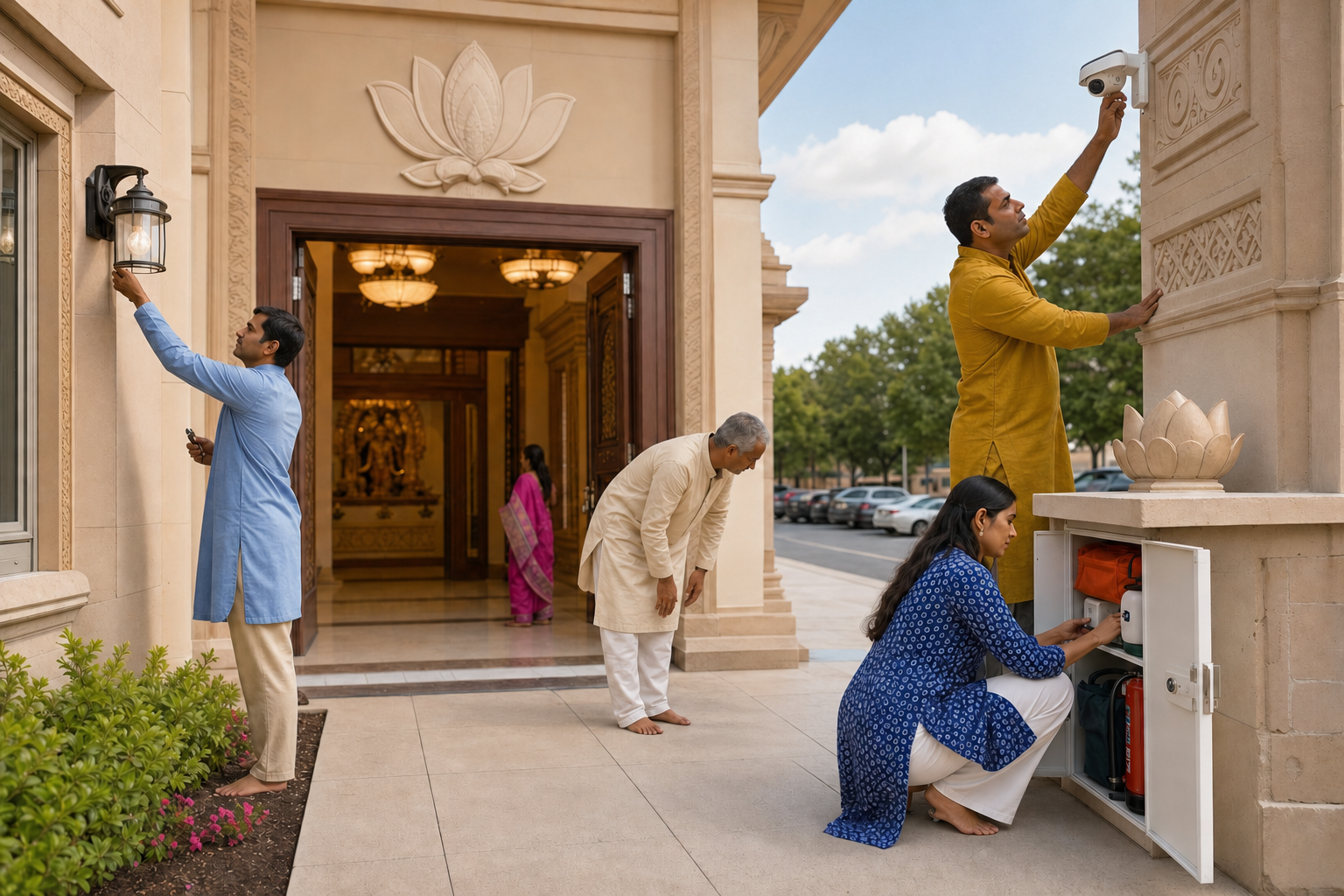
A temple becomes more resilient when its first contact with police, prosecutors, and victim-support staff occurs during an educational meeting rather than in the middle of a crisis. In San Jose, Hindu residents, temple representatives, police officers, and prosecutors met inside a mandir; sacred mantras opened the gathering, and young Hindus welcomed participating officials. Civic preparation did not require the temple to hide its Hindu character.
Temple leadership can turn that model into routine preparedness:
- Verify the local emergency, non-emergency, online reporting, prosecutor, and victim-services contacts. Review them before major festivals and whenever local leadership or agency information changes.
- Assign a primary community safety contact and a backup. Make clear that their role is to support reporting and preserve information, not to investigate suspects or decide guilt.
- Invite police and prosecutor representatives to explain local definitions, intake channels, evidence submission, language access, case handoffs, and victim support. Use realistic temple and online-harassment scenarios.
- Prepare the incident record in advance and train volunteers on privacy. A victim’s name, immigration information, medical details, phone number, or unredacted messages should not be broadcast through community groups.
- Give elders, youth, priests, trustees, and event volunteers the same basic instruction: protect life first, report through the right channel, preserve originals, and avoid confrontation.
- Decide who can speak publicly for the institution. Public statements should distinguish verified facts from allegations and should not identify victims or suspected offenders without lawful reason and informed consideration of the risks.
- Maintain contacts with nearby Hindu, Buddhist, Jain, and Sikh institutions that want to exchange reporting knowledge. Shared civic methods can strengthen Dharmic communities without flattening their distinct traditions.
Community leaders should also define what their safety team will not do. It should not conduct vigilante surveillance, pressure a victim to report publicly, coordinate witness stories, publish an unverified accusation, or promise confidentiality that the organization cannot actually protect. The goal is a safe and accurate handoff to the appropriate institution while the affected person retains dignity and agency.
Before your next large gathering, create a single-page local contact sheet, verify it directly with the listed agencies, choose the people responsible for receiving an incident report, and schedule a community education session. Suraksha becomes durable when every person knows the next safe action before fear and confusion set the pace.