
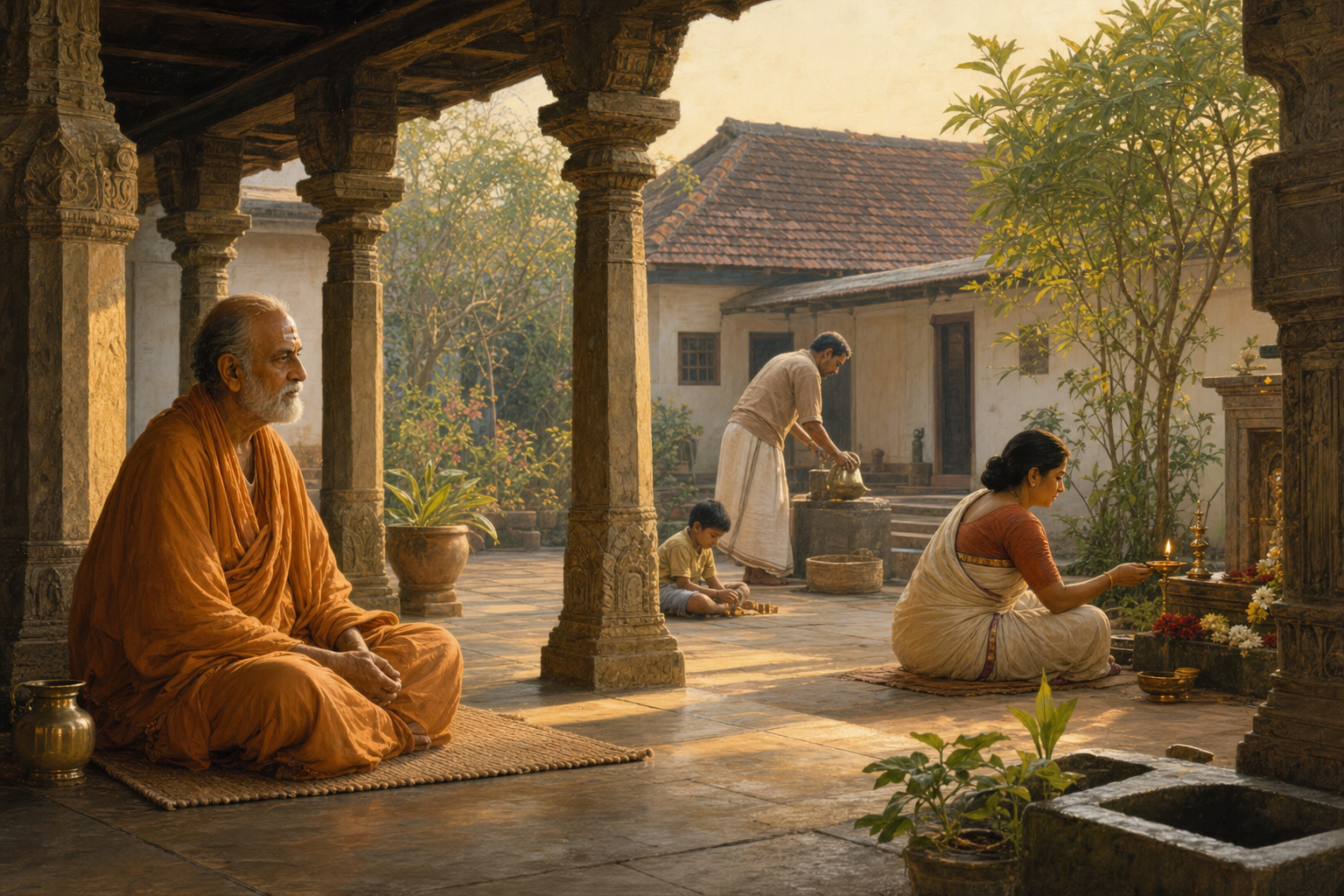
You may understand non-duality well enough to discuss it, yet lose that clarity when a colleague insults you, a plan fails, or family duties consume the day. That gap is the real problem. Advaita has to reach your speech, schedule, work, worship, and treatment of other people before it can be called lived knowledge.
Mahaperiyava’s way of teaching Advaita offers a disciplined answer: prepare the mind through dharma, steady it through devotion and japa, clarify it through scripture and a guru, and test every insight in conduct. You do not have to imitate the austerities of a sannyasi. You do have to stop treating spiritual life as something that begins after ordinary life is finished.
Advaita begins with fitness, not a grand claim
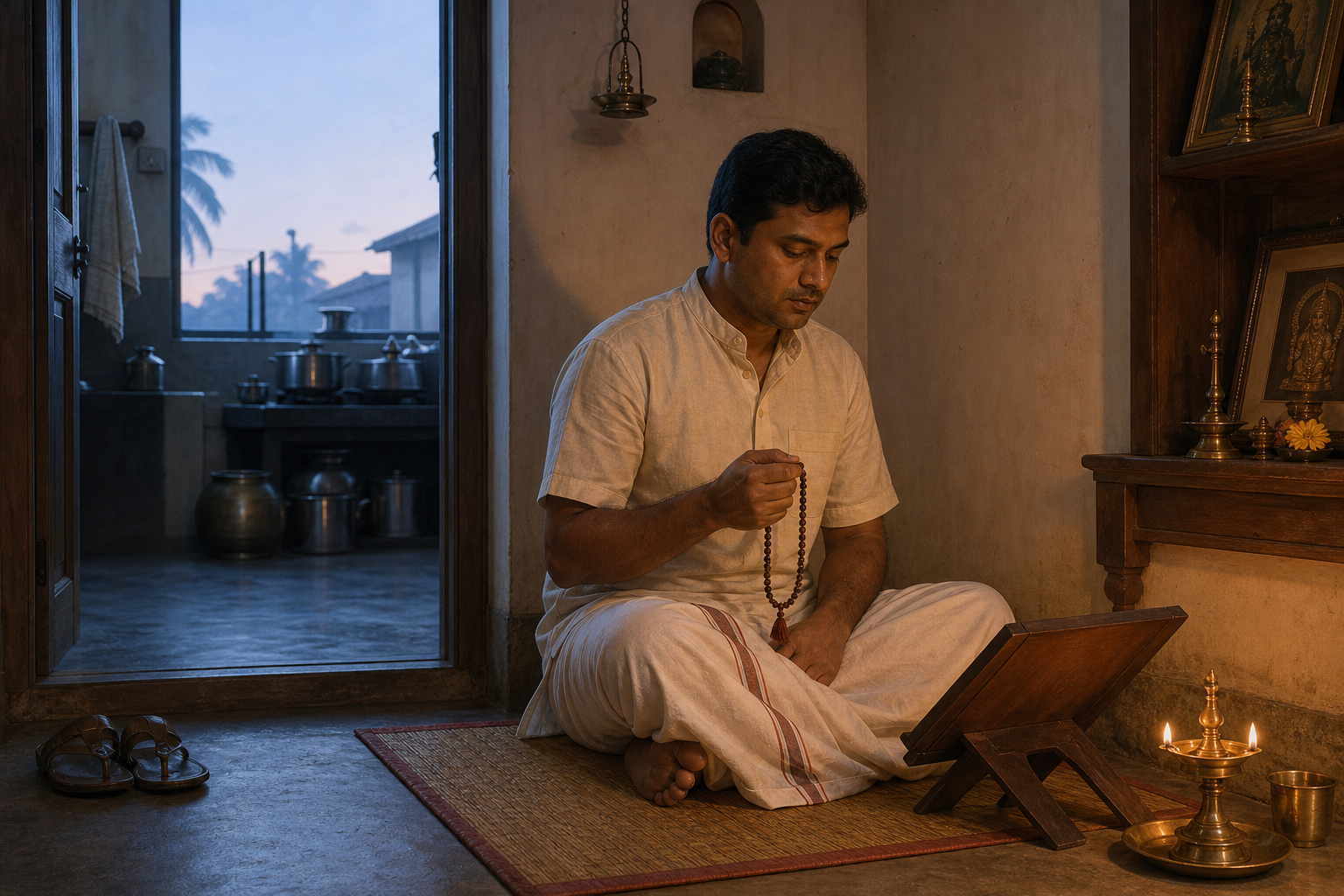
Advaita Vedanta does not ask a beginner to repeat that everything is one while anger, vanity, fear, and appetite continue to govern every decision. The truth of non-duality and your present capacity to remain established in it are not the same thing. Confusing them produces spiritual language without spiritual transformation.
Mahaperiyava, Shri Chandrashekarendra Saraswati Swamigal (1894-1994), served as the 68th Jagadguru of the Kanchi Kamakoti Peetam. His place in the Shankaracharya parampara associated with Adi Sankara matters here. In that tradition, Advaita is transmitted through disciplined preparation, śāstra, a competent guru, reflection, and contemplation. It is not merely an attractive conclusion reached by private speculation.
The traditional foundation is sadhana-chatuṣṭaya, the fourfold preparation for liberating knowledge:
- Viveka, discernment: learn to distinguish what changes from what is not dependent on change. When praise or blame alters your whole sense of self, notice that you have handed identity to something unstable.
- Vairagya, dispassion: reduce the demand that circumstances must please you before you can act properly. Dispassion is not neglecting people or duties. It is freedom from bargaining with dharma for a preferred outcome.
- Śamādi-ṣaṭka, mental and ethical discipline: train attention, restraint, endurance, and steadiness. If the mind follows every impulse, subtle inquiry will become another passing interest.
- Mumukṣutva, longing for liberation: decide whether freedom from fundamental ignorance is central or merely decorative. Your calendar will reveal the honest answer.
This foundation gives you a practical diagnostic. If you cannot sit steadily, begin with regularity and japa. If resentment dominates your day, work first on truthful, non-harming conduct. If you are emotionally dry, deepen bhakti rather than forcing abstract inquiry. If you are steady, ethically alert, and drawn to the meaning of the Upanishads, give greater attention to Vedantic study.
That is adhikāra-bheda: people differ in temperament, preparation, responsibilities, and present capacity. Mahaperiyava adapted guidance to the seeker while keeping the goal and the authority of the tradition intact. You should therefore resist two temptations: copying an advanced practitioner’s routine because it looks impressive, and choosing only practices that leave your habits undisturbed.
Build a daily rule that survives an ordinary household
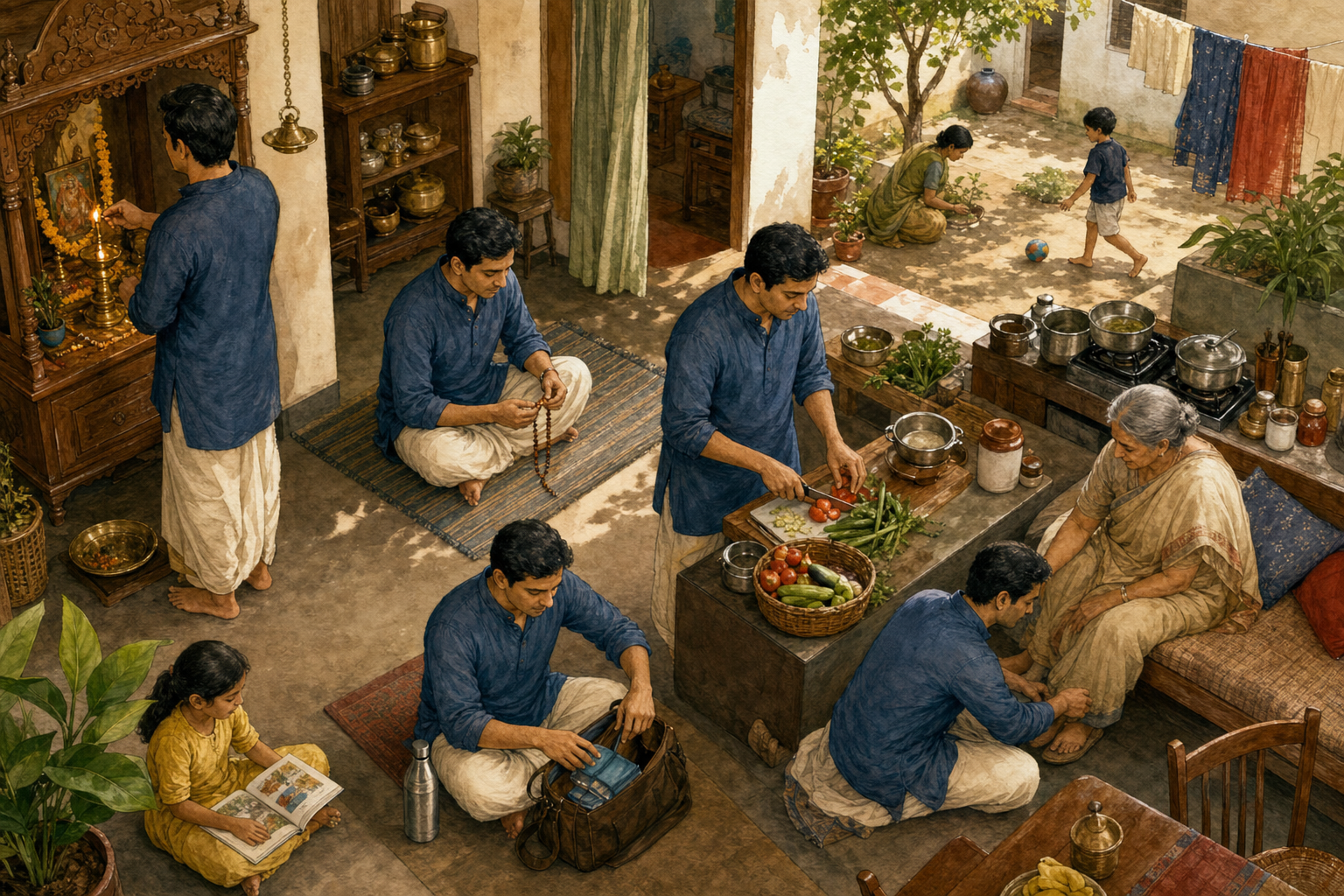
A practice that exists only on peaceful mornings will disappear when you most need it. The first task is not intensity but niyama: a dependable appointment with dharma. Attach it to a daily hinge already present in your life, such as bathing, the beginning of household worship, or the transition into work. Use the same place when possible, and keep the phone outside that space.
If sandhyāvandana, a vrata, or another inherited nitya practice applies to you, do not casually replace it with generic meditation. Follow its form and timing as received, and ask a competent teacher when circumstances genuinely prevent observance. Convenience alone is not a method of interpretation.
For voluntary additions to your daily discipline, use this sequence:
- Begin with recollection. Bow, invoke the deity or guru according to your sampradāya, and let the body register that this period is not an extension of work or entertainment.
- Do steady japa. Use the mantra received through your family tradition or guru. Repetition is meant to gather a scattered mind and soften self-centredness, not to generate an unusual experience. Do not collect mantras from the internet as though quantity were progress.
- Undertake svādhyāya. Read or recite a manageable passage from the Bhagavad-Gita, an Upanishad, or another text appropriate to your lineage. Stay with the same teaching long enough to understand it. Constantly changing texts can feel productive while preventing depth.
- Carry one principle into the day. Choose a concrete expression of satya, ahimsa, dāna, or seva. You might refuse to exaggerate in a meeting, refrain from humiliating someone during a disagreement, assist a person without seeking recognition, or give where there is a real need.
- Review your conduct before sleep. Ask where attachment spoke, where fear distorted the truth, and where you remembered dharma. The point is correction, not self-condemnation. Decide what repair or restraint is required when the same situation returns.
Japa, svādhyāya, disciplined timing, selfless action, and satsanga belong together in this method. Japa without ethical vigilance can become mechanical. Study without devotion can feed pride. Service without reflection can turn into identity and display. A balanced routine lets each practice correct the weaknesses of the others.
On a disrupted day, preserve the appointment even if voluntary portions must be shorter. Continuity prevents an exceptional day from becoming an abandoned month. This fallback does not authorize you to abbreviate a prescribed rite on your own; it applies to the voluntary structure you have built around your obligations.
Prāṇāyāma may support steadiness when it belongs to your tradition and you have appropriate instruction. Forceful breath retention or improvised techniques are unnecessary for the basic routine. The governing principle is simple: practise what you can perform correctly and consistently.
Use work, conflict, and seva to expose the ego

Your workplace and family life are not interruptions to Advaita. They reveal the identifications that a quiet prayer room can temporarily conceal. A delayed promotion exposes dependence on status. Criticism exposes the demand to control another person’s view. Family friction exposes how quickly affection becomes possession. These moments show you exactly where inquiry and purification are needed.
Nishkāma karma is the discipline of acting without making the desired result the condition for inner balance. It does not mean careless work, passivity, or indifference to consequences. You still prepare, exercise judgement, keep promises, and correct mistakes. What you release is the claim that the outcome must confirm your worth.
Use this procedure when a conflict catches you:
- State the event without character assassination. Separate what was said or done from your judgement that the other person is selfish, ignorant, or malicious.
- Identify the duty. Ask what your role requires: a truthful answer, a boundary, an apology, patient listening, or decisive action.
- Identify the ego’s extra demand. Notice the wish to win, punish, appear superior, secure praise, or force immediate agreement.
- Choose the truthful and least harmful effective response. Ahimsa does not require evasion, and satya does not require cruelty. Speak to the problem without using truth as a weapon.
- Reflect after the emotion settles. Ask what exactly felt threatened. Position, reputation, control, and possession are objects known to you; they cannot be the witnessing Self merely because the mind clings to them.
- Repair actual harm. If you lied, correct the record. If your speech injured someone, apologise without defending the injury. If selfishness denied another person what was due, restore it where possible.
This is how metaphysics begins to alter character. The recognition that the same Self is not confined to your preferred body-mind should make casual humiliation harder, not easier. If talk of oneness produces less responsibility, the idea has been recruited by the ego.
Dāna and seva also need scrutiny. Give or serve because a need should be met, not because you want a spiritual identity. Choose a recurring responsibility that connects you to an actual community: support dharmic learning, contribute to temple life, help sustain traditional arts, assist education or healthcare, or serve a neighbour facing difficulty. Mahaperiyava’s encouragement of pathashalas, temples, education, healthcare, and community service shows that inward freedom and civilizational responsibility need not compete.
Deepen knowledge without discarding devotion or tradition
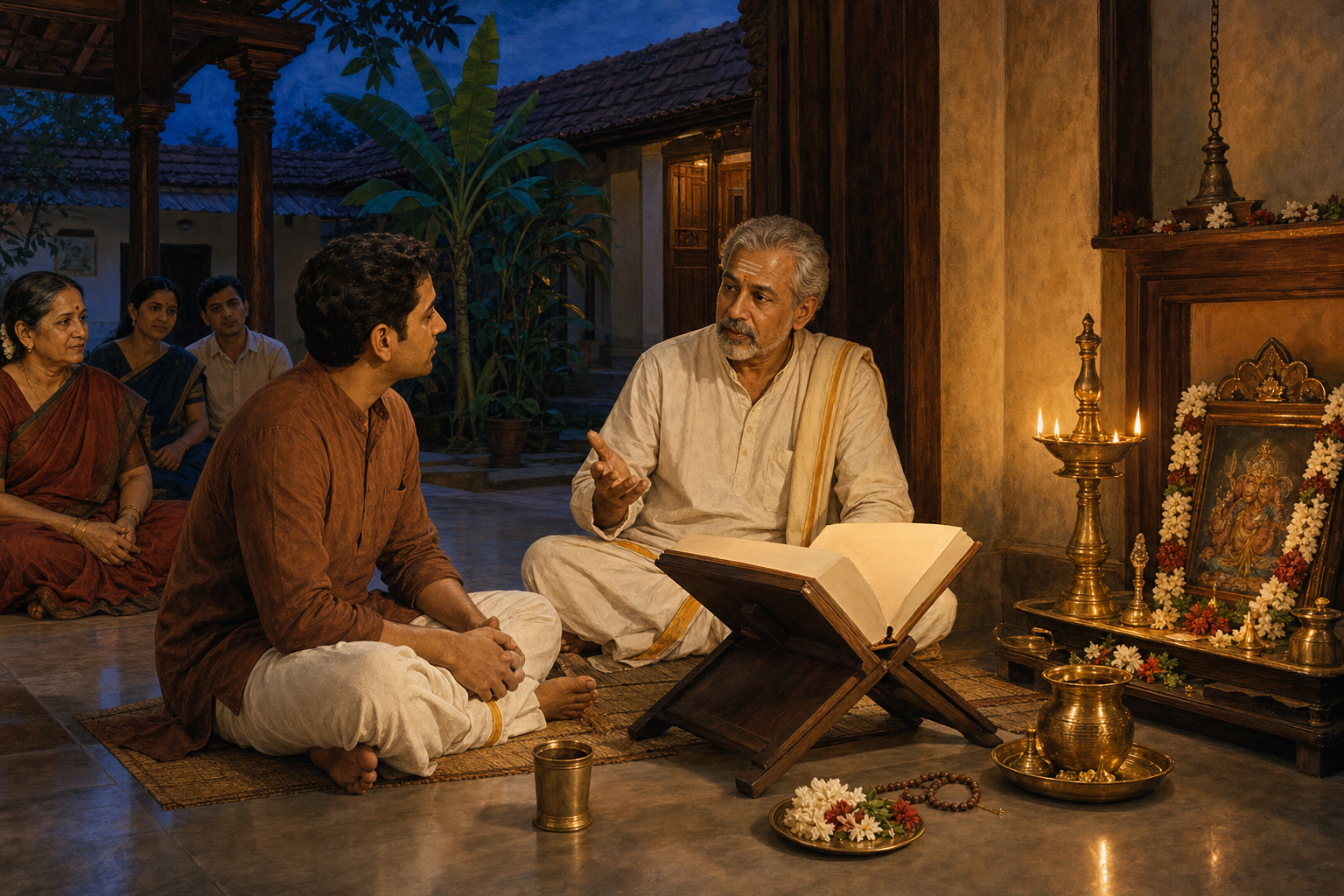
Move through śravaṇa, manana, and nididhyāsana
Once the mind has acquired some steadiness, Advaitic study proceeds through a precise movement. These are not boxes checked once. You return to them as understanding becomes subtler.
- Śravaṇa is disciplined listening. Receive the teaching of the Upanishads and its reasoning through a qualified guru and a coherent tradition. Random quotations may inspire you, but they cannot reliably resolve apparent contradictions or establish the intended meaning.
- Manana is reflective inquiry. Name the doubt exactly. Do not settle for a vague feeling that non-duality is confusing. Ask whether the problem concerns consciousness, individuality, action, causation, devotion, or the status of the world. A precise doubt can be examined; a mood cannot.
- Nididhyāsana is sustained contemplation. Revisit the understood teaching until habitual identification loses its grip. This is not an attempt to manufacture blankness or chase a special state. Every state begins and ends; Advaita directs attention to the reality because of which changing states are known.
Keep a small record of genuine doubts arising from study and life. Take them to satsanga or a teacher instead of resolving every difficulty through private intuition. Humble questioning protects you from blind acceptance; fidelity to śāstra protects you from making personal preference the final authority.
Let bhakti and temple practice prepare the whole person
Non-duality does not make devotion childish or temple worship obsolete. The intellect may grasp an argument while emotion, memory, and habit remain centred on the separate ego. Bhakti redirects love and dependence toward Īśvara. Pūjā trains attention, gratitude, reverence, and surrender through the body as well as the mind.
Mahaperiyava upheld both Veda and Agama, local sampradāyas, proper temple practice, and scriptural study. The practical implication is important: do not use the highest standpoint as permission to dismiss the disciplines that make the mind capable of assimilating it. Saying that the deity, worshipper, and act of worship are ultimately non-different does not mean an unprepared mind gains anything by treating worship carelessly.
Recognise unity without flattening real differences
Advaita can support generous engagement with other paths, but the formula that all religions are simply the same is too crude. Hindu, Buddhist, Jain, and Sikh traditions share powerful commitments to such values as self-discipline, compassion, non-violence, and service, while retaining distinct teachings, practices, and authorities. Respect does not require pretending those distinctions are meaningless.
People from several religious communities approached Mahaperiyava, and his guidance could respect their context without erasing conscience or inherited belonging. For you, that means refusing contempt, listening accurately, and cooperating in dharmic conduct where possible. It also means knowing your own sampradāya well enough that courtesy does not dissolve into confusion.
Adapt the circumstance, not the governing principle
Modern work and family life create genuine constraints, but adaptation needs discrimination. Before changing a practice, ask whether you are dealing with its indispensable principle, a prescribed obligation, or merely a customary delivery mechanism. Then ask whether the change serves dharma under necessity or simply removes inconvenience.
Preserve the kernel of śāstra while adapting what time and place legitimately require. If you cannot tell kernel from husk, do not guess. Consult someone competent in the relevant rite or teaching. The right adaptation keeps prayer, study, service, and ethical responsibility present in life; the wrong one gradually edits away everything that resists preference.
Key takeaways for lived Advaita
- Begin with a fixed rhythm of prayer, japa, study, and reflection rather than waiting for a spiritual mood.
- Use practices received through your guru, family, or sampradāya; do not assemble a path from disconnected fragments.
- Treat satya, ahimsa, dāna, and restraint as tests of understanding, not as optional virtues below philosophy.
- Perform work carefully while loosening the demand that its result must validate your identity.
- Move repeatedly through śravaṇa, manana, and nididhyāsana instead of mistaking information or a quiet state for realization.
- Retain bhakti, temple life, and seva as disciplines that purify the person who seeks non-dual knowledge.
- Respect other Dharmic traditions without erasing differences or becoming careless about your own inheritance.
Before the next day closes, choose a daily hinge for practice, identify the text or recitation you will continue, and name one place where ego repeatedly distorts your conduct. Work on that place without drama. Mahaperiyava’s path becomes practical when the same vision that draws you toward Brahman also makes your next word more truthful, your next duty less selfish, and your next encounter more reverent.