

You have opened a report about India because someone insists it proves either that Bharat is becoming intolerant or that every critic of India is hostile to Hindus. The headline offers certainty. The available evidence may not.
Before you believe or forward the claim, you need a way to separate the event from the political story wrapped around it. That discipline does not weaken a pro-Dharmic position. It keeps you from lending your credibility to exaggeration, selective outrage, or an allegation that the evidence cannot carry.
Break every contentious story into four layers
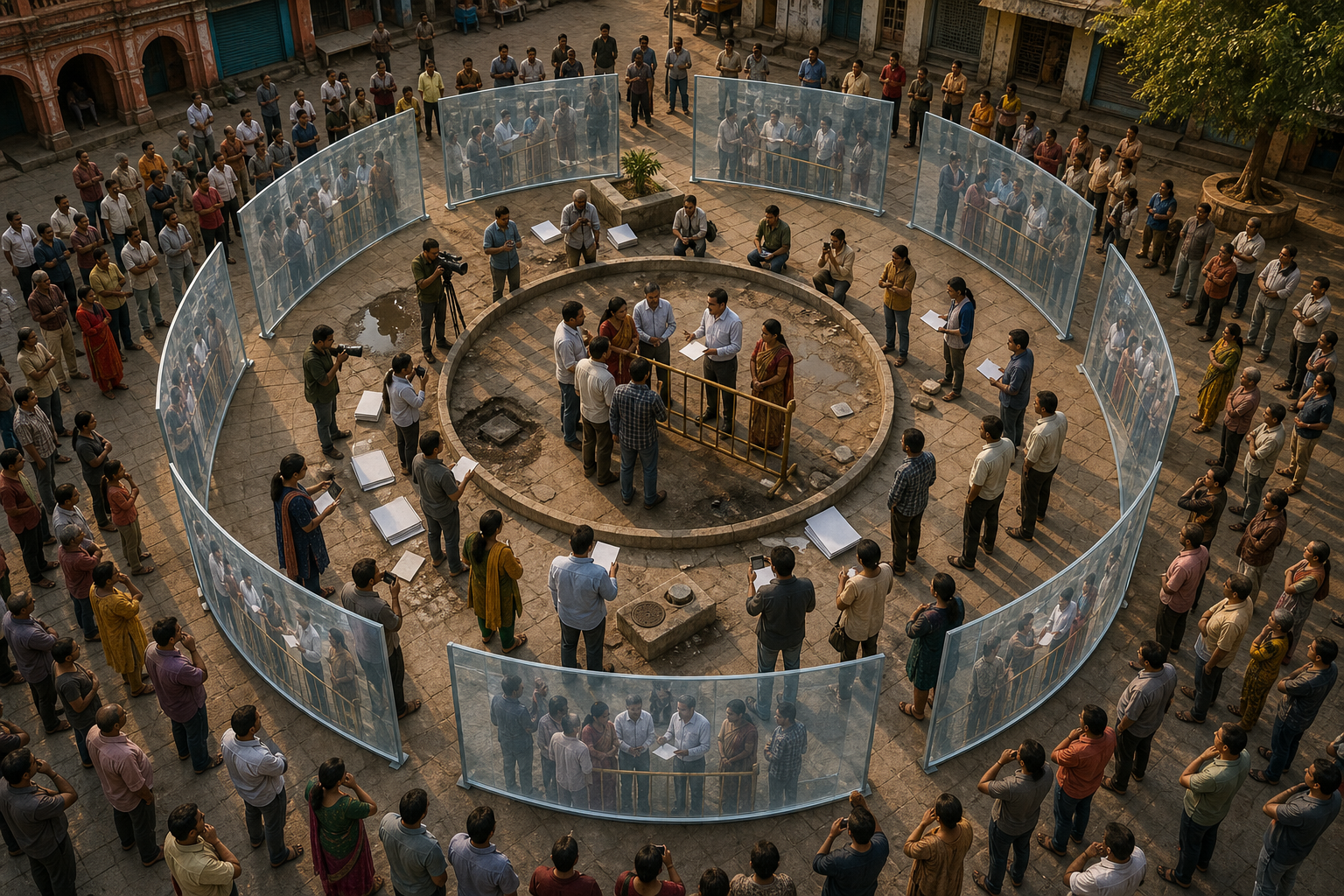
Partisan narratives gain force by compressing different kinds of claims into one emotional conclusion. Slow the process down and separate what was observed, what was reported, what was inferred, and what was morally judged.
Consider a recent protest video. It was described as showing an ABP News reporter being pushed and treated abusively during a CJP demonstration at Jantar Mantar in early June 2026. The clip reportedly circulated again on July 19–20 while demonstrators were demanding Education Minister Dharmendra Pradhan’s resignation over the NEET paper-leak controversy.
Those details give you a concrete allegation and a preliminary timeline. They do not, by themselves, establish everything later said about the encounter, the demonstrators, the reporter, or an entire political constituency.
- Observation: What can you actually see or hear? Identify particular actions by particular people. Do not turn several visible individuals into a whole movement.
- Provenance: Who first uploaded the recording? Is this the complete sequence? Does the stated date match the original upload rather than the day it became viral again?
- Context: What happened immediately before and after the circulated segment? Why was an older clip being recirculated at that particular moment?
- Interpretation: Words such as assault, provocation, mob, suppression, justification, and lynching make claims of different severity. Ask which word the visible evidence actually supports.
This distinction does not require you to excuse mistreatment of a journalist. If the recording clearly shows pushing or abuse, condemn the conduct at the scale proved: the visible conduct of the identifiable participants. Motive, coordination, collective guilt, and ideological endorsement require additional evidence.
The timeline matters as much as the footage. A genuine recording can still mislead when its date, precipitating event, or reason for resurfacing is concealed. Before sharing a viral clip, look for the earliest available upload and write down two dates: when the event occurred and when the claim reached you. If those dates differ, include both.
Read the labels, verbs, and changes of scale
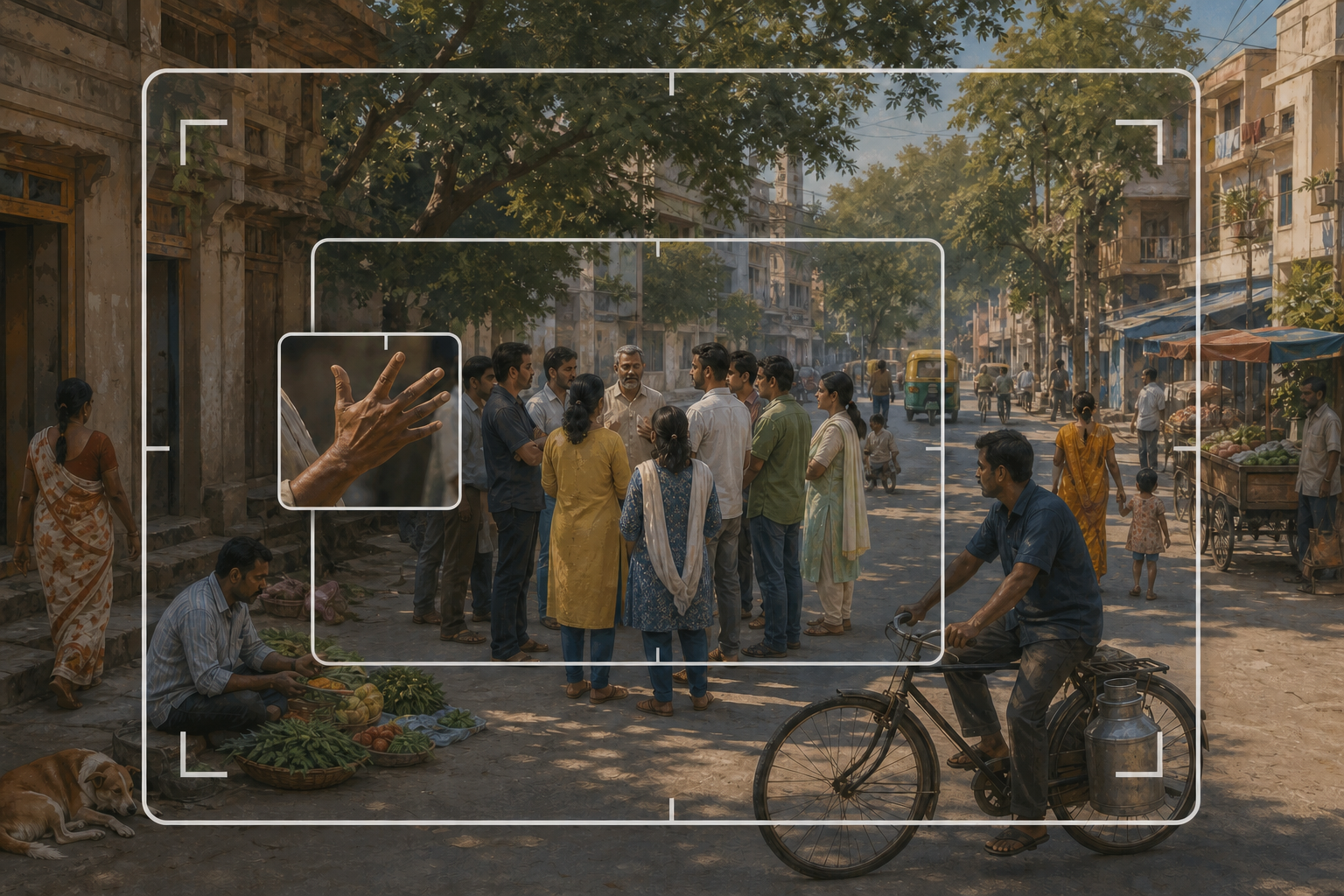
Loaded language is not automatically false. It is a signal that you should demand more evidence, because the writer is trying to settle your moral judgement before you have examined the factual claim.
When Washington Post correspondent Niha Masih is called a “brown sepoy”, you have learned something definite about the critic’s contempt. You have not yet learned whether a particular dispatch contains a false statement, omits decisive evidence, applies an inconsistent standard, or deserves correction. A slur cannot do the work of a fact-check.
The reverse is equally important. A prestigious newsroom, an international award, or the language of human rights cannot certify every sentence in a report. Institutional standing is relevant context, but a factual claim must still survive examination of its evidence.
A portfolio described as concentrating on Kashmir, Hindutva, surveillance, the Citizenship Amendment Act protests, and China may raise a legitimate question about editorial selection. It does not prove that the underlying reporting is false. To establish a pattern of distortion, you must move from dislike of the subjects to demonstrable problems in the work: incorrect facts, omitted primary evidence, inconsistent treatment of comparable cases, or claims that remain unchanged after contrary evidence appears.
- Identity substitution: The writer attacks the nationality, religion, caste, colour, or presumed loyalty of a person instead of answering the person’s claim.
- Agency asymmetry: One side acts, chooses, attacks, or incites, while the favoured side merely reacts, suffers, or becomes involved.
- Category inflation: Conduct by several demonstrators becomes the character of “the Left,” “Hindus,” “Muslims,” “nationalists,” “liberals,” or India itself.
- Credential substitution: Awards, affiliations, or moral language stand in for evidence.
- Timeline compression: An older incident is inserted into a newer controversy without making the gap clear.
- Mind-reading: The writer claims to know what a person or community wanted without providing a statement, action, or document that demonstrates intent.
Run a simple symmetry test. Replace the political or religious identities in the sentence while leaving the conduct unchanged. If your standard of proof or condemnation changes, you are defending a camp rather than judging the evidence.
Judge factual accuracy and narrative selection separately
Many arguments about India become confused because accuracy and selection are treated as the same question. They are not. A report can be factually sound but narrowly selected. It can be politically loaded yet contain valid evidence. It can also identify a genuine bias while overstating or failing to prove its own accusations.
| Dimension | Question to ask | What you may conclude |
|---|---|---|
| Event accuracy | Do original footage, records, or direct statements support the precise claim? | Supported, contradicted, or still unverified |
| Context completeness | Are the date, preceding events, relevant responses, and limits of the evidence disclosed? | Adequately contextualised or materially incomplete |
| Editorial selection | Are similar cases covered under a consistent standard, including cases inconvenient to the outlet’s preferred narrative? | A pattern demonstrated by comparison, or merely alleged |
| Language | Do the nouns and verbs describe evidence, or assign collective guilt and motive? | Proportionate, exaggerated, identity-loaded, or unclear |
| Correction behaviour | Does the claim change when stronger evidence emerges? | Responsive to evidence or resistant to correction |
This two-axis method prevents two common mistakes. The first is dismissing a documented event because the outlet publicising it is partisan. The second is accepting a sweeping ideological conclusion merely because the event itself occurred.
The standard rises with the breadth of the accusation. One complete recording may establish that a named person pushed a reporter. It cannot establish what every participant believed. A documented falsehood may justify correcting one dispatch. A career-wide label such as “India-basher” requires a representative body of work, clear comparison criteria, and examples showing a recurring defect rather than a recurring subject.
Claims of endorsement need the same precision. A direct statement approving violence is not the same as criticism of a reporter’s conduct, silence about an incident, a social-media like, or association with someone who commented on it. Record the exact words and action before writing “supported,” “defended,” or “justified.” If the evidence establishes only a weaker proposition, use the weaker verb.
Use a repeatable verification workflow before sharing

You do not need to resolve the whole politics of India before deciding whether one claim deserves circulation. Keep a small verification card in your notes app and complete it for contentious reports.
- Write the atomic claim. Reduce the headline to one sentence containing a named actor, a specific action, a place or setting, and the relevant date when known.
- Mark the claim type. Label each part as observed fact, attributed statement, inference, prediction, or moral judgement. Do not let one category borrow certainty from another.
- Trace the material backward. Seek the full recording, original upload, complete quotation, public record, or direct statement. A screenshot of someone else’s caption is not provenance.
- Build the timeline. Separate the date of the event, the date of publication, and the date of renewed circulation. Ask what changed between them.
- Find the exact disagreement. Do opposing accounts dispute what happened, what preceded it, who was responsible, what it means, or how representative it is? Do not describe interpretive disagreement as factual disproof.
- Test the scale. Check whether the evidence concerns one person, several participants, an organisation, an ideology, a religious community, a government, or the whole country. Stop the conclusion at the narrowest level the evidence supports.
- Assign a sharing label. Use “verified” only when the underlying evidence is available and matches the claim. Otherwise say “reported,” “contested,” “unclear,” or “opinion,” as appropriate.
Your completed note should contain six short fields: claim, evidence, provenance, missing context, strongest counterclaim, and present verdict. If you cannot fill the evidence or provenance field, do not repeat the claim as fact. If the matter is still worth discussing, share it as an unresolved allegation and state what would resolve it.
Do not confuse reading an opposing account with accepting it. Its function is diagnostic. It may expose a missing segment, a disputed date, an alternative translation, or a change of scale. If it offers only counter-labels and no evidence, you have learned that too.
Let a Dharmic standard make your argument stronger

A pro-Dharmic media ethic begins with satya, not with reflexive defence of whoever speaks in our name. Viveka asks you to distinguish an event from an interpretation and a justified inference from an emotional leap. Anekantavada adds another useful discipline: a partial viewpoint can contain truth without containing the whole truth.
This does not require false equivalence. Two accounts need not receive equal weight when one has direct evidence and the other has only assertion. Nor does many-sidedness mean that truth is whatever each faction prefers. It means you examine the limits of every standpoint before claiming a complete view.
That standard helps pro-Hindu advocacy in a practical way. A rebuttal built on the exact quotation, full chronology, primary evidence, and a consistently applied rule is difficult to dismiss. A rebuttal built on a person’s ancestry, loyalty, or insulting nickname invites readers to ignore the substantive criticism. Anger may attract attention, but precision earns trust beyond the people who already agree with you.
Key takeaways
- Separate observation, provenance, context, interpretation, and moral judgement before accepting a political conclusion.
- Treat loaded labels as prompts for closer verification, never as proof that the target is right or wrong.
- Evaluate factual accuracy and editorial selection on separate axes; evidence for one does not settle the other.
- Match the scale of your conclusion to the scale of your evidence, especially when a claim expands from individuals to an entire community or country.
- Use the same evidentiary standard for hostile foreign coverage, Indian partisan outlets, and voices that present themselves as defenders of Dharma.
The next time a furious headline about India reaches you, pause at its strongest adjective. Write the narrow factual claim, trace the original evidence, and identify what remains unknown. If the claim survives, share it with its proper scope. If it does not, decline to make Dharma carry a burden that the evidence cannot bear.
References
- Hindu Post — ‘द वायर’ वाली आरफा हो या ‘द हिंदू’ वाली विजेता… CJP प्रदर्शन में पत्रकारों के साथ बदसलूकी से लेफ्ट-लिबरल जमात को मिला ‘चरमसुख’
- Hindu Post — Meet Brown Sepoy Niha Masih: The Washington Post’s India-Basher-in-Chief