

If you are preparing to donate, join a temple committee, or defend a mandir whose land is under threat, goodwill is not enough. You need to know who owns the property, who controls the money, who can remove the decision-makers, and what happens when any of them fail.
A healthy temple can answer those questions without asking you to trust a personality. Shraddha and scrutiny are not opposites. Clear stewardship protects worship, devotees, donations, and the continuity of the institution long after the present office-holders have gone.
Know who holds each power, and make each holder answerable
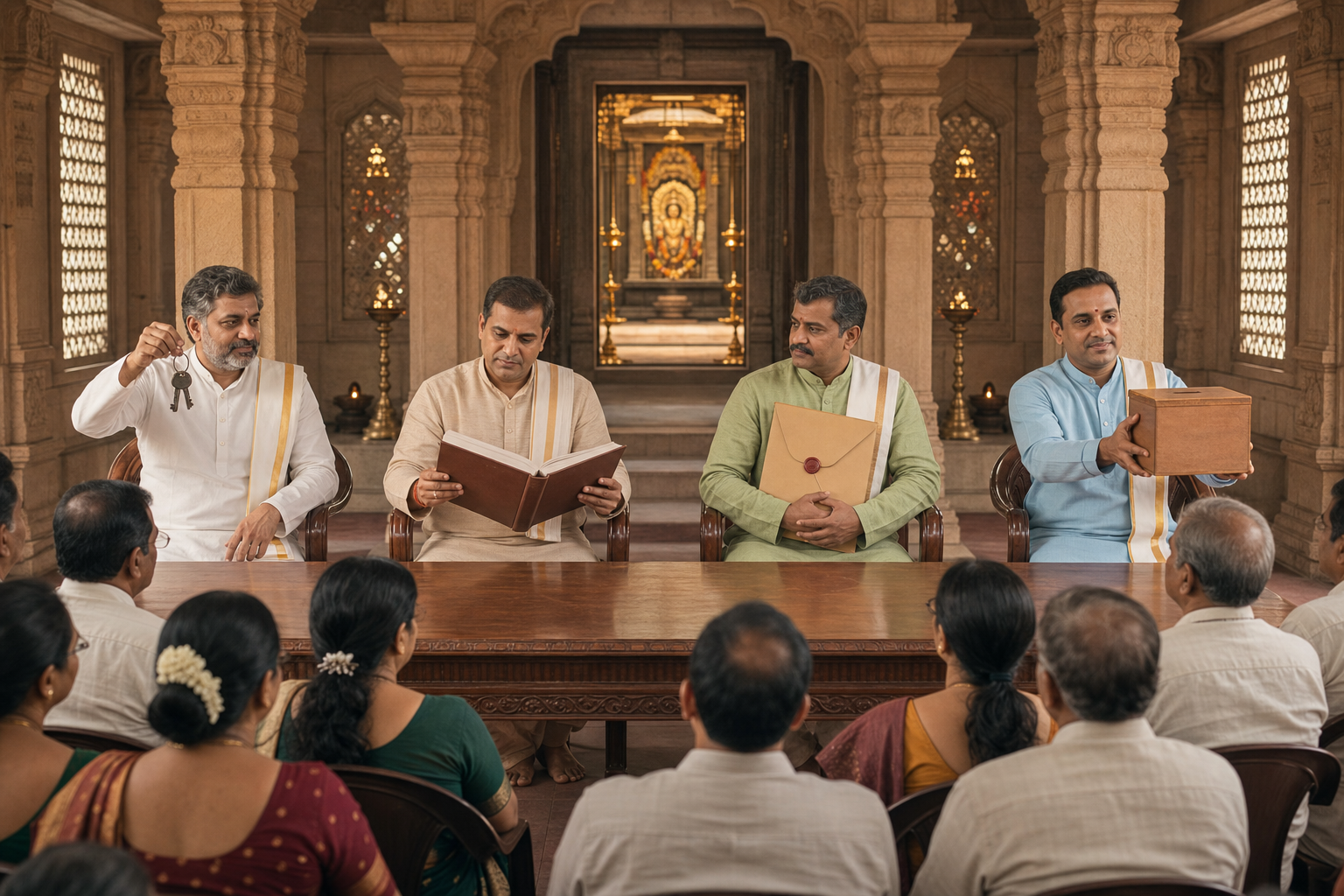
Start by refusing to let the word “ownership” carry several meanings at once. A temple can belong to the Deity and the sampradaya in a sacred sense while its land is legally held by a trust, association, company, public authority, landlord, or another entity. Its daily operator may be different again.
- Sacred custody answers what the temple exists to preserve: puja, seva, tradition, festivals, learning, and a living relationship between the Deity and devotees.
- Legal title or tenure answers whose name is on the property record, lease, licence, or governing instrument.
- Governance authority answers who appoints and removes trustees, approves budgets, changes bylaws, borrows money, or authorizes a sale.
- Operating control answers who handles collections, banking, procurement, staff, keys, passwords, bookings, and daily decisions.
These powers may properly sit with different people. The danger comes when nobody has mapped them, or when one office-holder quietly exercises all of them. A temple can have honest priests but weak financial custody. It can have clean accounts but insecure tenure. It can own valuable land while having no valid succession plan for its governing body.
| Question to ask | Evidence to inspect | Warning sign |
|---|---|---|
| Who holds the land or building? | Current title record, lease, licence, and any amendments | No current copy is available, or renewal and termination dates are unknown |
| Who appoints or removes the governing body? | Trust deed, constitution, bylaws, election rules, and valid resolutions | Custom or personal influence has replaced the written process |
| Who can sell, mortgage, lease, or change the use? | Governing instrument, delegated-authority schedule, and applicable legal advice | A major property decision can begin without documented scrutiny |
| Who controls collections and accounts? | Financial policy, bank mandates, accounting roles, and reconciliation records | The same person can receive, record, deposit, and reconcile money |
| Who safeguards religious continuity? | Objects clause, ritual charter, denominational rules, and appointment process | Financial or property controllers can alter sacred use without Dharmic review |
The reported allegations of donation theft at Ayodhya’s Sri Ram Temple, the resulting investigation, and demands for supervisory accountability make an important distinction visible. Senior leaders need not have personally handled a missing donation to be responsible for a system that failed to protect it. Personal honesty and governance competence are different questions.
An allegation is not a conviction. Accountability is not a conviction either. It is the obligation to preserve evidence, explain the control failure, submit to an independent examination, correct the system, and accept an appropriate consequence when supervision has plainly failed.
Every temple should maintain a governance packet that can be produced without a scramble. It should contain the legal identity of the operating body, governing instruments, an authority map, current office-holders and their terms, conflict declarations, bank mandates, delegated spending powers, minutes-retention rules, property documents, and the process for complaints and removal. Review it whenever leadership changes and on a regular annual cycle. A public version can redact signatures, account numbers, donor data, security arrangements, and legally privileged material.
Large temples can borrow the disciplines associated with listed corporations, including segregation of duties, independent assurance, conflict disclosure, and timely reporting. They should not borrow the corporation’s purpose. A mandir is not operated to maximize shareholder return; professional governance exists to protect its sacred purpose.
Put every donation through a traceable chain
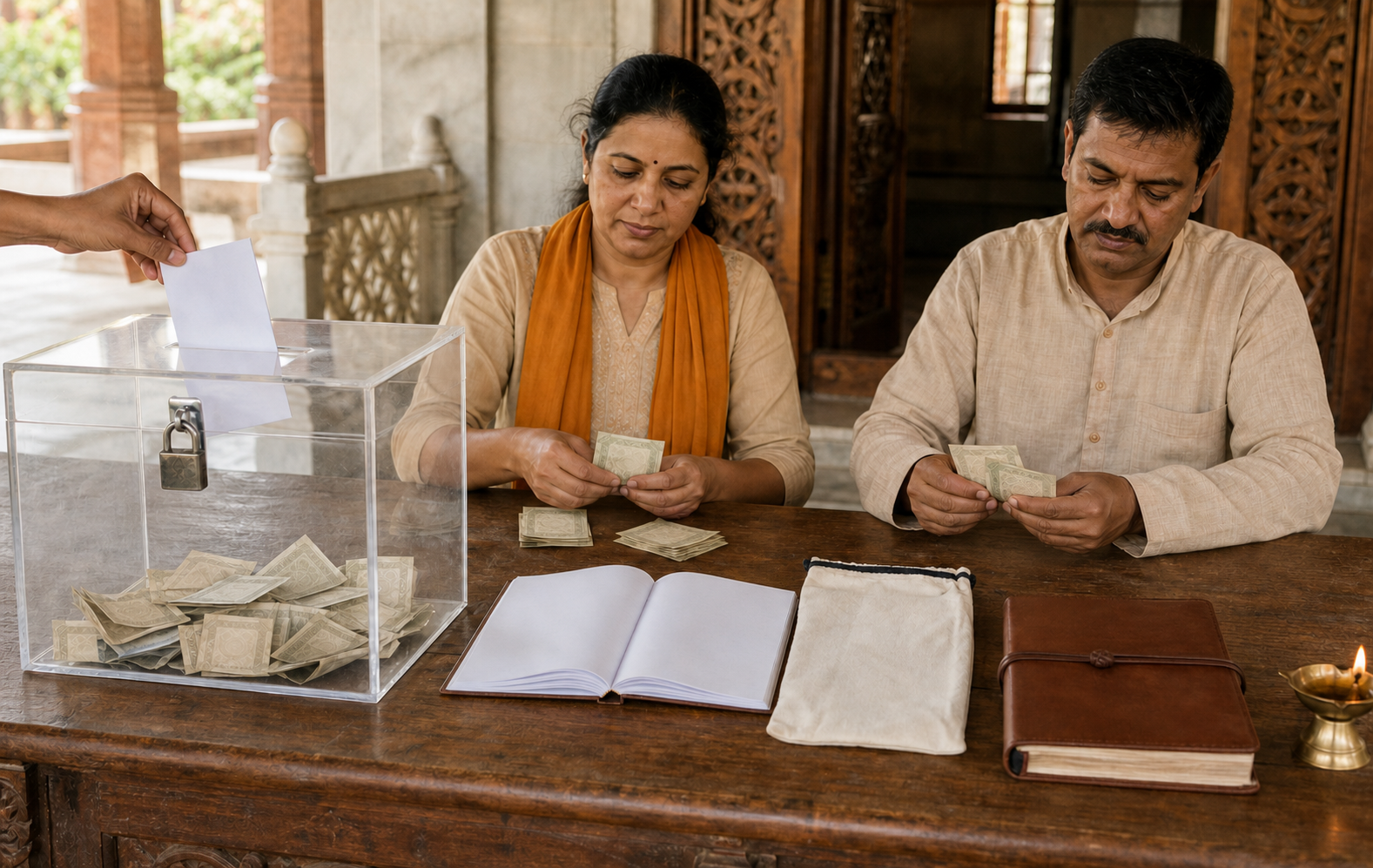
The decisive control is not the annual statement produced after the money has moved. It is the unbroken chain from the moment a gift enters the temple’s custody until it appears in the bank and accounting ledger. If the first link is missing, a later audit may identify a discrepancy without being able to reconstruct what happened.
- Define authorized channels. Publish the approved donation boxes, counters, bank accounts, payment links, and collection events. Temple funds should never pass through an office-holder’s personal account.
- Use joint custody. No individual should open, count, transport, or store a physical collection alone. Record who held custody at every handoff.
- Create a record at the point of count. Use signed count sheets, controlled receipt books, or electronic transaction references. Corrections must remain visible rather than being erased or silently overwritten.
- Deposit collections intact. Do not pay expenses directly from undeposited offerings. Record the full collection first, then process an authorized expense through the normal payment system.
- Reconcile independent records. Compare the collection record, bank deposit, payment-processor report, and general ledger. The person reconciling them should not be the person who controlled the collection.
- Escalate every unexplained variance. A written policy should say who is notified, what access is restricted, which records are preserved, and who can close the matter after review.
Restricted gifts require another layer. If devotees are asked to fund annadanam, a renovation, an ornament, education, or another named purpose, define that purpose in writing before accepting the money. Track the fund separately. State in advance what happens if the project becomes impossible, costs less than expected, or is abandoned. A vague promise to “use it for temple work” does not give a donor meaningful assurance.
Public reporting should be understandable to a devotee who is not an accountant. Depending on the temple’s size and legal obligations, it should show:
- income by major channel and expenditure by major purpose;
- opening and closing balances, including restricted funds;
- capital-project budgets, approvals, payments, and progress;
- related-party transactions and how conflicts were managed;
- the form of independent review or audit obtained and any unresolved qualification;
- material losses and the corrective action taken, subject to legal, investigative, privacy, and security limits.
Transparency does not mean publishing donor identities, bank credentials, security-camera locations, or details that could prejudice an investigation. It means disclosing enough for the community to see whether money reached the declared purpose and whether independent people tested the process.
Before making a material gift, ask which legal entity will receive it, whether you will receive a valid receipt, how the purpose will be recorded, when results will be reported, and who independently checks the accounts. If the temple cannot answer, pause the gift until it can. For an endowment, land transfer, or other consequential donation, use local legal and tax professionals to review the instrument; enforceability, charitable status, and tax treatment depend on the jurisdiction.
Defend the property before a sale is already in motion

A community may worship in the same building for decades without holding the legal power to keep it. Moral belonging, cultural importance, legal title, and contractual tenure can overlap, but they are not interchangeable.
In Peterborough, a temple and community centre operating for about four decades in the New England Complex faced a proposed council sale to the United Kingdom Islamic Mission. Bharat Hindu Samaj challenged the auction process, alleging that the site’s Hindu religious and community role had been disregarded and that the evaluation was flawed. A High Court interim order in February 2026 prevented completion while the challenge proceeded. Those objections were claims awaiting adjudication, and an interim restraint should not be confused with a final decision on the merits.
The proposed buyer’s identity understandably intensifies the fear of losing a Hindu sacred and cultural home. But a durable defence must be built from documents, authority, process, valuation, and enforceable rights. Protecting Hindu continuity does not require collective hostility toward another religious community. It requires evidence, disciplined advocacy, and lawful action before the transaction becomes irreversible.
Your temple’s property register should identify the title holder or landlord, the form of tenure, renewal and termination dates, permitted uses, restrictions, charges or financing interests, insurance, the location of originals and backups, and the people authorized to act. Treat a lease expiry or licence review as a governance event requiring advance action, not as an administrative date noticed at the last moment.
For a sale, mortgage, long lease, redevelopment, relocation, or change of sacred use, adopt a written process before any proposal appears:
- Require a written case explaining the purpose, alternatives, financial effect, and effect on worship and community access.
- Record every personal, family, business, or organizational conflict connected to the transaction.
- Obtain an independent valuation appropriate to the property and jurisdiction.
- Give the community sufficient notice and access to non-confidential decision documents.
- Apply the approval threshold in the governing instrument and law; if stronger safeguards are desired, amend the rules prospectively with qualified advice.
- Record attendance, questions, recusals, votes, conditions, and the reasons for the final decision.
Ask local charity and property counsel whether the temple’s objects, trust structure, lease terms, covenants, use restrictions, or another lawful mechanism can protect continuing Dharmic use. The available instrument and its effect vary by jurisdiction. Do not assume that long use creates ownership, that registration alone defeats every community claim, or that a committee resolution can override the title documents.
If a disputed transfer is already moving, collect the governing documents, title or lease records, notices, valuations, minutes, correspondence, and a verified chronology. Secure originals, appoint an authorized spokesperson, and obtain qualified local counsel quickly enough to assess interim relief. Do not destroy records, make unsupported public accusations, occupy property unlawfully, or sign a settlement merely to gain time. Each can weaken the temple’s legal position or create new exposure.
Respond to a breach without hiding it or staging a trial by rumour
When money is missing or authority is disputed, communities often divide too early into defenders and accusers. The governing body needs a response sequence that protects both due process and the temple.
- Secure the assets. Restrict relevant payment permissions, preserve cash and valuables, inventory sensitive items, and change credentials only through authorized procedures.
- Preserve the record. Retain bank data, processor reports, emails, messages, access logs, receipts, count sheets, camera footage, and meeting records. Suspend routine deletion where legally appropriate.
- Separate allegation from fact. Record what was reported, by whom, when, and what evidence presently supports or contradicts it. Avoid embellishment.
- Remove conflicts from control. A person implicated in the matter should not supervise the evidence, witnesses, reconciliation, or investigator. Temporary recusal is a protective measure, not a declaration of guilt.
- Commission independent work. Define the scope for an external accountant, auditor, investigator, or lawyer. Independence is compromised if the reviewer answers to the person whose conduct is being examined.
- Notify the proper bodies. Take advice on reports to law enforcement, regulators, insurers, banks, payment processors, or other authorities. Suspected crime and legal reporting duties should not be handled as an internal public-relations problem.
- Communicate in stages. Tell devotees what is known, what is not known, what has been secured, who is examining the matter, and when the next update will come. Do not name an alleged wrongdoer publicly without a lawful and evidence-based reason.
- Test the repair. Publish the control changes that can safely be disclosed, assign responsibility, and obtain a follow-up review rather than treating a new policy as proof that the risk has disappeared.
Leadership consequences should follow both the facts and the governing rules. Possible measures include recusal, loss of financial authority, temporary suspension, an independent monitor, removal under the constitution, or resignation. Theft by an employee does not automatically prove theft by a trustee. Yet a serious and preventable collapse of supervision can make continued leadership untenable even without evidence of personal enrichment.
The Ayodhya controversy has produced a public demand that senior office-holders accept moral responsibility for failures under their supervision even when their personal integrity is not questioned. That is a claim about fitness and institutional trust, not a substitute for proving criminal guilt.
Your temple should settle this principle before any individual is accused. Write who may order an investigation, impose interim restrictions, communicate publicly, decide consequences, and hear an appeal. A rule written during a crisis will always be suspected of protecting one faction or punishing another.
Key takeaways
- “Who owns the temple?” is not one question. Trace sacred custody, legal title, governance authority, and operating control separately.
- A leader can be personally honest and still answer for an avoidable failure of supervision.
- Donation transparency begins at collection, not with an annual report. Every gift needs a traceable route into the bank and ledger.
- Long religious use creates a powerful moral and community claim, but it may not provide the legal power to block a sale. Secure the documents and protections early.
- Major property decisions need independent valuation, conflict disclosure, valid authority, recorded reasons, and meaningful notice.
- When a breach occurs, protect assets and evidence first, use an independent process, communicate verified facts, and preserve due process.
At the next committee meeting, table a resolution to compile an authority-and-asset register, publish a safe version, and assign named responsibility and completion dates for every gap. If a transfer is imminent or funds may have been stolen, move immediately from informal argument to qualified local counsel and independent financial examination. That is how concern becomes stewardship, and stewardship becomes a durable service to Dharma.
References
- Hindu Post — Ram Temple Donation Theft: Run Rich Temples as Listed Corporations
- Hindu Post — ब्रिटेन में मंदिर की जगह मुस्लिमों को बेचने पर विवाद: हिंदू समाज ने हाई कोर्ट में याचिका लगाई; नीलामी की प्रक्रिया गलत होने का आरोप