
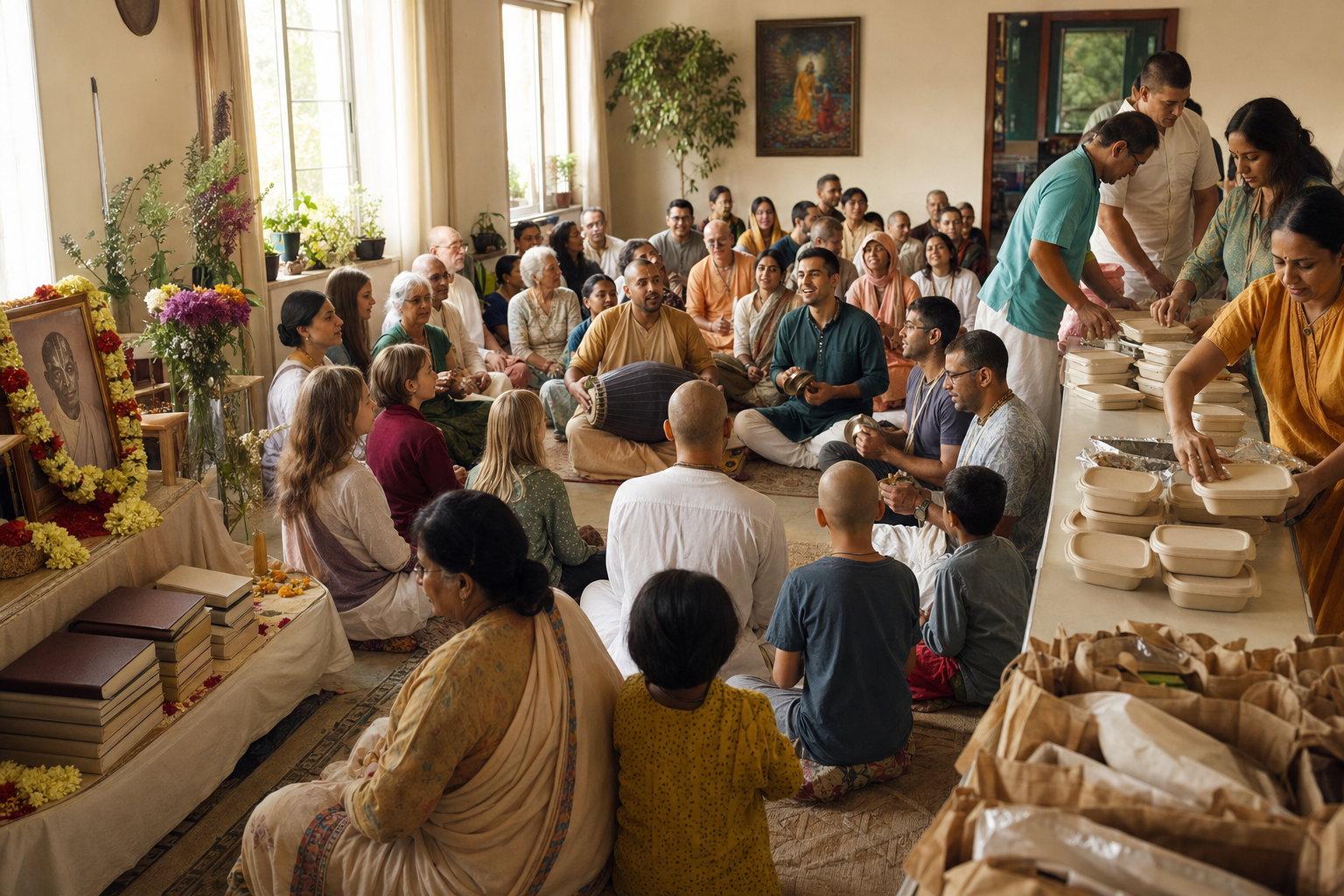
You may be helping to plan a Sunday feast, deciding whether to join a kirtan mela, or wondering what remembrance of Srila Prabhupada should change after the program ends. The useful question is not how full the calendar looks. It is whether memory, chanting, and service form a continuous movement in your life and community.
That movement has a clear direction: remembrance restores purpose, kirtan makes devotion participatory, and compassionate seva gives that devotion a recipient. When the connection breaks, remembrance can shrink into nostalgia, kirtan can feel like a performance, and goodwill can disappear without follow-through.
Build the gathering around a complete devotional arc
Contemporary ISKCON life appears in many forms: a July 19, 2026 Sunday Feast remembrance of Srila Prabhupada with HG Yadubara Prabhu, a Prem Kirtan Mela at ISKCON Rohini, a live Jutranji program from ISKCON Ljubljana, and a Mission of Compassion connected with ISKCON Columbus. The location and format change, but the central test does not: what is the gathering asking people to remember, experience, and do?
Before preparing the poster, stage, or livestream, complete these sentences in plain language:
- We are remembering this person, teaching, or example because it should shape this part of our conduct.
- We will conduct kirtan so that newcomers, regular participants, children, elders, and remote listeners know how they can take part.
- Compassion will take a concrete form through this task, for these people or this community need.
- After the gathering, participants can contact this responsible person or use this clearly identified channel.
If an organizer cannot complete one of those sentences, the program has a structural gap. More publicity will not repair it. The missing connection has to be designed into the gathering itself.
The sequence also matters. Remembrance should identify a principle worth carrying forward. Kirtan should move that principle from private admiration into shared devotional attention. The service invitation should then show how that attention becomes responsibility. Follow-up should keep the responsibility alive after the hall empties.
Do not insert seva as an unrelated fundraising announcement while an audience is available. Explain why the need belongs in the devotional arc. If money is requested, give equal prominence to non-financial participation, accountability, and the people who will carry the work forward.
Remember Srila Prabhupada by preserving direction, not only mood

A remembrance succeeds when you can identify what should govern your next choice. Affection and gratitude belong in a tribute, but they should lead toward fidelity in practice. Otherwise, the listener may leave moved without knowing what the memory asks of them.
A useful remembrance keeps several kinds of speech distinct:
- A historical claim should be presented as something that can be checked, not embellished for emotional effect.
- A personal recollection should be identified as recollection. It may illuminate character, but it should not silently become a universal doctrinal rule.
- A teaching should be stated clearly enough that the listener can distinguish it from the speaker’s commentary.
- An application should answer where that teaching meets present conduct: worship, family life, temple responsibility, hospitality, ethical discipline, or care for another person.
If you are speaking, choose an episode because it reveals a principle, not merely because it is charming or unusual. Then ask: What does this memory disclose? What habit does it correct? What responsibility does it create for a devotee now? If the connection cannot be stated without exaggeration, choose a better episode.
If you are listening, divide your notes under the headings Remember and Practice. Under Remember, capture the principle rather than trying to transcribe every detail. Under Practice, name the next setting in which that principle should affect your behavior. This turns remembrance into a discipline of transmission rather than a collection of devotional impressions.
Be especially careful with anecdotes that cannot be verified. They can be shared humbly as memories, but they should not be used as proof for a contested claim. Respect for an acharya does not require careless history. Precision protects the teaching from becoming whatever a later speaker wishes it to mean.
Lead kirtan for participation, not display
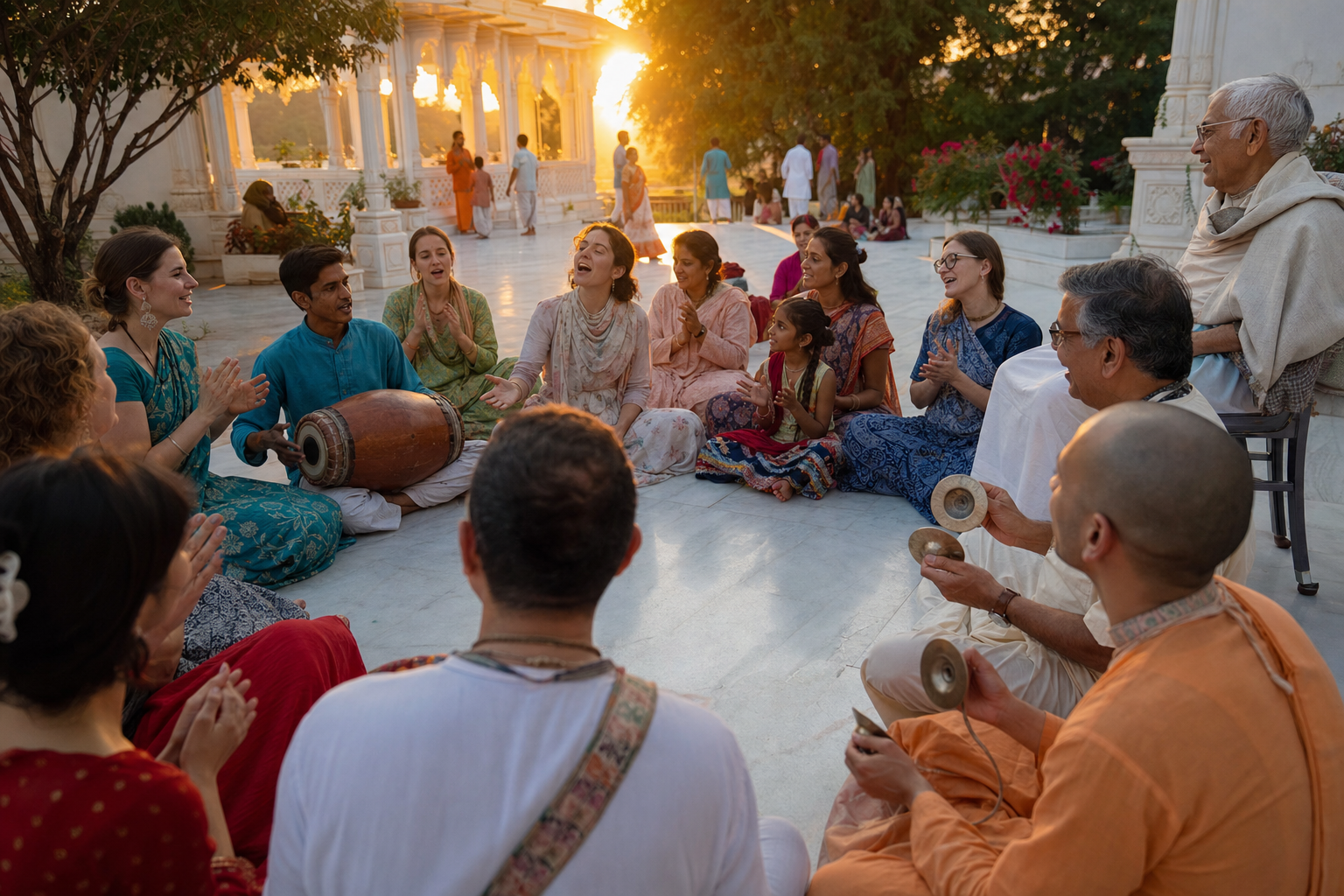
The name Prem Kirtan Mela places prem, love, beside congregational chanting. That pairing gives organizers a practical standard. Musical skill should serve loving attention and shared participation; it should not make the congregation feel like spectators at a devotional concert.
You do not need to reduce the musical richness of kirtan to make it welcoming. You do need to remove avoidable barriers:
- Make the response pattern clear before rapid or elaborate changes begin.
- Display the words, or explain how the congregation follows the leader, when unfamiliar participants are expected.
- Return to a recognizable melodic phrase often enough for the room to rejoin.
- Use visible cues for changes instead of expecting everyone to know an unspoken convention.
- Leave room for seated participation as well as movement.
- Do not treat loudness, dancing, or musical confidence as the measure of a person’s devotion. Attentive listening and a quiet response are also forms of participation.
- Ask musicians to support the congregational voice. If participants cannot locate the response beneath the instruments, the arrangement is working against the purpose.
A live ISKCON Ljubljana program also points to a contemporary question: does the remote participant receive only a window into the room, or a doorway into practice? A livestream becomes more usable when the accompanying page supplies the words being sung, enough context to understand the gathering, a clear indication of when participation begins, and a path toward local or remote service afterward.
The transition out of kirtan deserves care. An abrupt switch from chanting to logistics can make seva feel like an interruption. A simple bridge is enough: We have chanted together; here is how we can serve together. Then describe the need without inflating it, name the available task, and tell people exactly where to go.
Make compassion visible, bounded, and accountable

Compassion is not measured only by the sincerity of those offering service. It must also be visible in the burden reduced, the dignity protected, or the reliable care made possible for someone else.
The Mission of Compassion with HG Patri das appears alongside an appeal to help build a new temple in Central Ohio. That proximity raises a useful distinction for every community. A temple building can support dharmic life, but a capital project and an outward-facing compassion program are not automatically the same undertaking. If an appeal includes both, donors and volunteers should be able to tell which resources support construction, which support ongoing programs, and how each advances the stated mission.
Before asking anyone for time, money, or materials, prepare a service brief containing:
- The need: describe the actual problem without using vague language such as helping the community.
- The boundary: state what the temple or volunteer team can and cannot provide.
- The recipient: identify the group being served while protecting personal privacy.
- The action: name the task that this gathering will make possible.
- The steward: identify who is responsible for decisions, safeguarding, records, and follow-up.
- The resources: separate requests for funds, materials, professional expertise, transport, preparation, administration, and volunteer labor.
- The return path: state where participants will receive an update or find the next task.
Boundaries are part of compassion. Volunteers can help within their competence, but enthusiasm does not qualify someone to provide medical, psychological, legal, or financial advice. When a need requires trained professionals or formal safeguarding, partner with qualified people and state the limits of the temple team’s role. Good intentions do not protect a vulnerable person from poorly handled assistance.
Dignity matters just as much as efficiency. Do not publish a recipient’s name, image, hardship, or testimony merely to make an appeal more persuasive. Obtain meaningful permission, explain where material will appear, and make refusal possible without threatening access to help. Service should not require someone to surrender privacy or perform gratitude.
After the gathering, close the accountability loop. Acknowledge what was received, report what was completed, identify what remains unresolved, and publish the next contact point. If plans change, say so. The test is not whether the appeal produced a powerful moment in the room; it is whether responsibility survives after the sound system is packed away.
Key takeaways
- Design remembrance, kirtan, seva, and follow-up as a continuous devotional arc rather than unrelated program segments.
- Keep historical claims, personal memories, teachings, and present-day applications distinct when remembering Srila Prabhupada.
- Judge kirtan leadership by whether the congregation can participate, not by the complexity of the performance.
- Give remote participants words, context, participation cues, and a service pathway rather than only a video feed.
- Define compassionate service through a specific need, bounded task, responsible steward, protected recipient, and visible follow-up.
- Separate temple-building appeals from direct service claims unless the relationship and use of resources are clearly explained.
For your next Sunday feast, mela, or livestream, draft the service brief before finalizing the publicity. Then test the gathering with practical questions: Can a newcomer join the kirtan? Can a listener name the principle being remembered? Can a willing participant find a real task after leaving?
If any answer is unclear, revise the program while there is still time. Write down the responsible person’s name and the next contact point before the microphones are set up. That small discipline is where a devotional event begins to become a durable practice of compassion.
References
- Dandavats – July 19, 2026 – Remembering Srila Prabhupada by HG Yadubara Prabhu
- Dandavats – Prem Kirtan Mela 2026 I ISKCON Rohini I AKINCHANA KRISHNA PR
- Dandavats – Jutranji ISKCON Ljubljana Live
- Dandavats – Mission of Compassion – HG Patri das