
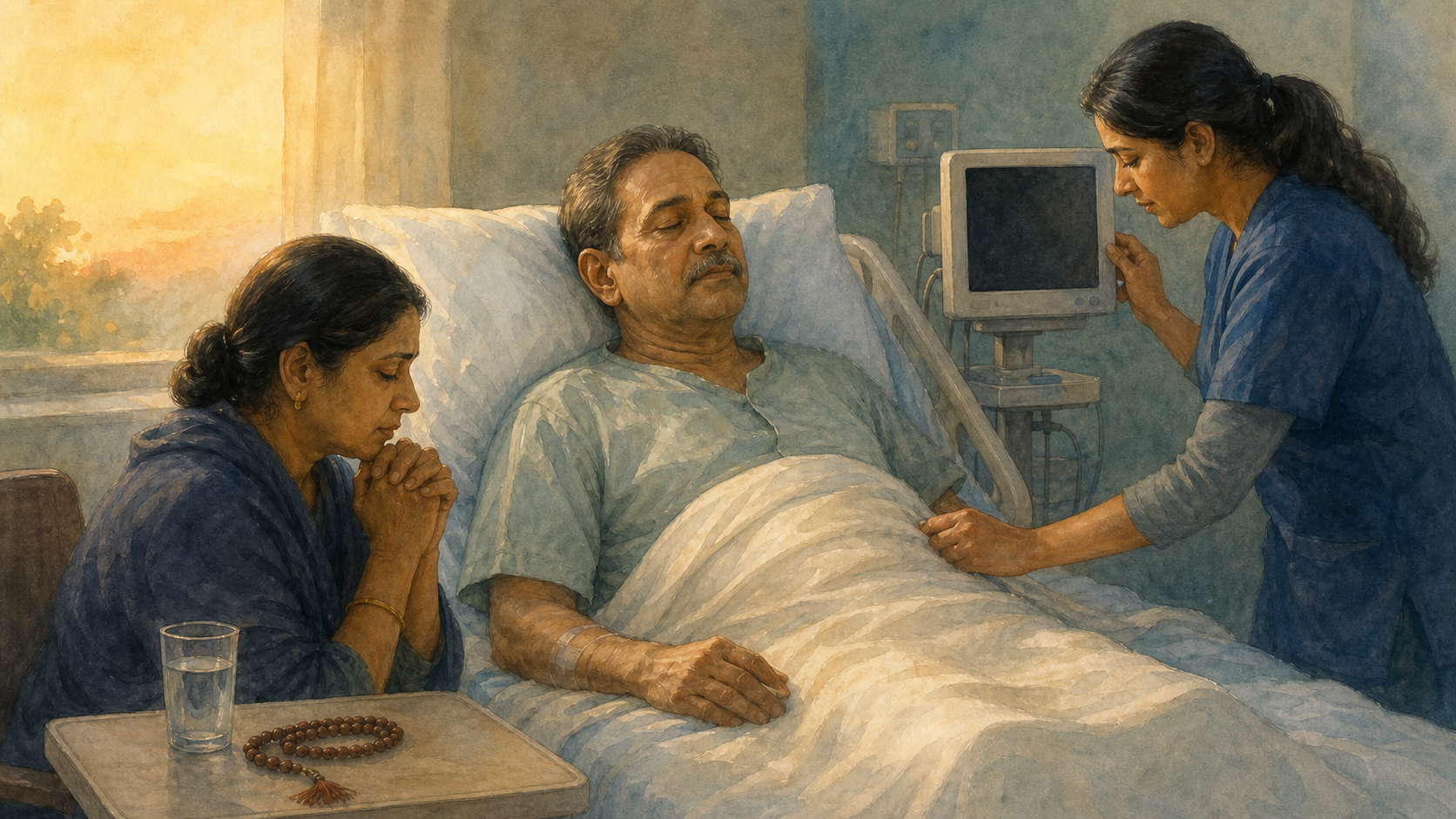
Someone you love is seriously ill, and you are being pulled in several directions at once. You want to pray with conviction, make the right medical decisions, protect the person’s dignity, keep the family together, and somehow prevent the outcome you fear.
You do not have to choose between faith and practical care. You do have to give each its proper role. Prayer can steady attention, express devotion, and gather a community around suffering. It cannot guarantee recovery, replace treatment, or make you responsible for controlling another person’s fate.
In a medical crisis, prayer supports action rather than delaying it
A sudden stroke in Montreal left a spiritual teacher conscious but unable to speak, with weakness on his right side; after prompt hospital treatment, his strength improved substantially. The request for prayer accompanied emergency and neurological care. It did not replace them.
That order matters. New weakness on one side, new difficulty speaking, unresponsiveness, serious breathing difficulty, severe chest pain, or rapid deterioration requires immediate medical attention. Contact local emergency services or alert the treating team. If another person is present, one of you can pray while the other makes the call. Do not spend critical time organizing a prayer circle, contacting a religious leader, or waiting for a home remedy to work.
Once urgent care is underway, give prayer a clear intention. Depending on the person’s tradition and wishes, this might take the form of japa, ardas, naam simran, recitation, kirtan, or silent meditation. The form matters less than the honesty of the prayer. You can pray for recovery without pretending that recovery has been promised.
A grounded prayer might ask that the person receive timely care, relief from suffering, steadiness of mind, wise clinical judgment, and loving company. It can also ask that caregivers act without panic, possessiveness, or neglect. This widens prayer beyond a demand for one biological outcome.
A prayer for full recovery is a legitimate expression of hope. It becomes harmful when non-recovery is treated as evidence of weak faith, insufficient chanting, defective karma, or a failure by the family. Medical outcomes are not a public test of anyone’s devotion.
Love can shape the experience without commanding the outcome

The most painful limit of caregiving is also the most important one to accept: love is not control. Serious illness may end in recovery, lasting disability, recurrence, or death. Your attention and effort can matter enormously without giving you authority over which path unfolds.
A practical Dharmic discipline here is wholehearted action without a claim on the result. Your responsibility is to notice changes, obtain appropriate help, ask clear questions, protect consent, reduce avoidable distress, and remain present. Your responsibility is not to manufacture certainty or force the person to recover through the correct combination of treatment, food, attitude, and spiritual practice.
Acceptance is not passivity. It means responding to the reality in front of you instead of bargaining with the reality you wish you had. You can pursue treatment while acknowledging uncertainty. You can hope for healing while discussing disability or end-of-life wishes. You can say that you do not know what will happen and still promise that the person will not face the next decision alone.
This distinction changes the way you speak. Avoid assurances you cannot verify, such as promising that everything will be fine. Offer commitments you can keep: you will listen, contact the clinical team, return after resting, bring the requested item, or make sure a trusted person receives the next update.
Serious illness also narrows everyone’s attention until the person can disappear behind symptoms, appointments, medicines, and prognoses. A dying father was most recognizably himself in an ordinary, mischievous moment, a reminder that preserving a person is not the same as continuing to see the person. Ask whether your loved one wants to discuss the illness or something else. Bring up familiar memories. Make room for humour if they invite it. Offer ordinary choices about clothing, food permitted by the care plan, visitors, recitation, music, light, and quiet.
If speech is impaired, do not automatically assume comprehension is absent. Ask the clinical team how to communicate reliably, speak to the person rather than around them, reduce background noise, and allow time for a response. Do not turn every visit into a test of memory, speech, optimism, or piety.
You may begin grieving before a death occurs. The role reversal, loss of familiar abilities, and recognition that a shared future may be changing can all bring grief into the room while the person is still alive. Naming that grief does not abandon the ill person. It helps keep unacknowledged fear from becoming pressure, irritability, or false promises.
Care for the person without turning family fear into control
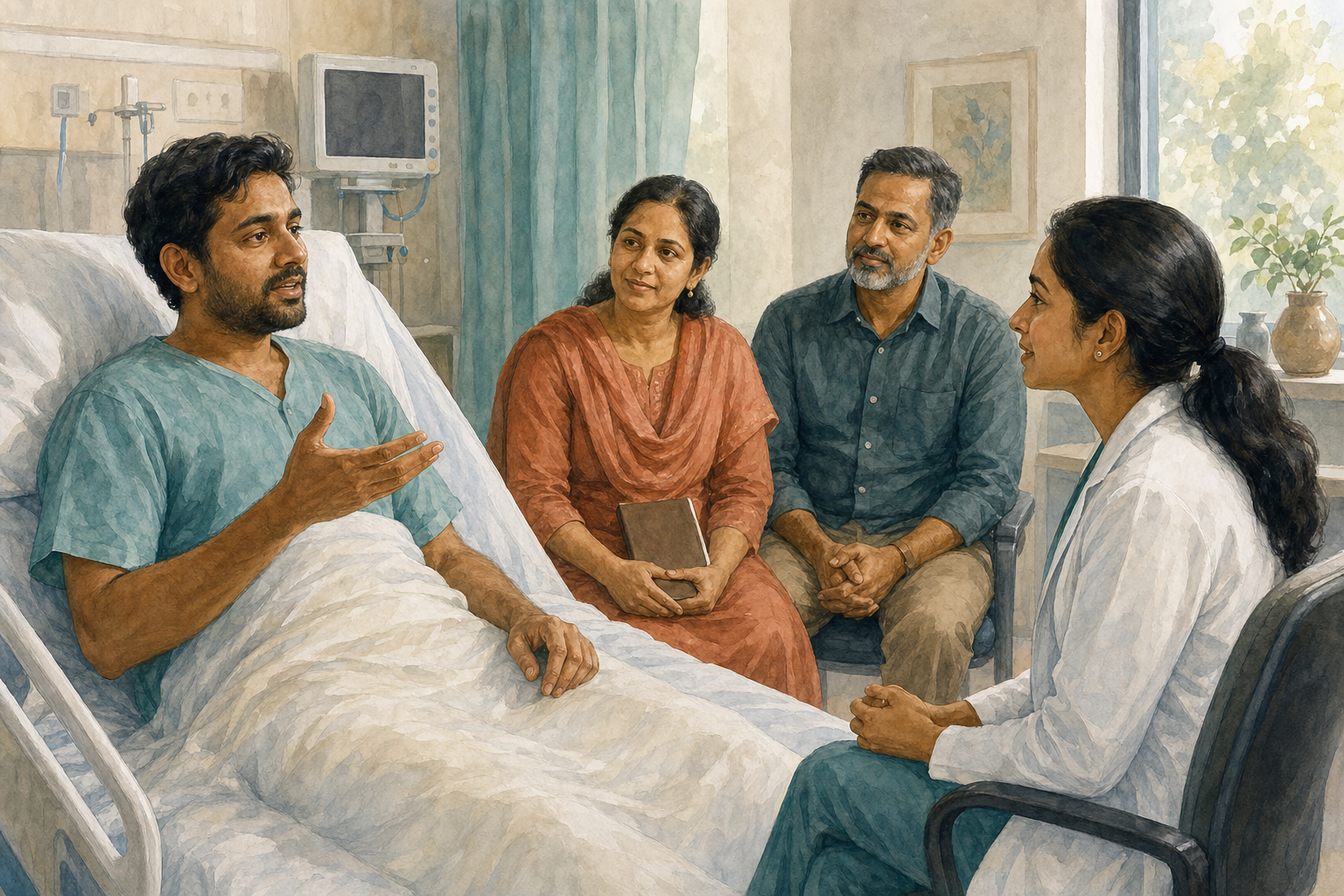
Families rarely respond to helplessness in the same way. One relative organizes appointments. Another searches for treatments. Someone focuses on food or supplements. Someone else avoids the hospital, becomes angry, or insists that the person should be left alone. These can look like competing moral positions, but they are often different attempts to create certainty where none is available.
Before arguing about a special diet, supplement, alternative therapy, visitor, or ritual, ask four practical questions:
- Does the ill person want this, assuming they can make the decision?
- Has the treating team confirmed that it is safe with the current condition and treatment?
- Will it provide comfort or create another burden, expense, conflict, or obligation?
- Who will carry out the task without neglecting more urgent care?
Do not introduce supplements, restrictive diets, fasting, or changes to prescribed treatment without discussing them with the clinical team. Natural and traditional practices can still interact with medicines, procedures, hydration, nutrition, and the underlying illness. Spiritual sincerity does not make an unsafe intervention safe.
Put the patient’s voice at the centre of the family conversation. Ask what kind of prayer is welcome, who may visit, what medical details may be shared, and who should speak on the person’s behalf if communication becomes impossible. If the person cannot make or communicate decisions, follow the treating team’s process for identifying the appropriate decision-maker; the governing rules differ by location.
Prayer communities also need boundaries. A person’s illness does not become public property because many devotees care about them. With permission, appoint one person to distribute verified updates. Share what is known, what remains unknown, and the specific prayer intention. Do not circulate speculative diagnoses, private photographs, unconfirmed prognoses, or claims that a particular practice caused improvement or decline.
Apply ahimsa to speech. Whatever your understanding of karma, you do not possess a bedside ledger explaining why another person became ill. Telling someone that fear, past conduct, weak devotion, or insufficient positivity caused the illness turns metaphysics into blame. It also pressures the person to perform serenity for everyone else. Seva serves the person who is present; it does not impose the caregiver’s theology on them.
When conflict rises, translate accusation into fear before continuing the discussion. Instead of insisting that a sibling does not care, identify the concrete concern: a missed update, an uncovered caregiving shift, an unasked medical question, or exhaustion affecting judgment. If the dispute cannot be resolved safely, ask a hospital social worker, counsellor, spiritual-care professional, or appropriate community elder to facilitate the conversation.
Build a bedside plan that leaves room for both seva and rest

Love often becomes frantic when nobody knows who is responsible for what. A simple plan reduces duplication, rumour, and resentment. It also lets you stop working for a while without feeling that you have abandoned the person.
- Confirm the immediate clinical situation. Record the care location, the appropriate clinical contact, the current instructions, the next known decision, and the symptoms staff want reported.
- Ask the person what matters most now. Pain relief, quiet, a particular visitor, privacy, prayer, food, sleep, or help contacting someone may matter more than the solution the family is debating.
- Name one family communicator. This person gathers verified updates and sends a single clear message to the agreed recipients, subject to the patient’s consent.
- Assign concrete tasks. Use specific responsibilities such as staying at the bedside, bringing permitted belongings, caring for dependants, handling transport, or contacting the person’s chosen religious community.
- Write down questions for the next clinical conversation. Separate medical questions from spiritual hopes so that neither becomes a substitute for the other.
- Plan a real handoff. State when your caregiving period ends, who takes over, and how urgent information will reach you. Rest is part of safe caregiving, not a withdrawal of love.
- Review the plan whenever the condition changes. Acceptance follows reality; it does not freeze the family into yesterday’s assumptions.
If symptoms are difficult, decisions are overwhelming, or comfort is becoming harder to maintain, ask the treating team whether palliative care is available. Palliative care can be considered alongside treatment directed at the illness; availability and eligibility vary by location. You can also ask whether the hospital can accommodate contact with the person’s own pandit, granthi, monk, teacher, chaplain, or another trusted spiritual companion.
Watch your own capacity honestly. Confusion about instructions, unsafe fatigue, uncontrolled anger, inability to complete essential tasks, or driving when too tired are signs that the care arrangement needs reinforcement. Ask for a replacement shift or professional help before exhaustion causes harm. If despair or panic is making safe care impossible, contact a qualified mental-health professional or the hospital’s support service. Immediate danger or thoughts of self-harm require emergency help.
A caregiver’s boundary can be both loving and exact: you can stay until the agreed handoff, complete the assigned tasks, and then rest while someone else serves. No one proves devotion by collapsing. Sustainable seva allows care to continue after the first surge of crisis has passed.
Key takeaways
- Urgent medical care comes first. Prayer may accompany emergency action but must never delay it.
- Pray hopefully without claiming that recovery is guaranteed or that decline reflects a failure of faith.
- Measure love by the quality of your presence and service, not by whether you can control the outcome.
- Protect the ill person’s consent, privacy, spiritual preferences, ordinary identity, and right not to perform optimism.
- Turn family anxiety into named tasks, verified updates, clinical questions, and dependable caregiving handoffs.
- Seek clinical, palliative, spiritual, or mental-health support when the needs exceed what family care can safely provide.
Before sending another update or searching for another remedy, verify that immediate medical needs are covered, ask what the person wants now, and give each available helper a defined responsibility. Then pray with full commitment and open hands: ready to hope, ready to serve, and ready to meet reality without making the ill person carry your fear.
References
- Dandavats – Prayers for HH Bhakti Anugraha Janardan Swami who got a stroke
- Tiny Buddha – The Day I Realized Love Couldn’t Save Someone