
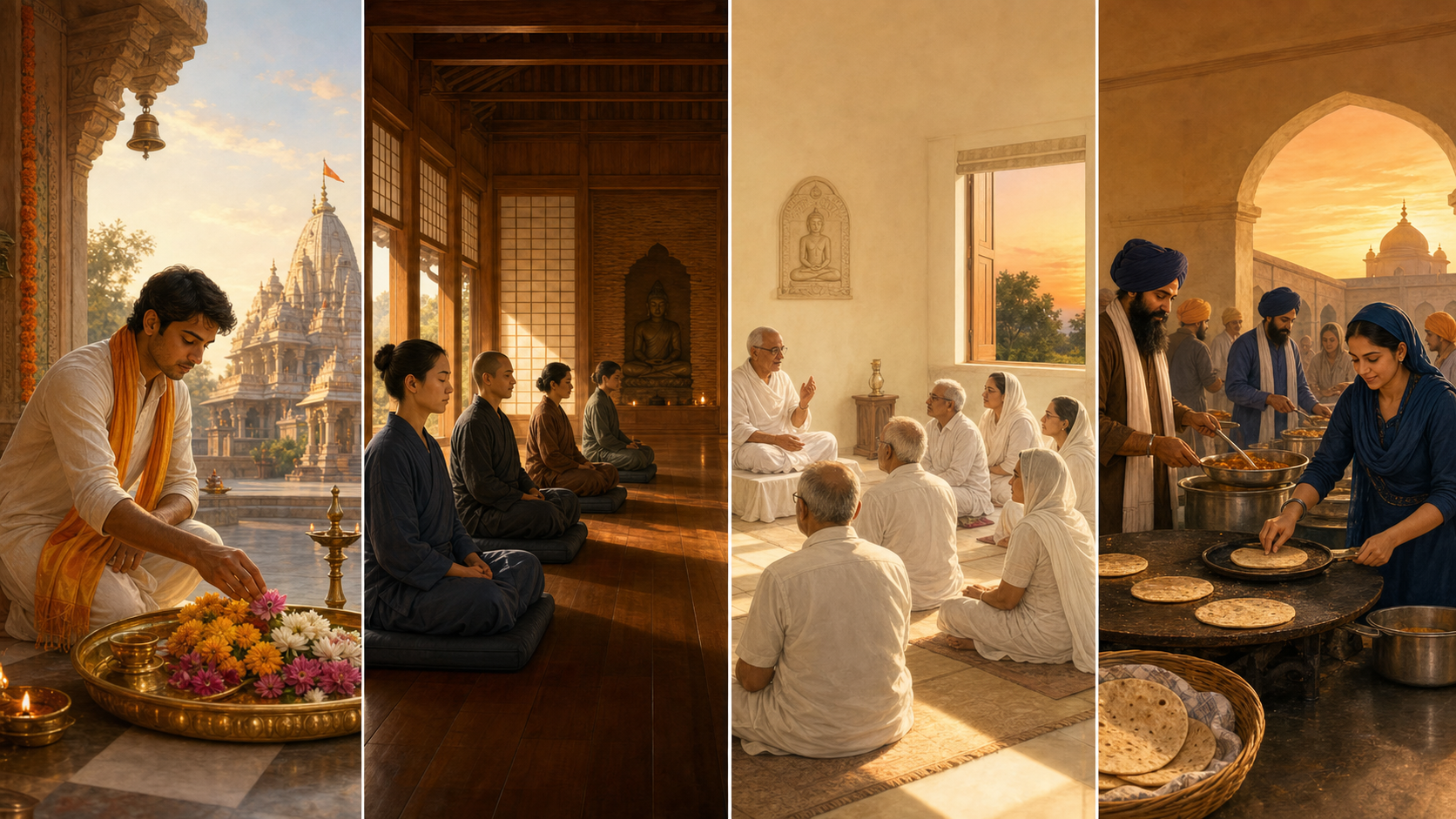
You may recognize the same moral seriousness in a Hindu temple, a Buddhist meditation hall, a Jain vow and a Sikh langar, yet hesitate when someone says the traditions are "all the same." That hesitation is sound. Their kinship is real, but sameness is not the price of honoring it.
If you want common ground you can actually live, compare what these paths ask you to notice, restrain, cultivate and give. The overlap is strongest in disciplined conduct, contemplative training and service. Their accounts of the Self, no-self, karma, Divine Reality and liberation still deserve to be heard in their own terms.
Key takeaways
- Dharmic unity is most credible as a shared discipline of truth, non-harm, self-mastery, contemplation and service, not as a claim that every doctrine means the same thing.
- Dharma asks what a choice sustains: within your character, among other beings and in relation to ultimate reality.
- Dukkha and ananda answer different questions. Dukkha diagnoses unstable, grasped experience; ananda names the joy disclosed in particular Hindu and Sikh spiritual horizons.
- A rooted daily practice is more useful than collecting techniques. Choose one contemplative method, carry one ethical commitment and let service test your progress.
- Good inter-tradition dialogue identifies both the resemblance and the point where the resemblance ends.
Dharma is alignment, not a membership badge
A religious label usually answers, "Which community do you belong to?" Dharma asks a more demanding question: "What way of living sustains truth, order and the proper development of a being?" The distinction between religion as an identity and dharma as a sustaining responsibility matters because it moves attention from ownership to practice.
This does not make historical identities disposable. Hinduism remains a capacious civilizational home containing multiple philosophies, deities, lineages and disciplines. Buddhism, Jainism and Sikhism have their own authorities, communities and theological boundaries. Calling them Dharmic recognizes a family resemblance within the Indic world; it does not turn them into subdivisions of one modern organization or settle every question of doctrine.
Use three lenses whenever you want to know whether a choice is dharmic:
- Inner: What quality is this action strengthening in you: clarity or confusion, restraint or compulsion, humility or self-importance?
- Relational: Whom does it protect, burden, deceive or exclude? Good intentions do not cancel foreseeable effects on other beings.
- Ultimate: Does it loosen attachment and deepen awareness, remembrance or insight, as your path understands those aims?
The same questions appear with different emphases across the four traditions. Comparing those emphases is more accurate than searching for one word that supposedly makes every teaching interchangeable.
| Tradition | What it asks you to notice | How it trains you | Difference that must be preserved |
|---|---|---|---|
| Hindu traditions | Changing conditions and mental movements do not exhaust the reality of the Self; duty must be performed without captivity to its fruits. | Jnana, karma, bhakti, yoga, mantra-japa and dhyana provide different but potentially complementary approaches. | Claims about Atman, Brahman, Bhagavan and ananda are substantive teachings, not generic names for any inward experience. |
| Buddhism | Conditioned experience is unstable, and grasping at what changes produces dukkha. | Sila, the Eightfold Path, mindfulness of breathing, vipassana and compassion train conduct, attention and insight. | Anatta does not affirm a Vedantic Atman under another name. Buddhist analysis must not be rewritten merely to make agreement easier. |
| Jainism | Actions contribute to karmic influx and bondage, while one-sided descriptions fail to capture a many-faceted reality. | Ahimsa, aparigraha, disciplined vows, anekantavada and practices directed toward karmic purification reinforce one another. | Many-sidedness conditions a claim by its standpoint; it does not mean that every assertion is equally true or ethically sound. |
| Sikhism | Life unfolds within hukam, and hardship can be met without surrendering remembrance, courage or responsibility. | Naam-simran, seva, righteous action and chardi kala orient the person toward Ik Onkar and the welfare of all. | Naam, hukam and Ik Onkar retain their Sikh theological setting. They should not be reduced to vague synonyms for spirituality. |
The overlap becomes clearest in the verbs: tell the truth, restrain harmful impulses, attend carefully, reduce grasping, remember what is ultimate and serve beyond the narrow self. The major nouns remain more contested. Self and no-self cannot be fused by changing capitalization; Brahman, Dharmakaya and Naam cannot be declared identical simply because each points beyond ordinary ego-consciousness.
A defensible formulation is therefore precise: Hindu, Buddhist, Jain and Sikh paths share a Dharmic grammar of ethical formation, contemplative discipline and responsibility toward other beings, while offering distinct accounts of reality and freedom. That statement is strong enough to support solidarity without asking anyone to misstate a teaching.
Make the common ethical grammar decide something

Shared wisdom earns its name only when it alters your next choice. Across the Dharmic family, truthfulness, non-harm, compassion and service form a practical moral core. Their formulations differ through yama-niyama, Buddhist sila, Jain vows and Sikh rehat, but each refuses the idea that spiritual life can be separated from conduct.
Turn that moral core into three tests:
- Satya, the truth test: Separate what you observed from what you inferred. Remove the detail added only to make your side look purer. Ask whether your description would remain fair if the person concerned were present.
- Ahimsa and daya, the harm test: Identify the likely injury caused by acting and by refusing to act. Non-harm is not an excuse for abandoning someone who needs protection. Choose firmness without indulging humiliation, hatred or needless injury.
- Seva and dana, the service test: Add an action whose value does not depend on praise, visibility or group advantage. Ask what would genuinely help the recipient rather than what would advertise your virtue.
Suppose an inflammatory clip arrives in your community group. A vague appeal to harmony will not tell you what to do. The three tests will. First, distinguish verified content from captions, edits and assumptions. Second, refuse language that degrades an entire people, even when a particular act deserves clear condemnation. Third, decide what protects the community: correcting a falsehood, reporting a real threat, helping the person harmed or declining to amplify rage bait. Silence can enable falsehood; anger can multiply injury. Dharma rejects both shortcuts.
The same sequence works in a family dispute, professional decision or public disagreement:
- State your actual duty in one sentence. Do not hide a preference inside a grand slogan.
- List the known facts, your interpretations and what remains unknown.
- Name the people or beings likely to bear the cost, including the cost of inaction.
- Choose the most truthful response that fulfills the duty without dehumanizing anyone.
- Add repair, generosity or service so that the decision produces more than a personal victory.
This is also why ethics cannot be treated as decoration around meditation. Conduct marked by deceit, exploitation or uncontrolled appetite creates contradiction that follows you onto the cushion. Ethical restraint reduces avoidable conflict and mental noise, making steadier attention more possible. If contemplation never improves speech, restraint or responsibility, the problem is not a shortage of advanced techniques.
Use dukkha and ananda as two diagnostic lenses

You do not have to decide whether life is fundamentally miserable or fundamentally joyful before you can practise. The apparent contradiction weakens once you ask what level of experience each term describes.
Dukkha does not mean that every moment is agony. It identifies the instability and insufficiency of conditioned experience when you demand permanence from changing health, roles, relationships, possessions or moods. Even pleasure becomes a source of strain when the mind insists that it must remain. Craving and aversion then add a second difficulty to the unavoidable fact of change.
Ananda, in Vedantic usage, is not ordinary cheerfulness. It names the fullness associated with the realized nature of consciousness, uncovered as agitation and false identification subside. The difference between unstable conditions and the joy disclosed through disciplined awareness allows difficulty to be acknowledged without making difficulty the final truth of a Hindu spiritual life.
These claims can illuminate one another without becoming identical. Buddhism uses dukkha, impermanence and anatta to dismantle clinging; it does not need an eternal Self to complete that analysis. Vedanta can affirm ananda without denying empirical pain. Jain anekantavada helps by requiring statements to be indexed to standpoint: life may be difficult with respect to changing conditions and liberating with respect to awakened discipline. Sikh chardi kala holds resilient uplift together with hukam, simran and seva, so hardship is neither denied nor granted sovereignty over the spirit.
Two mistakes now become easier to spot:
- Spiritual bypassing: Repeating that reality is bliss while refusing to face grief, injustice, illness or the consequences of your own conduct. A claim about ultimate reality does not erase pain at the level where a person is living through it.
- Making pain absolute: Treating dukkha as proof that joy, meaning and freedom are delusions. The diagnosis is intended to expose the mechanism of bondage, not to turn despair into a philosophy.
When a difficult experience arises, make three passes through it. Ask: What is changing that I am demanding must remain fixed? What craving or aversion is amplifying the difficulty? What truthful, non-harming or service-oriented action is available before my mood improves? The first question brings impermanence into view. The second exposes attachment. The third returns insight to dharma.
Apply the lenses with care. In loss, acknowledge pain before speaking about bliss. In success, enjoy what is present without pretending it can be possessed forever. In conflict, consider whether another standpoint reveals a fact you missed, but do not use many-sidedness to excuse dishonesty or cruelty. Perspective should refine judgement, not dissolve it.
Build one rooted practice and meet others without flattening them
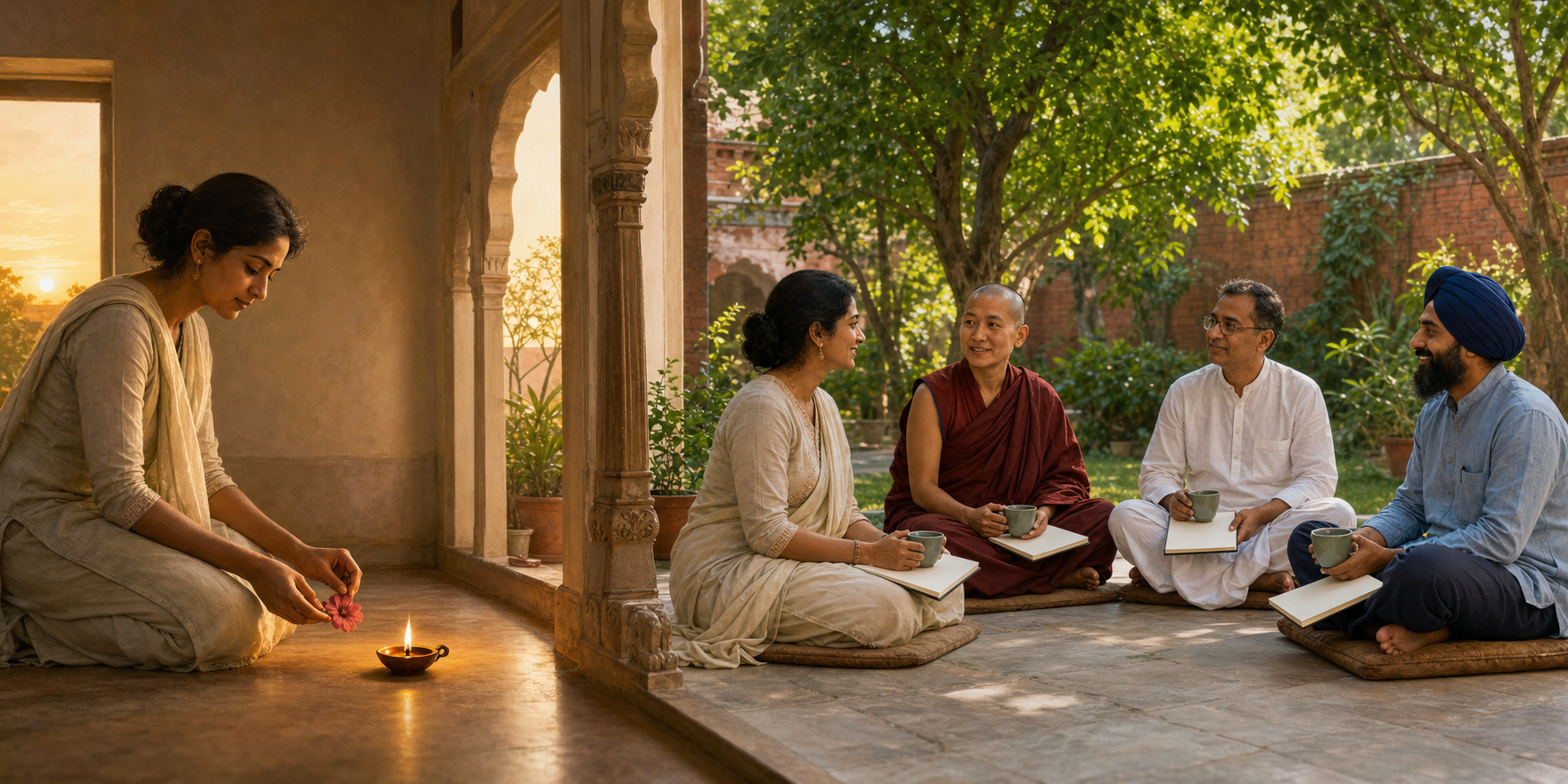
A synthesis becomes vague when it is detached from repetition. You do not need to perform four traditions every morning. You need a coherent practice that trains attention, an ethical commitment that follows you into the day and a form of service that reveals whether self-concern is actually loosening.
A workable daily sequence is:
- Settle for 5 to 10 minutes. Attend to natural, unforced nasal breathing. If nadi shodhana is already part of your training, use the gentle form you have learned without turning the breath into a performance.
- Train attention for 10 to 20 minutes. Choose one established method: mantra-japa or dhyana, anapanasati or vipassana, Naam-simran, or a Jain contemplative discipline connected to your vows and lineage. Do not cycle through every option in one sitting.
- Carry one ethical micro-commitment. Make it observable: no deliberate exaggeration in speech, no forwarding unverified accusations, no avoidable injury, or one act of generosity without seeking credit.
- Close the loop with gratitude or seva. Name the person you will help, the task you will perform or the community obligation you will fulfill. An intention becomes more reliable when it has an object and an action.
The durations and sequence reflect a practical progression from settling the breath to training attention, ethical alignment and service. Keep breathing unforced; if it causes discomfort, return to ordinary breathing. The spiritual work here is steady attention, not endurance.
Judge progress by ordinary conduct before unusual experiences. Are you catching a misleading sentence before saying it? Can you notice anger as a changing state without immediately obeying it? Do you repair harm sooner? Does service still happen when nobody praises you? A dramatic meditation followed by the same dishonesty and contempt is weaker evidence of growth than a quiet increase in clarity and responsibility.
Community keeps this practice from becoming self-certified. Satsang, sangha, collective remembrance, kirtan, langar and shared service provide correction, continuity and accountability. They also reveal a crucial Dharmic insight: liberation may require inward transformation, but ethical life is never merely private. Your habits enter families, institutions and public life.
Rootedness should make dialogue more accurate, not more defensive. When you encounter another Dharmic path, use four habits:
- Ask what a term excludes. You understand anatta, Atman, hukam or anekantavada better when you know which error it is meant to correct.
- Compare functions before declaring identities. Two practices may both steady attention while resting on different metaphysical accounts. Similar fruit does not prove identical doctrine.
- Say where agreement ends. "We share a discipline of compassion, but our traditions describe the self differently" is more respectful than an easy claim that the difference is merely verbal.
- Let service carry what debate cannot settle. Feeding people, protecting life and supporting a community do not require a manufactured theological merger.
Within Hindu traditions, ishta offers a particularly useful model: a seeker can be devoted to a chosen form or mode of worship without requiring every other person to share that affinity. It supports confidence without coercion. It should be offered as a Hindu resource for pluralism, not imposed as an explanation of how Buddhists, Jains or Sikhs secretly understand themselves.
The next time you face a hard choice, begin with satya, ahimsa and seva, then return to the rooted practice that can expose your self-deception. When you meet another Dharmic tradition, ask one exact question before announcing an equivalence. That is how civilizational kinship becomes lived dharma: through disciplined respect, honest difference and work done for the welfare of beings.
References
- Dandavats — Sanatana Dharma Beyond Labels: A Scholarly Guide to Universal, Compassionate Spirituality
- HinduPad — Is Life Easy or Difficult? Dharmic wisdom unites dukkha and ananda with practical tools