
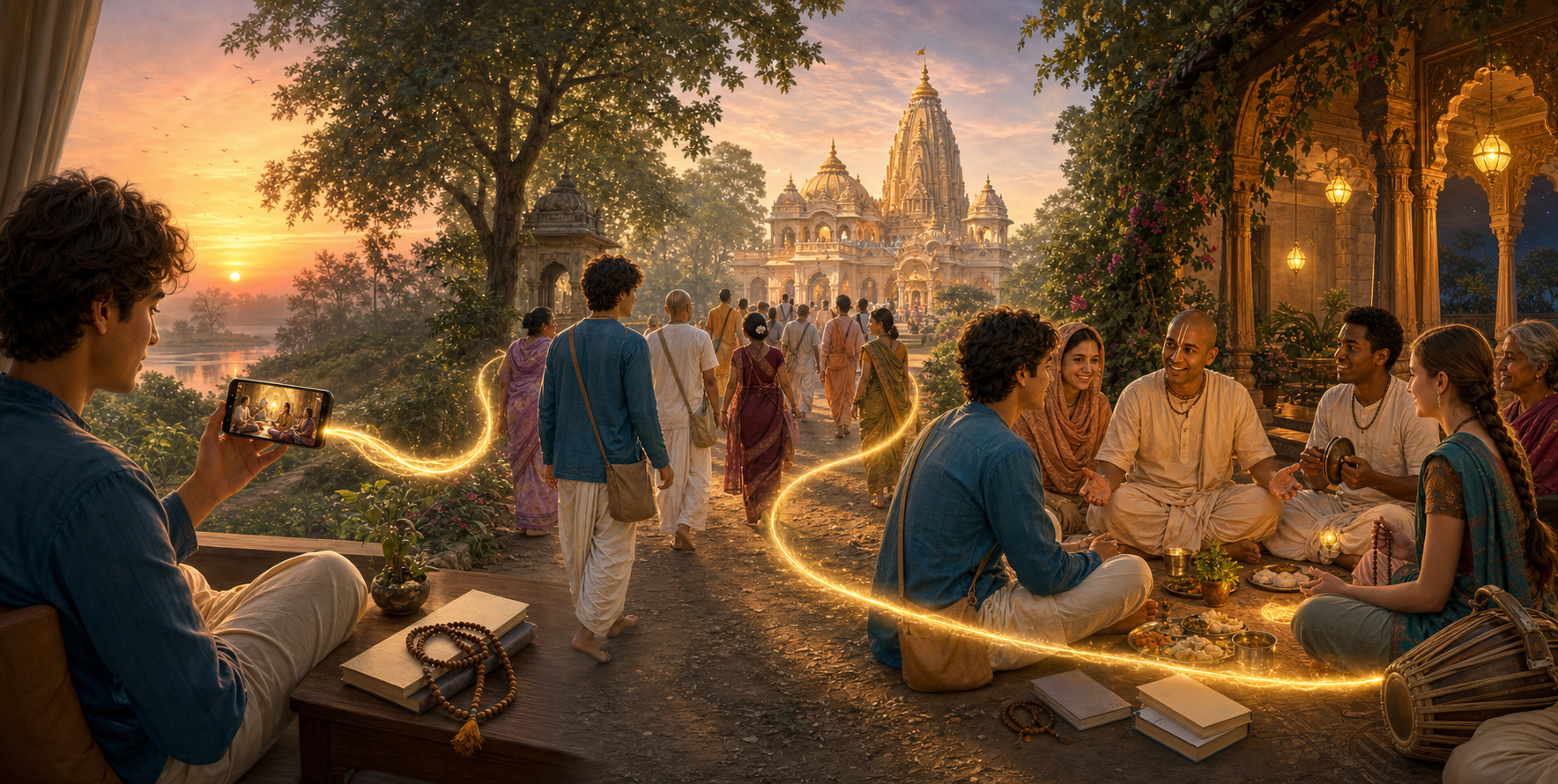
If you help an ISKCON temple or devotee group communicate, you may be deciding whether the next effort belongs in video, pilgrimage promotion, print, or a local programme. Treating those as separate choices is usually where the outreach path breaks.
The more useful question is what should happen after someone first pays attention. Media can help a newcomer recognise a practice. Pilgrimage can place that person inside its sacred setting. The institution must then provide a clear way to learn, belong, and serve. When those stages reinforce one another, attention can mature into sadhana rather than ending as another passing impression.
Media should prepare a person for practice
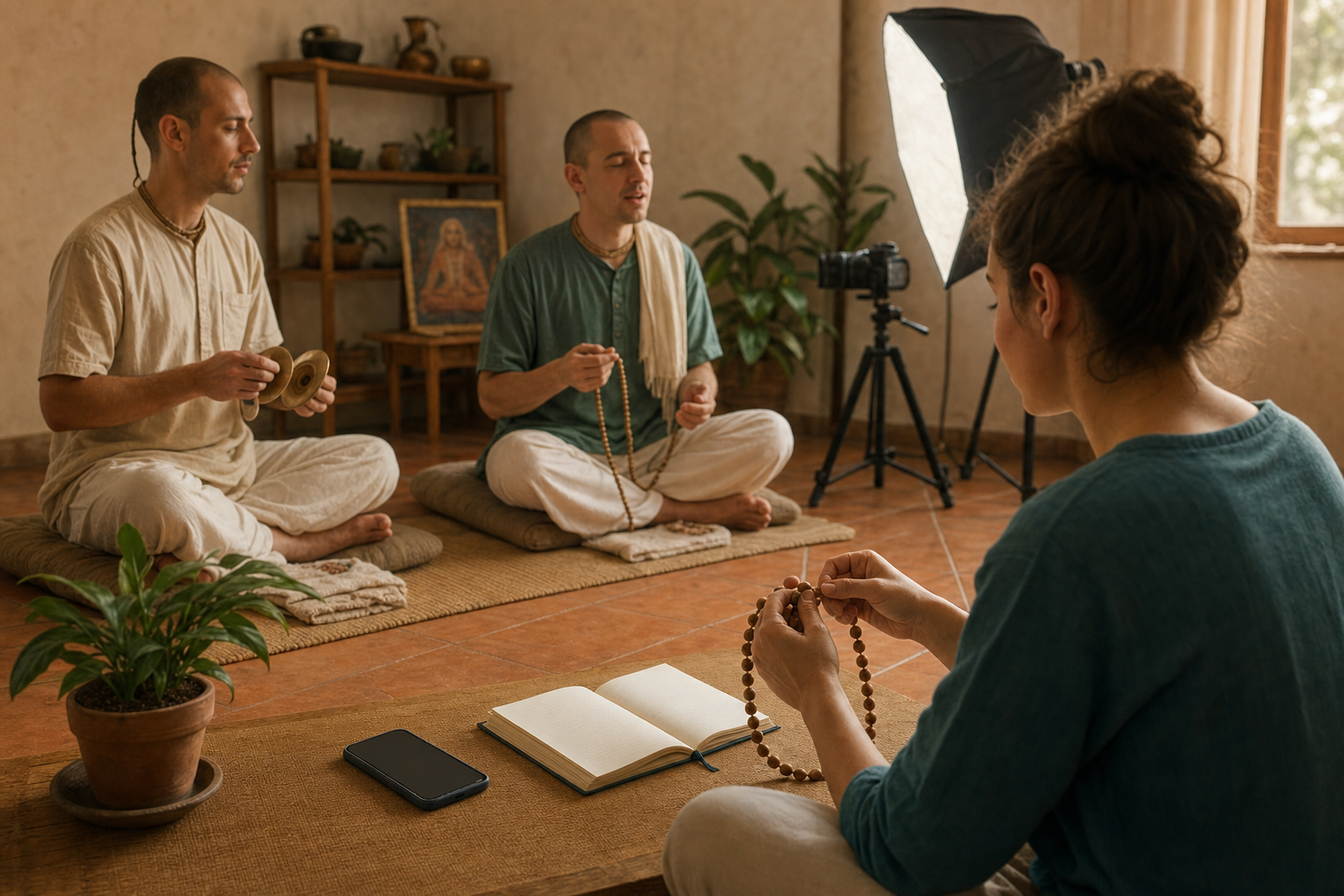
Online attention creates recognition, not yet relationship. Someone may enjoy the sound of a kirtan, admire a temple procession, or become curious about Mayapur without knowing what the participants are doing or why it matters. A beautiful image can open the door, but context determines whether the viewer can walk through it.
ISKCON has an unusually rich range of practices to communicate. Through kirtan, yajna, Gaura Purnima observances, temple festivals, Navadvipa pilgrimage and the developing Temple of the Vedic Planetarium, a newcomer can encounter devotion as sacred sound, ritual, learning, community, geography and institution building. That range is a strength. Presented as an unexplained montage, however, it can leave the viewer with atmosphere but no understanding.
Give each media story three jobs:
- Name the practice. Tell the viewer whether they are seeing sankirtana, japa, yajna, darshan, parikrama, abhishekam, scriptural study or seva. Do not make newcomers infer the vocabulary from images alone.
- Explain the devotional meaning. A kirtan is not merely a musical performance; melody, rhythm and repeated nama support attentive remembrance of Krishna through shared participation. A parikrama is not simply a walk between landmarks; the movement through sacred space is joined to hearing, chanting, memory and humility.
- Offer one proportionate next step. A first-time viewer might chant along, attend a local kirtan, read an introductory passage from the Bhagavad-Gita, ask about a festival, or join a simple act of service. Do not give five competing invitations when one clear action will do.
This structure also corrects a common media mistake: assuming that more spectacle produces more understanding. The most useful devotional recording often keeps the rite, not the camera, at the centre. Clear kirtan audio, steady observational framing and context-rich narration help viewers perceive a coherent practice rather than disconnected colour and sound. Production quality matters because it removes obstacles to attention; it should not make worship behave like entertainment.
The Temple of the Vedic Planetarium requires the same discipline. Its educational vision, including the proposed cosmic chandelier presentation of traditional cosmological tiers, can invite serious interest in Vedic knowledge. Communicate that aim as an opportunity for study and inquiry. Do not reduce a complex cosmological tradition to a slogan, and do not imply that a visually impressive exhibit settles every interpretive question. Intellectual hospitality is stronger than forced certainty.
Pilgrimage turns sacred geography into discipline
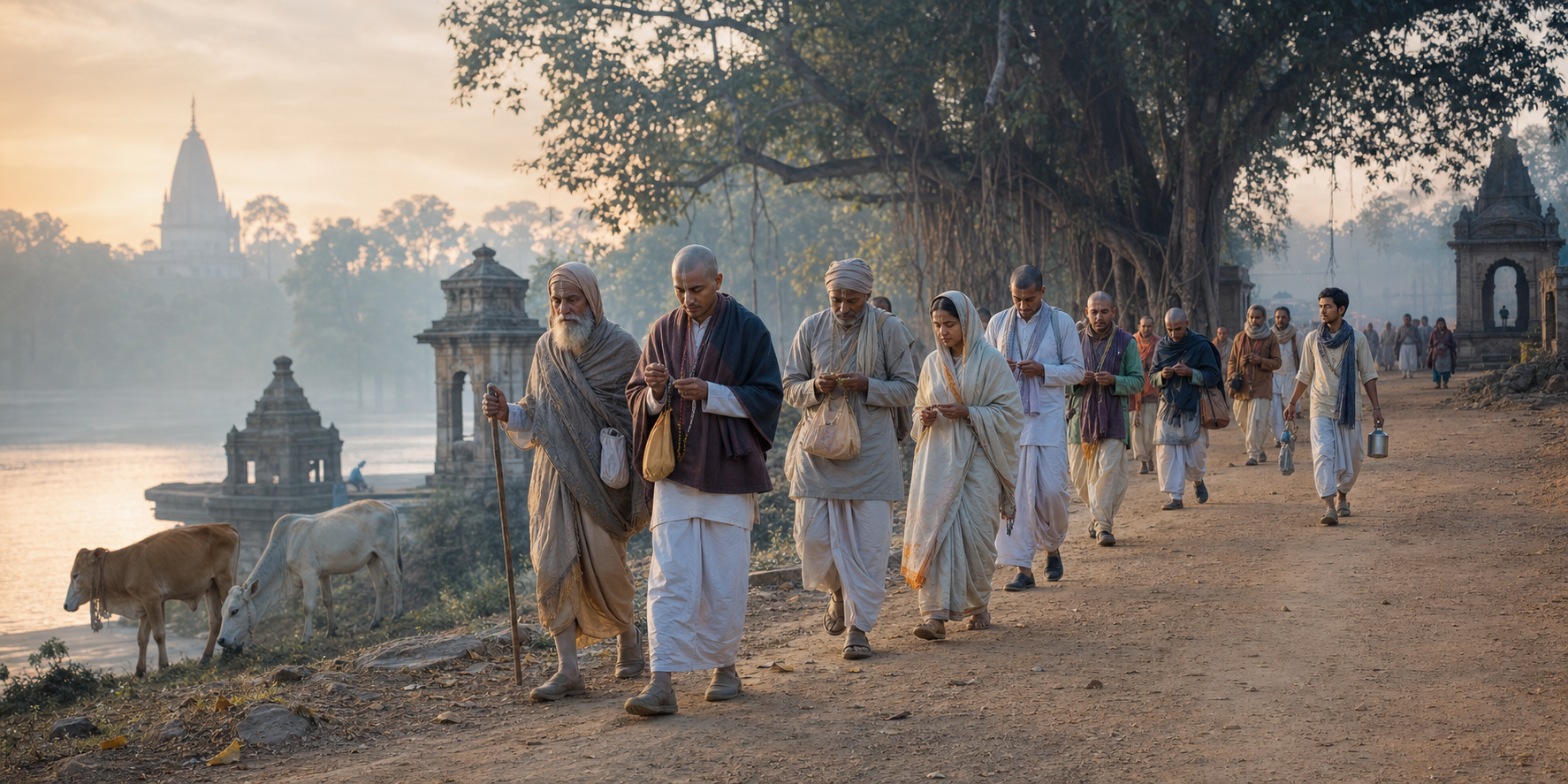
Media may make someone want to visit Mayapur, but pilgrimage should do more than confirm that the place looks as beautiful as it did on a screen. Sridhama Mayapur is a living centre of Gaudiya Vaishnava worship, study, sankirtana and seva in the region associated with Sri Chaitanya Mahaprabhu. The pilgrim therefore needs a formation plan, not only an itinerary.
The traditional Navadvipa parikrama connects nine islands with nine limbs of bhakti: shravanam, kirtanam, smaranam, pada-sevanam, arcanam, vandanam, dasyam, sakhyam and atma-nivedanam. That correspondence gives an organiser a ready-made way to prevent sacred geography from becoming religious sightseeing. At each place, connect location, teaching and practice. Ask what the pilgrim is meant to hear, remember, offer or reconsider there.
A useful pre-pilgrimage briefing should cover four maps:
- The sacred map: why Mayapur and Navadvipa matter within the Gaudiya Vaishnava lineage, especially in relation to Sri Chaitanya Mahaprabhu.
- The practice map: how kirtan, japa, darshan, study, prasada, parikrama and seva fit together rather than functioning as isolated activities.
- The community map: whom a newcomer can approach with a question, how to participate respectfully, and where guidance comes from during the journey.
- The return map: which local congregation, study circle, devotional routine or service responsibility will continue after the pilgrim goes home.
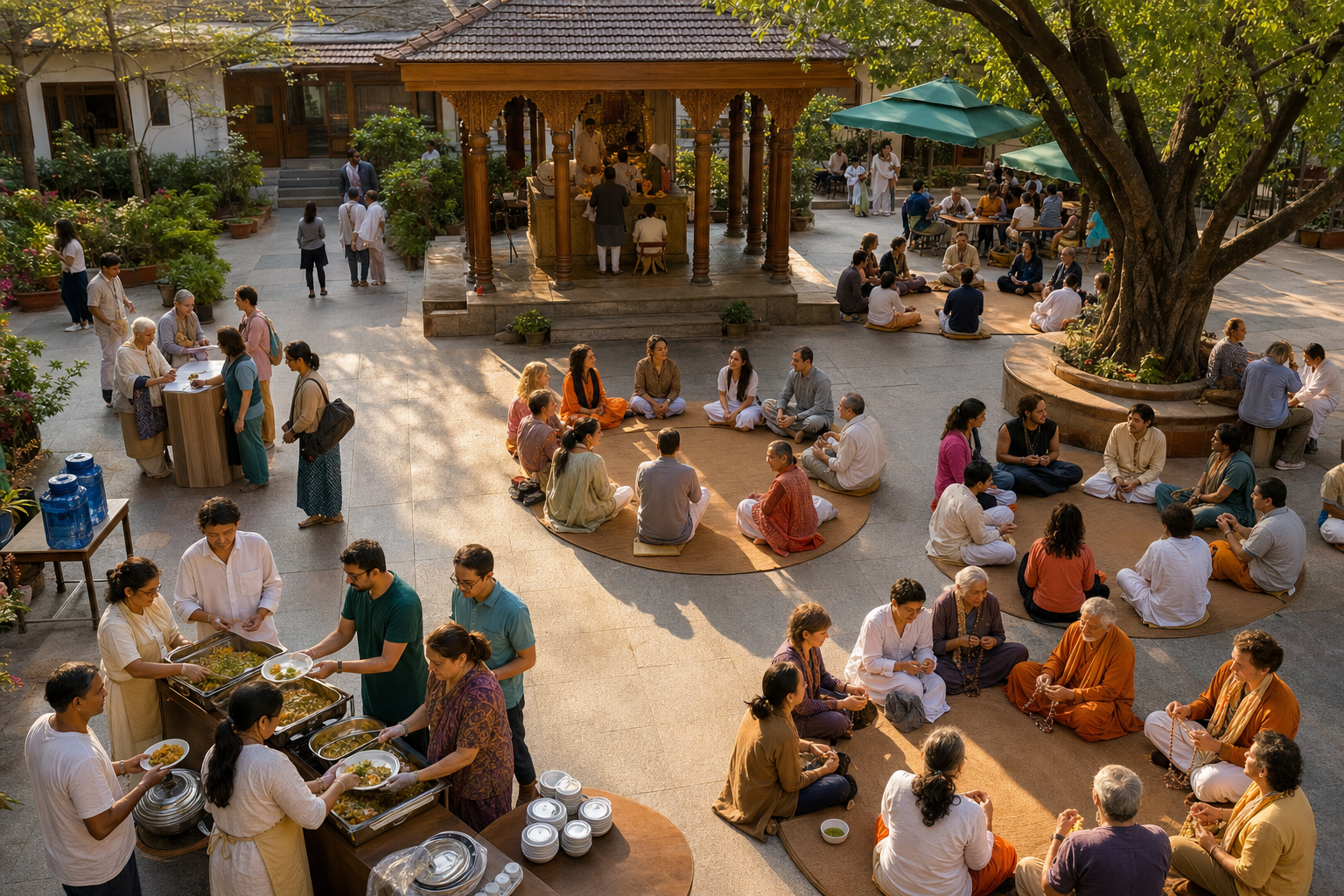
The return map is the one most easily neglected. Inspiration naturally rises in a dense devotional environment, where sacred sound, shared schedules and sangha reinforce one another. Ordinary life removes much of that external support. Arrange the next local contact before the pilgrimage ends. Ask each participant to choose one durable continuation: a consistent japa practice, regular kirtan, scriptural study, congregational participation or a defined seva. A large promise made in an elevated moment is less useful than a modest practice that survives the return home.
Documentation also needs boundaries. If you are filming a pilgrimage, decide beforehand when the device serves orientation or cultural preservation and when it should remain out of the way. Record enough context to identify the place, practice and teaching. A sequence of scenic shots without that information turns sacred geography into travel content. At the same time, not every intimate devotional moment needs to become public material.
Institutional outreach lives or dies at the handoff
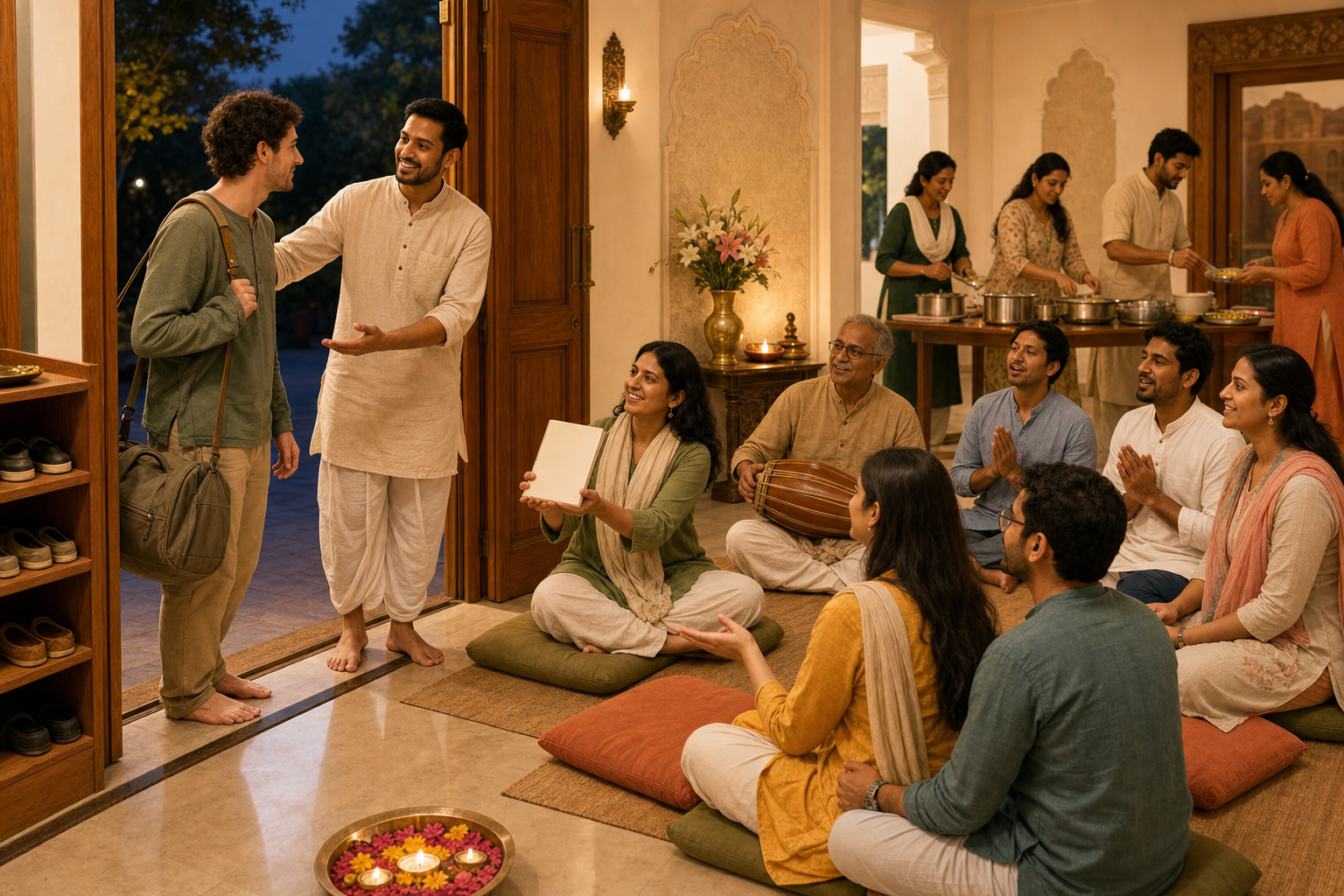
Broadcasting is only the first institutional responsibility. Every stage should answer the question the participant is likely to have at that moment, then provide a suitable next action. The sequence can be designed explicitly:
| Stage | What the person needs | Institutional next move |
|---|---|---|
| First encounter | One recognisable practice and a plain explanation of its purpose | Publish concise media with one invitation appropriate to a newcomer |
| Orientation | Basic vocabulary, expectations, etiquette and theological context | Provide a newcomer session, accessible guide or named contact |
| Participation | A safe place to listen, chant, ask questions and contribute | Offer guided kirtan, study, prasada and manageable seva |
| Pilgrimage | A connection between sacred place, lineage teaching and personal practice | Prepare participants before travel and provide contextual guidance on site |
| Return | A routine and a continuing relationship with sangha | Arrange local follow-up before the journey ends |
| Service | A role with purpose, instruction and accountability | Give a defined responsibility rather than a vague request to get involved |
To find a broken handoff, start where people disappear rather than where the largest audience appears.
- If videos receive attention but generate few meaningful questions, inspect the explanation and invitation. The viewer may not understand what the next step is.
- If newcomers repeatedly ask the same elementary questions, turn those questions into orientation material instead of expecting every volunteer to improvise an answer.
- If festival visitors enjoy kirtan and prasada but leave without a relationship, make the welcome path visible and assign someone to receive them.
- If returning pilgrims cannot name the practice they intend to continue, build post-pilgrimage commitment into the journey itself.
- If core volunteers are overwhelmed, reach has outgrown service capacity. Narrow the invitation or define more roles before expanding the campaign.
Views, impressions and shares can tell you that material travelled. They cannot tell you whether someone understood the teaching or found a spiritual community. Look for behaviours that indicate a developing relationship: thoughtful questions, return participation, sustained study, regular practice and accepted service. These are not merely marketing conversions. They are signs that communication has done its proper work and handed the person to sangha.
Scale only when the institution can serve the audience
Srila Prabhupada combined spiritual urgency with close attention to production and distribution. He acquired two used printing machines for a total of $150, began with runs of about five hundred copies, and later saw roughly twenty-five hundred copies sell from a printing of three thousand. When professional production required a minimum run of twenty thousand, he authorised twenty thousand.
The lesson is not that bigger is automatically more devotional. The larger commitment followed evidence that readers wanted the magazine and that devotees could distribute it. Quality, demand and distribution were treated as one decision. A large print run without a route to readers would have produced stored paper, not outreach.
Use the same discipline for contemporary media:
- Begin with the smallest format your team can publish consistently. Test whether the intended reader or viewer understands it.
- Measure response through action, not exposure alone. Look for questions, attendance, study, repeat participation and service.
- Improve production where quality affects comprehension and trust. For devotional video, clean sound and intelligible narration may matter more than elaborate visual effects.
- Confirm the route from content to community. A global video needs a local or online reception point for the person who responds.
- Increase reach only when teachers, hosts, pilgrim coordinators and volunteers can carry the resulting relationships responsibly.
Archival value should be part of that production decision. Record the location, festival, practice and relevant context while the information is still available. Sacred music, ritual sequence and community memory are forms of living heritage. A file that looks polished but cannot later be identified is much less useful for teaching or preservation.
Wider Dharmic outreach also depends on precision. Hindu, Sikh, Jain and Buddhist audiences may recognise resonances among nama-japa, simran, seva, ahimsa, compassion, pilgrimage, satsang and communal sharing. Those resonances can open a respectful conversation. They should not be used to pretend that every lineage holds identical theology or follows interchangeable practices. Shared ethical and contemplative concerns can support unity without erasing spiritual diversity. Make the doorway broad, then teach the Gaudiya Vaishnava tradition in its own voice.
Key takeaways
- Do not make media, pilgrimage and institutional outreach compete for attention. Design them as successive stages of one devotional path.
- Every media item should make three things clear: what is happening, why it matters, and what the viewer can do next.
- Prepare pilgrims with a sacred map, a practice map, a community map and a return map.
- Arrange post-pilgrimage contact before participants leave the devotional environment.
- Judge outreach by understanding, repeat participation and service, not reach alone.
- Scale media only when production, distribution and the capacity to receive people are ready together.
- Use shared Dharmic values as bridges while preserving the distinct teachings and practices of the Gaudiya Vaishnava lineage.
For your next festival, take one recent video, one pilgrim itinerary and one newcomer pathway. Trace what a person is asked to do after each encounter. The first missing or ambiguous step is your next outreach assignment. Repair that handoff before adding another channel.
References
- Dandavats – May 2026 ISKCON TV Diary: Sridhama Mayapur’s Sacred Pulse, Gaura Purnima, and TOVP’s Promise
- Dandavats – From $150 to 20,000: Srila Prabhupada’s daring print strategy that built Back to Godhead