
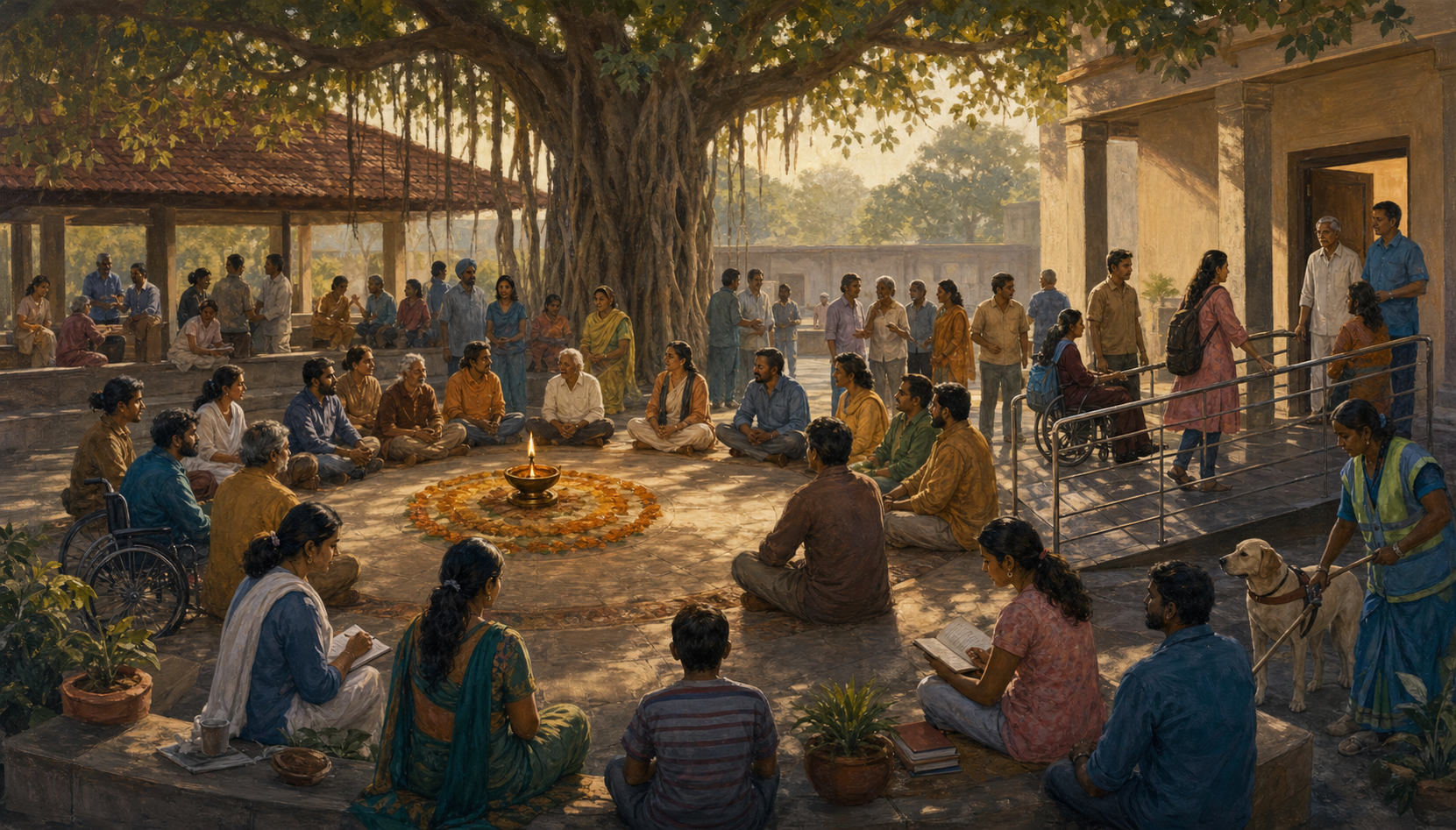
You are told that a caste is “under-represented.” The next sentence usually jumps to a quota, electoral ticket, appointment or accusation. Slow that jump down. Before you decide whether the claim is just, you need to know what kind of representation is missing, where the power lies and whether the proposed remedy will protect people or merely harden another political label.
An Indic approach broadens the inquiry beyond head counts. It asks whether political authority is protecting people from domination, whether communities can sustain meaningful institutions and whether individuals retain dignity within those communities. It does not require you to romanticise caste or deny historical injustice. It gives you a more exact way to distinguish a serious claim from a slogan.
Representation has four different meanings
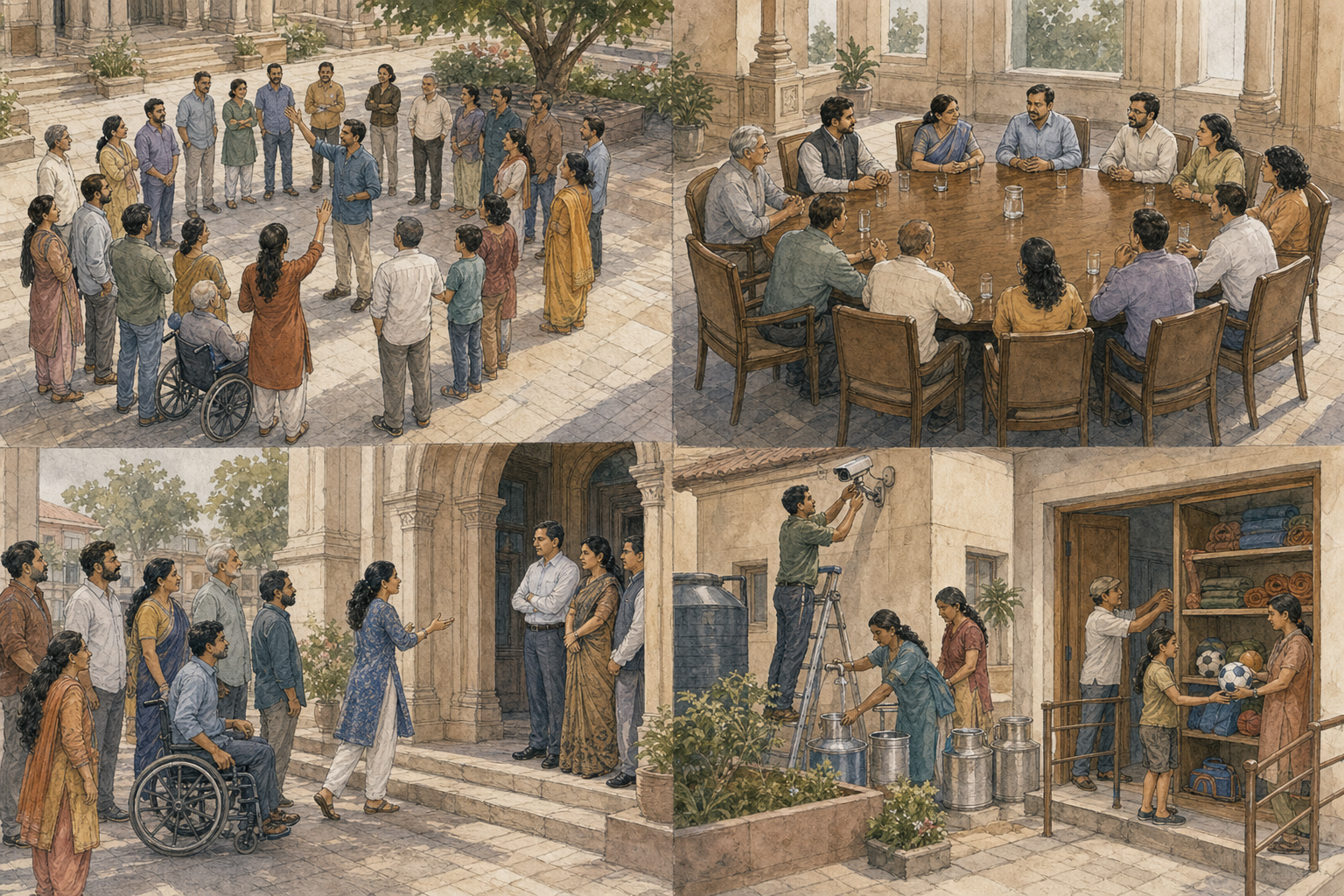
Many arguments become confused because they use one word for four different problems. Separate them before discussing remedies.
- Presence: Are members of a community present in an institution, and in what proportion? This is the familiar numerical question.
- Decision-making power: Can those members set priorities, control resources, challenge a decision or place an issue on the agenda? A visible office may carry little practical authority.
- Outcomes: Does the institution’s conduct remove a particular barrier or improve access to a public good? Shared caste identity does not automatically make an office-holder an effective representative.
- Security and recognition: Can the community preserve its dignity, memory, customs, institutions and legitimate ways of life without fear? This dimension can matter even when an economic demand is not immediately visible.
None of these measures can substitute for all the others. A minister from a community does not by that fact prove that ordinary members possess influence. A proportional head count does not prove that discriminatory barriers have disappeared. Conversely, absence from one committee does not by itself demonstrate exclusion across an entire social system.
When you encounter a representation claim, fill in four blanks: the institution, the relevant decision, the barrier being alleged and the remedy being requested. “Community X needs representation” is too vague to test. “Community X lacks a voice on the local body that allocates access to a shared resource, despite bearing the consequences of its decisions” is a public claim that can be examined.
Rājadharma changes how you understand the state

An Indic political vocabulary begins from duties and relationships rather than assuming that the state creates society. Rājadharma asks what political authority owes the people. Daṇḍanīti asks how coercive power should be disciplined and used against predation. The Puruṣārthas direct attention to the conditions in which human beings can pursue dharma, artha, kāma and mokṣa.
In the Śānti Parva, Bhīṣma presents the ruler as a protector of an existing moral and social order. The ruler must work for the welfare of all beings, preserve dharma and prevent matsyanyāya—the condition in which the strong consume the weak. Political authority is therefore a protector rather than the sole creator of social legitimacy.
This matters because a jāti or other inherited community has often been more than a box on an official form. Communities have carried networks of economic exchange, ritual participation, aesthetic traditions, shared customs and sacred practices. They have given people recognition, continuity and a place within a larger social world. Destroying those functions without replacing them can produce cultural and psychological insecurity even when the policy responsible is presented as administratively neutral.
The practical principle is not that the state should leave every inherited arrangement untouched. It is that intervention must answer two questions at once: What danger or injustice is being restrained, and what legitimate capacity for self-organisation is being preserved? If a policy counts people but makes their functioning institutions dependent on distant political patrons, numerical representation may increase while community agency declines.
No single Indic verdict follows automatically from these categories. They discipline the inquiry. Rājadharma prevents authority from becoming indifferent to the vulnerable. Matsyanyāya prevents community autonomy from becoming a licence for local domination. The Puruṣārthas prevent political analysis from reducing a human being to a vote, income bracket or administrative identity.
Community autonomy cannot become an alibi for injustice
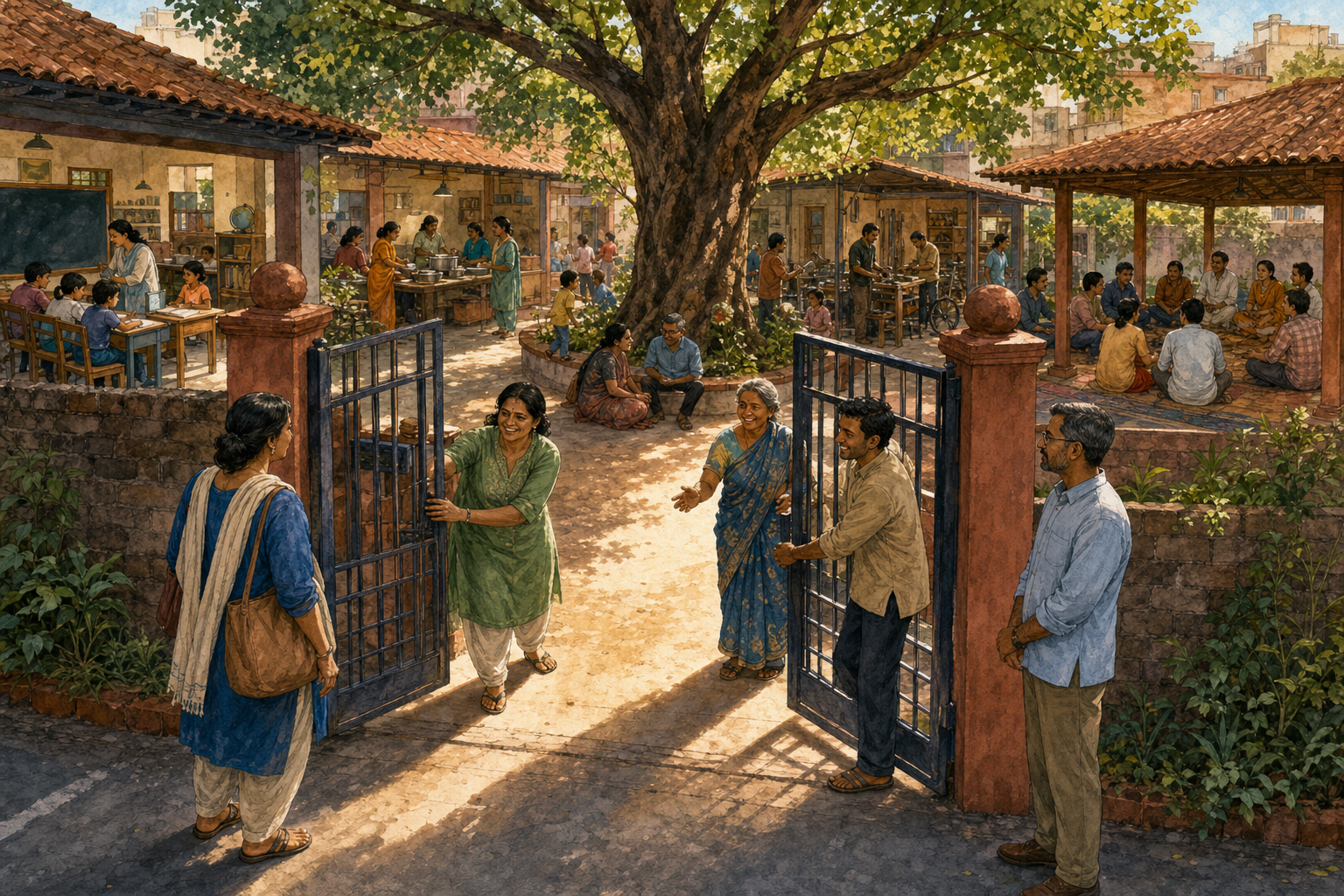
There are two historical realities to hold together. Communities can provide belonging, knowledge, livelihood networks, ritual life and continuity. They can also enforce hierarchy, exclusion, untouchability and unequal access to social or economic resources. B. R. Ambedkar described caste in 1936 as a system of graded inequality. Any Indic account that remembers interdependence but forgets coercion is incomplete.
Nor was pre-modern Bharat governed by one uniform arrangement. Relationships among rulers and communities varied across regions and kingdoms. Political power could operate through local elites, temples, chieftains and patronage networks. Some communities enjoyed substantial room to regulate their affairs; others experienced autonomy through authorities they could not meaningfully challenge. “The state kept its distance” is therefore a hypothesis to examine in a particular place and period, not a civilisational blank cheque.
Use five questions when someone invokes tradition or community rights:
- Can an individual refuse a customary role without losing basic civic standing?
- Can weaker members challenge community authorities, and is there an impartial avenue of appeal?
- Are access to education, livelihood, public space or sacred participation restricted solely by birth?
- Is political authority protecting a living institution, or merely empowering a broker who claims to speak for everyone?
- Would the proposed reform stop a concrete abuse while allowing legitimate cultural, economic and religious functions to continue?
A defensible Dharmic position is community autonomy bounded by equal civic protection. Autonomy matters because human beings do not live as isolated units administered from a capital. The boundary matters because a community cannot demand protection from outside domination while denying dignity to people within it.
Colonial classification changed what representation was for
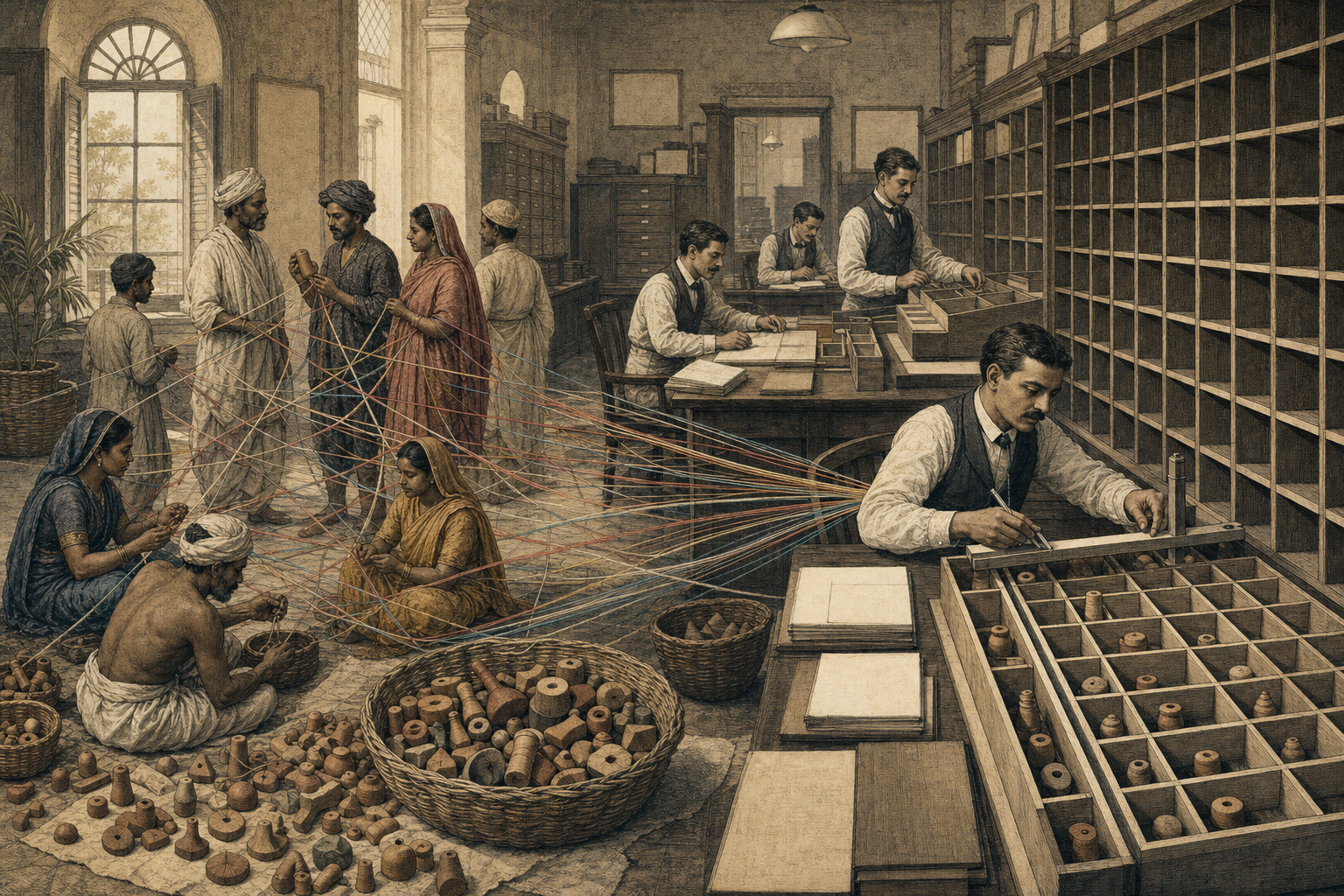
The Census of British India began in 1871–72. By 1901, the operation led by Herbert Hope Risley had systematised the classification of society into caste and religious categories. Identities that had often been fluid, local or regionally negotiated were increasingly recognised and governed through fixed administrative labels.
The census did not invent every distinction it recorded. Its deeper effect was to alter the setting in which distinctions acquired political force. Administrative centralisation, legal codification, surveys and bureaucratic expansion increasingly placed the state between communities and the conditions of their continuity. Once recognition, security and access had to be negotiated through central institutions, an official category became a political bargaining unit.
This helps you notice why a representation demand may be about more than a job or seat. A community may be seeking material access, but it may also be trying to recover honour, continuity or control over decisions that once belonged closer to community life. Dismissing that concern as mere identity politics misses the source of its force.
Yet colonial classification is not a complete explanation of present conditions. Constitutional guarantees, democratic expansion, economic modernisation, urbanisation, educational mobility, demographic change and new social movements have all added later layers to caste identity and political aspiration. A category may have an older social life, a colonial administrative form and a post-independence electoral function at the same time.
That layered history changes how you assess remedies. Do not assume every official label is an eternal description of a timeless community. Ask when the relevant boundary became politically decisive, which institution now maintains it and whether the proposed remedy reduces dependence or gives political intermediaries another reason to preserve the category forever.
Key takeaways for evaluating a representation claim
- Name the arena. Representation in a legislature, civil service, university, temple body, professional association and village institution can involve different powers and different barriers.
- Separate presence from influence. Count seats where counts matter, but also identify who controls agendas, appointments, budgets, rules and appeals.
- State the injury precisely. Distinguish unequal access, inherited stigma, loss of community autonomy, material deprivation and lack of cultural recognition. One remedy will rarely address all five.
- Identify the historical layer. Do not treat an inherited practice, a colonial classification and a modern electoral arrangement as though they were the same phenomenon.
- Protect people inside the community. Cultural autonomy needs a civic floor: dignity, protection from coercion and a credible avenue of appeal.
- Protect the community from unnecessary absorption. Reform should not automatically transfer every local function to a central bureaucracy or political broker.
- Demand a reviewable remedy. A serious proposal should name its objective, the mechanism expected to achieve it and the evidence that would show whether it is working.
You can compress the whole test into one sentence: “In this institution, this community faces this specific barrier to this kind of power or security; the proposed remedy changes this mechanism while protecting these individual rights.” If a claimant cannot fill those blanks, the demand is not ready for endorsement. If the blanks can be filled, you can debate the remedy without denying either historical injustice or the value of community life.
The next time a caste-representation slogan reaches you, ask for that completed sentence. That small discipline turns a charged identity claim into a testable question of dharma, power and public responsibility.