
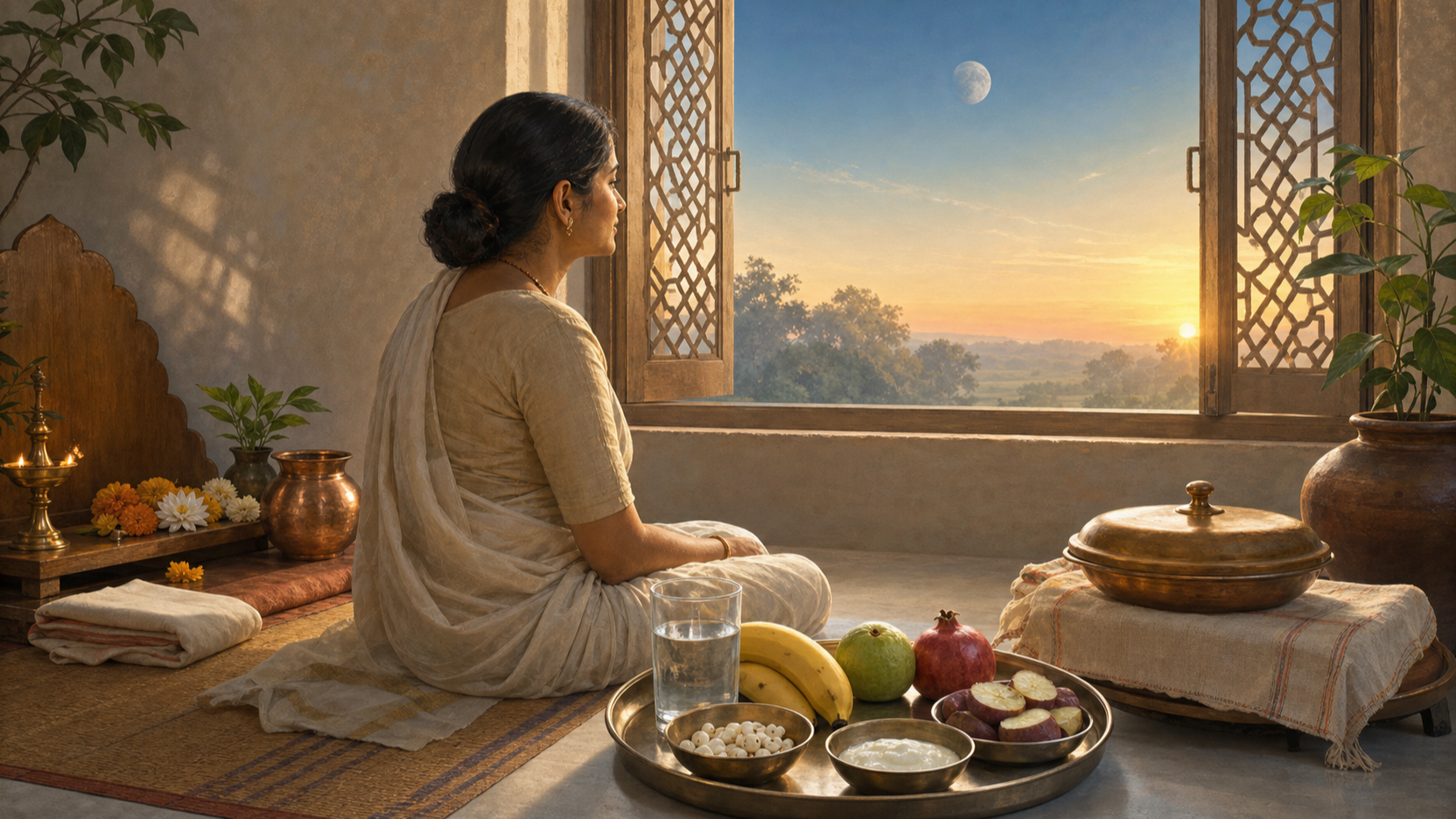
You checked the calendar, but the answers still do not line up. One Panchang places the fast on one civil date, another shows the tithi changing after sunrise, and your family follows food rules that an online list calls optional. The solution is not to choose whichever answer looks strictest. First settle the tithi and parana for your location. Then choose the food discipline that fits your parampara, health, and duties.
That order prevents the two mistakes that cause most confusion: keeping the approved menu on the wrong ritual day, or attempting a severe fast that you cannot complete safely or calmly. A useful fasting plan should tell you four things before the vrata begins: which local tithi governs the observance, what level of restraint you are undertaking, which foods your tradition permits, and exactly when you will perform parana.
The civil date does not determine the vrata by itself

A civil day runs from midnight to midnight. A tithi does not. It is an astronomical division based on the changing angular relationship between the Moon and Sun, with each 12-degree interval constituting one tithi. A tithi can therefore begin at 2:00 AM, end shortly after sunrise, or span portions of two civil dates.
The clock time printed beside a tithi is only one part of the decision. Many vrata rules also ask which tithi is present at local sunrise, whether the next tithi lasts long enough after sunrise, and which interval is prescribed for breaking the fast. This is why a generic festival date, detached from a city and a sunrise calculation, is not enough for careful observance.
A worked example makes the distinction clear. In the stated reckoning for May 27, 2026, Shukla Ekadashi continued until 7:49 AM and Dwadashi followed. Sunrise occurred while Ekadashi was still present. An Ekadashi observer therefore could not assume that the fast should be broken immediately after waking. Parana had to wait for Dwadashi and then follow the locally prescribed interval.
The exact clock time can shift with location and calculation convention. Use a Panchang calculated for the city where you will actually observe the fast, not your ancestral hometown, a distant temple’s city, or an app left on its default location. If your family follows a particular sampradaya or almanac, use it consistently rather than combining the festival date from one system with the parana time from another.
Month names can create a second layer of apparent disagreement. Amanta calendars end the lunar month at Amavasya, while purnimanta calendars end it at Purnima. Adhika-month conventions can also change the month label or festival name shown on a calendar. That difference does not automatically mean the tithi calculation is different. When two calendars disagree, compare the tithi start, tithi end, local sunrise, and observance rule before focusing on the month name.
Use this sequence whenever you need to settle a fasting date:
- Select the city where you will perform the vrata.
- Confirm whether the required tithi is present at local sunrise.
- Write down the tithi’s start and end times; do not rely only on the festival label.
- Check the observance rule followed by your sampradaya or household.
- Record the parana window before the fast begins, including any excluded interval such as Hari Vasara for Ekadashi.
- If the post-sunrise portion of Dwadashi is brief, seek a trusted local Panchang or knowledgeable acharya rather than estimating.
Choose the form of vrata before planning the menu
Fasting is not a competition in deprivation. The outward rule should support the inward discipline of sattva, remembrance, restraint, and compassion. If the food question consumes the entire day, the means has displaced the purpose.
Three practical forms appear frequently, although their names and details are not universal across Hindu lineages:
- Nirjala means abstaining from both food and water for the defined vrata window. It is the most physically demanding form and is appropriate only for a healthy, prepared adult who can avoid heat and strenuous activity.
- Phalahari replaces ordinary meals with permitted fruits, dairy, roots, vrat flours, and other foods accepted by the household tradition. It preserves a clear food discipline without requiring complete abstinence.
- A simplified sattvika observance may use modest, easily digested food when age, health, medication, pregnancy, work, or caregiving makes a stricter form unsuitable. Japa, svadhyaya, dana, seva, and reduced sensory distraction can carry the vrata’s intention.
Decide your form before hunger and fatigue begin negotiating on your behalf. In your sankalpa, be concrete: name the vrata, state the discipline you can actually maintain, and know the parana time. If you are keeping Phalahari, settle the disputed ingredients with your family’s parampara before shopping or cooking. A clear, moderate commitment is more coherent than declaring Nirjala and then repeatedly changing the rule during the day.
A family restriction is not disproved by a generic list of fasting foods. Regional traditions differ on sama, dates, jaggery, ginger, green chilli, lemon, turmeric, red chilli powder, and particular cooking fats. If you do not have an established household rule, choose the simpler preparation and seek guidance before the next observance. Do not turn uncertainty into an excuse for an elaborate substitute feast.
Build a Phalahari plate without recreating an ordinary feast
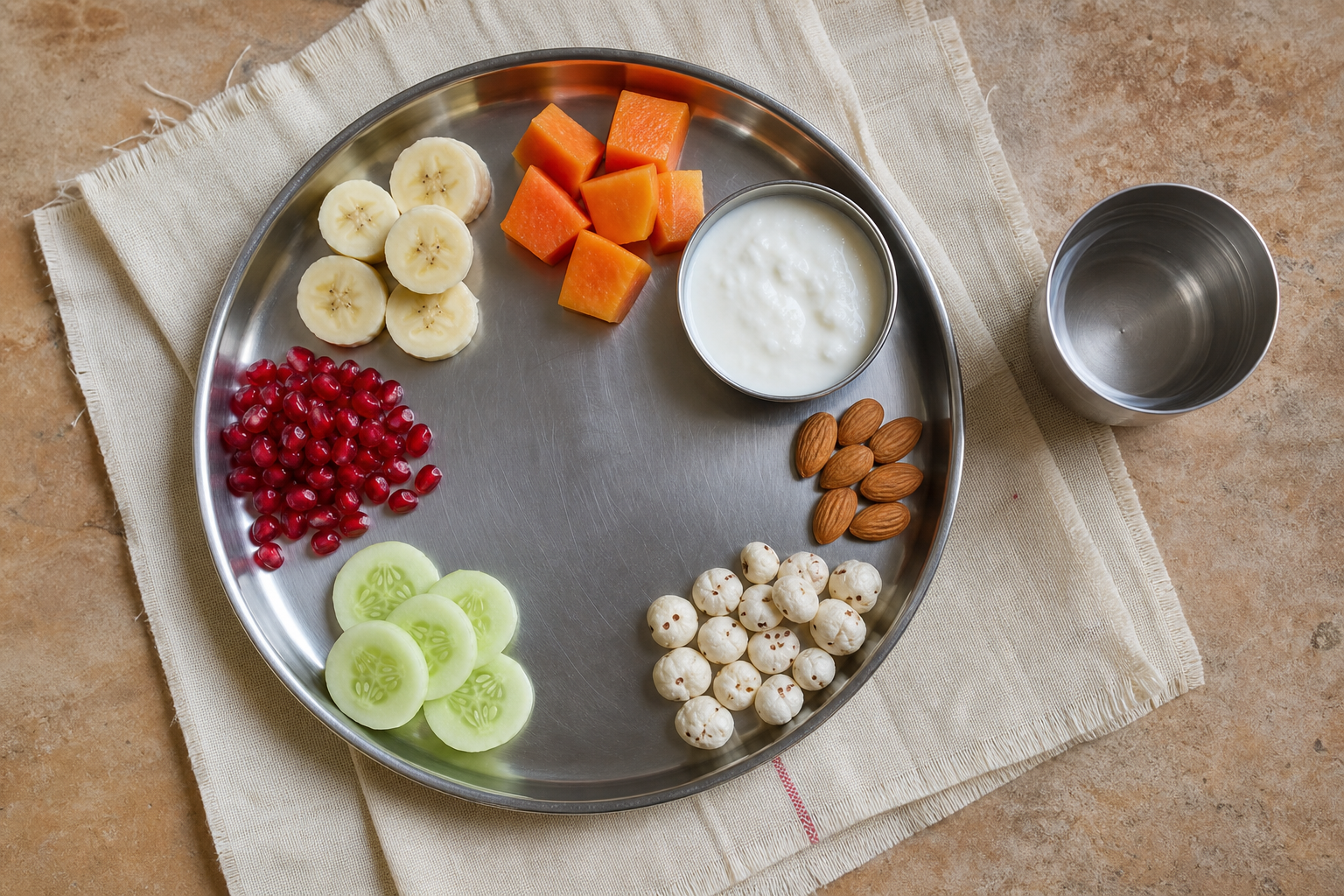
The usual Phalahari pattern removes regular cereals and pulses, then builds meals from fruit, selected roots and gourds, fresh dairy, vrat-approved staples, and sendha namak. The following table is a planning aid, not a ruling that overrides your guru, sampradaya, or family custom.
| Usually used in Phalahari observance | Commonly excluded | Check your parampara |
|---|---|---|
| Banana, apple, guava, papaya, pomegranate, citrus, grapes, coconut, and seasonal fruit | Wheat, ordinary rice, oats, maize, and foods made from regular cereals | Dates and jaggery |
| Potato, sweet potato, arbi, pumpkin, lauki, cucumber, and ash gourd | Chana, moong, masoor, rajma, and other pulses or legumes | Ginger, green chilli, and lemon |
| Kuttu, singhara, rajgira, sama or samak, sabudana, and makhana | Ordinary table salt, bakery products, and packaged foods containing grain-derived additives | Sama or samak, which some households omit |
| Fresh milk, homemade curd, fresh paneer, and modest amounts of ghee | Onion, garlic, mushrooms, vinegar, fermented condiments, meat, eggs, and alcohol | Turmeric, red chilli powder, and the choice of cooking oil |
| Sendha namak, cumin, black pepper, cardamom, cloves, and permitted lemon juice | Commercial masala blends and hing when they contain wheat or another prohibited carrier | The exact seasoning code followed by your household |
Packaged food requires more attention than its front label suggests. A product described as plain, vegetarian, or gluten-free is not automatically suitable for vrata. Read the ingredient list for cereal flour, starches, ordinary salt, emulsifiers, flavouring mixtures, and prohibited spice carriers. Hing deserves special attention because commercial preparations often use a flour carrier. When the label is unclear, use a whole ingredient instead.
Balance also matters. Sabudana is traditional, but it is largely a starch. Pairing it with peanuts, cumin, and a modest amount of ghee produces a steadier meal than eating a large bowl of plain sabudana. Fruit can be accompanied by soaked almonds, paneer, curd, coconut, or lightly roasted makhana where those foods are permitted. The aim is enough nourishment to preserve composure, not enough variety to imitate a festival banquet.
The Ayurvedic frame can help you choose the form of permitted food, but it should not be treated as a diagnosis. Someone who tends toward dryness or discomfort with raw food may find warm sama khichdi, cooked lauki, or aloo with curd easier than a large raw fruit plate. Someone who becomes heavy after starch-rich meals can reduce sabudana, fried preparations, and oversized portions. Coconut water, cucumber, lauki, and sweet fruit provide lighter options when they agree with the person and the tradition.
A workable Phalahari day
You do not need to prepare every vrat dish you know. One fruit meal, one cooked meal, and a light evening option are usually easier to manage than continuous snacking:
- Begin with your sankalpa and japa. If the observance is not Nirjala, take water or coconut water according to your practice.
- In the late morning, choose a small fruit plate. Add soaked almonds or makhana if permitted and needed for satiety.
- For the main cooked meal, make one dish such as sama khichdi with lauki or pumpkin, kuttu or rajgira roti with aloo-dahi, or a mild singhara-flour kadhi.
- Use sendha namak and only the seasonings your parampara accepts. Keep frying and heavy sauces to a minimum.
- In the evening, take warm milk with cardamom or a small portion of another permitted food if needed. Do not keep eating merely because each individual item qualifies as vrat food.
Prepare enough in advance to protect the contemplative rhythm of the day. Constant recipe decisions, shopping, frying, and cleaning can occupy the very attention the vrata was meant to release for japa, reflection, charity, or seva.
Safety determines the appropriate discipline

Nirjala is not simply Phalahari with greater willpower. Removing both food and water creates a materially different physical demand. It is not advised for children, adolescents in growth spurts, frail older adults, pregnant or lactating people, those with diabetes using medication or insulin, chronic kidney disease, peptic disorders, or people doing strenuous physical labour. A supervised Phalahari or simple sattvika observance is the safer choice in those circumstances.
Do not stop, delay, or alter prescribed medicine to make a fast stricter. If a medicine must be taken with food or water, ask the prescribing clinician how to observe safely. A religious fast is not a substitute for medical care, and ending a fast because you become unwell is not the same as treating the vrata casually.
Prepare for Nirjala before the vrata begins
For a Somvati Amavasya Nirjala observance, the customary window described here runs from sunrise to sunset. Do not automatically transfer that timing to Ekadashi or another vrata; each observance has its own rule and parana discipline.
- Eat an early, simple sattvika dinner on the previous evening.
- Hydrate beforehand with plain water and, where suitable, coconut water or thin buttermilk.
- Reduce strong tea, coffee, excess salt, and other habits that make the fasting day harder.
- Finish shopping and cooking arrangements in advance, and sleep at a reasonable time.
- During the fast, stay cool, minimise unnecessary movement and speech, and avoid strenuous exercise or physical work.
- If you become unwell, end the fast safely. Seek medical help when symptoms are severe or do not settle.
A healthy adult may still decide against Nirjala because the day involves travel, outdoor heat, manual work, caregiving, or limited opportunity to rest. That is a sound decision about the conditions of the vrata, not a judgement on devotion.
Parana is part of the vrata, not an afterthought
For Ekadashi, the classical pattern is to break the fast during Dwadashi, after sunrise, while avoiding the excluded Hari Vasara interval. The exact window depends on local sunrise, the Ekadashi-Dwadashi transition, and how long Dwadashi remains available. Save that interval before beginning the fast. If Dwadashi has only a short post-sunrise span, do not improvise from a national festival calendar.
Timing tells you when to break; pacing tells you how. After a demanding or Nirjala fast, begin with a few sips of water or the ritual liquid accepted in your tradition. Coconut water or thin lemon water with a small amount of sendha namak may follow where permitted. After 15 to 20 minutes, take a soft food such as banana or a small bowl of lauki soup before moving to a heavier vrat dish. A sudden large meal can turn parana into digestive distress.
Do not extend the fast merely to make it appear more austere once the prescribed parana window has arrived. Observing the ending correctly is part of observing the vow correctly.
Key takeaways
- Use a Panchang set to the place of observance; a civil date without local tithi and sunrise data is incomplete.
- For Ekadashi, record the Dwadashi parana window and any excluded interval before starting the fast.
- Choose Nirjala, Phalahari, or a simpler sattvika discipline according to health, duties, and parampara, not social pressure.
- Under Phalahari practice, regular grains and pulses are usually excluded; family rules decide disputed ingredients.
- Read packaged-food labels carefully, especially for flour carriers, ordinary salt, cereal starches, and mixed seasonings.
- Prepare the previous evening and break a demanding fast gradually rather than with a large meal.
Before your next vrata, write four lines on paper: the local tithi, the observance date, your chosen food discipline, and the parana window. Once those decisions are settled, keep the kitchen simple and give the recovered attention to japa, study, dana, or seva. That is where timing and food restraint begin to serve the purpose for which the vrata was undertaken.
References
- DharmaRenaissance Blog – May 27, 2026 Panchang: Comprehensive Guide to Shukla Ekadashi, Nakshatra, Rashi & Muhurats
- DharmaRenaissance Blog – Somvati Amavasya Fasting Masterclass: What to Eat, What to Avoid, and Safe Nirjala-Phalahari Plans