
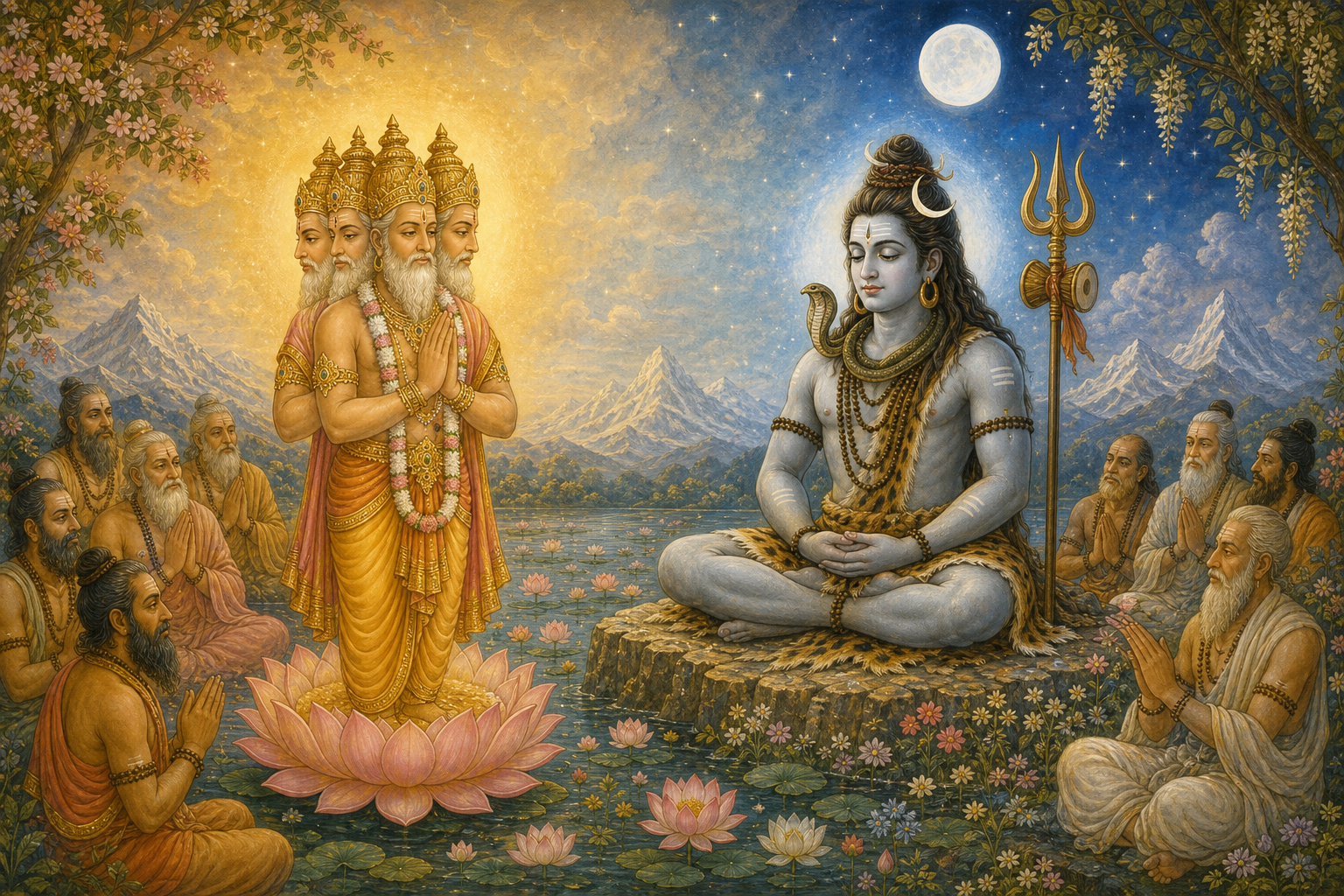
You may have reached Brahma’s praise of Siva with a practical doubt: if this is a Vaishnava setting, why is Siva being glorified, and what are you supposed to conclude from it? The usual mistake is to turn the scene into a contest before noticing what bhakti is asking us to value.
In Brihad-bhagavatamrita 1.2.81-88, Brahma glorifies Siva. That act gives you the key to the exchange: spiritual greatness cannot be measured only by cosmic office, visible power, or sectarian allegiance. It must also be recognized through relationship, devotion, humility, and service.
The question is not whether Brahma and Siva are rivals
Modern religious arguments often begin with a scoreboard: Who is higher? Who is independent? Whose worship is superior? Once that frame controls the reading, every expression of reverence is treated as either a victory or a concession.
Brahma’s glorification works differently. A great being recognizes greatness in another and directs attention away from himself. The first lesson therefore concerns the character of the speaker as much as the status of the one being praised. Brahma does not have to diminish Siva to protect his own dignity.
This distinction matters whenever you read a devotional scripture. Cosmic function answers one question; spiritual intimacy answers another. Authority within the universe is not automatically identical to depth of devotion. Bhakti repeatedly unsettles the assumption that the most prominent office must belong to the most spiritually intimate servant.
Keep the names clear as you read. Brahma is the personal deity associated with cosmic creation; Brahman is a term for ultimate reality and is not simply another spelling of Brahma. Siva, Shiva, and the diacritic form Siva with an accent mark are English transliteration choices for the same name, not three different figures.
What Brahma’s praise asks you to notice
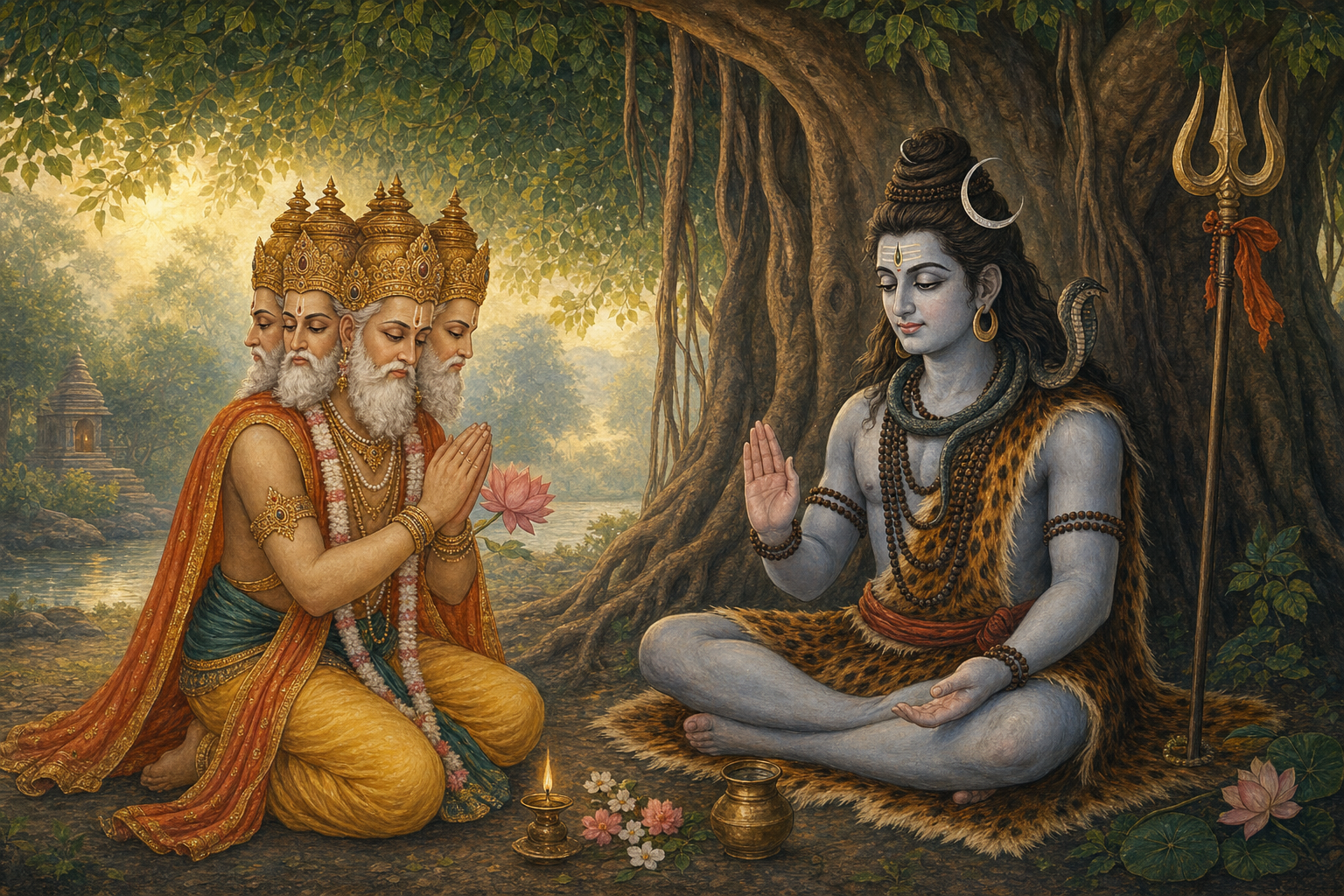
Glorification in bhakti literature is not decorative praise inserted between more important events. It discloses relationships. To understand it, look beyond titles and ask four concrete questions: Who offers honor? Which qualities are honored? How is the honored person related to Bhagavan? What change is the listener expected to undergo?
- Notice the direction of honor. Brahma is the speaker and Siva is the one being praised. Whatever hierarchy you bring to the scene, you must account for that voluntary movement of reverence.
- Separate position from disposition. A cosmic responsibility describes what a deva does. It does not, by itself, tell you the full quality of that deva’s devotion.
- Look for relationship rather than isolation. Within a Vaishnava reading, Siva’s greatness is not understood apart from his relationship with Bhagavan. Honoring such devotion can intensify devotion to Bhagavan rather than compete with it.
- Watch what praise does to the praiser. Genuine glorification loosens the desire to monopolize honor. Brahma’s words should therefore be read not merely as information about Siva but as a model of how a spiritually mature person recognizes excellence.
This gives you a useful test. If your interpretation makes Brahma anxious to defend his rank, or makes Siva valuable only as ammunition against another tradition, the sectarian argument has displaced the devotional movement of the exchange.
Honor does not require theological flattening

Reverence and doctrinal sameness are not synonyms. Vaishnava and Shaiva traditions do not all describe Siva’s ultimate status in the same way. A Shaiva may worship Siva as Supreme, while a Vaishnava may glorify him through a theology centered on Bhagavan and the excellence of devotion. Respecting both approaches requires stating the difference honestly, not blending them into a vague claim that every tradition teaches exactly the same thing.
If you are reading as a Vaishnava
Do not treat praise of Siva as an embarrassment that must be explained away. A Bhagavan-centered theology is not weakened when it recognizes an exalted devotee. It is weakened when loyalty becomes so brittle that another’s greatness cannot be acknowledged.
Your practical question should be: what does Brahma recognize that you have been failing to recognize? Read for qualities of devotion and service before reaching for a ready-made ranking.
If you are reading as a Shaiva
Receive the reverence without forcing a Vaishnava work to speak in an exclusively Shaiva theological grammar. Brahma’s glorification establishes that Siva cannot be casually dismissed, but one speech of praise does not by itself settle every metaphysical question debated among Hindu schools.
Your practical task is to distinguish sincere honor from complete doctrinal agreement. That distinction makes dialogue more accurate and protects Siva’s praise from being reduced to a debating weapon.
If you are seeking a non-sectarian reading
Do not confuse harmony with erasure. The scene remains meaningful precisely because Brahma and Siva are distinct, the act of praise has a direction, and their relationships matter. A pluralism that refuses to notice real differences becomes too thin to explain why one revered figure would glorify another.
A stronger non-sectarian approach allows each tradition to describe its own theology while expecting humility, accuracy, and freedom from contempt. You can honor a form of devotion without borrowing every doctrine or ritual practice associated with it.
A six-step reading practice for verses 81-88

Use the following method before consulting a sectarian debate about the verses. It keeps the words and relationships in view long enough for the theological point to emerge.
- Read verses 81-88 as one unit. Do not isolate a favorable phrase and build a complete doctrine on it. Note where Brahma’s glorification begins, how it develops, and where the speech turns next.
- Mark every action. Record who praises, serves, worships, receives, remembers, or redirects attention. Verbs often disclose the devotional relationship more clearly than titles do.
- Make four separate notes. Use the headings cosmic office, devotional quality, relationship with Bhagavan, and purpose within the conversation. Do not place a statement in more than one column unless the wording genuinely supports both.
- Identify imported assumptions. If your conclusion depends on an idea that is not present in these verses, label it as background from your own school. Background may be valid, but it should not be mistaken for the wording in front of you.
- Write the strongest conclusion and its limit. For example, the glorification clearly demands serious reverence for Siva. It does not, standing alone, resolve every Vaishnava-Shaiva disagreement about ultimate status.
- Choose one behavioral consequence. Replace mockery with accurate language, offer respect before disagreement, or acknowledge a genuine spiritual quality in someone outside your immediate community. If nothing changes in your conduct, the reading has remained theoretical.
Key takeaways
- Brahma’s praise of Siva should be read as an act of devotional recognition, not as a modern contest between religious teams.
- Cosmic office, metaphysical status, and devotional intimacy are related questions, but they are not interchangeable.
- A Vaishnava can honor Siva deeply without abandoning a Bhagavan-centered theology.
- A Shaiva can receive that honor without pretending that Vaishnava and Shaiva schools make identical claims.
- The most faithful interpretation should produce greater humility, more accurate speech, and less appetite for contempt.
Carry the glorification into your own conduct
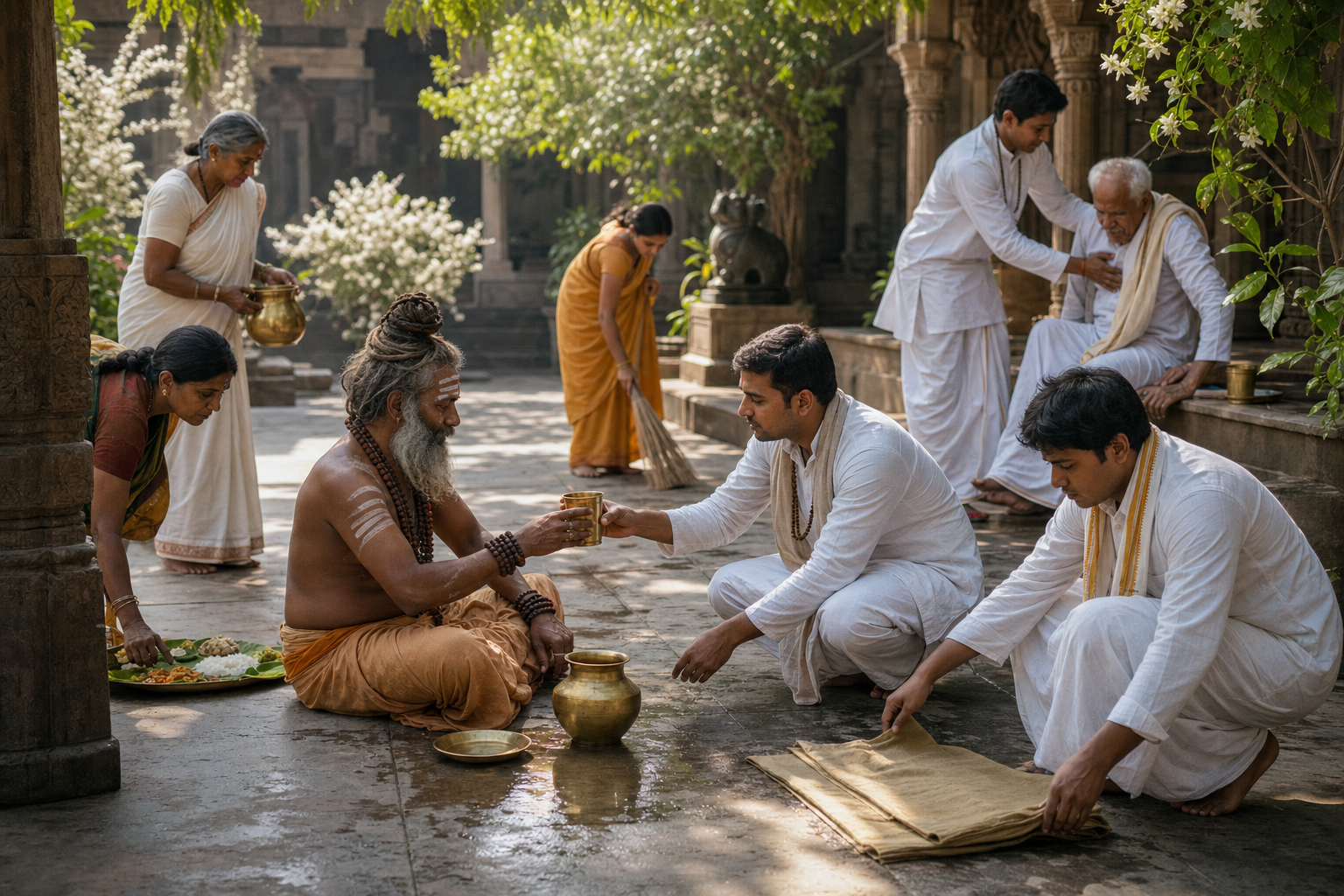
The sharpest question raised by Brahma’s words may not be where Siva belongs on your theological chart. It may be whether you can recognize holiness without feeling that your own devotion has been threatened.
At your next study gathering, resist beginning with the supremacy question. Read the eight verses aloud, list the qualities and relationships actually present, and allow each participant to state one conclusion the wording supports and one conclusion it cannot support by itself. That small discipline prevents both sectarian dismissal and sentimental flattening.
Then make the lesson personal. Think of one Dharmic community or teacher you usually approach as a competitor. Name one genuine excellence without pretending all doctrines are the same. Brahma’s glorification becomes spiritually useful when praise no longer feels like a loss of status and reverence becomes stronger than rivalry.