
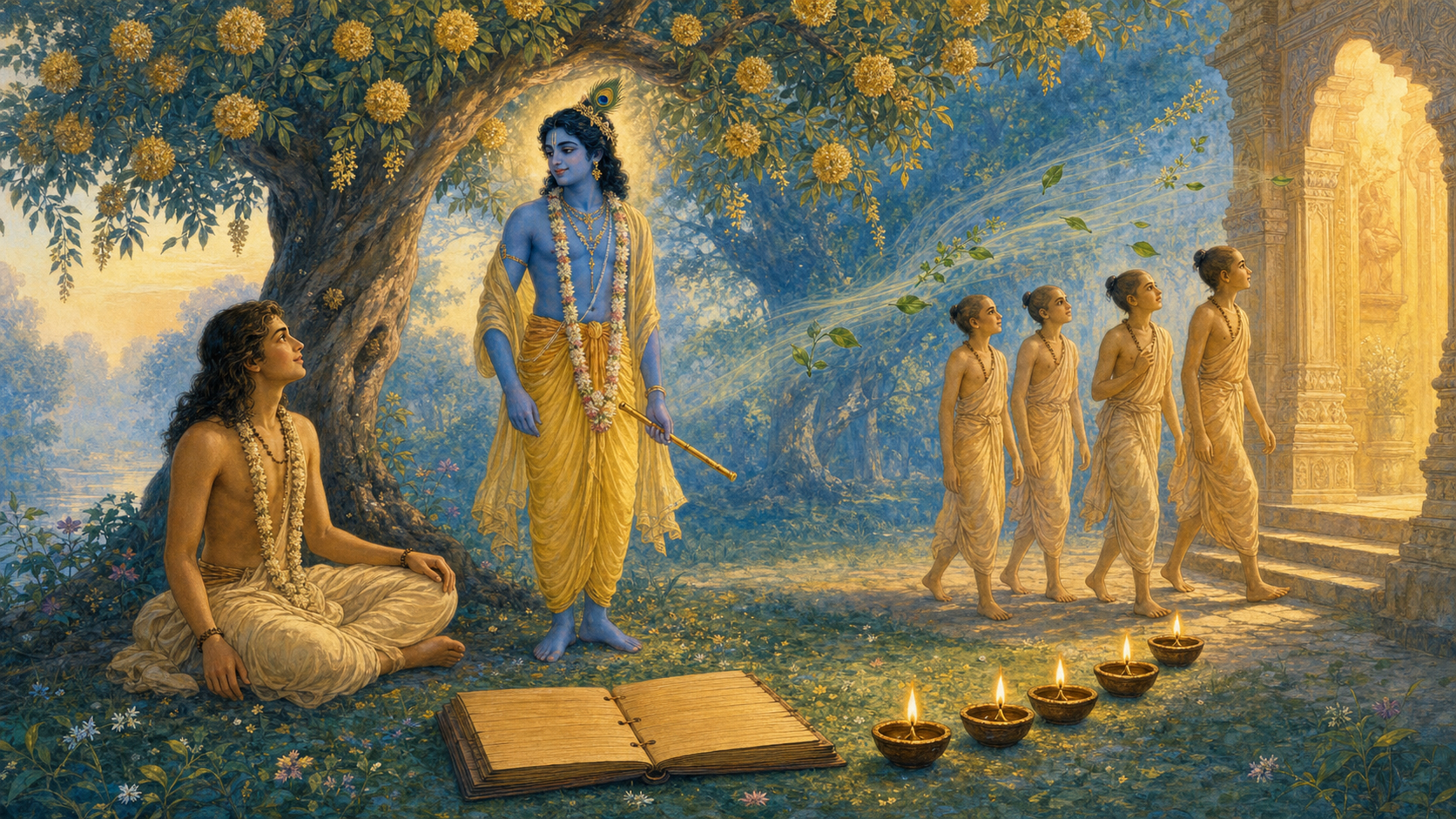
If you opened Madhya 17.138-142 and wondered why Sukadeva, the atmaramas, the Kumaras, and Tulasi appear within five verses, you are seeing the passage’s deliberate design. These are not disconnected examples. They answer one question from different angles: what can Krishna-bhakti offer someone who is already free from ordinary material craving?
The answer is not that spiritual knowledge is worthless. The verses make a subtler Gaudiya Vaishnava claim. Freedom from material want can bring profound satisfaction, but Krishna’s personal qualities, pastimes, and sacred presence awaken something more: loving relationship expressed through seva.
The five verses form one carefully ordered argument
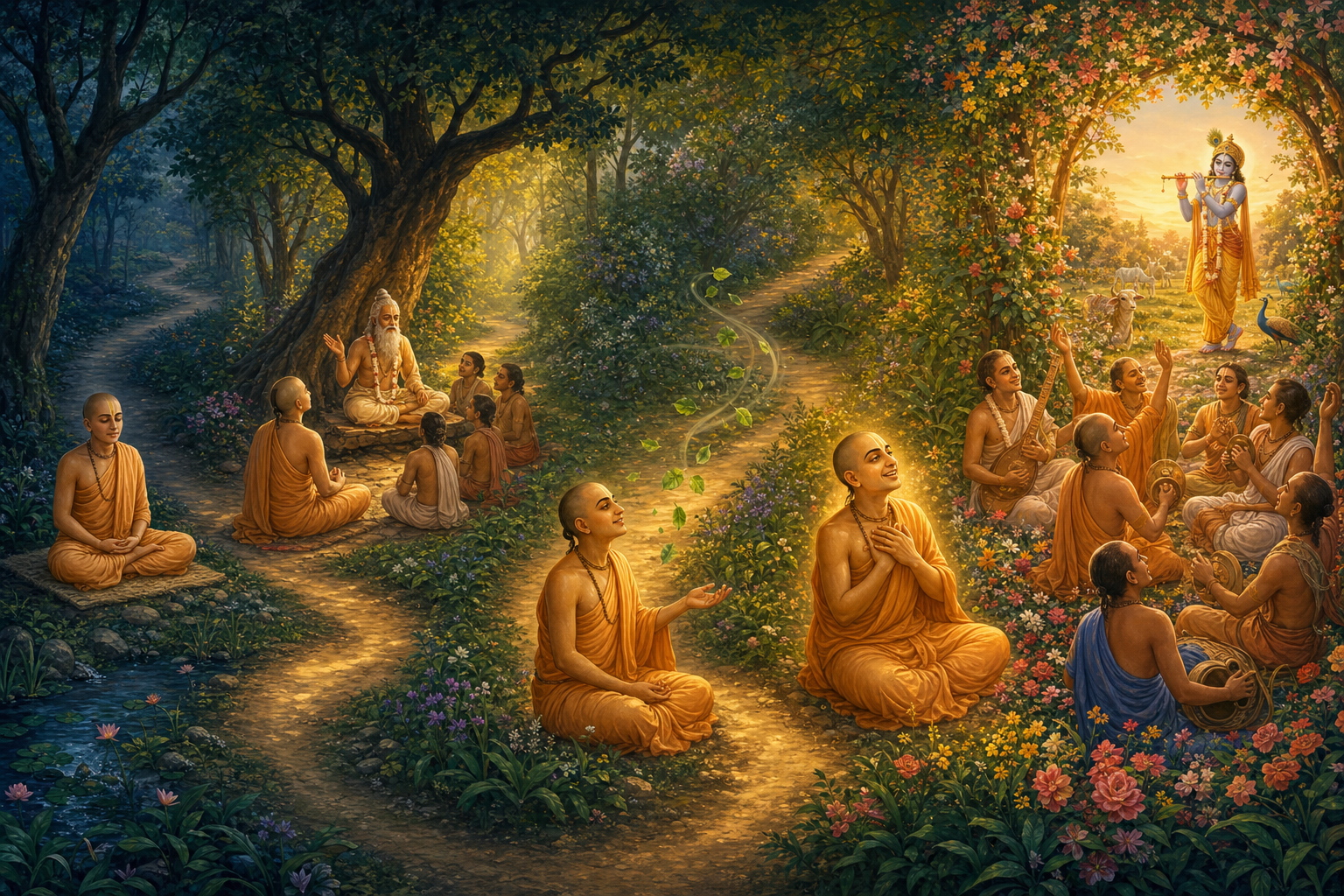
It is easy to extract verse 140, the celebrated atmarama verse, and treat it as a self-contained declaration. Read in sequence, however, Madhya 17.138-142 moves from a particular devotee to a general principle and then to a second embodied example.
- Verse 138 gives the first witness: Sukadeva Gosvami is already absorbed in the happiness of Brahman realization, yet Krishna’s melodious pastimes attract him. That attraction bears fruit when he speaks the Srimad-Bhagavatam for the benefit of others.
- Verses 139-140 state the principle: Krishna’s qualities and astonishing activities attract even atmaramas, people satisfied within the self and not driven by external material desires, toward loving service.
- Verses 141-142 give the second witness: the Kumaras encounter the fragrance of Tulasi and saffron carried from Krishna’s feet. The contact reaches them through smell and produces a change in both body and mind despite their attachment to impersonal Brahman realization.
The sequence matters. Sukadeva shows attraction through hearing Krishna-lila. The atmarama verse explains why that attraction is theologically significant. The Kumaras show sacred fragrance opening the same movement toward personal devotion. Narrative, doctrine, and embodied encounter all point in one direction.
When you study the passage, therefore, do not ask only, “What happened to these sages?” Ask, “What did they already possess, what reached them, and what kind of response followed?” Those questions reveal the argument far more clearly than isolating a Sanskrit term or collecting a memorable quotation.
Sukadeva shows why spiritual completion need not mean closure
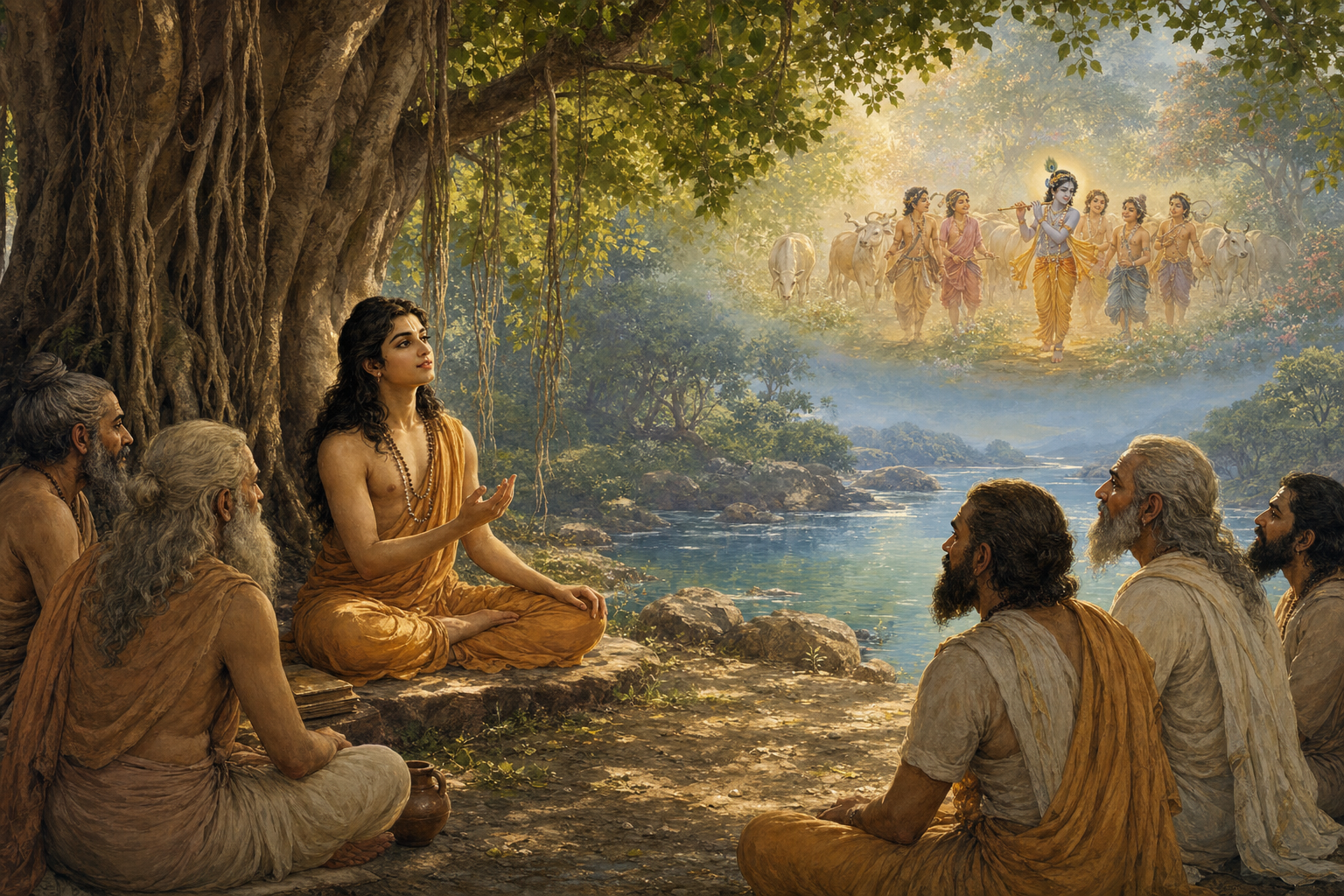
Verse 138 presents Sukadeva as already absorbed in Brahman happiness and living in seclusion. He is not portrayed as spiritually empty, frustrated by worldly pleasures, or looking for a distraction. Krishna’s pastimes attract someone who has already gone beyond the ordinary economy of desire and gratification.
This detail rules out a common misreading: bhakti is not introduced here as emotional compensation for people unable to sustain jnana. Sukadeva is chosen precisely because material need cannot adequately explain his response. He is fulfilled, but his fulfilment has not made him incapable of receiving a richer disclosure of the Absolute.
The result of that encounter is just as important as the attraction itself. Sukadeva does not merely enjoy an elevated private feeling. He speaks the Srimad-Bhagavatam. In other words, his attraction becomes service through sacred speech, and his inward realization becomes mercy directed toward listeners.
That gives you a practical test for hearing Krishna-katha. Do not measure a worthwhile hearing only by the intensity of the feeling it produces during the narration. Look at what follows. Are you more willing to remember Krishna, speak about him responsibly, serve devotees, and make your conduct answerable to what you heard? If Krishna-katha becomes only aesthetic consumption or material for winning arguments, the movement shown by Sukadeva has been interrupted before its fruit.
Verses 139-140 then generalize the example. An atmarama is satisfied in the self rather than dependent on external material objects for fulfilment. Yet Krishna’s transcendental qualities and wonderful activities attract such persons toward loving service. The crucial phrase is not attraction alone but attraction toward service. Bhakti is relational. It does not merely replace one inner state with a more pleasurable inner state.
The distinction can be put plainly. Brahman realization, as represented in these verses, removes dependence on material lack. Krishna-bhakti introduces loving reciprocity with the personal Absolute. The Gaudiya claim is therefore a claim of positive fullness: not simply freedom from craving, but freedom used for loving service.
Other Vedanta traditions do not all arrange Brahman realization and personal bhakti in this hierarchy. You should read the claim accurately as Gaudiya Vaishnava theology, not flatten it into a verdict supposedly shared by every Hindu sampradaya. That precision does not weaken the passage. It lets you understand what it is actually trying to establish.
The Kumaras show that the senses can become doors to bhakti

Verses 141-142 change the mode of encounter. Sukadeva is drawn by Krishna’s pastimes. The Kumaras are reached by fragrance: a breeze carries the aroma of Tulasi leaves and saffron from the feet of the lotus-eyed Lord, enters through their nostrils, and affects their hearts. Their body and mind change even though they are attached to the impersonal understanding of Brahman.
The point is not that any pleasant aroma is spiritually transformative. The passage carefully preserves a chain of relationship: the breeze carries Tulasi and saffron; they have been in contact with Krishna’s feet; the fragrance is then received by the sages. Remove that relationship to Krishna and seva, and all that remains is perfume.
This corrects two opposite mistakes. One mistake treats the senses as inherently unspiritual and assumes that mature practice must become increasingly abstract. The other mistakes any strong bodily sensation for proof of realization. The Kumaras’ experience supports neither conclusion. Their senses matter because they receive something sanctified through relationship with Krishna, while the value of the experience lies in the devotional reorientation it produces.
If Tulasi offering belongs to the worship taught by your sampradaya, do not handle the leaf as mere decoration or a ritual object to be moved mechanically. Follow the received method of your temple, guru, or lineage. Then notice what the passage asks you to remember: Tulasi is being offered in service and understood through her relationship with Bhagavan.
The same discipline applies to darshan, kirtan, incense, bells, prasada, and sacred spaces. A sense impression is not the final goal. Let the impression carry your attention toward the person being served. When your mind wanders during worship, return through the sense already engaged: hear the name you are chanting, see the murti before you, or attend to the fragrance associated with the offering. Do not wait passively for an extraordinary emotion.
Nor should you imitate the bodily transformation of the Kumaras. The verses describe their response; they do not give you a performance standard. Tears, trembling, stillness, or excitement can arise for many reasons. A safer question is whether the experience deepens remembrance, humility, and willingness to serve. That keeps your attention on the passage’s direction rather than on displaying its symptoms.
Use Madhya 17.138-142 as a five-step sadhana study

You can turn these five verses into a compact study practice without reducing them to slogans. Keep your chosen translation and commentary beside you, and work through the following sequence.
- Read all five verses as one unit. Do not stop after the atmarama verse. Verse 138 supplies the first example, while verses 141-142 complete the argument with the Kumaras.
- Write down what each person already possesses. Sukadeva is absorbed in Brahman happiness. The atmaramas are self-satisfied and free from external material desire. The Kumaras are attached to impersonal Brahman realization. This prevents you from explaining their attraction as ordinary neediness.
- Identify the form of contact. Mark Krishna’s melodious pastimes, his transcendental qualities and activities, and the fragrance of Tulasi and saffron from his feet. The passage does not present bhakti as a conclusion reached by abstraction alone.
- Trace the movement after contact. Sukadeva speaks the Bhagavatam. The atmaramas turn toward loving service. The Kumaras undergo a change in body and mind. In every case, encounter becomes reorientation.
- Choose a corresponding act of seva. Hear Krishna-katha without multitasking, chant while attending to the sound, speak one insight for another person’s benefit, or participate carefully in Tulasi seva according to your lineage. Choose the act that makes the teaching concrete rather than merely memorable.
As you work, catch three interpretive errors. Do not turn the verses into an insult aimed at every non-Gaudiya school. Do not reduce bhakti to emotional stimulation. And do not make impersonal realization the villain of the narrative. The argument depends on Sukadeva and the Kumaras already possessing genuine spiritual attainment; Krishna’s personal attraction is presented as surpassing that attainment through relationship, not merely repairing a failure.
Key takeaways
- Madhya 17.138-142 presents one argument through Sukadeva, the atmarama principle, and the Kumaras.
- Bhakti is not portrayed as the product of material deficiency; Krishna attracts persons already satisfied beyond external desire.
- The decisive movement is from attraction to loving service, not from one private feeling to another.
- Sacred sensory experience gains meaning through its relationship to Krishna and seva, not through sensation alone.
- The passage should sharpen your own hearing, remembrance, and service before it becomes material for a sectarian debate.
On your next reading, keep this sequence in view: prior fulfilment, contact with Krishna, attraction, and seva. Trace it through each example, then give your next act of hearing or worship undivided attention. That is where these verses stop being an argument you understand and begin becoming a discipline you can live.