
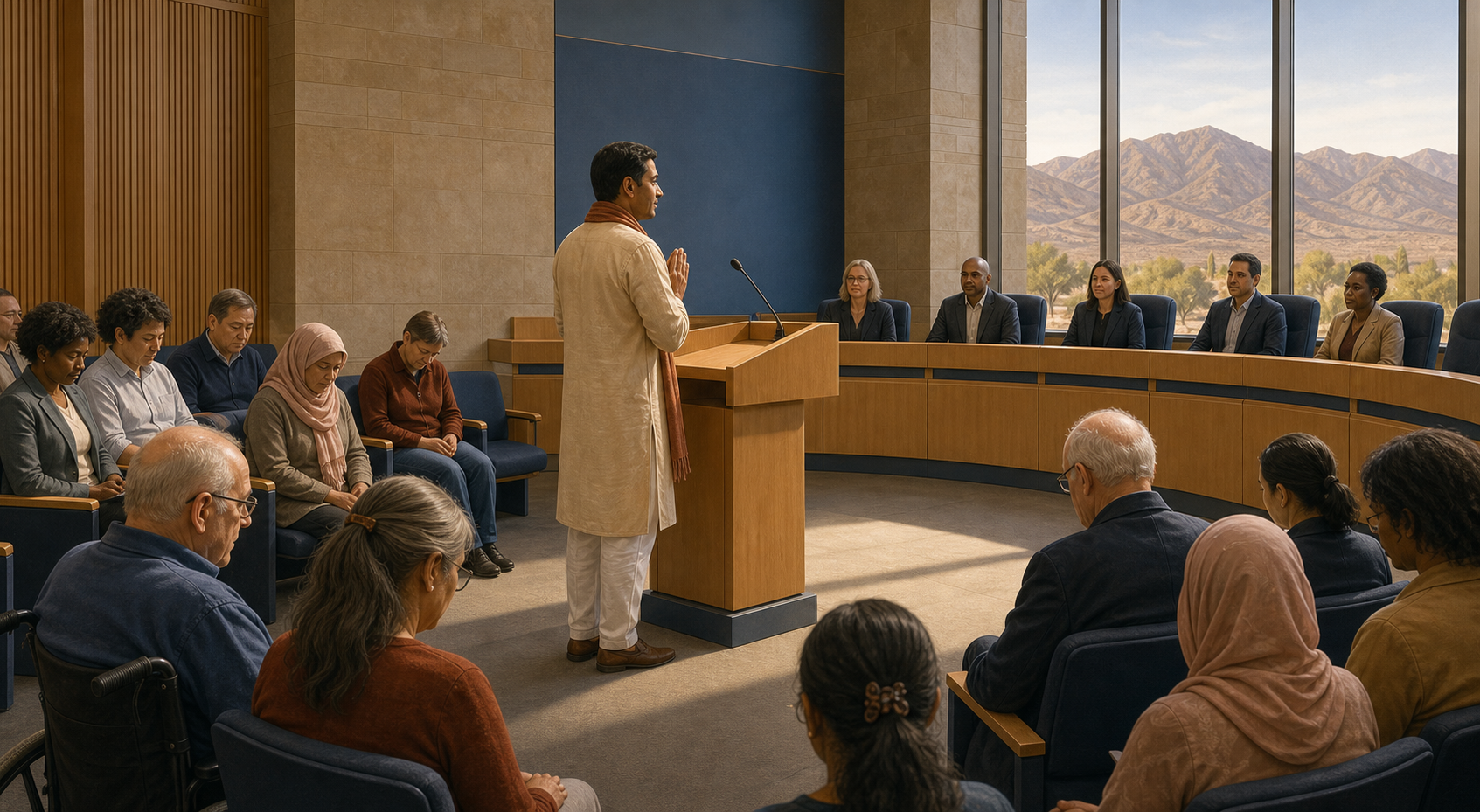
If your city hall announces a Hindu invocation, pride may be your first reaction. The harder question comes next: does a Vedic prayer belong inside an American institution that serves people of every faith and none?
It can, but the terms matter. A civic invocation should make room for a Hindu voice without turning participation into a test of belonging. Elko, Nevada offers a useful case for seeing how sacred identity, public ethics, and freedom of conscience can meet without any one of them being diminished.
Elko’s first marks equal standing, not civic conversion

The Elko City Council scheduled its May 26, 2026 meeting to open with its first Hindu invocation. Rajan Zed was to lead the prayer, centering the Gayatri Mantra and drawing on other Vedic or Upanishadic verses selected for a brief public setting.
The word “first” matters because Hindu Americans are not asking to be visible only at festivals, temples, or multicultural exhibitions. They are residents, taxpayers, public servants, and neighbors. Hearing Sanskrit within the ordinary work of local government acknowledges that a Hindu voice belongs in the civic community rather than at its ceremonial edge.
That recognition should be described accurately. One Hindu invocation does not make a council Hindu, place its decisions under religious authority, or give Hinduism a preferred legal status. It shows that an established civic custom can include a tradition that had not previously been heard there.
If you are speaking about such an occasion, call it equal civic inclusion rather than a religious victory over somebody else. The first description asks for a public square open to many communities. The second turns a contemplative moment into a contest for possession of the institution.
What the Gayatri Mantra asks of a public institution

The commonly recited form of the Gayatri Mantra addresses Savitr, the vivifying solar principle, and asks that divine radiance awaken and guide human understanding:
om bhur bhuvah svah | tat savitur varenyam | bhargo devasya dhimahi | dhiyo yo nah pracodayat
Rigveda 3.62.10
A concise English rendering is: We contemplate the divine radiance of the life-giving source; may it illuminate and direct our intellects. The crucial word for civic purposes is dhi, the faculty of understanding, discernment, and judgment. The prayer does not supply officials with a policy answer. It asks that the mind making the decision become clearer and worthier of its responsibility.
That makes the mantra unusually apt before deliberation. Council members are about to weigh competing claims, limited resources, legal duties, and consequences for people who may not be in the room. A prayer for disciplined intelligence is more demanding than a request for success. It turns attention toward the quality of judgment itself.
The Gayatri is also a precise verbal form, not a piece of generic inspirational language. Its classical meter has three lines of eight syllables, making 24 syllables in the core verse. Formal Vedic recitation preserves distinctions of pitch known as udatta, anudatta, and svarita. A civic recitation may use a simpler cadence for brevity and intelligibility, but it should not be advertised as a fully accented formal chant if those features are not being observed.
Translation matters just as much in the council chamber. A one-sentence explanation does not replace the Sanskrit or reduce its sacred character. It lets a listener understand that the invocation concerns illumination of the intellect, not submission to an unfamiliar creed. Conversely, translating the Gayatri as nothing more than a vague wish for peace loses the mantra’s emphasis on awakened discernment.
A short peace verse can widen the frame after the Gayatri. The Upanishadic movement from untruth toward truth and darkness toward light is immediately relevant to public responsibility. A prayer that all may be happy, healthy, safe, and free from suffering directs attention beyond the faction that happens to hold power. The closing cadence of om shantih shantih shantih then allows the room to settle before debate begins.
Four tests for an inclusive civic invocation
An invocation at a government meeting is not identical to worship in a temple. Officials exercise public authority, attendance may be necessary for residents with business before the council, and the room includes people who did not choose a religious gathering. Constitutional permission is therefore only the beginning; the practice must also be administered with care.
Marsh v. Chambers (1983) and Town of Greece v. Galloway (2014) form part of the constitutional background for legislative prayer in the United States. In practical terms, a sound municipal practice should be non-coercive, religiously neutral in access, and open to different traditions rather than designed to preserve one customary faith as the default.
- Neutral access: The method for inviting or selecting speakers should not exclude a tradition merely because it is unfamiliar. A rotation or open process is more defensible than informal preference for the community’s historically dominant religion.
- No compelled participation: Residents must remain free to listen, sit quietly, participate silently, or refrain. Nobody should have to recite om, bow, close their eyes, or make a religious gesture to appear respectful or receive ordinary civic treatment.
- A civic purpose and tone: The invocation may express a tradition clearly, but it should not seek converts, disparage another path, or turn the meeting into a platform for sectarian rivalry.
- Brevity with intelligibility: Sanskrit can remain Sanskrit, but a short English meaning and a sentence of context give every listener a fair way into the moment. The prayer should steady the meeting rather than displace its public business.
Apply those tests consistently. Sanskrit is not coercive merely because some listeners do not understand it, just as familiarity does not automatically make another tradition’s prayer neutral. Look at the invitation policy, the words spoken, the directions given to attendees, and the way officials respond to nonparticipants.
If you are involved in an actual dispute over a council’s policy or conduct, the two court decisions are starting points rather than a personalized legal answer. Local procedures and the facts of the meeting can affect the analysis, so obtain advice from a qualified constitutional or municipal-law attorney before pursuing a legal challenge.
How to request a Dharmic voice without asking for preference

If you want a Hindu, Buddhist, Jain, or Sikh voice included at a local meeting, begin with the institution’s existing procedure. A well-prepared request makes it easier for officials to recognize equal access and harder for them to mistake the request for a demand that the city endorse a religion.
- Read the current policy. Ask the city clerk how invocation speakers are selected, how far in advance the agenda is set, whether a time limit applies, and whether proposed wording must be submitted.
- Request inclusion under the same rule. Ask for a qualified Dharmic representative to participate through the process already available to other communities. If no clear process exists, ask the council to adopt a neutral one rather than requesting a private exception.
- Provide the exact material. Submit the Sanskrit text, its textual identification, a plain-English rendering, the officiant’s name, and the expected duration. This reduces avoidable uncertainty without surrendering the tradition’s voice.
- Design for the room. A practical sequence is a short introduction, the Gayatri, an English meaning, and a peace closure. The recitation and explanation can be delivered in roughly one minute when the local format requires brevity.
- Protect textual integrity. Check pronunciation with someone competent in the recitation. If a simplified melodic cadence will be used, describe it honestly rather than claiming the full pitch discipline of formal Vedic transmission.
- State the freedom to observe. Ask the chair or officiant to make clear that attendees may participate silently, listen respectfully, or simply remain present. That sentence protects the conscience of the room and the dignity of the prayer.
After the meeting, make the text and translation available for residents who are curious. A library discussion, classroom resource, or interfaith conversation can turn a brief ceremony into durable understanding. Avoid treating the occasion as a victory lap; the best result is normal, informed inclusion rather than permanent novelty.
A Dharmic coalition can help, provided it does not flatten distinct traditions. Hindu invocations, Buddhist metta, the Jain Namokar Mantra, and the Sikh Mool Mantar are not interchangeable. They can meet in a public vocabulary of non-harm, truth, compassion, service, and moral clarity while each community explains its own practice in its own terms. Shared values become more credible when differences are not concealed.
Quick answers about Vedic prayer in civic space
Is the Gayatri Mantra universal or specifically Hindu?
It is a specifically Vedic and Hindu sacred text whose appeal can be understood universally. Its request for illuminated judgment does not require the mantra to be stripped of its origin. Inclusion works when a tradition can speak in its real voice while listeners remain free to receive its ethical meaning without adopting its theology.
Does an English translation weaken the Sanskrit?
No. In a civic setting, translation is a bridge, not a substitute. Keep the Sanskrit intact, identify the Rigvedic verse, and offer one accurate sentence about Savitr, divine radiance, and the guidance of the intellect. That is more respectful than either omitting the original or leaving unfamiliar listeners to guess what was said.
What should you do while the invocation is recited?
You may join silently if the practice is yours, listen with respectful attention, or observe without religious participation. You do not need to imitate gestures or repeat words you do not believe. A properly conducted civic invocation leaves all three choices open.
If you want the next Dharmic civic invocation to be more than a symbolic first, ask the clerk for the policy, prepare the exact Sanskrit and translation, time the recitation, and insist on freedom of response. That is how Vedic prayer can enter American public life with confidence, accuracy, and restraint.