
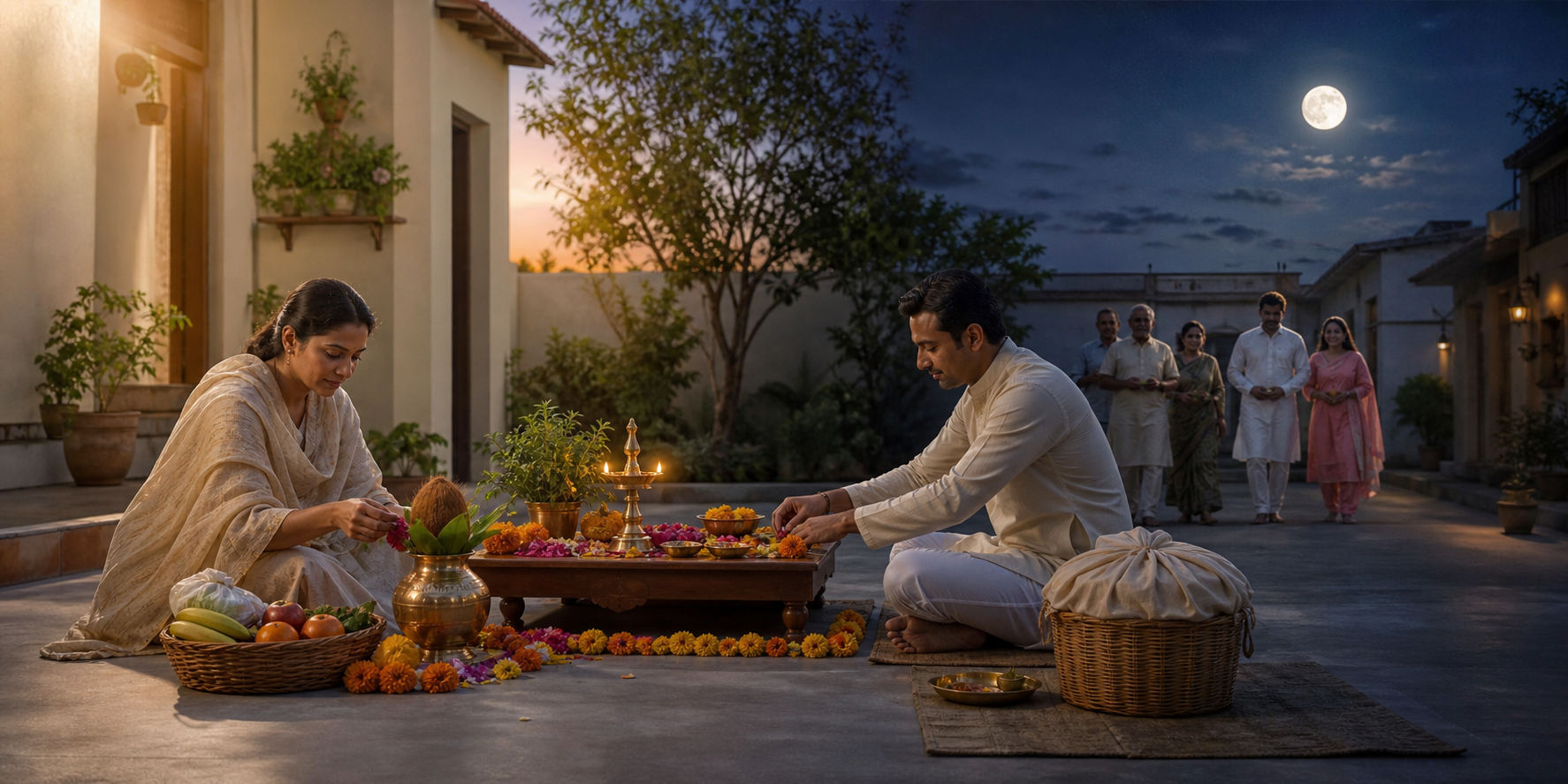
If you are deciding when to perform puja, keep a vrata, make dana, hold satsang, or arrange a community observance on May 30, the date needs more than a single festival label. Saturday begins under Shukla Paksha Chaturdashi and moves into Purnima during the day.
The practical answer is to use the morning for preparation, verify the transition for your city, and place any specifically Purnima observance after the local change of tithi. Do not copy a clock time from another city or treat the unqualified time “1:02” as a dependable cutoff.
What changes at 11:11 AM on May 30
Shukla Paksha Chaturdashi is listed as prevailing until 11:11 AM in most regions, after which Purnima begins. This makes May 30 a transition day rather than a civil date governed by one tithi from midnight to midnight.
A tithi is determined by the changing angular distance between the Moon and Sun. Each tithi covers 12 degrees of that separation. Shukla Paksha Chaturdashi corresponds approximately to 156 degrees through 168 degrees; Purnima covers approximately 168 degrees through 180 degrees, with the exact full-moon condition reached near 180 degrees. The transition therefore occurs when the celestial geometry changes, not when a conventional clock reaches a standard hour.
This distinction explains why two almanacs can show slightly different times without either one necessarily being careless. Longitude, latitude, local sunrise, time-zone treatment, and the calculation method used for the chosen place can move the displayed boundary by minutes or, in some cases, longer. Use 11:11 AM as an orientation point, not as a universal command for every location.
Purnima is also shown as continuing until 1:02, but that bare time is incomplete for practical planning. Before using it, confirm whether your local Panchang means 1:02 AM or 1:02 PM and whether the endpoint falls on May 30 or after the civil date rolls over. This matters for a vrata ending rule, a late-night puja, or any program advertised as taking place while Purnima is still operative.
Build your schedule in the right order
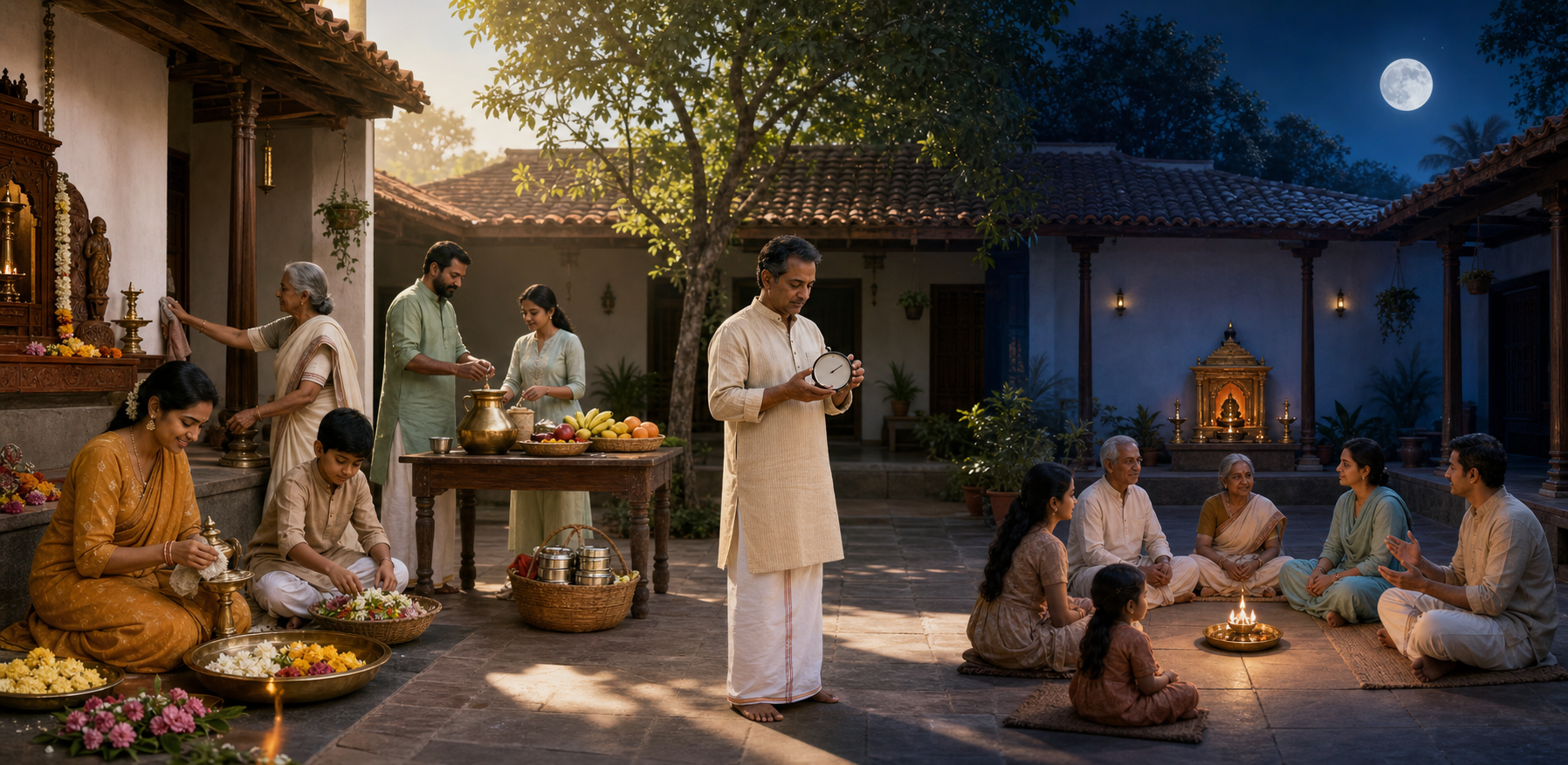
The common planning error is to find an attractive muhurta first and only afterward ask whether the required tithi is present. Reverse that order. The tithi establishes the relevant lunar window; local auspicious and avoidance periods refine where within that window you act.
- Set the exact venue. Enter the city where the observance will physically happen, not the city where the organizer lives and not a family hometown whose Panchang you normally follow. For an online gathering, select the venue or lead officiant’s location and tell participants which location governs the schedule.
- Record the complete tithi line. Write down the local end of Chaturdashi, the beginning of Purnima, and the full Purnima end time with its date and AM or PM designation. If an app shows only “1:02,” open its detailed day view before relying on it.
- Decide which part actually requires Purnima. Cleaning the worship space, arranging materials, preparatory recitation, and forming the household’s resolve can be completed during Chaturdashi. If the main puja, vrata observance, satsang, dana, or study session is intended specifically for Purnima, place that part comfortably after the locally verified transition.
- Overlay the local day divisions. Check Abhijit Muhurta, Rahu Kalam, Gulikai Kalam, and Yamaganda only after establishing the usable tithi interval. Abhijit Muhurta is centered on local solar noon; it is not automatically a fixed 12:00 PM slot. Saturday’s Rahu Kalam generally occupies a morning division after sunrise, but its clock time changes with the local span from sunrise to sunset.
- Publish one unambiguous schedule. A family message or temple notice should state the city, time zone, tithi transition, and chosen start time. If the gathering spans locations, add the equivalent civil times for participants while keeping one declared Panchang location as the ritual reference.
Do not place the main act exactly on a predicted boundary. Astronomical timings are precise within a calculation system, but your household clock, the officiant’s arrival, and the almanac used by another participant may not match perfectly. A start comfortably within the verified Purnima portion avoids turning a devotional observance into an argument over a few minutes.
Observances that fit the Chaturdashi-to-Purnima movement
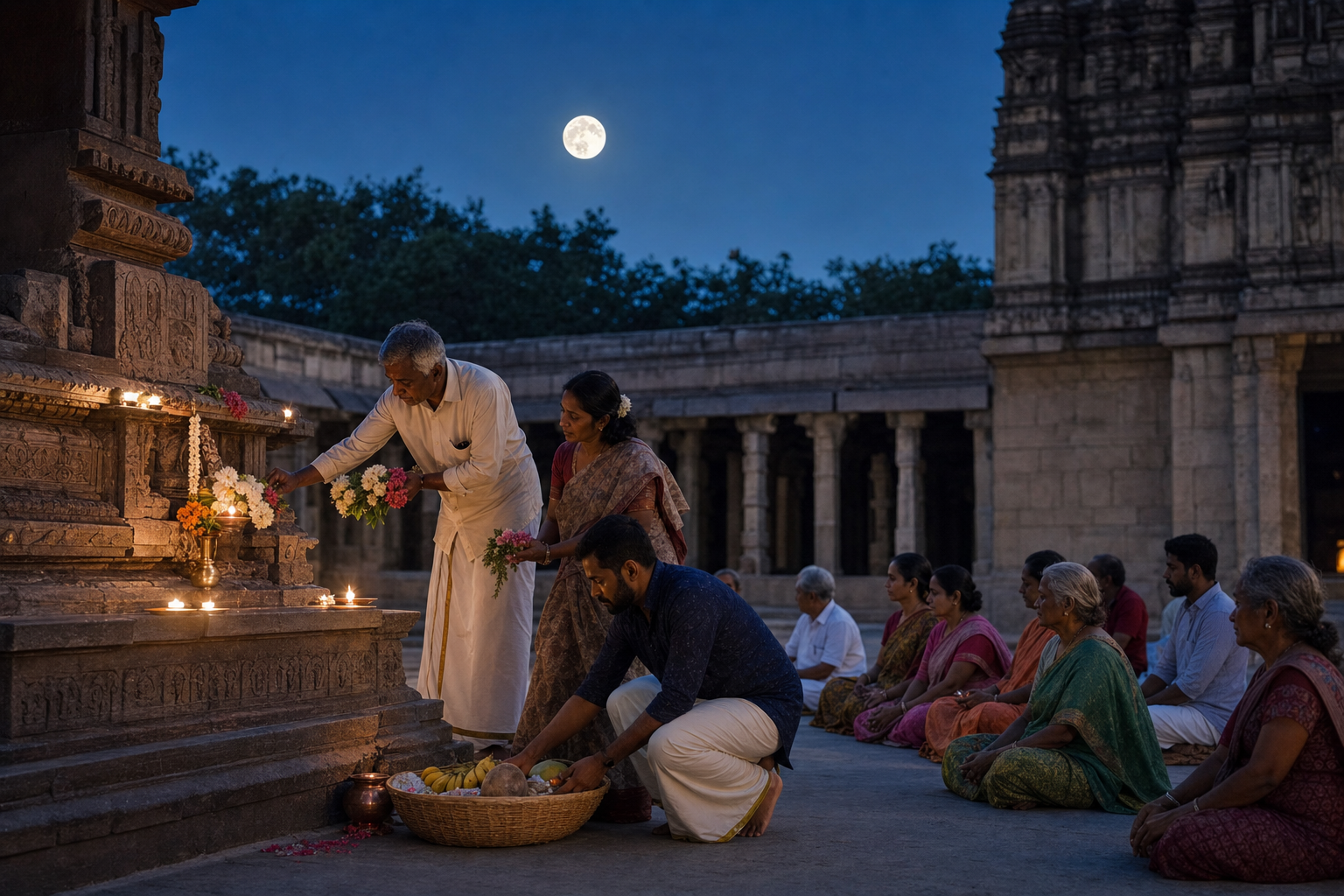
For a Hindu household
The closing portion of Shukla Paksha Chaturdashi lends itself to completion and preparation. Use it to settle unfinished arrangements, complete preliminary worship, clarify the sankalpa, and reduce avoidable activity around the main observance. The purpose is not to treat Chaturdashi as spiritually inferior; it is to let one phase complete before beginning an act deliberately assigned to Purnima.
After Purnima begins locally, suitable choices include Satyanarayan Puja where that is your family tradition, stotra recitation, satsang, darshan, scriptural study, quiet contemplation, or dana. You do not need to combine all of them. Choose one primary practice that your household can perform attentively, then support it with a simple act of seva or giving.
If you are keeping a particular vrata, follow the vrata’s own lineage or household rules for sankalpa, fasting, worship, and parana. A general Purnima timetable cannot determine every observance’s breaking rule. Confirm those details with the temple, acharya, or established calendar your family already trusts.
For Buddhist, Jaina, and Sikh families
Full-moon observance has significance across several Dharmic traditions, but the same lunar phase does not make every community’s calendar identical. Many Buddhist traditions give the full moon an important place in communal and contemplative practice. Jaina communities may coordinate fasting and pratikraman cycles with lunar phases. If your sangha or local community has issued a calendar for May 30, use that tradition-specific calendar rather than assigning a universal festival name from the word Purnima alone.
Some Sikh commemorative dates have historically been reckoned through the Punjabi lunar or Bikrami calendar. That shared civilizational use of lunar time is meaningful, but Purnima on May 30 does not by itself establish a Gurpurab or another Sikh commemoration. Check the gurdwara’s calendar before announcing one.
For a mixed Dharmic gathering
A family or community containing several traditions can honor the day without blending distinct rites into an invented composite ceremony. Keep lineage-specific worship in its proper form, then gather around practices that genuinely travel across traditions: gratitude, disciplined study, silence, seva, dana, and respectful fellowship.
For a shared program, announce the tithi transition as calendrical context rather than claiming that every participant observes Purnima in the same way. This preserves unity without erasing theological and ritual differences.
Five Panchang mistakes to avoid on this date
- Treating midnight as the ritual boundary: May 30 contains both Chaturdashi and Purnima. The Gregorian date changes at midnight; the tithi changes when the Moon-Sun angular separation crosses its next 12-degree boundary.
- Copying 11:11 AM without setting a city: The listed transition is a useful general marker, but your local Panchang governs a location-sensitive observance.
- Reading “1:02” as a complete endpoint: A time without AM or PM and a civil-date reference can move an observance to the wrong side of the Purnima boundary.
- Choosing Abhijit Muhurta before checking the tithi: A favorable solar-noon interval does not answer whether Purnima has begun. Establish the lunar requirement first, then compare the local muhurta and avoidance periods.
- Guessing Nakshatra or lunar Rashi from the full moon alone: Near the end of May, the Sun is in Vrishabha under the relevant sidereal framework, and a full Moon stands opposite the Sun. That broad relationship is not enough to supply an exact Nakshatra or a dependable lunar Rashi for every requested time. Read both from a Panchang calculated for the venue.
The visible Moon is not a substitute for this calculation. Purnima tithi spans an angular interval leading toward the exact full-moon condition; its beginning is not simply the moment when the Moon looks round to the eye. Weather, horizon, and observation time affect what you see, while the tithi is determined astronomically.
Key takeaways: your May 30 checklist
- May 30, 2026 is a Saturday that moves from Shukla Paksha Chaturdashi into Purnima.
- Use 11:11 AM as the general transition reference, then replace it with the value calculated for your city.
- Verify whether the listed Purnima endpoint of 1:02 is AM or PM and which civil date it belongs to.
- Complete preparatory activity during Chaturdashi and schedule a specifically Purnima rite after the locally confirmed transition.
- Check Abhijit Muhurta, Rahu Kalam, Gulikai Kalam, and Yamaganda from local sunrise data rather than from a generic clock-time chart.
- Obtain Nakshatra and lunar Rashi from the same location-specific Panchang instead of inferring them from the date.
Set your city first, write the complete tithi timings beside your intended practice, and share that schedule with everyone involved. Once those three things agree, you can give the observance your attention instead of spending the day resolving calendar confusion.