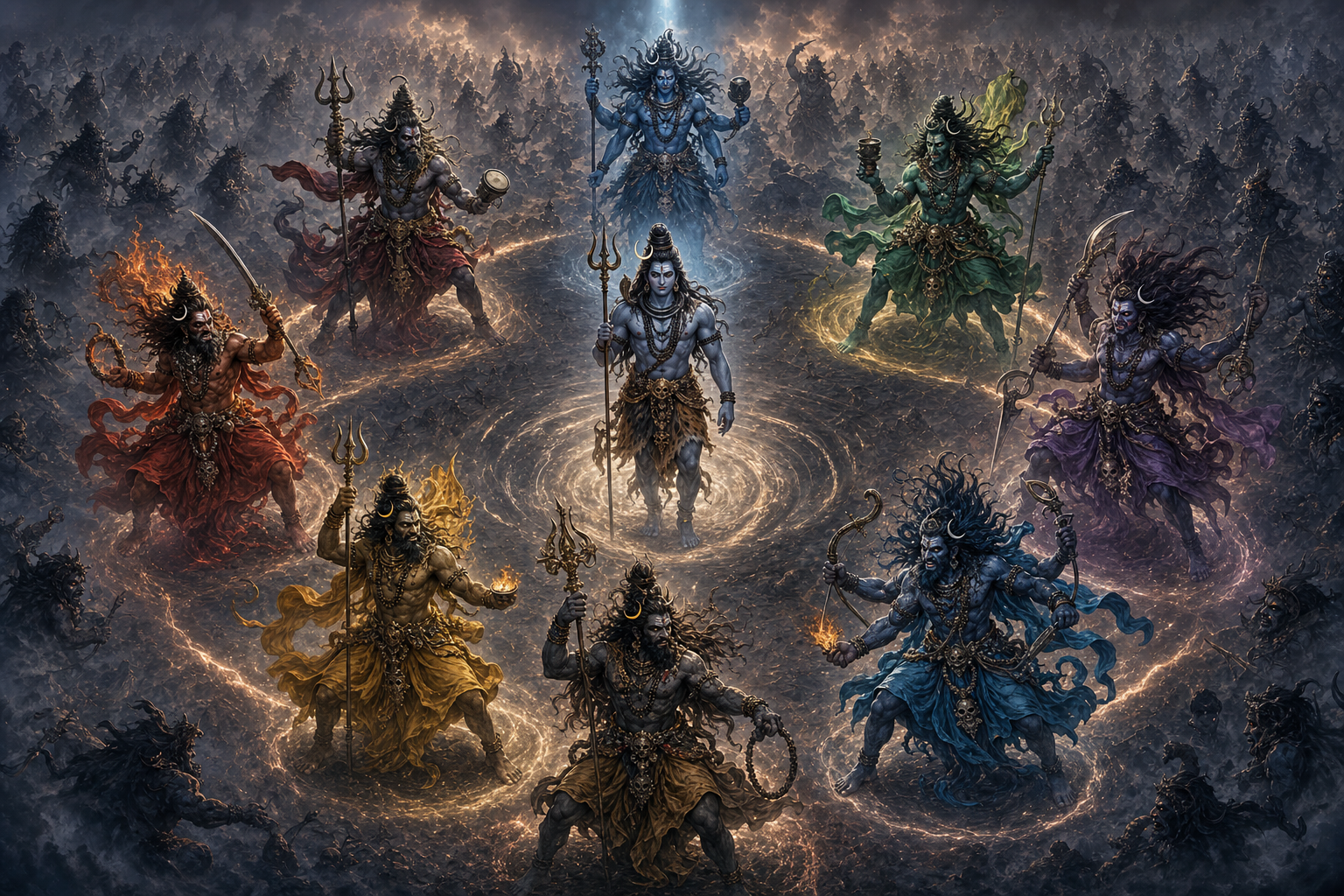
You may have encountered three explanations for the Eight Bhairavas: they arose from Shiva’s blood, they are emanations of Kala Bhairava, and they guard the eight directions. These explanations need not compete. Each answers a different question about the same group of fierce deities.
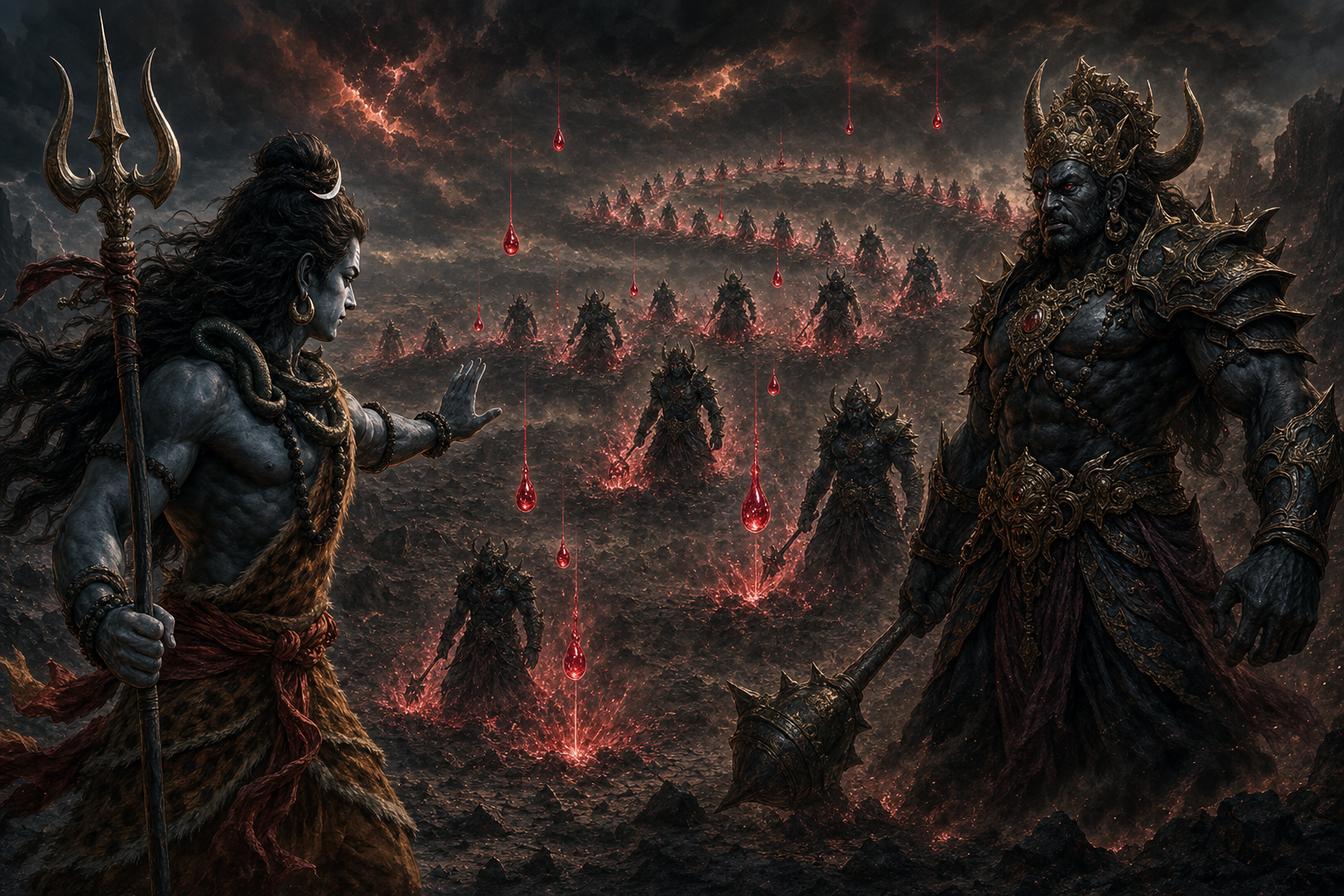
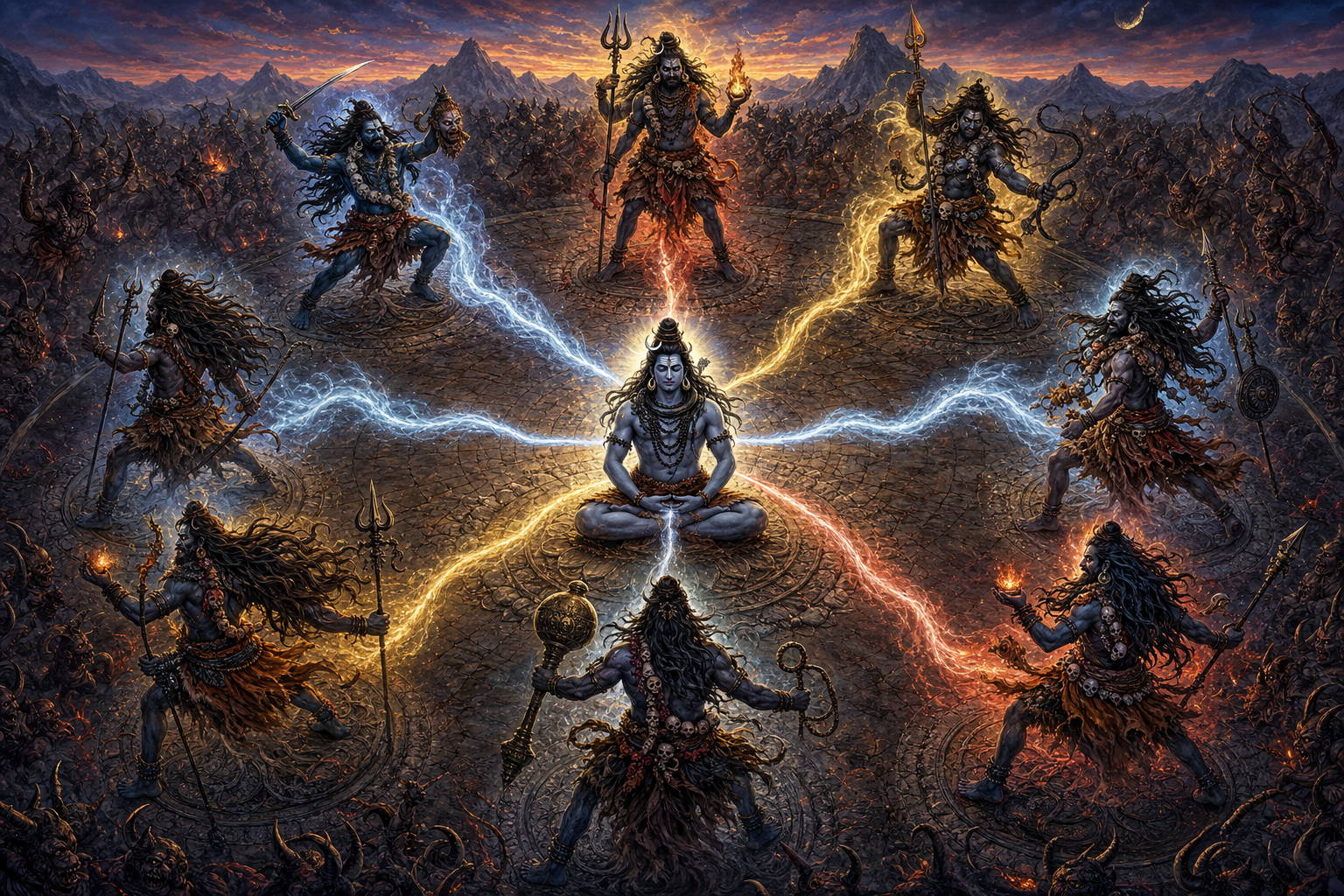
The clearest Puranic sequence places their manifestation within Shiva’s battle against Andhaka. Andhaka’s spilled blood keeps producing more enemies, so ordinary attack only enlarges the danger. Shiva responds by bringing forth eight forms of precisely directed power. Their purpose is not indiscriminate destruction. They secure every direction, stop the blood from reaching the ground, and make Andhaka’s eventual transformation possible.
Three questions are hidden inside the word “origin”
Confusion begins when a narrative origin, a theological identity, and a ritual arrangement are treated as rival historical claims. Keeping these layers separate gives you a much cleaner understanding of the Ashta Bhairavas.
| Layer | Question being answered | Careful answer |
|---|---|---|
| Puranic narrative | During what crisis do the eight appear? | They manifest during Shiva’s conflict with Andhaka, when multiplying blood must be contained. |
| Shaiva theology | Whose power do they embody? | They are forms of Shiva’s fierce protective power and are often understood as emanations of Kala Bhairava or Mahabhairava. |
| Ritual arrangement | Why is the group composed of eight? | They form a complete protective perimeter around the eight directions as kshetrapalas, guardians of a field or sacred territory. |
Being born from Shiva’s released power does not contradict being an emanation of Kala Bhairava. The first description dramatizes how the guardians enter a particular cosmic conflict. The second identifies their underlying divine identity. A circuit of eight shrines or a directional diagram then places that power within ritual space.
You should also expect variation in the physical language of manifestation. Shiva’s blood appears in the most arresting form of the episode, while related tellings can speak of sweat, wrath, radiance, or tejas. The stable point is functional rather than anatomical: Shiva’s concentrated power differentiates into eight guardians because the disorder has spread in every direction. Allied versions of the wider Andhaka conflict also occur in the Shiva Purana and Skanda Purana, often with greater attention to the Mothers who help contain the blood.
The battle sequence that produces the Ashta Bhairavas
The origin becomes intelligible when you follow the crisis in order. Each stage explains why a new kind of divine intervention is required.
- Andhaka embodies failure to see. Born blind and raised by the asura king Hiranyaksha, he comes to represent avidya, the ignorance that mistakes desire for rightful possession. His blindness should not be read as a judgement on disability. The moral problem is his unknowing conduct: he desires Parvati without recognizing the deeper relationship that binds him to Shiva’s household.
- Power magnifies the ignorance. Protected by formidable boons, Andhaka attacks Kailasa and violates both familial and cosmic boundaries. His strength does not correct his lack of insight. It merely gives that lack a wider field in which to operate.
- Every drop creates another enemy. When Andhaka’s blood touches the earth, another form of the asura arises. A blow that would normally weaken an opponent therefore reproduces him. The battlefield becomes a lesson in how badly chosen remedies can feed the very disorder they are meant to stop.
- Shiva releases eightfold guardian power. At the point when ordinary force has become counterproductive, Shiva’s fierce energy takes eight distinct forms. They are Asitanga, Ruru, Chanda, Krodha, Unmatta, Kapala, Bhishana, and Samhara.
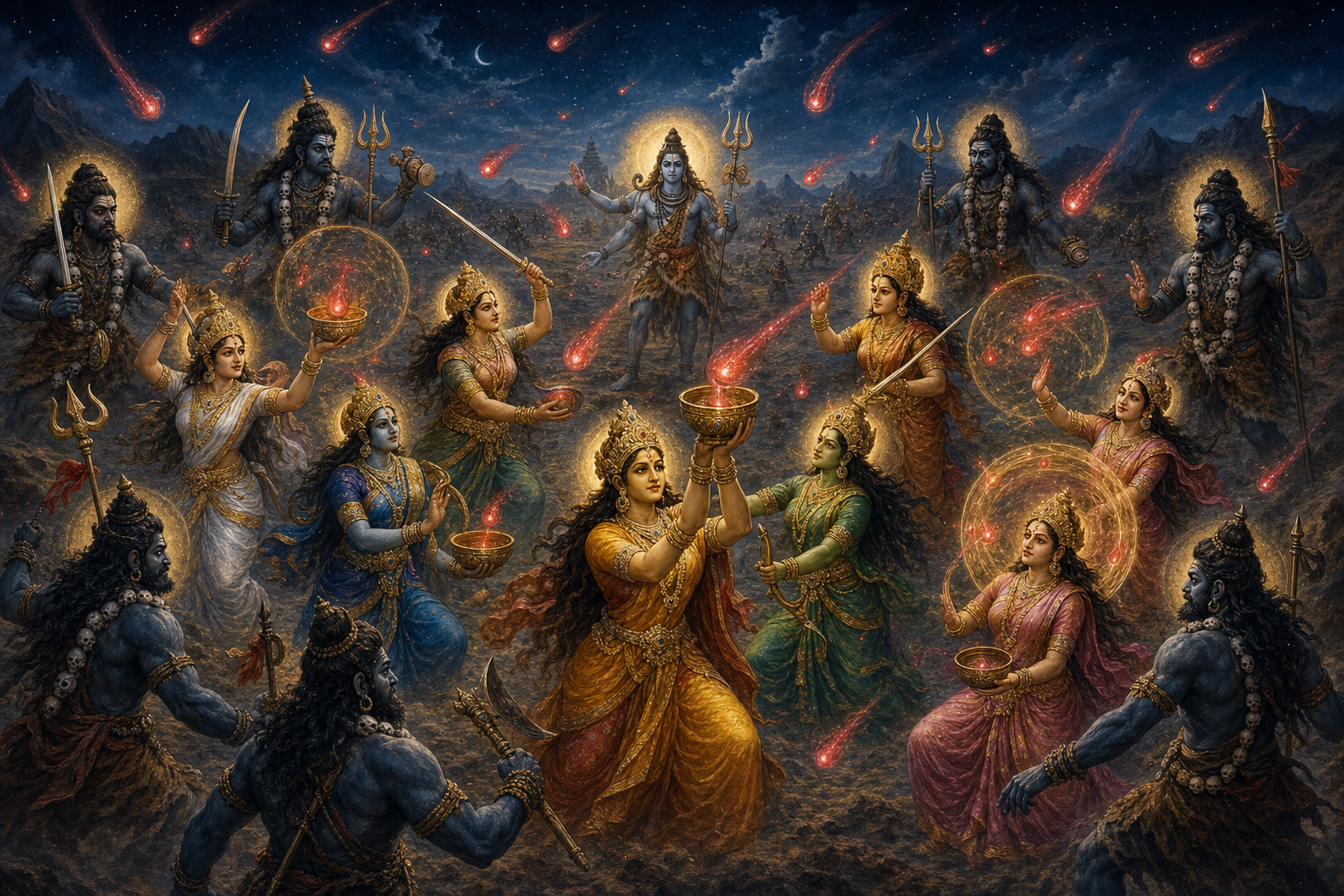
- The guardians prevent contact. The Bhairavas intercept and consume the falling blood before it can seed further enemies. In allied Shaiva-Shakta tellings, the Saptamatrikas, or Seven Mothers, participate in the same work. The response succeeds because it closes the route through which harm reproduces itself.
- Defeat becomes purification. With the multiplying blood contained, Shiva pierces Andhaka with the trident and holds him aloft. The end is not mere erasure. In several tellings, Andhaka is cleansed of his delusion and accepted into Shiva’s retinue as a devotee or attendant.
This sequence gives the most useful short answer to the origin question: the Eight Bhairavas arise because Andhaka cannot be defeated until the whole field is guarded. Their number expresses complete directional vigilance, while their fierce appearance reflects the severity of the danger being contained.
Why the two kinds of blood matter
Andhaka’s blood and Shiva’s released power perform opposite kinds of multiplication. One reproduces blindness without distinction: every drop makes more of the same problem. The other differentiates power according to need: one divine force becomes eight coordinated guardians. The contrast is the interpretive centre of the episode.
Andhaka’s multiplication offers a precise model of recurring adharma. An impulse becomes a thought, the thought becomes speech, the speech provokes an action, and the action creates conditions for the same impulse to return. Striking only at the final action leaves the reproductive chain intact. The Bhairavas intervene at the point of transmission, catching the symbolic drop before it can take root.
This is also why the episode should not be reduced to divine rage. Rage spreads itself. Bhairava contains what is spreading. His fierceness is disciplined by a boundary, a purpose, and an endpoint. Force is applied to prevent further harm; once the field is secure, even the aggressor can be restored to right relationship.
If you use this episode to think about a personal or social conflict, ask three concrete questions. What is the first “drop” through which the harm reproduces itself? What boundary would prevent that contact? What would restoration look like after the boundary holds? Without the first two questions, compassion can become permission for repetition. Without the third, severity loses its dharmic purpose and becomes retaliation.
What the eight names establish, and what they do not
The names most widely associated with the directional group are:
- Asitanga Bhairava
- Ruru Bhairava
- Chanda Bhairava
- Krodha Bhairava
- Unmatta Bhairava
- Kapala Bhairava
- Bhishana Bhairava
- Samhara Bhairava
The durable common structure is the eightfold group, its relation to Shiva or Kala Bhairava, and its guardianship of the directions. Precise attributes and directional assignments can vary with text, region, temple, and lineage. A chart that supplies one exact arrangement may be perfectly valid within its own ritual setting, but the list of names alone does not make every accompanying detail universally Puranic.
That distinction matters when you encounter confident diagrams online. Before treating one as definitive, look for the named textual or lineage context. If none is given, retain the broad eightfold pattern but avoid assuming that every colour, implement, direction, or ritual instruction must be identical across Bharat.
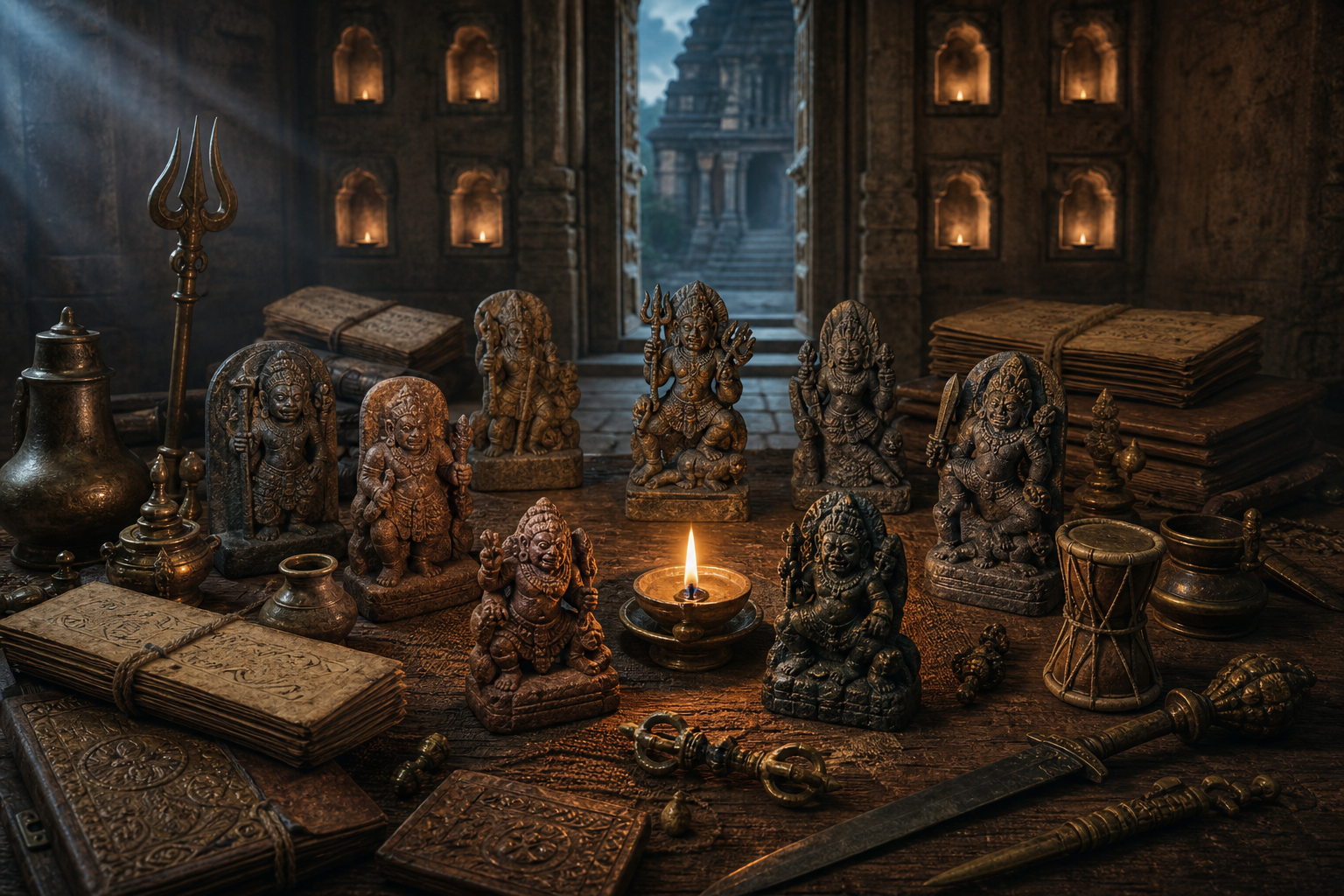
Across their iconography, the Bhairavas may carry the trident, sword, noose, drum, and skull-bowl. These objects make their governing logic visible. The trident penetrates bondage; the sword cuts; the noose restrains; the damaru recalls cosmic rhythm; and the skull-bowl confronts the worshipper with mortality and impermanence. They are implements of discernment and control, not a collection of decorations intended merely to make the deity frightening.
Kala Bhairava’s association with a vigilant dog and his role as the Kotwal of Kashi carry the same logic into sacred geography. A kotwal does not create chaos at the gate. He preserves the order that allows pilgrims to enter, worship, and surrender without the sacred field being overrun. The directional Bhairavas extend this guardianship around the entire perimeter.
Key takeaways for reading and applying the episode
- The immediate Puranic reason for the Eight Bhairavas is tactical and cosmic: Andhaka’s multiplying blood requires a guardian force covering the whole field.
- Descriptions involving Shiva’s blood, sweat, wrath, or tejas are variant ways of expressing the release of fierce divine power. They should not be forced into one uniform physical account.
- The eight are commonly understood as directional kshetrapalas and as differentiated forms of Shiva or Kala Bhairava.
- The Saptamatrikas join the work of containment in related tellings, showing Shaiva and Shakta powers acting together rather than competing for the same role.
- Andhaka’s physical blindness must not be equated with moral failure. His symbolic blindness is avidya: the failure to recognize relationship, limit, and truth.
- His final reintegration is essential to the meaning. Bhairava’s severity protects dharma so that transformation can occur; it is not cruelty presented as holiness.
You can turn that logic into a disciplined contemplative exercise without pretending that your exercise is an ancient one-to-one assignment. Place one repeating problem at the centre of a circle. Around it write eight guardrails: attention, restraint, courage, clarity, humility, accountability, remembrance, and compassion. Then identify which guardrail must meet the problem before its next “drop” lands. Attention notices the beginning; restraint interrupts transmission; courage holds the necessary boundary; clarity names what is happening; humility checks what you may not understand; accountability faces consequences; remembrance restores the dharmic standard; and compassion keeps correction directed toward restoration.
For mantra, offerings, initiation, or shrine-specific worship, follow the instructions of the relevant temple or lineage rather than constructing a practice from a general chart. For study, keep the narrative, theological, and ritual layers distinct. For reflection, choose one pattern that repeatedly causes harm and guard the point where it first spreads. That is where the Puranic logic of the Eight Bhairavas becomes something you can actually use.