

You may have a worthy aim and still find yourself repeating the same cycle: strong resolve, scattered effort, disappointment, and another attempt to force certainty. Prakamya Siddhi offers a more demanding path. Your wish must become a dharma-tested sankalpa, your attention must become steady, and your intention must take visible form through action.
If you are trying to decide whether an intention is spiritually sound or merely a craving with sacred language around it, use the tests and practice below. They will not guarantee that every preferred outcome occurs. They will help you pursue the right aim by clean means, recognize what is actually within your agency, and release what is not.
Prakamya begins where wishful thinking ends
Within the Ashta Siddhi framework, Prakamya is the fruition of a deliberately chosen intention. The term is connected to kama, meaning desire or intention, intensified by pra-, suggesting desire brought toward fullness or ripeness. This is not the same as wanting something intensely. It is will that has been clarified, disciplined, and made effective.
Prakamya is also distinct from prapti. Prapti concerns reach, access, or attainment beyond ordinary limits. Prakamya concerns whether a chosen intention comes to fruition. Classical lists of the siddhis vary over the eighth member, sometimes naming garima and sometimes kamavasayitva, but that variation does not erase the practical distinction between access and fulfilled will.
A dharmic understanding does not give thought magical sovereignty over nature, karma, social conditions, or another person’s freedom. A mental image is not a command issued to the universe. Intention becomes effective by entering the lawful field of causes: it changes what you notice, what you decline, how you use your time, which skills you develop, whom you approach, and how reliably you act.
The clearest practical model is the triad of iccha, jnana, and kriya:
- Iccha is will. It selects the direction and supplies resolve.
- Jnana is knowing. It tests the motive, understands the situation, learns the necessary means, and corrects error.
- Kriya is action. It gives the intention a body in conduct, work, speech, and repeated choices.
Will without knowledge becomes impulsive. Knowledge without action remains sterile. Action without a clear intention becomes restless activity. Prakamya-compatible practice brings all three into agreement.
Non-attachment completes the discipline. You commit fully to the means without treating your preferred result as proof of spiritual worth. Sometimes greater clarity strengthens an intention. Sometimes it changes the method. Sometimes it reveals that the original aim should be relinquished. Giving up an adharmic or deluded aim is not a failure of will; it is will becoming answerable to wisdom.
Put your sankalpa through a dharma test

Do not begin by asking how powerfully you can visualize the result. Begin by asking whether the result and the means deserve your energy. Concentration can make a confused motive more efficient, so ethical examination must come before techniques intended to strengthen attention.
The yamas provide hard boundaries. Apply each one directly to the intention you are considering:
- Ahimsa: Who could be harmed, pressured, humiliated, neglected, or treated as expendable if you pursue this aim?
- Satya: What fact would you have to deny, distort, conceal, or exaggerate to obtain the result?
- Asteya: Would success require taking another person’s time, labor, credit, opportunity, trust, or property without rightful consent?
- Brahmacharya: Does this intention gather your energy around a worthy purpose, or does it scatter your attention through compulsion and excess?
- Aparigraha: Can you work for the result without making possession, status, or control the basis of your identity?
If the desired outcome requires deception, coercion, exploitation, or deliberate harm, reject it. Do not try to purify a corrupt aim by adding mantra, visualization, or devotional language.
Other aims need revision rather than rejection. An intention such as making another person apologize places the decisive act outside your agency. A cleaner sankalpa would concern your own conduct: speaking truthfully, listening without retaliation, setting a necessary boundary, or making an honest offer of reconciliation. You may invite another person’s response, but you cannot make possession of their will into a spiritual accomplishment.
The niyamas then show how to cultivate a worthy intention:
- Saucha asks you to remove mixed motives and needless complication. State one clear intention rather than hiding several desires inside one sentence.
- Santosha prevents the sankalpa from being driven entirely by resentment or the belief that you are incomplete until you obtain something.
- Tapas accepts the heat of repetition, inconvenience, restraint, and delayed reward.
- Svadhyaya examines the person who wants the result. Notice fear, pride, imitation, old habits, and the need for approval before they choose the method for you.
- Ishvara-pranidhana dedicates the effort to the Divine and releases the claim that reality must obey your preferred timetable.
Write your sankalpa only after this examination. Keep it within your sphere of responsibility and connect it to conduct. A useful working form is:
- My intention is…
- This serves dharma by…
- The people who may benefit are…
- I will not use these harmful or dishonest means…
- The next action within my control is…
- I offer the result and remain willing to correct my course when truth requires it.
Test the sentence by imagining that nobody will praise you for fulfilling it. If the intention immediately loses its value, recognition may be the real object. Test it again by imagining that the outward result takes longer than expected. If the chosen conduct would still make you more truthful, capable, compassionate, or useful, the sankalpa has a sounder foundation.
Turn one intention into a repeatable sadhana
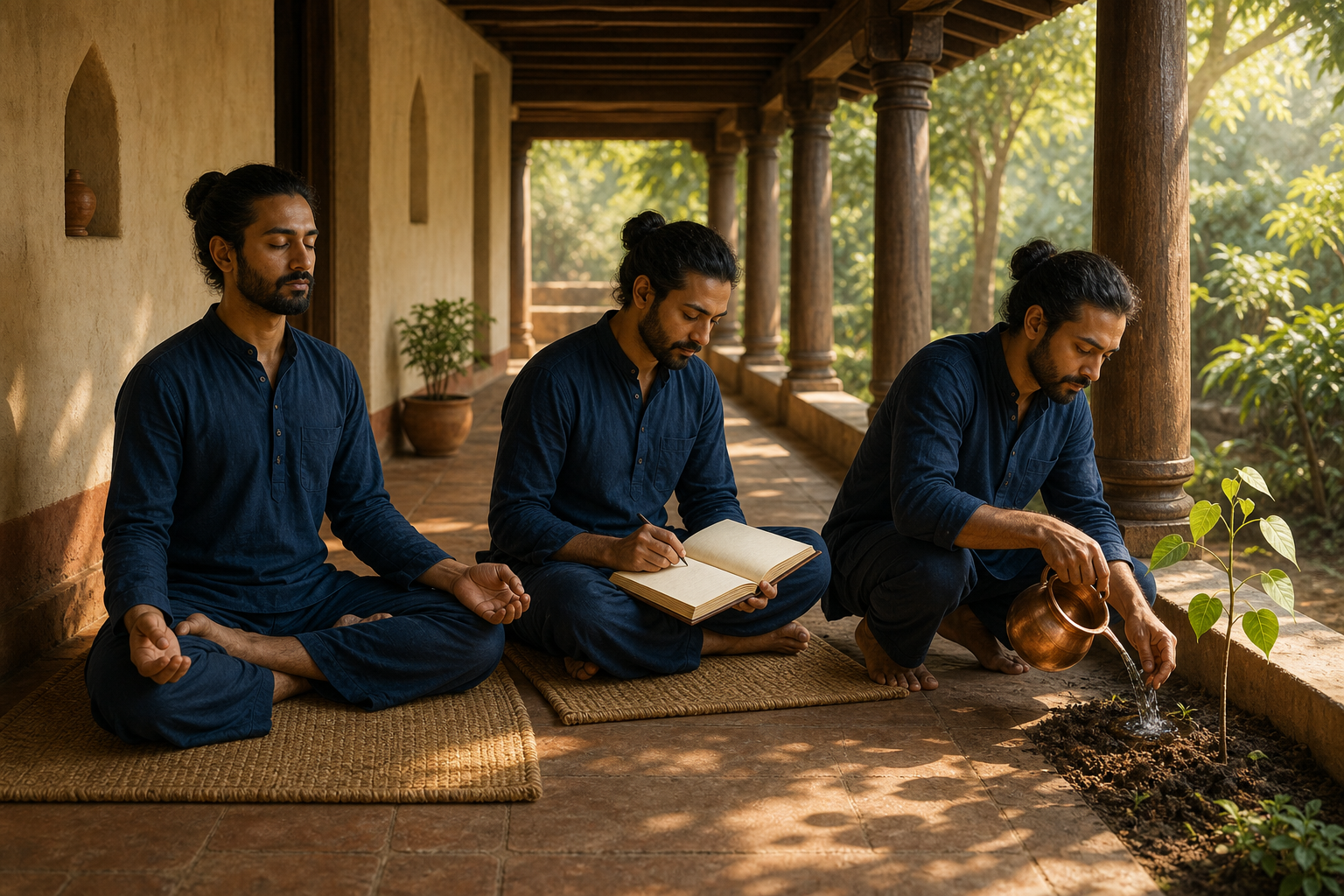
A sound sankalpa still needs a container. The aim of practice is to reduce the gap between what you affirm inwardly and what you repeatedly do. Use a simple sequence that joins the body, breath, attention, action, feedback, service, and surrender.
- State the intention in actionable language. Replace an outcome you cannot command with conduct you can undertake. Instead of demanding a particular examination rank, employment decision, or response from another person, name the preparation, application, conversation, or service for which you are responsible.
- Settle the body in a sustainable posture. The posture should support alertness without turning discomfort into the central event. If gentle breath regulation is already appropriate for you, an easy inhale-to-exhale ratio such as 1:1 or a comfortably longer exhale such as 1:2 may support steadiness. These ratios are examples, not tests of attainment. Do not force the breath.
- Practise pratyahara by withdrawing from unnecessary stimulation. Put aside messages, competing plans, and mental rehearsals that have nothing to do with the chosen duty. This is not withdrawal from life; it is a temporary refusal to let every input claim equal authority.
- Use dharana to return attention to the sankalpa whenever it wanders. Do not add emotional drama to make the sentence feel powerful. Clarity and continuity matter more than intensity.
- Let concentrated attention become quieter. In classical yoga, samyama joins dharana, dhyana, and samadhi and is an advanced discipline, not a label for a brief visualization exercise. A daily practitioner can work honestly with its foundations: sustained attention, uninterrupted contemplation, and a willingness to let the intention rest in silence rather than constantly manipulating it.
- Translate clarity into kriya immediately. Choose a visible action tied to a reliable cue: when a defined part of your day begins, undertake the next relevant task in the place and manner you have already chosen. The action should be small enough to perform but direct enough to matter.
- Review feedback without defending the original plan. Notice what was done, what obstructed it, whether the method remained ethical, and what should change. Correction is not disloyalty to the sankalpa. It is jnana guiding kriya.
- Connect the effort to seva and close with Ishvara-pranidhana. Ask how the capacity you are building can reduce another person’s burden or contribute to lokasangraha, the sustaining and uplift of the wider world. Offer the result rather than grasping at it.
Mantra-sadhana, nyasa, bandha, mudra, prolonged kumbhaka, and kundalini-oriented practices belong to structured lineages of training. If you have received a formal practice, follow it as taught. Do not intensify breath retention or manipulate advanced energetic processes merely because an ordinary period of concentration has not produced the result you want. Greater force does not correct an unclear motive, an unrealistic plan, or an ignored constraint.
Keep a record that exposes the gap between intention and action
After practice, write a short entry using the same prompts each time:
- Sankalpa: State the intention without embellishment.
- Kriya: Record the action completed, not the action imagined.
- Friction: Name the distraction, fear, practical obstacle, or ethical doubt that appeared.
- Correction: Choose the next change in method.
- Attachment: Identify the result, recognition, or timetable you are trying to control.
- Seva: Note who beyond yourself is served by continuing.
This record keeps spirituality connected to evidence in your own conduct. It also prevents a common error: repeating the sankalpa more intensely while leaving the causes of non-action untouched.
Recognize progress without manufacturing omens
The first signs of progress are usually sober: attention steadies, inner bargaining diminishes, priorities become easier to see, and the next appropriate action becomes less negotiable. You may also notice better timing because you are observing conditions more carefully and carrying less cognitive noise into decisions. These changes matter even when nothing spectacular occurs.
Ordinary causal mechanisms can account for much of this efficacy. Focused-attention practice trains you to return to a chosen object. A cue linked to a defined action reduces the need to make the same decision repeatedly. Breath regulation can support equanimity, while a written review reveals failing habits and weak assumptions. These mechanisms neither prove nor disprove metaphysical accounts of siddhi. They show how refined intention can produce tangible effects without requiring you to treat every coincidence as supernatural confirmation.
Judge the process by its ethical reliability:
- If the outcome is moving and the means remain clean, continue without display.
- If effort is steady but no movement occurs, examine your knowledge, method, available resources, social conditions, and the part of the result that belongs to other people.
- If new understanding reveals harm or vanity in the aim, revise or release it.
- If the preferred result does not occur, preserve whatever truthfulness, discipline, skill, and service the practice genuinely developed.
Dharmic traditions place even intense sankalpa within karma, including prarabdha, and within conditions larger than an individual’s will. Do not turn that principle into fatalism, and do not use karma to blame yourself or another person for suffering or delay. Non-attainment is not proof of impurity. It may reveal a mistaken means, an external constraint, an unsuitable time, a dependent outcome, or a direction that needs to change.
The shared Dharmic safeguard is freedom from display

Hindu, Buddhist, Jain, and Sikh traditions do not use identical metaphysical systems, and their teachings should not be collapsed into one doctrine. They do, however, supply closely related safeguards against allowing unusual capacities, concentrated will, or spiritual ambition to outrun ethical purification.
Patanjali’s Yoga Sutra does not present the Ashta Siddhi as one fixed list. It explains extraordinary vibhutis in relation to samyama while warning that such attainments can distract the practitioner from kaivalya. The practical warning is direct: an experience that strengthens fascination with your own specialness can become an obstacle even if the experience itself is unusual.
Buddhist practice offers the Four Bases of Power: chanda, or wholesome resolve; viriya, or energy; citta, or collected mind; and vimamsa, or investigative discernment. Resolve must be joined to effort, concentration, and inquiry. Iddhi is not allowed to displace liberation and compassion. When assessing your own intention, ask whether the practice is reducing grasping and confusion or merely giving them a spiritual vocabulary.
Jain teachings place riddhi and labdhi within demanding disciplines of conduct, especially ahimsa and aparigraha. The stronger your claimed capacity becomes, the stricter the test of non-violence and non-possession should become. If attainment increases domination, accumulation, or disregard for living beings, its spiritual value has failed the ethical test.
Sikh teaching turns the seeker toward Hukam, Naam, and seva. A capacity is neither an advertisement nor a personal throne. The question is whether you can remain a servant of Divine Order, continue the work without craving credit, and use whatever ability has arisen for the good of others.
These Dharmic cautions place conscience before capability. Pause and re-examine your sankalpa if you notice any of the following:
- You are trying to control a particular person’s feelings, choices, or allegiance.
- You excuse deception or harm because the intended result seems noble.
- You substitute signs, visions, or repeated affirmations for observable action.
- You measure progress by admiration, superiority, or the ability to impress others.
- You treat every setback as evidence of spiritual impurity rather than investigating practical causes.
- You escalate intense breath or kundalini practices without competent guidance.
- You cannot accept revision, delay, redirection, or an outcome different from the one imagined.
A siddhi pursued as a possession feeds the very clinging that dharmic practice seeks to loosen. A capacity received as responsibility becomes quieter. It appears as truthful speech, disciplined work, dependable service, moral courage, and the humility to change course.
Key takeaways
- Prakamya is disciplined and fulfilled intention, not casual wish-fulfilment or a guarantee that thought alone controls events.
- A worthy sankalpa must pass the tests of ahimsa, satya, asteya, brahmacharya, and aparigraha before concentration strengthens it.
- Iccha chooses the direction, jnana tests and corrects it, and kriya gives it visible form.
- Attention, breath, reflection, and devotional surrender support the intention, but daily ethical action is the decisive bridge into life.
- Progress looks first like steadier attention, reduced inner friction, clearer priorities, cleaner conduct, and greater reliability.
- Karma, social conditions, timing, and other people’s agency remain real constraints. Non-attachment allows full effort without turning a preferred result into a spiritual entitlement.
- Across Dharmic traditions, capability is subordinate to liberation, non-violence, humility, Divine Order, compassion, and seva.
Before you leave this page, write one dharma-tested sankalpa and name the next clean action that belongs entirely to you. Perform that action before looking for another sign. Let reliability, not spectacle, show whether your intention is ripening.