

You have books, willing sevaks, and perhaps a promising place to meet the public. The hard question is not how quickly the cartons can be emptied. It is how to offer each book with dignity, help the right person begin reading, and make your temple feel like a natural next step.
Treat literature distribution as the beginning of a relationship rather than the completion of a transaction. That shift changes the conversation at the table, the information placed inside the book, the programs scheduled back at the temple, and even the numbers you choose to celebrate.
Begin with the next temple step, not the book count
ISKCON’s capacity to place spiritual literature in public life remains substantial. Participating centres recorded nearly 300,000 distributions during March 2026. That figure measures reach, but a copy leaving the table answers only a logistical question. It does not tell you whether the recipient wanted that title, understood what it contained, knew where to begin, or found a community willing to help.
Plan each outing around two outcomes. The field outcome is voluntary acceptance of suitable literature. The relationship outcome is one clear way for an interested reader to continue: a beginner-friendly Bhagavad Gita circle, temple kirtan, prasada hospitality, an introductory course, a family program, or a simple opportunity for seva.
Choose that next step before the team leaves the temple. If volunteers cannot describe it plainly, the newcomer will not understand it either. A vague invitation to visit sometime creates work for the recipient. A specific invitation to a recurring program tells the person what happens, whom it is for, and what to expect.
- Select one principal audience for the outing: first-time readers, students, families, festival visitors, commuters, or people already curious about Hindu philosophy.
- Choose literature appropriate to that audience’s familiarity and language. A concise introduction and a detailed commentary do different jobs.
- Connect the literature to one relevant temple program rather than reciting the entire calendar.
- Make one volunteer responsible for confirming that the program details, contact information, and directions are accurate.
- Prepare the temple host to welcome people who heard about the program through book distribution. A field invitation fails if nobody at the temple knows it was made.
Work backwards from the reader’s likely first visit. If the next event assumes knowledge of Sanskrit terms, temple etiquette, or devotional practice, explain those expectations in advance or offer a more accessible entry point. Outreach should reduce uncertainty, not test whether a newcomer can decode an unfamiliar community.
Make every encounter voluntary and intelligible

The spiritual purpose of sankirtan does not excuse a pressured exchange. Voluntary acceptance, informed consent, and courteous dialogue protect both the person in front of you and the temple’s standing in the wider community. The strongest encounter leaves someone free to accept, ask questions, or walk away without embarrassment.
- Ask permission to begin. A direct opening such as Would you like to see an introduction to bhakti and the Bhagavad Gita? makes the subject clear and gives the other person an easy choice.
- Listen before selecting a title. Ask whether the person wants a first introduction, a practical daily discipline, or a deeper philosophical commentary. Do not assume that age, clothing, ethnicity, or familiarity with India reveals spiritual knowledge.
- Describe the book honestly. Explain its subject, level, and tradition in ordinary language. A person should know what is being accepted before the handoff occurs.
- State any conditions in advance. If a donation is requested, explain that before the person takes the book. Never allow an apparently free gift to turn into an unexpected demand.
- Offer a choice without manufacturing urgency. Let the reader compare suitable titles or decline. Interest created by confusion or social pressure rarely becomes thoughtful engagement.
- Close the conversation cleanly. If the answer is no, offer thanks and make space. If the answer is yes, show the reader where to begin and mention the single most relevant temple program.
Public kirtan can create a warm point of contact, but music should invite attention rather than trap it. Keep pathways clear, observe local rules governing sound and public space, and secure any permissions required for stalls or organized activity. A temple may remember an energetic day of distribution; the neighbourhood will remember whether the team behaved responsibly.
Train volunteers for difficult moments before they enter the field. They should know how to answer a sincere question briefly, how to admit when they do not know, how to refer a deeper question to a qualified teacher, and how to disengage from an argument. Sankirtan is not improved by winning a street debate while losing the person’s trust.
Use a simple ethical test: could the person decline without being followed, shamed, surrounded, or made to feel that refusal was offensive? If not, change the method. Respect is not an optional public-relations layer placed over seva; it is part of the seva.
Make the temple the next chapter of the book
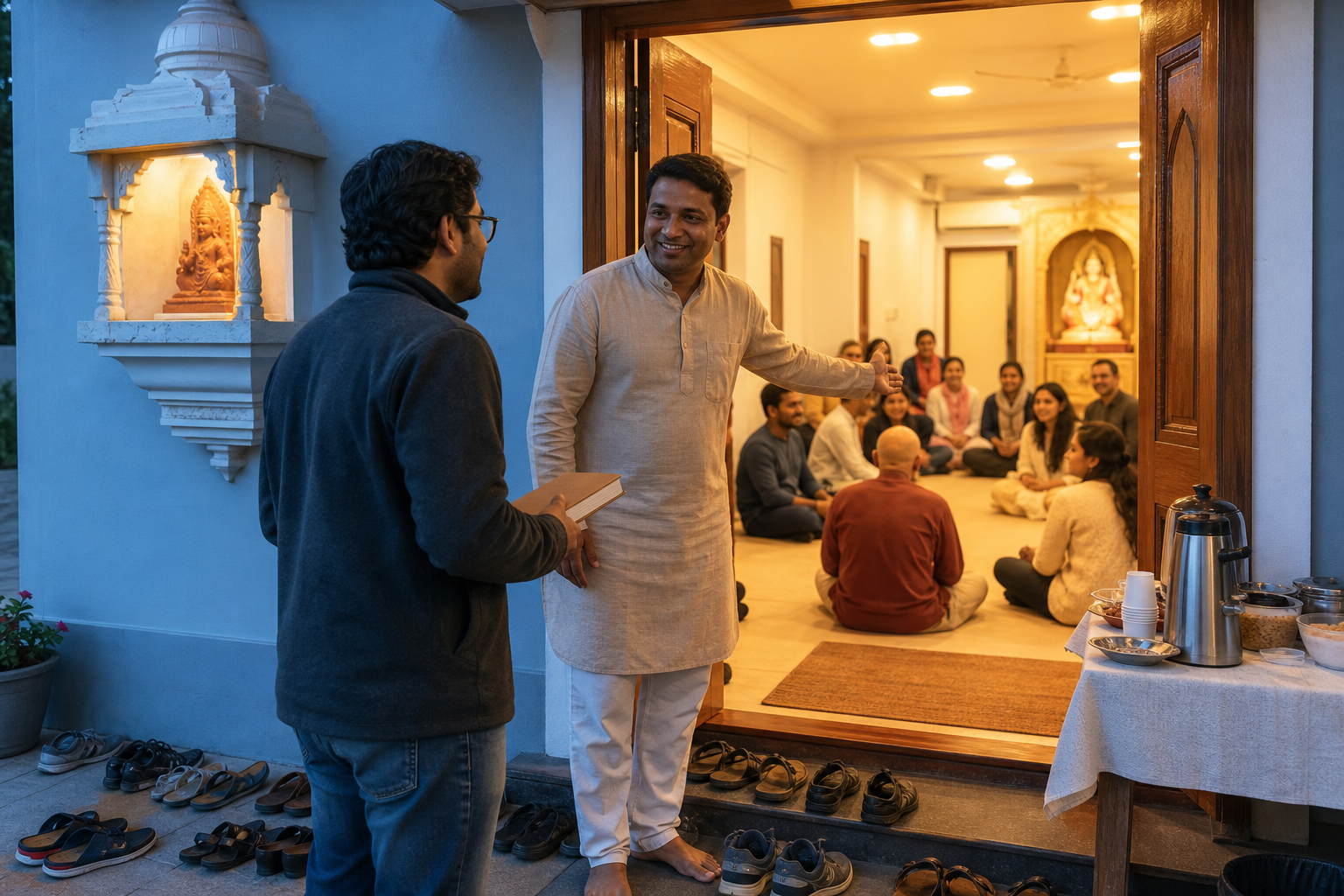
A book can introduce Krishna consciousness, but sustained understanding usually requires places to ask questions, hear kirtan, share prasada, study with others, and observe devotional life. Your follow-up path should therefore connect the printed page to a living community without making the reader surrender privacy or commit before being ready.
Place a short web address or QR code inside the literature when appropriate. Send it to one maintained page, not a maze of unrelated links. The page should state what newcomers can attend, the current time and location, the language used, whom to contact, whether families are welcome, and what a first-time visitor should expect. Check it before every campaign. An expired schedule quietly wastes the trust earned in person.
Digital summaries and QR codes should complement printed literature rather than replace it. The book offers an undistracted object for reflection; the digital path carries details that change, such as schedules, directions, registration, and contact information. Give each medium the job it performs well.
Build a gradual path into temple life. Public kirtan and prasada hospitality can offer a low-pressure first encounter. An introductory reading circle can help the person develop context and vocabulary. Regular study and seva can follow when genuine interest appears. Do not treat every book recipient as though they have already agreed to the entire path.
- Give the reader a manageable starting point in the book instead of merely saying to read all of it.
- Explain unfamiliar Sanskrit terms when they first appear; do not dilute the teaching, but do remove avoidable confusion.
- Offer programs in the languages your local audience actually uses, with a competent speaker available for questions.
- Assign someone to welcome first-time visitors and explain temple customs without scolding or testing them.
- Ask explicitly before adding a person to a messaging list. Keep contact data only for the purpose to which the person agreed.
- Provide a clear way to stop messages. Continued contact is meaningful only when continued consent is present.
Localization is not dilution. A presentation suited to Vrindavan’s sacred setting cannot simply be transferred word for word to Silicon Valley, London-Soho, Swansea, or Porto Alegre. Preserve the core teaching while adapting examples, language, program timing, and volunteer roles to the people and conditions in front of you.
The same honesty matters when Buddhist, Jain, Sikh, or other Hindu visitors approach. Values such as ahimsa, service, disciplined practice, and truth-seeking can open a respectful conversation across the dharmic family, but shared values do not make the traditions interchangeable. Joint service, cultural music gatherings, and serious dialogue build trust when they are offered as genuine cooperation rather than disguised recruitment.
Manage outreach at your temple’s real scale
Raw volume can inspire a team, but it can also tempt a small temple to imitate an operation with entirely different people, transport, inventory, and public access. During March 2026, Mumbai-Juhu, Vrindavan, and Silicon Valley led the large-temple results; London-Soho, Bengaluru-South, and San Diego led the medium category. Atlanta Krishna Life, Surat, and Swansea stood out among small temples, while Baltimore, Heidelberg, and Porto Alegre headed the maha-small group.
Those size categories describe operating scale, not spiritual worth. The useful benchmark is therefore not the largest number anywhere in the world. Compare your temple with centres of similar capacity and, more importantly, with its own previous months. Ask whether the system is becoming more reliable, ethical, and responsive to readers.
Define a distribution before recording it. Count a book after it has been willingly accepted, and keep refusals or returned copies separate. If every volunteer uses a different definition, the total may look precise while telling the temple very little.
- Track literature by title and language. This reveals which stock is moving and which audience may be underserved.
- Track the channel. Distinguish a public stall, kirtan outing, festival, temple reception, or another recurring setting so that the team can see where each kind of book belongs.
- Track invitations separately from books. A book accepted and a temple visit are different outcomes. Combining them hides the point where follow-up is failing.
- Record attendance without invading privacy. The temple can note how many newcomers arrived through an outreach channel without collecting unnecessary personal details.
- Add qualitative feedback. Note recurring questions, misunderstood phrases, missing languages, unsuitable titles, and invitations that were difficult to explain.
Monthly tallies submitted by participating centres can support planning, but self-reported numbers need clear definitions. A consistent record of title, language, and channel helps the temple refine print orders, reduce unused stock, and prepare the right follow-up program. It also keeps the team from mistaking activity for understanding.
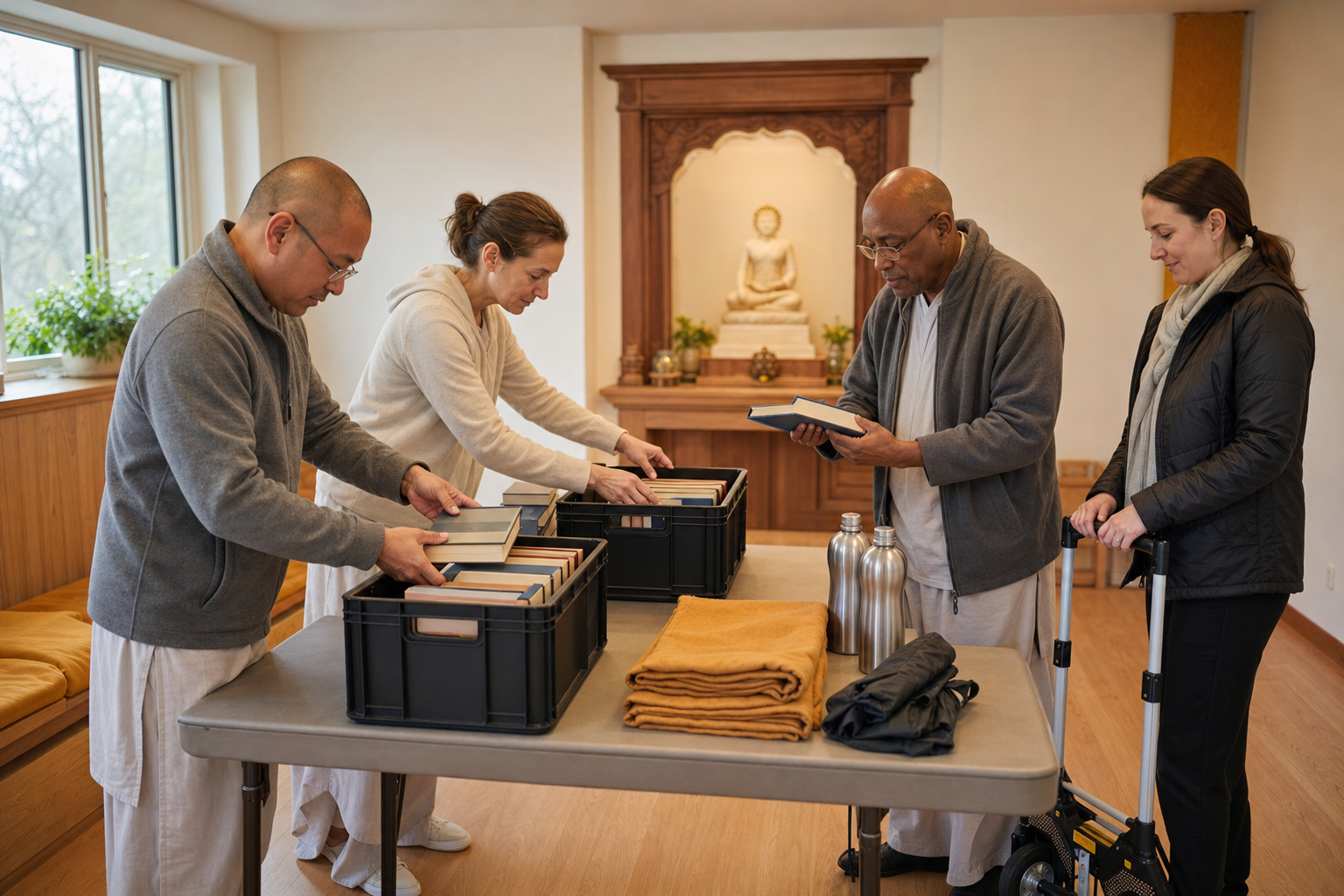
The operational side deserves the same care as the public conversation. Name responsibility for stock, transport, permissions, volunteer coordination, field leadership, and newcomer follow-up. A compact team may combine roles, but no responsibility should remain invisible. When everyone assumes someone else checked the schedule or brought the correct language editions, the failure appears at the reader’s end.
- Count stock by title and language before departure, then reconcile what returns.
- Rotate greeting, listening, book explanation, kirtan, logistics, and recording roles so that the same confident volunteers do not carry every outing.
- Schedule around local weather, school terms, neighbourhood events, and observances such as Gaura Purnima when relevant to your community.
- Confirm stall, sound, transport, and public-space requirements before announcing the outing.
- Move surplus books to a centre or program that can use them rather than allowing them to deteriorate in storage.
- Consider responsible paper sourcing and print formats as part of stewardship, especially when ordering large quantities.
End each campaign with a short review focused on decisions. Which title and language should be restocked? Which venue produced attentive conversations? Which invitation was understood? Which volunteer role needs support? What should stop before the next outing? A review that produces no change is merely another tally.
Key takeaways
- Count willing acceptance, not the number of books displayed or conversations attempted.
- Build every outing around one clear next step into temple life.
- Ask permission, listen first, explain the literature honestly, and make refusal easy.
- Match the title, language, setting, and invitation to a defined local audience.
- Use printed books for sustained reading and digital links for changing practical information.
- Benchmark within your operating scale while measuring your own consistency over time.
- Protect public trust, reader privacy, volunteer energy, and material resources as parts of devotional service.
Before your next outing, write down four things: whom you hope to meet, which literature fits that person, which temple program follows, and who owns the welcome. If any answer is unclear, fix the pathway before adding more books. A thoughtful handoff can then become what sankirtan is meant to offer: a free invitation to hear, read, reflect, and take the next step willingly.