

You sit down to be present, and the mind immediately starts replaying a conversation, planning tomorrow, or reaching for the phone. If following the breath only makes that inner noise more obvious, you do not need to force yourself into silence. Let an ordinary sound give your attention somewhere concrete to land.
Nada Yoga turns listening into a discipline. You begin with sounds you can hear, learn to remain present as they change, and notice the quiet in which they arise and disappear. The aim is not to manufacture a blank mind or collect unusual inner experiences. It is to hear without grasping, resisting, or drifting away.
Key takeaways
- You do not need a silent room. A fan, birds, traffic, running water, your breath, or a sustained musical tone can become the anchor.
- Begin with two minutes of listening once a day. Consistency matters more than making the session long.
- When attention wanders, returning to sound is the practice. Wandering does not mean the session failed.
- Train focused listening and open listening: follow one sound closely, then receive the whole soundscape without choosing among its parts.
- Do not chase anahata nada or interpret every internal sound as a spiritual sign. Steady attention and greater equanimity are more useful measures of progress.
- Modify the practice if you have tinnitus, sound sensitivity, trauma-related reactions, or a mental health condition that can be aggravated by extended meditation.
Why sound can reach a restless mind
A sound does not wait for you to become calm. It arrives while the mind is busy and gives you an immediate point of contact with the present. You may remember a bell or anticipate the next note, but actual hearing occurs now. This makes sound especially useful when the breath feels too subtle, too personal, or difficult to follow.
Nada Yoga works with a progression from ahata nada, audible or “struck” sound, toward anahata nada, subtle or “unstruck” resonance. The Hatha Yoga Pradipika, particularly chapter 4, places nada anusandhana within the movement toward meditation. The Nada Bindu Upanishad also describes attention becoming absorbed as it moves from more obvious sound toward subtler resonance.
This map is practical before it is metaphysical. Begin with what can actually be heard. Notice its texture, duration, movement, and disappearance. As attention becomes less reactive, the boundary between sound and silence may feel less rigid. Silence is no longer merely the interval in which nothing happens; it becomes the receptive field in which every sound appears.
Do not hurry past external sound because the internal stage seems more advanced. That ambition recreates the same restlessness the practice is meant to expose. If you spend a session listening steadily to a refrigerator hum and returning whenever the mind wanders, you have trained presence. No special sensation is required.
Sound also reveals your habits quickly. You may reach mentally toward a pleasant note, tense against a harsh one, or begin naming everything you hear. Nada Yoga asks you to notice those movements without obeying them. The deeper skill is not better hearing in a technical sense. It is remaining available to experience without immediately trying to control it.
A repeatable practice using sound and silence
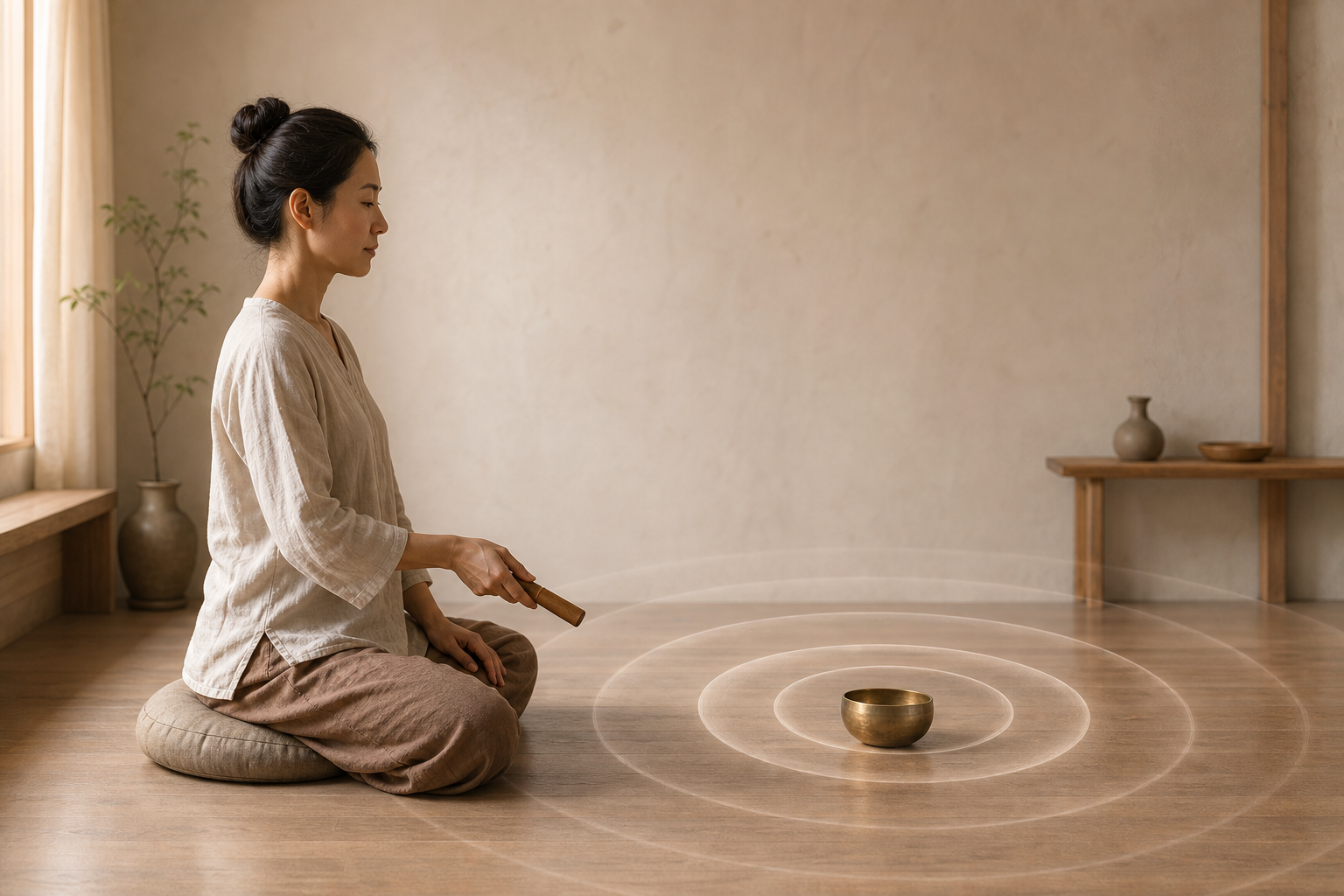
Choose a place where reduced visual attention is safe. Sit in a chair, on a cushion, or in any posture that allows your spine to be comfortably upright and your breathing unforced. You do not need a shrine, headphones, or an instrument. Begin with the sounds already present.
- Settle physically. Feel the support beneath you. Let the jaw, shoulders, and abdomen soften. Keep your eyes gently closed or lower your gaze if closing them feels uncomfortable.
- Listen for two minutes. Receive the nearest sound, the farthest sound, and the quieter sounds between them. Do not rank them as spiritual, distracting, pleasant, or unpleasant.
- Choose one anchor. Rest attention on a steady hum, a bird call, moving water, the sound of breathing, or another clear element of the soundscape. Hear its changing detail without trying to hold it still.
- Return without commentary. When you find yourself planning, remembering, or evaluating, come back to the sound. A simple return is enough; there is no need to criticize the thought or explain why it appeared.
- Open the field. Release the single anchor and allow all sounds to be present together. Notice that awareness can include several sounds without needing to pursue any of them.
- Notice the transition. When a sound ends, stay attentive. Rather than declaring that silence has begun, feel the fading edge and the space that remains.
The most important moment is the return. If attention leaves the sound repeatedly and you repeatedly bring it back, the essential training is occurring. Measuring success by uninterrupted concentration will make a normal mental event feel like failure. Measure it by whether you noticed the departure and returned without adding resentment.
Follow a single tone to its vanishing point
When you want a more defined anchor, ring a singing bowl, pluck one piano string, or use a sustained tambura or harmonium note. Listen through the tone’s full life: its attack, stable body, changing overtones, softening edge, and apparent disappearance. Then remain still with the question, “Where did the sound end?” Do not answer verbally. Let attention investigate.
A continuous drone can support dharana, or one-pointed attention, because the mind has a stable place to rest. Open reception of the full soundscape trains a complementary capacity: noticing experience without reacting to each event. Alternating focused tone-following with open listening is especially useful when either narrow concentration or complete openness becomes difficult.
Let voice and breath work together
A soft hum or gently intoned OM makes the exhalation audible and gives you vibratory feedback through the face, throat, and chest. Keep the sound easy. The purpose is not volume, vocal beauty, or breath retention. Let the tone ride the outgoing breath and stop before strain appears.
If counting supports you, use an easy inhale-to-exhale relationship of 1:1, or allow the exhalation to extend gradually toward 1:2 when that remains comfortable. Return to natural breathing as soon as you feel air hunger, tightness, light-headedness, or pressure to perform. Slow, regular breathing paired with gentle sound can reduce physiological arousal and help stabilize attention, but it should never become a contest to produce the longest breath.
Take listening into the parts of life where you disappear

A seated exercise matters only if it changes how you meet an ordinary moment. The best place to test Nada Yoga is a routine in which you usually go on autopilot. Choose one activity and remove the optional audio. While washing dishes, hear the water, the contact of utensils, and the pauses between movements. While walking in a safe place, notice footsteps, wind, voices, and distance instead of automatically starting a podcast.
This may expose discomfort that constant audio has been covering. Boredom, grief, uncertainty, or an unfinished decision can seem louder when entertainment stops. Do not turn the practice into an interrogation. Notice what arises, keep contact with your body and surroundings, and decide later whether anything calls for reflection or action. The immediate task is honest contact, not instant resolution.
Listen to music without using it to manage yourself
Choose one composition and give it your full attention. Put the phone out of reach and do nothing else. Follow melody, rhythm, timbre, and the spaces between notes. Notice bodily responses and emotional shifts without trying to intensify or suppress them. When a thought carries you away, return to what is sounding now.
The distinction is subtle but important. Music can be used to force a mood, drown out a feeling, or maintain stimulation. Conscious listening lets music meet the state that is already present. You may still feel soothed or energized, but the outcome is no longer the demand placed on the music.
Hear the person, not only the words
In conversation, give one exchange the same quality of attention you give a fading tone. Hear pace, pitch, hesitation, emphasis, and silence. Resist preparing your answer while the other person is still speaking. A pause may carry uncertainty, restraint, care, or a request for more time; filling it automatically can erase information that words alone do not convey.
This is where mindful presence becomes relational. Listening is no longer a display of politeness. It becomes a willingness to receive another person before arranging a response. You can act on this immediately: in your next conversation, allow the speaker’s final words to settle before you answer.
Keep the Dharmic pathways distinct while recognizing the kinship
Nada anusandhana belongs to a particular yogic vocabulary, but disciplined attention through sound and silence appears across Dharmic traditions. Hindu japa and kirtan steady awareness through mantra and sacred singing. Buddhist shamatha and vipashyana can include mindful reception of sound. Jain samayik and mauna cultivate equanimity and deliberate silence. Sikh Shabad and Naam Simran center consciousness through the Guru’s Word and remembrance of Naam.
These are not interchangeable techniques, and their theological meanings should not be flattened into a generic wellness method. Their practical kinship lies in how sound, recitation, attention, and silence can discipline consciousness. If you already belong to one of these paths, begin with its received practice and guidance rather than collecting disconnected sacred sounds. Nada Yoga can deepen listening without displacing the lineage that gives your practice meaning.
Adjust the practice when listening becomes difficult

Match the method to the obstacle
- If the mind is restless: follow one continuous tone for a while, then open to the whole soundscape. Move between these modes whenever attention becomes scattered.
- If you become dull or sleepy: straighten the posture, open the eyes slightly, or choose a clearer and somewhat brighter timbre. Do not solve dullness by making the sound painfully loud.
- If you keep labeling sounds: shift from nouns to direct qualities. Instead of mentally repeating “car” or “bird,” notice rising, fading, pulsing, roughness, or distance, then release even those labels.
- If you keep waiting for silence: include every interruption. A passing vehicle or barking dog is not outside the practice; resistance to it is another event to notice.
- If the breath becomes strained: stop extending it. Let breathing return to an easy rhythm and use an external sound as the anchor.
- If you start chasing unusual experiences: return to the simplest test. Are you more capable of noticing distraction, releasing reactivity, and listening to people in daily life?
Know when shorter and gentler is wiser
If you have tinnitus or marked sound sensitivity, begin with softer tones and brief sessions. Avoid headphones or instruments at an intensity that aggravates symptoms. Tinnitus should not automatically be interpreted as anahata nada or evidence of spiritual progress. New, changing, or distressing auditory symptoms deserve appropriate professional assessment.
Silence and repetitive sound can sometimes evoke trauma-related reactions. If you become overwhelmed, open your eyes, orient to the room, feel your feet or the support beneath you, and return to an ordinary activity. Work with a qualified clinician if you want to continue a practice that repeatedly triggers fear, dissociation, or intrusive material.
Anyone experiencing active mania or hypomania should seek clinical guidance before attempting extended meditation. Nada Yoga is an attentional and spiritual discipline, not a substitute for medical or psychological treatment. It should also never be practiced in a way that reduces the awareness you need while driving, crossing roads, operating equipment, or navigating another hazardous setting.
Your next practice can be very small. During one safe, ordinary pause today, set aside optional audio and listen for two minutes. Receive the nearest sound, the farthest sound, and the quiet after one of them fades. When the mind leaves, return. That uncomplicated movement back to hearing is how presence becomes a habit rather than an idea.