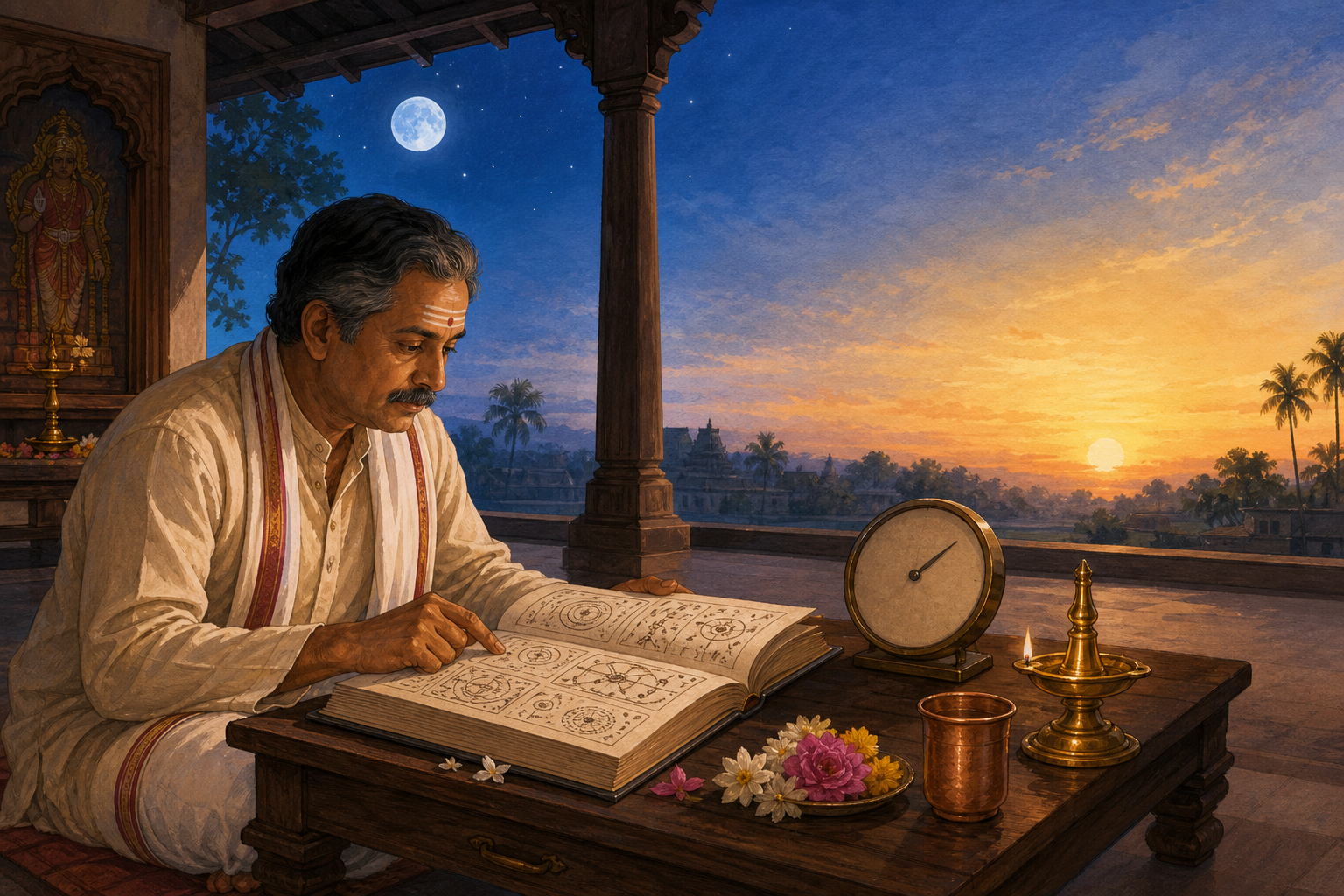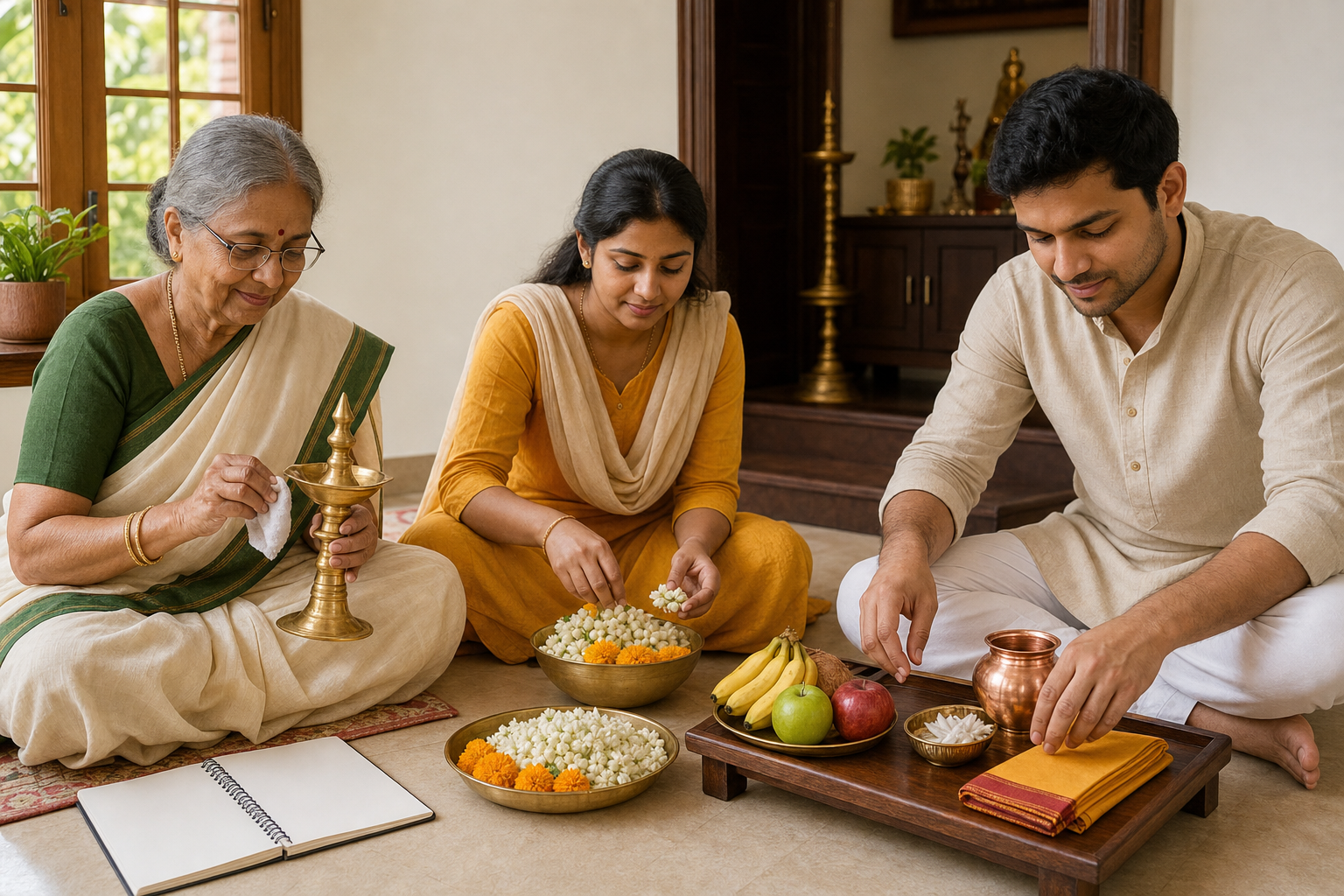
If you are arranging family travel, reserving Sundays for Bonalu, choosing dates for a samskara, or trying to keep the right vrata, begin with two firm calendar boundaries. In the Telugu Amavasyant calendar, Ashada Masam 2026 runs from 15 July through 12 August.
The observances inside that window require more care. A tithi does not necessarily begin at midnight, and some vratas depend on the tithi present at sunrise or during a particular worship period. Use the calendar below to plan the month, but confirm the final festival dates and puja times with a Panchang calculated for your city.
Ashada Masam 2026 at a glance
Ashada is the fourth lunar month in the Telugu Panchangam followed in Andhra Pradesh and Telangana. The calendar is Amavasyant, also called Amanta: each month begins after Amavasya and ends on the next Amavasya. That differs from the Purnimant convention common in parts of North India, where the month name changes at a different point in the lunar cycle.
| Calendar point | Placement in 2026 | What to plan |
|---|---|---|
| Ashada begins | 15 July 2026, Ashada Shukla Pratipada | Begin your monthly sankalpa, regular japa, reading, or seva practice. |
| Shukla Paksha | From 15 July until Purnima in late July | Confirm Ratha Yatra, Devshayani Ekadashi, and Guru Purnima timings locally. |
| Ashada Purnima | Late July | Observe Guru Purnima or Vyasa Purnima according to your parampara. |
| Krishna Paksha | After Purnima through 12 August | Mark Sankashti Chaturthi, Pradosha, Masik Shivaratri, and the approach to Amavasya. |
| Ashada ends | 12 August 2026, Ashada Amavasya | Make arrangements for pitru tarpan or family ancestral prayers where customary. |
Key takeaways
- Enter 15 July and 12 August as the Telugu Ashada boundaries, but treat internal festival dates as provisional until you check a local Panchang.
- Devshayani Ekadashi begins Chaturmas, so choose a discipline you can continue beyond the end of Ashada rather than treating it as a one-day observance.
- Keep the Sundays within Ashada available if your family participates in Telangana’s Bonalu celebrations; procession schedules remain temple- and locality-specific.
- Do not describe Ashada as simply unlucky. Its traditional emphasis is vrata, study, restraint, Guru-bhakti, ancestral duty, and seva.
- If you live outside Bharat, use a Panchang calculated for your actual location and time zone. An Indian civil date copied into a diaspora calendar can produce the wrong observance day.
Plan each major observance by its tithi
The safest way to organize Ashada is by lunar phase, not by a list of unverified civil dates. First identify the relevant tithi, then obtain the date and ritual window for your location. This is especially important for Ekadashi, Purnima, Amavasya, and evening vratas.
Jagannath Ratha Yatra on Shukla Dwitiya
Jagannath Ratha Yatra belongs to Ashada Shukla Dwitiya, near the beginning of the bright fortnight. If you plan to visit a temple, follow a procession, or hold a household observance, search your local calendar for Shukla Dwitiya rather than assuming that the second civil day after 15 July must carry the festival. Tithi transitions can place the operative observance on a different civil date.
Devshayani Ekadashi and the start of Chaturmas
Devshayani Ekadashi, also called Sayana Ekadashi, occurs in Ashada Shukla Paksha and opens the four-month Chaturmas period. It is the month’s natural point for turning a good intention into a defined vrata. Choose something measurable: a fixed daily round of nama-japa, a regular Vishnu Sahasranama recitation, a period of scriptural study, a food restraint followed in your sampradaya, or a recurring act of seva.
If you observe the Ekadashi fast, plan the entire vrata rather than only the fasting day. Traditional observance includes attention to the preceding Dashami, worship with tulasi, remembrance of Bhagavan Vishnu, and parana on Dwadashi within the prescribed local period. Ask your temple or purohit for the applicable parana window. If a strict fast conflicts with your health needs, follow medical guidance and choose an appropriate devotional alternative such as japa, reading, or dana.
Guru Purnima or Vyasa Purnima
Ashada Purnima in late July is Guru Purnima, also known as Vyasa Purnima. Hindu observance honours Bhagavan Veda Vyasa, the guru-shishya parampara, and the living transmission of Dharma. Prepare before the full moon: decide whom you will thank, what teaching you will revisit, and what offering or act of dana will express that gratitude.
A workable household observance can include Guru-parampara puja, recitation from the Bhagavad Gita or Srimad Bhagavatam, reflection on a teaching you have neglected, and support for a teacher, pathashala, temple, or educational cause. The point is not a ceremonial greeting alone. Let the day change what you study or practise afterward.
The Krishna Paksha observances
After Purnima, the month enters Krishna Paksha. The monthly Sankashti Chaturthi is observed in honour of Bhagavan Ganesha. Pradosha Vrata belongs to Trayodashi, while Masik Shivaratri is kept on Krishna Chaturdashi. Because Pradosha is tied to an evening worship period and Masik Shivaratri has its own timing considerations, a sunrise-only calendar entry may not be sufficient.
Ashada concludes with Amavasya on 12 August 2026. Many families reserve this day for pitru tarpan, shraddha where prescribed, or prayers for ancestral welfare. Follow your family parampara and eligibility rules rather than assembling a rite from disconnected online instructions. If a priest assists your household, give the priest your city and time zone when requesting the sankalpa and timing.
Bonalu Sundays in Telangana
Bonalu gives Ashada a distinct public character in Telangana. Sunday celebrations honour Mahankali and local Gramadevatas through traditional offerings, processions, dance, music, and neighbourhood participation. The lunar month tells you which Sundays to protect in your schedule; the local temple program tells you when and where the actual events occur.
Check the announcement from the temple or locality you intend to visit before arranging travel. Customs and procession times are local. Participate with the community’s guidance, and make practical seva part of the day through water distribution, responsible waste handling, or support for the temple’s own arrangements.
Why your local Panchang can differ from a generic calendar
A lunar tithi is measured by each 12-degree increase in the angular separation of the Sun and Moon. It can begin or end at any clock time, so it does not map neatly onto a midnight-to-midnight civil day. Most festival decisions begin with the tithi present at local sunrise, but particular vratas can instead require the tithi during a specified morning, evening, or parana period.
Use this four-part check before treating any date as final:
- Confirm the calendar system. For the dates in this calendar, select the Telugu Amavasyant or Amanta system.
- Set the actual location. Use the city where the vrata will be observed, not a default city in India or the location of the family member who sent you the calendar.
- Check the rule for the observance. Sunrise prevalence is the usual starting point, but Ekadashi parana, Pradosha worship, and some Purnima or Amavasya rites depend on more specific windows.
- Reconcile the Panchang with the temple schedule. The Panchang establishes the tithi; the temple bulletin gives the operational time for the puja, procession, or community program you will attend.
This check matters most when a tithi touches two civil dates. For Ekadashi, verify the correct fasting day, the avoidance rules associated with Dashami, and the Dwadashi parana time as one connected calculation. For Purnima and Amavasya rites, verify that the required tithi is present during the ritual period your tradition uses.
Kannada, Marathi, and Gujarati Amavasyant Panchangas should show nearly the same Ashada boundaries as the Telugu calendar. A North Indian Purnimant calendar may use the name Ashadha for a period extending from a full moon in late June to the full moon in late July. That difference in month naming does not mean the underlying tithis are different. It means two regional systems are grouping and naming the lunar cycle differently.
Diaspora households need one more check. Longitude, local sunrise, time-zone conversion, and daylight saving time can move an observance relative to the date printed in an Indian calendar. Use a city-specific Panchang or a trusted local temple bulletin before announcing a date to the family.
Ashada calls for discipline, not fear of an unlucky month
Traditional muhurta practice generally avoids major samskaras such as vivaha and griha pravesh during Ashada. The reasoning is not that the month is spiritually empty or inherently negative. Ashada redirects attention from large social celebrations toward vrata, tapas, japa, study, Guru-bhakti, and the beginning of Chaturmas.
If you are choosing a wedding or housewarming date, consult the purohit who follows your family’s Panchang tradition before paying a non-refundable deposit. Give the purohit the event location, the family’s calendrical convention, and any practical date constraints. A generic statement that no auspicious activity is possible throughout Ashada is too broad: temple worship, dana, seva, scriptural study, ancestral duty, and the beginning of devotional disciplines are central to the month.
The monsoon gives these practices a seasonal setting in Andhra Pradesh and Telangana. Family routines often become quieter and more home-centred, while temple visits, satvik food, collective recitation, and community observances take on greater importance. Ashada also usually encompasses Karka Sankranti, associated in many traditions with the beginning of Dakshinayana. Confirm its precise local timing separately rather than deriving it from the lunar-month boundary.
You can make the seasonal symbolism concrete. Pair a vrata with water conservation, tree planting, care for a local water body, or low-waste temple offerings. These acts are not substitutes for the prescribed worship in your parampara. They are a practical expression of gratitude during the rains and of the dharmic obligation to treat the Earth as worthy of reverence.
Build a household calendar that remains useful after Ashada
Set up your calendar in three layers. First, record the fixed Telugu month boundaries: 15 July and 12 August. Second, create provisional entries for Shukla Dwitiya, Devshayani Ekadashi, Guru Purnima, Sankashti Chaturthi, Pradosha, Masik Shivaratri, and Amavasya; replace them with confirmed dates and times from your local Panchang. Third, add the local layer: Bonalu programs, temple pujas, travel time, family tarpan arrangements, and any Guru Purnima gathering.
Then choose one daily discipline and one outward-facing act. A daily discipline might be a set period of japa or a defined passage of scripture. The outward act might be dana on Guru Purnima, assistance at a Bonalu event, support for a teacher, or environmental seva during the monsoon. Keep the plan small enough to survive ordinary work and family duties. Chaturmas begins during Ashada but continues after the month ends, so consistency matters more than an ambitious first week.
Share the Guru principle without flattening distinct traditions
Ashada Purnima carries meaning across the wider dharmic family, although the rituals are not interchangeable. Hindus observe Guru Purnima and honour Veda Vyasa and the Guru-parampara. Theravada Buddhists observe Asalha Puja, or Dhamma Day, remembering the Buddha’s first sermon at Sarnath. Jain traditions deepen restraint, ethical discipline, and scriptural engagement during Chaturmas. Sikh Dharma’s central reverence for the Gurus offers a related language of gratitude to the source of spiritual wisdom, without making Guru Purnima a uniform observance across every tradition.
A mixed dharmic family or community can therefore share a simple framework: gratitude to teachers, renewed commitment to Dharma, study within each inherited tradition, and dana or seva. Let each participant retain the prayers, texts, and ritual forms of their own sampradaya. Unity becomes stronger when it respects real distinctions rather than erasing them.
Your first step is straightforward: place 15 July and 12 August in your calendar now, then obtain a city-specific Panchang before assigning the internal observances. Build the month around verified tithis and one sustainable Chaturmas discipline, not around a copied civil-date graphic that may have been calculated for somewhere else.