
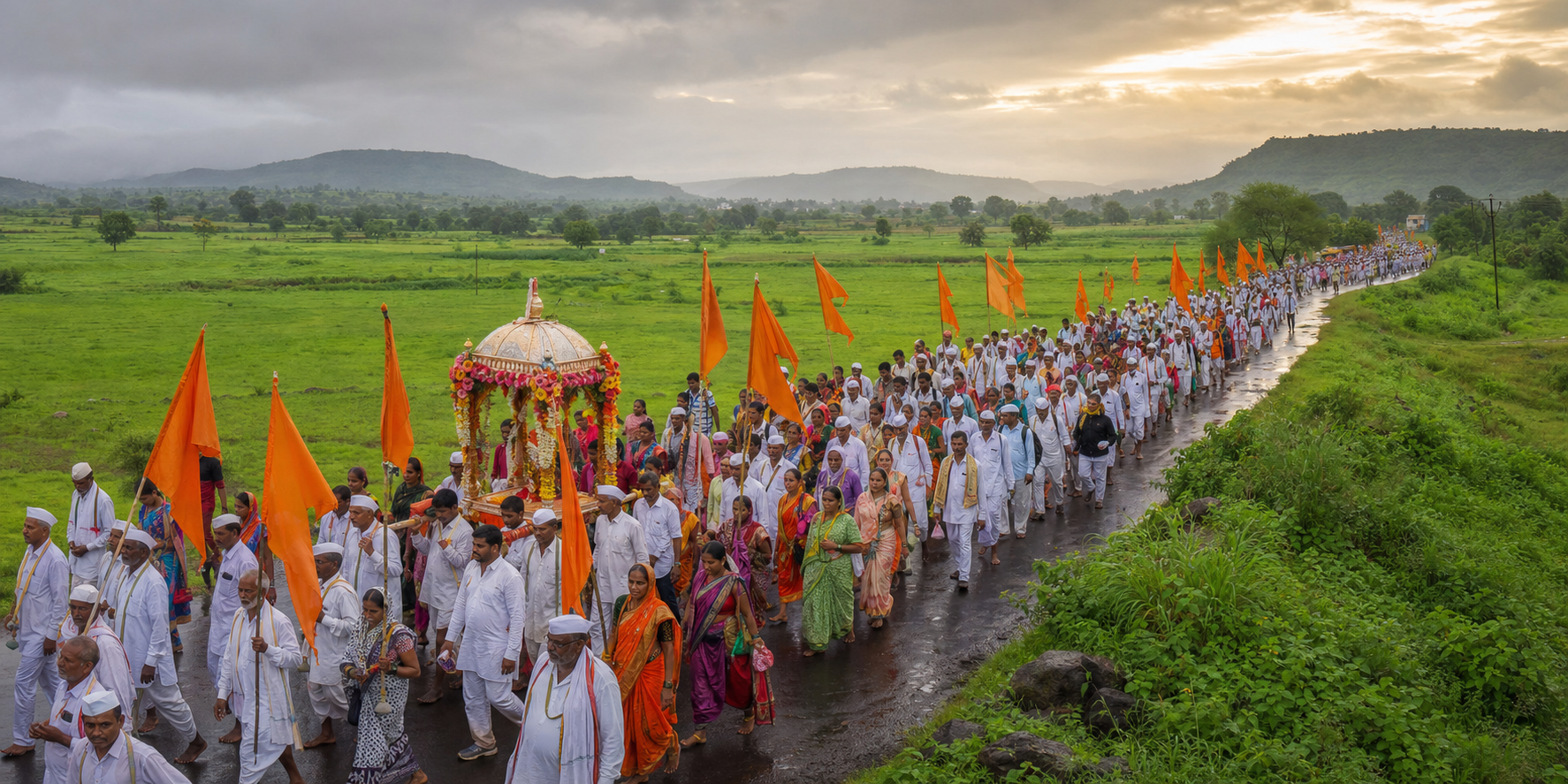
If you want to join the Pandharpur Wari in 2026, your first decision is not simply Dehu or Alandi. You need to decide what you actually want to do: walk for several weeks inside a disciplined dindi, accompany one Palkhi for a few days, witness a ritual halt, perform seva, or reach Pandharpur for darshan. Each choice requires a different date, joining point, physical commitment, and exit plan.
The Wari is not one procession following one road. It is a devotional network of approximately 43 traditional Palkhi yatras, their associated dindis, local hosts, service camps, and district administrations. Plan from that network outward: choose your form of participation, identify the relevant Palkhi and dindi, locate a confirmed halt, and verify the operational details again shortly before you travel.
See the Wari as a network before choosing a route
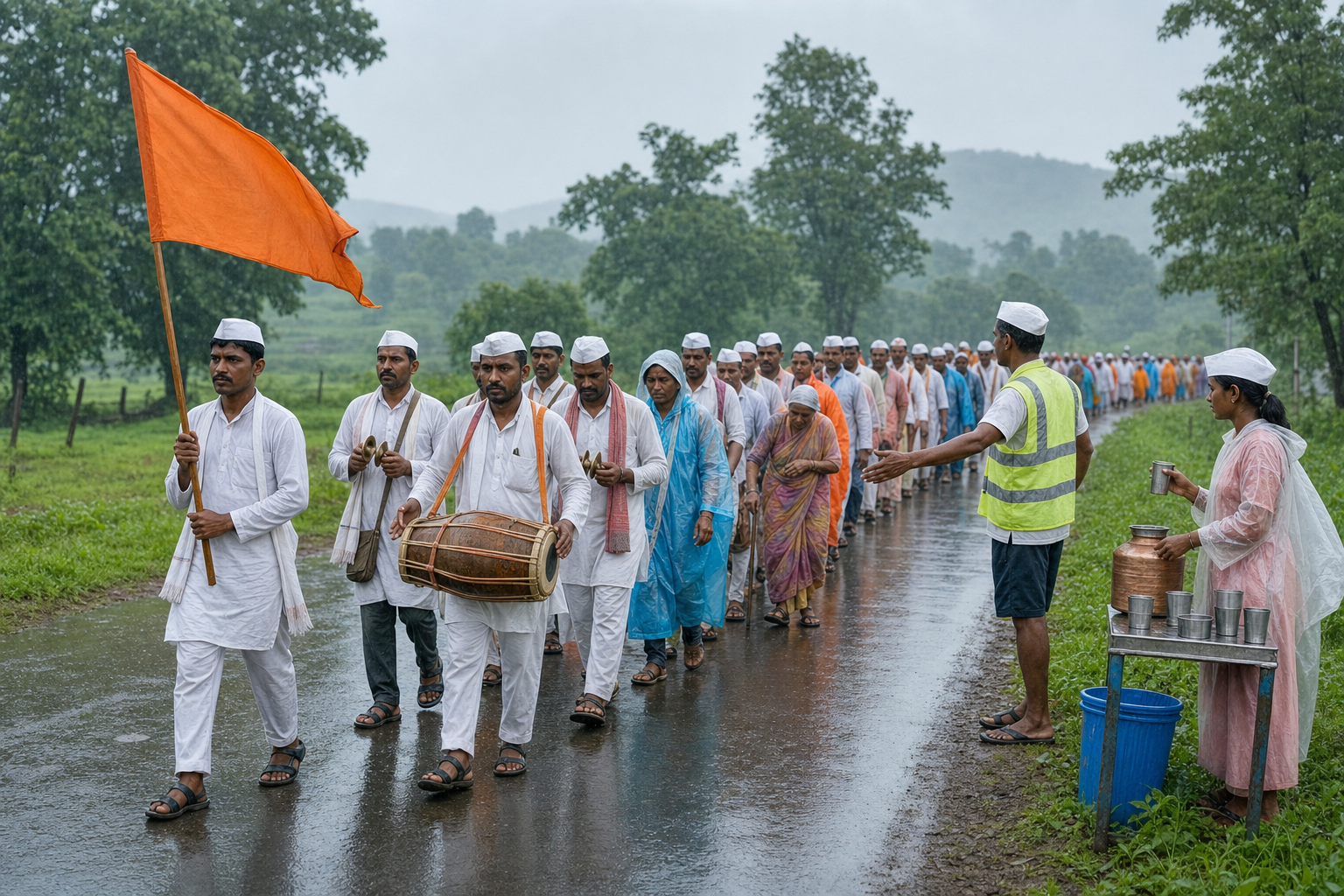
A Palkhi carries the padukas of a revered Sant and functions as a mobile shrine. A dindi is the organized devotional unit that walks with its own flag, leaders, singing group, food arrangements, discipline, and seva responsibilities. The distinction matters. You do not merely join a road full of walkers; you enter an ordered practice of nama-smaran, abhang-gayan, service, and collective restraint.
| Palkhi stream | 2026 planning anchor | What it means for you |
|---|---|---|
| Sant Tukaram Maharaj | Departure from Dehu on 7 July and arrival in Pandharpur on 24 July | Use this stream if Dehu, the Pune region, or Sant Tukaram’s abhang tradition is central to your vrata. Confirm every intermediate halt before joining. |
| Sant Dnyaneshwar Maharaj | Departure from Alandi on 8 July and arrival in Pandharpur on 25 July | This procession follows the familiar Alandi-Pune-Saswad-Jejuri-Lonand-Natepute-Malshiras-Wakhari corridor, subject to official refinements. |
| Sant Sopankaka Maharaj | A Saswad-centred procession whose precise daily timetable must be confirmed by its Samiti | Do not derive its dates from the larger Dehu or Alandi processions. Its inherited rath discipline and identity are distinct. |
| Sant Nivruttinath Maharaj | A 27-day Wari organized through 53 official dindis | Its longer duration shows why one standard three-week template cannot be applied to every Palkhi. |
| Wider Palkhi network | Dozens of processions arriving from several regions of Maharashtra | A local or regionally meaningful Palkhi may give you a more coherent pilgrimage than travelling to a famous starting point merely for visibility. |
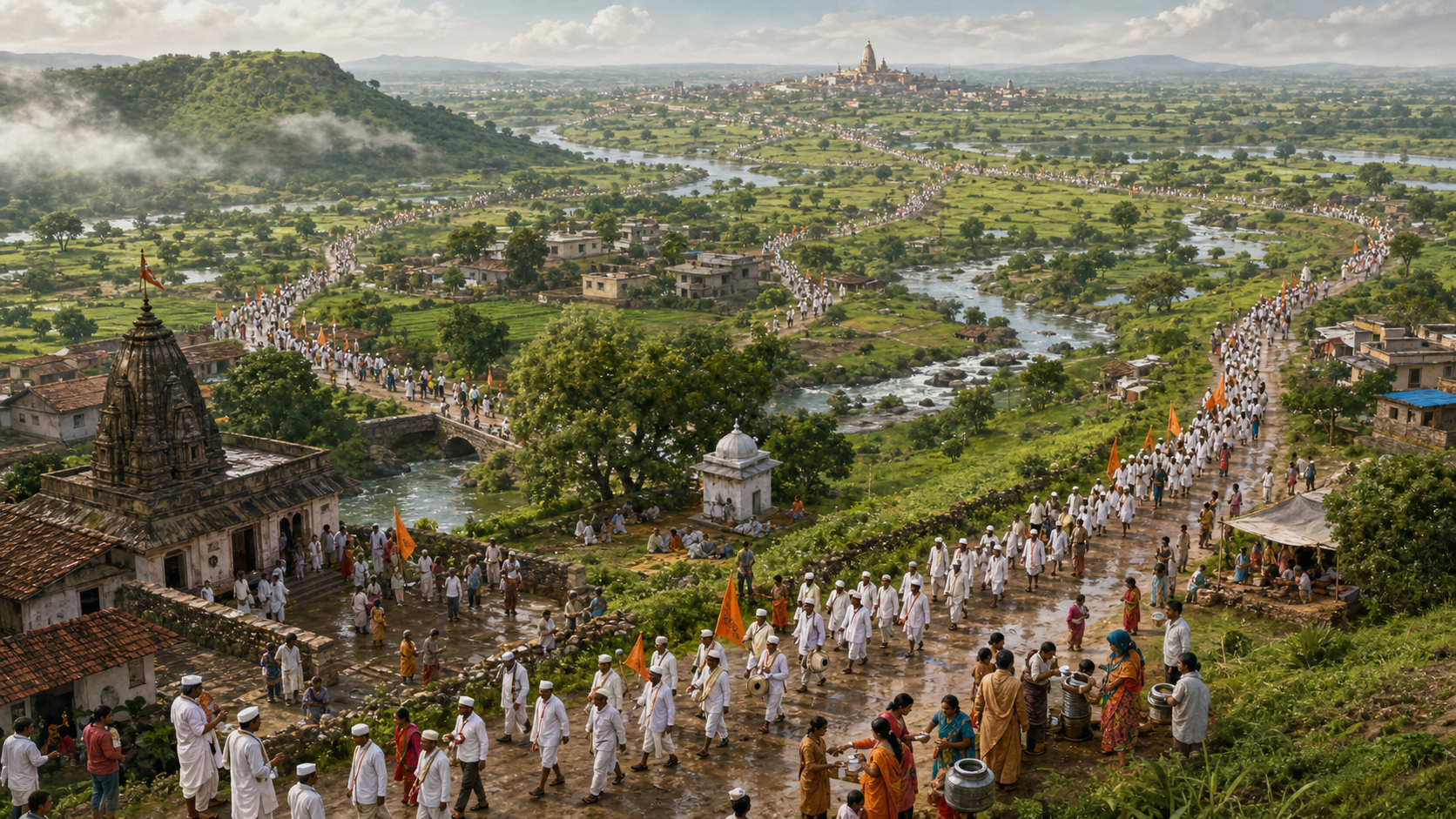
The broader network reaches Pandharpur through several geographic corridors. The Pune belt includes Dehu, Alandi, Saswad, and surrounding talukas. Marathwada contributes processions associated with places such as Paithan, Jalna, Parbhani, Nanded, and Chhatrapati Sambhajinagar. Western and southern routes gather walkers from the Satara, Sangli, and Kolhapur regions, while northern streams reach from Dhule and Jalgaon. Smaller contingents join larger streams as they approach Solapur district.
This changes the most common planning mistake. If you live outside the Pune region, do not automatically add a journey to Dehu or Alandi before you begin walking. First ask whether a recognized Palkhi or dindi passes through your district. A local stream can connect you to host communities, Sant traditions, and seva arrangements that you understand, while still carrying the same vow toward Vithoba in Pandharpur.
The wider network also preserves voices that can disappear when the Wari is reduced to two famous processions. Sant Eknath Maharaj’s Palkhi begins from Paithan and traditionally covers roughly 250-300 kilometres. Sant Namdev Maharaj’s stream recalls a bhakta whose compositions are also present in the Guru Granth Sahib. Traditions honouring Sant Chokhamela, Sant Savata Mali, Sant Gora Kumbhar, and Sant Janabai carry the memory of cultivators, artisans, women, and historically excluded communities into the common road to Pandharpur.
Treat the 2026 dates as distinct checkpoints
You will encounter a real calendar inconsistency when planning 2026. Ashadhi Ekadashi is placed on Saturday, 25 July 2026. At the same time, the Sant Tukaram itinerary gives 24 July as its Pandharpur culmination and identifies that date with Ekadashi, while the Sant Dnyaneshwar itinerary gives 25 July for arrival. These dates should not be silently treated as interchangeable.
The practical response is to ask what each date labels. Arrival at a final camp, movement from Wakhari, entry into Pandharpur, the Ekadashi tithi, and an individual pilgrim’s temple darshan are separate checkpoints. A date that answers one of those questions may not answer the others.
- Confirm the date and time when your chosen Palkhi leaves the halt where you intend to join it.
- Confirm the exact night-rest ground, not just the town name. A large town may have several dindi camps, controlled roads, and separate public-darshan areas.
- Ask when that Palkhi is expected at Wakhari and when its organized entry toward Pandharpur occurs.
- Check the Ekadashi tithi and parana timing through the local Panchang or temple guidance followed by your tradition. Do not infer a fasting window from a procession’s arrival date.
Use a simple verification ladder. Start with the relevant Sant Sansthan or Palkhi Sohala Samiti for the procession timetable. Check district administration and police notices for diversions, pedestrian corridors, parking, and controlled zones. Check health and weather bulletins for conditions along your actual stage. Use Shri Vitthal-Rukmini temple notices for the arrangements that apply inside Pandharpur.
Repeat those checks 48-72 hours before departure. Exact step-off times, lunch halts, night-rest grounds, and town-entry routes can change because of rain, road works, crowd density, or emergency access. Save the final timetable and route map offline, and send the relevant halt name to everyone in your group. A screenshot is more useful than a link when mobile networks become congested.
Keep one buffer day if you must connect from a train, flight, or long-distance bus to a moving Palkhi. A delayed journey does not merely make you late for a static event; it can leave the procession many kilometres beyond the joining point you selected.
Choose a form of participation that you can sustain
The Wari can accommodate several levels of participation, but each one should be planned honestly. The broader network commonly moves about 15-25 kilometres on a marching day, and its walking cadence is around 3-4 kilometres per hour. Ritual stops, regrouping, meals, rain, and town entries make the day longer than the distance alone suggests.
- Full Palkhi journey: Join through a recognized dindi and prepare for its complete discipline, not only the walking. The two major Dehu and Alandi routes extend roughly 225-270 kilometres over about three weeks, while other processions may follow different durations. You need arrangements for daily food, night shelter, bathing, laundry, foot care, medicines, and return travel from Pandharpur.
- Several consecutive stages: Select a sequence between two confirmed night halts. Arrive at the first halt before the evening programme so you can locate your dindi, understand its formation, and begin with the group the next morning. Decide how you will leave from the final halt before you start walking.
- One walking stage: Choose an ordinary stage if your aim is to experience the rhythm of nama-sankirtana and padayatra. Arrive the previous evening if possible. Trying to enter a moving column at a congested town gate is confusing for you and disruptive for the dindis.
- Ringan or public Palkhi darshan: Treat this as a high-density ritual visit, not as a normal walking day. Use the designated spectator area, stay outside the horse track and rath lane, and expect local road closures.
- Wakhari and Pandharpur convergence: If your priority is the final arrival and temple darshan, plan to reach the area 24-48 hours before the peak observance. Wakhari is the customary final staging point for many dindis, but access and movement become tightly controlled as the processions converge.
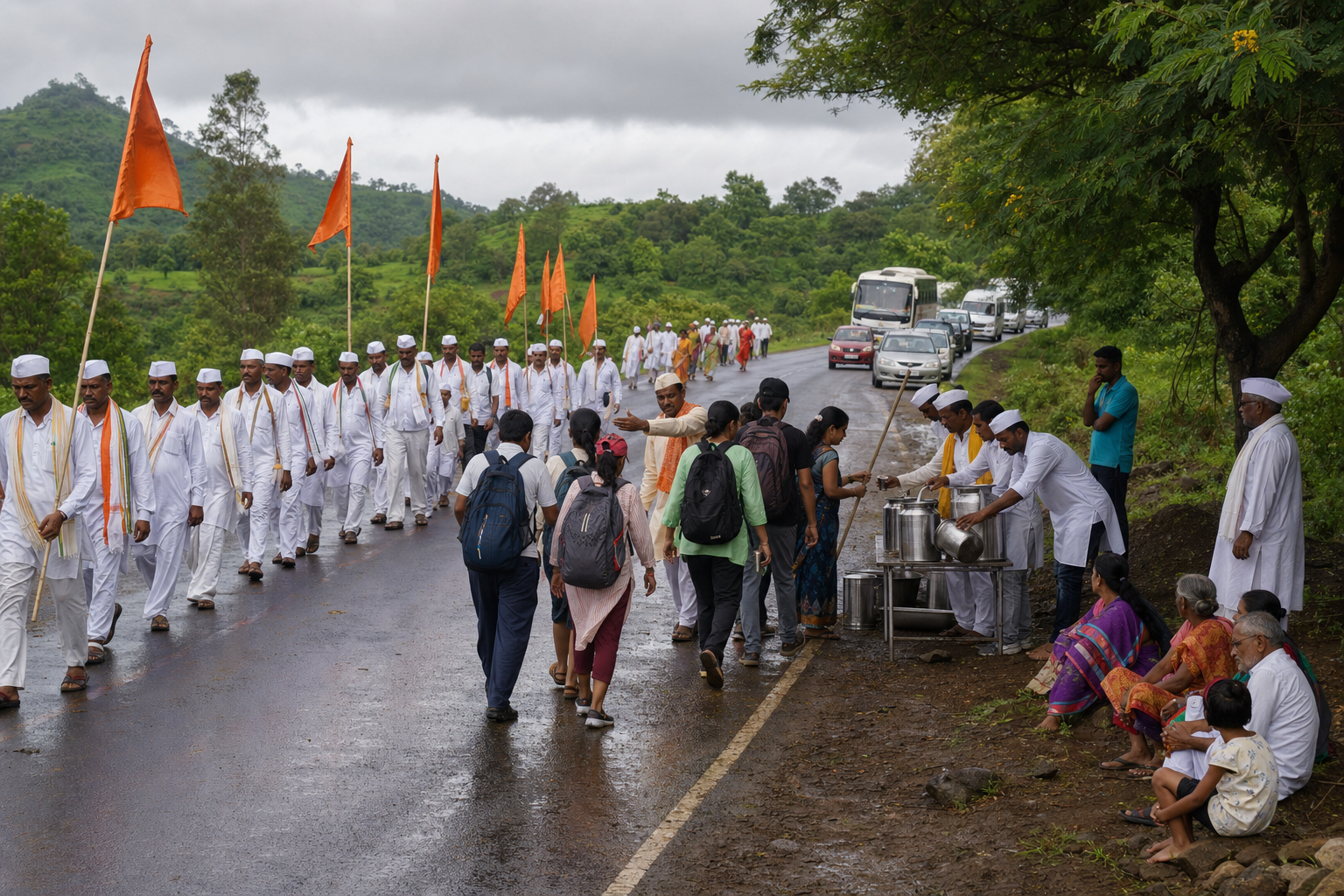
- Seva without a long walk: Work through an established annadan kitchen, medical team, sanitation group, lost-and-found counter, or host committee. Ask what is actually needed before bringing supplies; unsolicited distribution can obstruct walking lanes and create waste.
Families travelling with children, elders, or people with limited mobility should favour a short stage or a fixed halt rather than assuming that a full daily leg can be shortened after the procession begins. Identify seating, shade, water, toilets, and the nearest medical post before entering the crowd. Put a contact number and meeting-point information on a child’s wristband, and choose a physical rendezvous point that does not depend on a working phone.
Pune is the practical gateway for Dehu, Alandi, and Saswad. Pandharpur can be approached by road from Pune, Solapur, and Kolhapur, while Pandharpur station and Solapur Junction serve rail travellers during the Wari period. However, a ticket to the nearest town is not a final-mile plan. Temporary no-vehicle zones may require you to walk the last stretch with your luggage. Pack so that every person can carry their own essentials.
Accommodation inside Pandharpur is limited relative to peak demand. Dharmashalas, ashrams, community halls, temporary camps, and budget lodgings fill quickly. If you are not attached to a dindi, consider a confirmed stay in a nearby place such as Sangola or Mangalvedha, but verify onward transport and diversion rules rather than assuming that a vehicle can reach the temple area.
Build one plan for monsoon, crowds, and maryada
A good Wari kit is small enough to carry through rain and complete enough to keep a minor problem from ending your walk. July falls in Maharashtra’s monsoon season, so wet feet, slippery surfaces, humidity, and soaked belongings are normal planning conditions rather than unusual disruptions.
Pack for repeated wet walking
- A light backpack with a waterproof liner or separate waterproof covers for clothing, documents, and electronics.
- A reliable rain poncho or jacket that leaves your hands free. An umbrella is less useful in a dense moving formation.
- Quick-dry clothing and enough socks to change out of wet pairs. Keep one dry set reserved for the night halt.
- Breathable walking footwear with secure grip. Do not begin a long Wari in an unworn pair.
- A compact foot-care kit with dressings for early blisters. Trim toenails before the journey and check your feet at every night halt rather than waiting for pain to become disabling.
- A reusable water bottle, personal tumbler, and reusable eating utensils. Use designated refill points and drink small amounts regularly.
- Electrolyte supplies, simple dry food, personal medicines, and a basic first-aid kit. If you become unwell, use the medical posts or mobile clinics instead of trying to keep pace at any cost.
- Government identification, emergency contacts, a small amount of securely stored money, and as few valuables as possible.
Do not force yourself onward with dizziness, significant dehydration, a worsening wound, or an inability to bear weight. Step out through a marshal rather than stopping abruptly inside the formation, and seek the nearest medical team. The vrata is not strengthened by turning a manageable condition into an emergency.
Decide your crowd rules before the crowd decides for you
- Follow the dindi order. Walk with the unit that has accepted or guided you. Do not weave repeatedly between dindis or push ahead of traditional sasan dindis that hold processional precedence.
- Keep the Palkhi corridor clear. The rath, sacred horses, marshals, and emergency services require predictable lanes. Never step into that space for a photograph, closer darshan, or a shortcut.
- Watch the ringan from the assigned boundary. The horse’s circuit is a sacred and emotionally charged moment. Do not rush onto the track to gather dust or approach the animal while it is moving.
- Treat the padukas as the centre, not as a photo opportunity. Follow local rules concerning footwear, circumambulation, phones, and proximity. Ask before taking close photographs, and never block arati or Paduka darshan.
- Use an offline separation plan. Give every member the next halt, the dindi name, and one fixed meeting point. If a child or vulnerable adult is missing, report it immediately to volunteers or the police instead of sending the whole group into opposing crowd flows.
- Respect river restrictions. Chandrabhaga snana is a cherished practice, but monsoon water and crowd conditions can make access unsafe. Follow the barriers and local safety directions; entering a restricted stretch is not a devotional necessity.
- Protect the host settlement. Use toilets and waste points, carry reusable utensils, refuse unnecessary single-use plastic, and leave the night halt clean. Annadan does not make food, water, or disposable plates limitless.
- Preserve the devotional atmosphere. Avoid intoxicants, fireworks, disruptive amplification, aggressive jostling, and loud activity during night-rest hours. Sattvic conduct is part of participation, not an optional private preference.
Some visual customs belong to particular processions. In both the Sant Sopankaka Palkhi and the Sant Nivruttinath Palkhi, the charioteer’s position on the right is preserved as inherited maryada. Notice such details without assuming that every Palkhi must use identical rath choreography. The network remains united in destination and bhakti while retaining the disciplines of its individual lineages.
This order is not merely crowd administration placed around a religious event. It is part of the Wari’s spiritual method. The Palkhi makes the Sant’s presence the centre of movement; the dindi turns individual enthusiasm into a sangha; and the shared rules make equality workable across age, occupation, caste, class, and region. You experience the Varkari ideal by accepting a common pace, serving people you do not know, and yielding space when another person needs it more.
The Wari is specifically a Varkari Vaishnava pilgrimage to Vithoba-Rakhumai, and that identity should not be blurred. Its practices nevertheless reveal a wider dharmic kinship: nama and kirtan, annadan and seva, ahimsa, disciplined walking, restraint, and collective remembrance also find meaningful echoes in Sikh, Jain, and Buddhist communities. A visitor from another tradition can honour that kinship by participating under Varkari maryada rather than remaking the Wari in a more familiar image.
Key takeaways
- The 2026 Ashadhi Wari is a network of approximately 43 traditional Palkhis, not a single procession from Pune to Pandharpur.
- Sant Tukaram Maharaj’s Palkhi is scheduled from Dehu on 7 July to Pandharpur on 24 July; Sant Dnyaneshwar Maharaj’s Palkhi is scheduled from Alandi on 8 July to Pandharpur on 25 July.
- The available 2026 dates do not use arrival and Ekadashi labels consistently. Confirm the tithi, Wakhari arrival, Pandharpur entry, and temple arrangements separately.
- If you walk, align with a recognized dindi and plan around confirmed night halts rather than town names or estimated road positions.
- For final convergence and darshan, reach Wakhari or the Pandharpur area 24-48 hours early and expect a substantial final stretch on foot.
- Recheck the Palkhi timetable, police diversions, weather, medical arrangements, and temple notices 48-72 hours before travel.
Your next step is simple: choose one participation mode and one Palkhi stream. Write down the confirmed joining halt, step-off time, night destination, medical point, and exit arrangement on a single offline page. Once those five details are settled, the rest of your preparation can serve the purpose of the Wari: walking toward Vithoba with attention, humility, and room to help the person beside you.
References
- DharmaRenaissance Blog – Sant Sopankaka Maharaj Palkhi 2026 (Ashadhi Wari): Route, Schedule, Rituals, and Safety Guide
- DharmaRenaissance Blog – Pandharpur Palki Yatra 2026: Definitive Guide to Ashadhi Ekadashi Waari Dates, Routes, Rituals
- DharmaRenaissance Blog – Sant Tukaram Maharaj Palkhi 2026: Sacred Dehu-Pandharpur Schedule, Dates, and Pilgrim Guide
- DharmaRenaissance Blog – Sant Dnyaneshwar Palkhi 2026: Full Waari Schedule, Route Insights, Rituals & Planning Guide
- DharmaRenaissance Blog – Sant Nivruttinath Maharaj Palkhi Sohala 2026: 27-Day Timeless Wari of Devotion, Discipline, and Unity
- DharmaRenaissance Blog – Beyond Dehu and Alandi: 43 Sacred Palkhi Yatras Powering the Ashadhi Wari to Pandharpur