

If ash-smeared ascetics, skulls, and burning grounds are your first images of Aghora, you may be wondering whether its philosophy has anything to offer an ordinary householder. It does, but only after you separate its spiritual purpose from its most photographed symbols.
You don’t need to imitate an ascetic, seek out a cremation ground, or experiment with taboo rites. The relevant question is more demanding: can you meet what frightens or repels you without surrendering discernment, and can that steadiness make you more useful to another person?
What Aghora asks you to stop dividing

The Sanskrit term Aghora joins the privative prefix a- to ghora, meaning terrible or fearsome. It therefore points toward what is not terrible, not governed by fear, or beyond terror. This doesn’t mean pretending that death, pain, and grief are pleasant. It means discovering whether awareness can remain whole in their presence.
Within the five-faced representation of Śiva, Aghora is one face alongside Sadyojāta, Vāmadeva, Tatpuruṣa, and Īśāna. Its transformative force pacifies dread and integrates what the mind has pushed into shadow. The name is therefore a direction for sādhana, not a label for cultivating a frightening personality.
Non-dual Śaiva Tantra gives this direction its philosophical depth. Reality is understood as an undivided, self-luminous consciousness whose dynamism is expressed through spanda, or pulsation. Liberation is pratyabhijñā: recognition of what has always been present. The practitioner isn’t trying to manufacture a sacred reality somewhere else. The work is to recognize reality without carving it into what deserves reverence and what may be rejected from awareness.
This is close to the non-dual affirmation found in the Upaniṣadic inheritance, but Aghora should not be collapsed into every school called Advaita. Its characteristic methods belong to embodied Tantric disciplines, including mantra, mudrā, elemental purification, and, for qualified initiates, tightly contained encounters with aversion and taboo. The destination may converge with other non-dual paths while the method, vocabulary, and lineage remain distinct.
A crucial distinction follows. Non-duality is not moral indifference. The claim that reality is Śiva-pervaded does not imply that every action is equally wise, harmless, or permissible. One statement concerns the nature of being; the other concerns conduct. A mature practitioner develops viveka, or discernment, without dveṣa, the hatred that dehumanizes whatever has been judged impure.
You can notice this distinction in an ordinary moment of aversion. When your mind calls a person, occupation, body, emotion, or place dirty, pause before agreeing with the label. Identify the observable condition, the practical boundary it may require, and the story you have added about human worth. Aghora does not ask you to discard the boundary. It asks you to stop turning the boundary into contempt.
Why the cremation ground matters, and why you need not go there

The smashāna, or cremation ground, is a severe classroom in impermanence. Death strips social performance of much of its force. The body, status, possessions, and identities around which the ego organizes itself are seen as unstable. In that setting, aversion and attachment are not abstract ideas; they become immediate movements of the mind.
Its symbols are easy to misread when removed from that contemplative purpose:
| Symbol or setting | Its contemplative function | The misreading to avoid |
|---|---|---|
| Smashāna | Confronts mortality, attachment, and the reflex to flee what cannot be controlled. | Treating another family’s place of grief as a theatre of horror or spiritual tourism. |
| Vibhūti, or ash | Recalls the body’s impermanence and the eventual loss of what the ego possesses. | Assuming an ash-smeared appearance proves realization. |
| Skull or kapāla | Represents the emptying of the clinging mind and an encounter with reality without decoration. | Fetishizing human remains or confusing morbidity with wisdom. |
| Pañca-makāra | In some lineages, functions as a controlled means of transforming attachment and aversion; interpretations may be literal, symbolic, or substituted. | Using Tantra to excuse indulgence, coercion, intoxication, or harm. |
The five elements commonly grouped as pañca-makāra are madya, māṃsa, matsya, mudrā, and maithuna. Their treatment has varied across lineages and periods. Some have used literal forms; others use visualization, yogic meanings, vegetarian offerings, or non-intoxicating substitutes. The doctrinal purpose is the transmutation of reactivity, not the pursuit of forbidden experience. These methods are neither universal within Aghora-aligned practice nor necessary for realization.
That last point matters if spectacle has made you curious. Advanced transgressive methods presuppose adhikāra, or eligibility, as well as a guru-śiṣya lineage, vows, ethical restraint, and meditative stability. Removing the ritual container does not produce a more daring version of the practice. It removes the conditions meant to prevent self-deception and injury.
A real cremation ground also belongs to mourners, workers, and the dead. Entering it to provoke an experience can violate privacy and convert someone else’s loss into your spiritual prop. A householder can face impermanence more honestly through responsibilities already present: accompanying an ill relative when invited, listening to someone who is grieving, preparing practical help after a death, or contemplating the changes occurring in one’s own body and relationships.
Aghora’s method can be compared, at the level of mechanism, with controlled exposure to what ordinarily triggers avoidance. The comparison must remain limited. Aghora is a soteriological path directed toward recognition and compassion, not a clinical treatment protocol. If contemplation overwhelms you or activates unresolved trauma, stop and seek help from a qualified mental-health professional rather than intensifying the exercise. Spiritual practice is not a substitute for appropriate care.
Compassion is the test of non-dual recognition
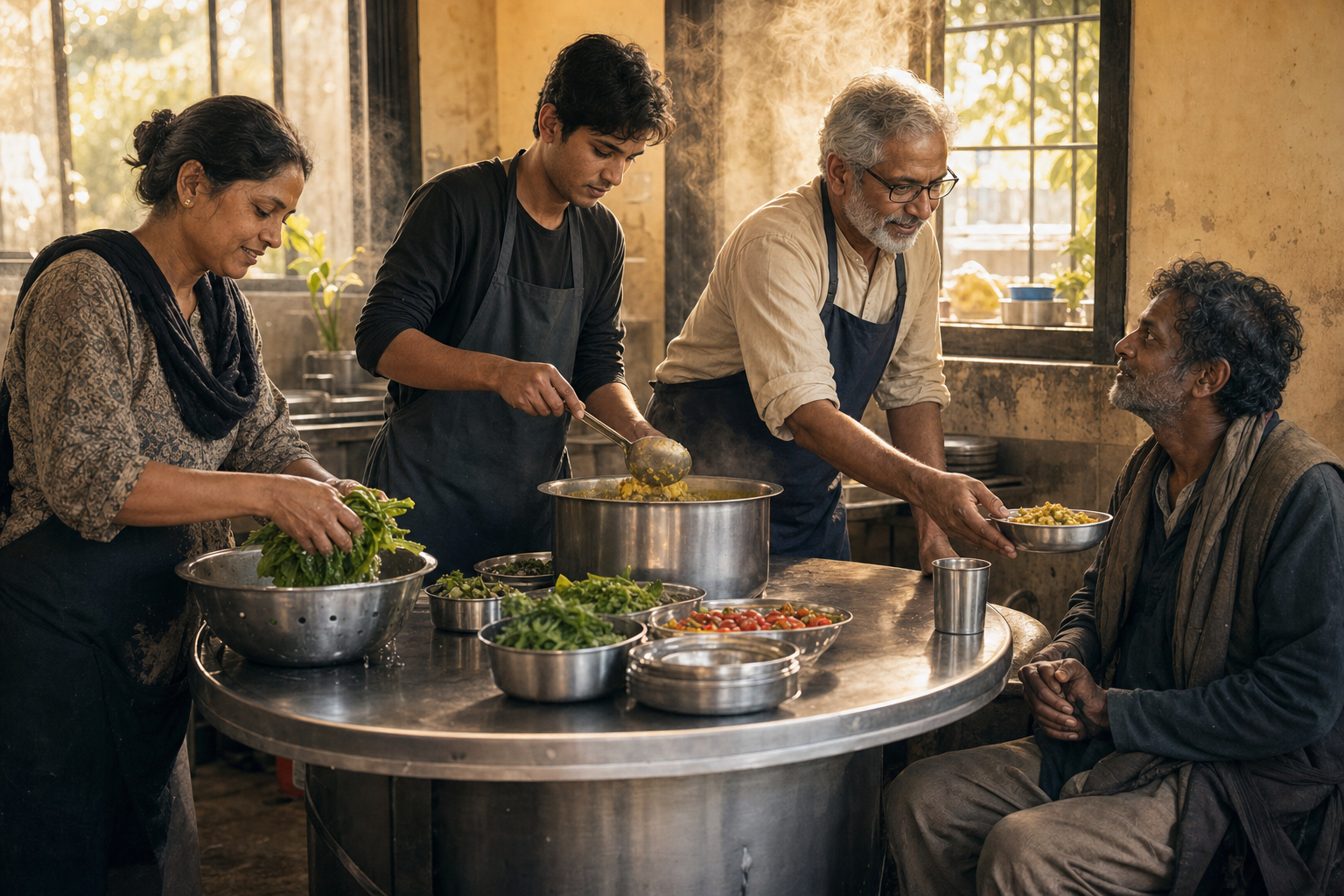
Fearlessness alone can become hardness. A person may tolerate disturbing sights and still remain vain, exploitative, or indifferent. Aghora reaches its ethical completion only when non-reactivity becomes karuṇā, compassionate responsiveness, and abhaya-dāna, the giving of safety.
This gives you a practical test for spiritual claims. Ask what happens to the people whom society places at its margins. If the distinction between pure and impure is genuinely loosening, the practitioner should become less willing to stigmatize the sick, the dying, mourners, those who perform death-related labor, and anyone treated as socially contaminating. The insight that no one falls outside Śiva’s presence should appear as dignity, patience, food, care, accompaniment, and service.
Steadiness beside grief is one example. It does not mean explaining away another person’s loss with a doctrine of immortality. It means refusing to flee because sorrow makes you uncomfortable. You listen without taking over, help with what has actually been requested, and allow grief to remain grief. Non-duality widens the capacity to accompany pain; it does not erase the mourner’s human reality.
The same principle has a social consequence. Purity language can attach stigma to caste, occupation, illness, death, and bodily processes. Aghora challenges the movement from necessary hygiene or ritual distinction to a judgement that another human being is beneath regard. You can keep sanitary, legal, and interpersonal boundaries while refusing humiliation. That is discernment without aversion in civic form.
Other Dharmic traditions illuminate this ethical horizon without becoming interchangeable with Aghora. Vajrayāna charnel-ground contemplations and Chöd confront ego-clinging through their own Buddhist frameworks. Jain reflection on the body’s transience cultivates dispassion without contempt. The Sikh ideal of Nirbhau, Nirvair, without fear and without hatred, is joined to sevā. These are resonances, not proof that the traditions teach identical metaphysics. Their shared practical question is whether a person can face impermanence with less clinging and serve living beings with less fear.
How to practise the Aghora principle in ordinary life

A safe householder practice begins with an ethical container and stays within the life you already have. It does not reproduce ascetic rites. Use the following sequence as a reflective discipline, not as initiation into a lineage:
- Choose an ordinary aversion, not an extreme ordeal. Work with a difficult conversation, discomfort around aging, resistance to visiting an ill person, or prejudice toward a socially stigmatized role. Do not deliberately provoke trauma, trespass, handle remains, use intoxicants, or create a sexualized ritual.
- Separate sensation from judgement. Notice tightening, heat, restlessness, the wish to leave, or whatever is actually present. Then notice the labels the mind adds. You are not required to suppress either. The practice is to see both without letting the label become a verdict on another person’s worth.
- Recall impermanence without becoming nihilistic. Let the changing body, a loss, or the end of a familiar phase remind you that possession and identity cannot be held permanently. Then ask what deserves care precisely because it is vulnerable and temporary.
- Restore the person hidden by the category. Replace a generalized label such as impure, hopeless, frightening, or beneath me with the concrete human being in front of you. Respect consent and safety. Non-duality never gives you permission to invade another person’s space.
- Turn recognition into one proportionate act. Listen, prepare food, make a practical call, support a caregiver, acknowledge overlooked labor, or remain quietly present when your presence has been welcomed. Choose what the situation needs, not what makes you appear spiritually brave.
- Examine the fruit. A sound practice should gradually reduce contempt, compulsive recoil, self-display, and fascination with taboo. It should increase humility, steadiness, ethical clarity, and useful service. If the opposite is happening, do not call the disturbance transformation; stop and reassess the method.
You can also use a brief end-of-day inquiry. Recall where you withdrew from something merely because it was uncomfortable. Distinguish a wise boundary from reflexive disgust. Then identify a respectful action you can take when the situation next arises. This keeps the work concrete: fear is not defeated by adopting an identity but by meeting the next responsibility without hatred.
How to recognize teaching that has lost Aghora’s centre
Not everything presented under the name of Aghora is authorized by a scripture or living lineage. Images can be copied more easily than discipline, and shocking behavior attracts more attention than years of ethical formation. Before trusting a teacher, retreat, video, or invitation, apply these checks:
- Can the teacher explain the non-dual purpose before displaying transgressive imagery?
- Are yama-niyama, vows, consent, legality, and the prevention of harm treated as binding rather than optional?
- Is eligibility taken seriously, or is an advanced practice marketed as a shortcut available to anyone?
- Does the teacher acknowledge that pañca-makāra has symbolic and substituted interpretations, and that such methods are not required for realization?
- Are mourners, cremation workers, ill people, and marginalized communities treated as persons with dignity rather than scenery for spiritual performance?
- Does the community’s visible fruit include service, humility, and care, or mainly secrecy, spectacle, money, sexual access, and the teacher’s special status?
- Can you decline participation without pressure, threats, humiliation, or claims that your discomfort proves spiritual inferiority?
A claim of transcendence does not cancel consent, law, or responsibility. Pressure to consume intoxicants, enter sexual activity, touch human remains, trespass, or conceal harm is a reason to leave, not evidence that your ego is resisting liberation. Responsible Aghora practice is contained by lineage, discipline, and concern for its effects on others.
Key takeaways
- Aghora means movement beyond terror, not the cultivation of a terrifying appearance.
- Its non-duality dissolves contempt; it does not erase ethical discernment or practical boundaries.
- Cremation-ground symbols teach impermanence and expose aversion. They are not instructions for householders to imitate extreme rites.
- The decisive fruit is compassionate service, especially toward people and forms of labor marked by stigma.
- For ordinary practice, meet one safe, real-life aversion with awareness, restore the human dignity obscured by your label, and take one useful action.
Begin where recoil already shapes your conduct. Approach only with consent and within safe boundaries, then replace avoidance with one proportionate act of care. If the practice makes you less interested in appearing fearless and more capable of protecting another person’s dignity, you are moving toward Aghora’s centre.