

You can remember a verse, repeat an acharya’s explanation, and still have no clear answer when the teaching collides with pride, distraction, or inconvenience. That does not make repetition useless. It shows where received knowledge has not yet become governing knowledge.
The practical question is not whether you should repeat sastra or speak from realization. Vaishnava practice requires both fidelity and assimilation. You need a way to preserve the teaching without pretending that borrowed words are already your character. The method below will help you study, practise, speak, and accept correction without turning scripture into either a slogan or a private invention.
Key takeaways
- Faithful repetition protects the siddhanta, or established conclusion; realization begins when that conclusion also directs your attention, choices, and service.
- You should be able to locate a teaching in its passage, explain it plainly, distinguish it from your application, and remain open to correction.
- Guru-sadhu-sastra is a test of convergence, not three quotations collected to defend a preferred opinion.
- The most useful evidence of assimilation is not spiritual self-certification but greater steadiness, humility, attentiveness, and willingness to serve.
- When you teach, separate what the text states, what the lineage explains, and what you are proposing as a present application.
Repetition is the beginning of transmission, not its finish
In a parampara, originality is not the highest credential. The teacher receives a conclusion, guards it against distortion, and makes it intelligible to another person. Srila Prabhupada repeatedly described his work as repeating what Krishna teaches in the Bhagavad Gita. That kind of repetition is disciplined accountability: the speaker does not replace revelation with charisma, fashion, or speculation.
Parrotlike repetition fails for a different reason. The problem is not that familiar words have been said again. The problem is that the sound is disconnected from understanding and life. A person may reproduce a sentence correctly while ignoring its context, misidentifying its conclusion, or behaving as though it places no claim upon him. Vaishnava teaching therefore preserves the conclusion while demanding comprehension, sadhana, and transformation.
Keep three levels distinct when you study:
- Wording: What does the passage actually say? Accuracy matters because a changed word can produce a changed teaching.
- Meaning: What conclusion follows when the words are read with their speaker, listener, question, and surrounding argument?
- Embodiment: What must change in your hearing, chanting, relationships, habits, or seva if you accept that conclusion?
A weakness at one level cannot be repaired by exaggerating another. Precise recitation cannot compensate for a context-free interpretation. Strong feeling cannot authorize a meaning that the passage and lineage do not support. Good conduct, though necessary, cannot by itself prove every theological claim. Realized engagement keeps the levels connected without confusing them.
This also clarifies what Srila Prabhupada meant when he contrasted living knowledge with something artificial or unscientific. In that Vaishnava usage, the standard is not laboratory approval for a theological conclusion. It is a pramana-based process: receive authoritative testimony, follow the prescribed discipline, and examine whether the promised purification is becoming visible in practice. Scripture supplies sabda-pramana; sadhana prevents sabda from remaining merely decorative.
You do not need to claim advanced spiritual attainment before discussing sastra. You do need existential honesty. Say what you have received, explain what you understand, acknowledge what you are still trying to live, and never use the authority of the lineage to conceal the distance between your speech and conduct.
Use a repeatable scripture-to-sadhana loop

The safest unit of study is a coherent passage, not the sentence that best fits an argument you already want to make. A verse becomes actionable when you follow it from hearing to understanding, verification, practice, and review.
- Receive before extracting. Read or hear the verse with the passages immediately around it. Identify who is speaking, who is listening, what question is being answered, and where the argument is going. If you cannot name those elements, postpone public conclusions and keep reading.
- Restate without rewriting. Close the book and explain the teaching in plain language. Then reopen the passage and check whether your paraphrase preserved its subject, action, and goal. Difficulty paraphrasing is useful evidence: it tells you exactly where familiar vocabulary has been masking incomplete understanding.
- Map the teaching. Ask whether the passage clarifies sambandha, the relationship among the Lord, the living being, and reality; abhidheya, the practice arising from that relationship; or prayojana, the goal. Some passages address more than one. Do not force every verse to do all three jobs, but do not interpret a local instruction against the larger theological architecture.
- Check guru-sadhu-sastra convergence. Compare your reading with the guidance of a guru representing the lineage, the explanations and conduct of recognized sadhus, and the plain sense and wider coherence of sastra. Bring a precise question to a qualified practitioner: name the passage, state your current understanding, and identify the point of uncertainty. A focused question is easier to correct than a request for general approval.
- Bind the conclusion to practice. Choose one observable response for the coming cycle of study. If the passage concerns hearing, remove one avoidable distraction during Bhagavata study. If it concerns humility, notice what happens when correction arrives. If it concerns seva, complete a necessary service that offers little visibility. At the next review, ask what changed, where resistance appeared, and whether your application actually followed from the passage.
Do not treat guru, sadhu, and sastra as three independent ballot boxes. Guru is not a license to defend personality against text. Sadhu does not mean collecting enough opinions to outvote an uncomfortable instruction. Sastra is not a searchable warehouse of fragments. The threefold test protects the same transmission from personal bias, social pressure, and quotational manipulation.
Questions are part of this method, not evidence of disloyalty. Bhagavad Gita 4.34 joins inquiry to guidance, and King Parikshit models questions organized around the real need of the listener. His inquiry moves through vast subjects while remaining directed toward remembrance at death. That structure matters for you: ask questions that move from information to practice rather than multiplying topics without changing attention.
A compact study note can keep the loop honest. Record the passage, its conclusion in your own words, the point that still needs verification, the practice you will attempt, and the correction or result that follows. Over time, those notes reveal whether you are repeatedly accumulating vocabulary or repeatedly submitting life to instruction.
Test realization where borrowed words usually fail

Realization should not become a title you award yourself. It is more useful to speak of degrees of assimilation. A teaching may be intellectually clear yet weak under pressure. It may guide private practice yet remain difficult to explain. These are not reasons for theatrical humility; they are instructions about where to work next.
The context and explanation test
Try to explain the passage to a sincere newcomer without relying on untranslated terminology. Define the necessary Sanskrit terms, but do not hide behind them. Then answer four questions:
- What problem or question is this passage addressing?
- What does it affirm, and what does it not establish?
- How does it fit the surrounding teaching rather than an isolated phrase?
- Which part of your explanation comes from the text, and which part is your practical application?
If the explanation collapses when a slogan is removed, return to study. If you can explain the idea but cannot show its place in the passage, return to context. If you can do both but have no idea what it asks of a practitioner, move deliberately into sadhana.
The pressure and fruit test
Inconvenience exposes the difference between admired teaching and operative teaching. A doctrine of humility is tested when you are corrected, not when you praise humility. A commitment to attentive hearing is tested when the mind wants novelty. A teaching on service is tested when the needed work is ordinary, unnoticed, or poorly timed.
Look for fruits such as steadier japa, less eagerness to win with quotations, greater care with context, dependable service, and more compassionate conduct. Treat these as diagnostics, not credentials. One peaceful meditation does not establish mature realization, and one difficult day does not prove that practice has failed. The meaningful pattern is whether scripture increasingly governs the response after distraction, praise, criticism, and inconvenience arise.
Japa makes the test immediate. Before chanting, identify the one thing you are asking to remember: that the holy name is to be heard rather than merely produced. During chanting, return attention to the sound whenever it wanders. Afterwards, name the recurring distraction without drama and alter one condition that encouraged it. The purpose is not to manufacture an impressive inner report. It is to reconnect repeated sacred sound with hearing, dependence, and service.
The correction test
A realized conclusion should make you more accountable to truth, not less reachable by others. Notice your first response when a senior practitioner supplies missing context or questions your application. Immediate defensiveness does not automatically make your interpretation false, but it is evidence that identity has become entangled with the interpretation.
Ask the person correcting you to identify the exact point: wording, context, siddhanta, application, or conduct. Then revise at the correct level. You may need to abandon an application while retaining the conclusion, improve an explanation without changing the practice, or admit that a quotation never supported the claim made for it. This precision turns correction into study rather than humiliation.
The larger Dharmic family offers comparable warnings against stopping at recitation. Buddhist pedagogy distinguishes study, practice, and realization; Jain thought distinguishes scriptural knowledge from direct realization and tests knowledge through ethics; Sikh practice joins shabad and simran to seva. These parallels identify a shared resistance to empty formalism. They do not make the traditions metaphysically interchangeable. For a Vaishnava, the distinctive center remains loving remembrance and service of Bhagavan.
Speak as a servant of sastra, not its owner
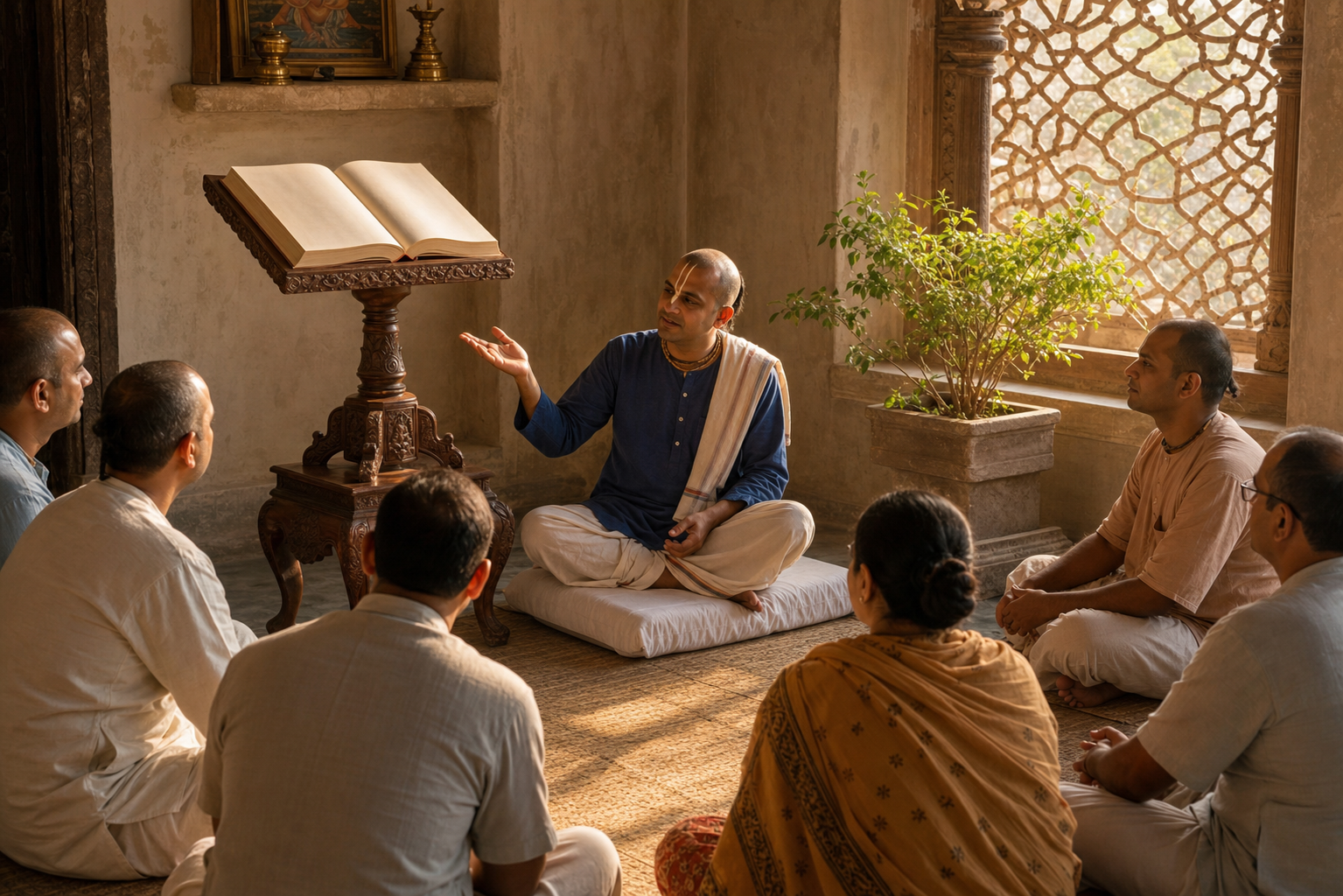
Teaching is one of the places where half-assimilated knowledge can do the most damage. An exact quotation can still mislead when it is detached from its question, audience, or place in the argument. The remedy is not to stop quoting. It is to make every quotation carry enough context for the listener to understand what authority is being claimed.
Use a simple sequence whenever you explain a passage publicly:
- Give the context. Name the speaker, listener, issue, and relevant surrounding movement.
- State the conclusion. Explain what the passage establishes before extending it to a current dispute or personal situation.
- Show the lineage connection. Make clear how the explanation aligns with guru, sadhu, and sastra rather than borrowing the prestige of those words.
- Label the application. Say plainly when a present recommendation is an application of the conclusion rather than the literal wording of the verse.
- Name the limit. Identify what the passage does not settle. A limit increases trust because it prevents a valid teaching from being stretched into an invalid claim.
This sequence allows adaptation without dilution. Language, analogy, and emphasis may change with time, place, and audience. Siddhanta cannot be bent merely to make the explanation fashionable. A good teacher therefore translates the route while preserving the destination.
The distinction is especially important online. Before sharing a quotation card, short clip, or forceful excerpt, open the full passage and ask whether the shortened form preserves its conclusion. Add the reference and enough context for another person to verify it. If the quotation is being used to defeat an opponent rather than illuminate a teaching, wait before publishing. Let sacred words open deeper study instead of closing discussion by force.
Hearing-led bhakti gives you a constructive alternative to performative certainty. Sravana receives; kirtana expresses what has been received; smarana lets it become a stable object of consciousness; seva gives it practical direction. The Bhagavata path joins hearing, contemplation, remembrance, and service so that knowledge does not terminate in abstraction. Even remembrance at death is approached as the culmination of a life trained in remembrance, not as a technique saved for an emergency.
Before your next class or study period, choose one coherent passage. Write its conclusion in plain language, identify one point that needs guidance, and attach one act of sadhana or seva to it. When you return to the passage, do not ask whether you now possess realization. Ask whether you can hear more carefully, explain more accurately, practise more steadily, and accept correction more honestly. That is how faithful repetition begins to become lived scripture.
References
- Dandavats – Beyond Parroted Words: Srila Prabhupada on Realized Repetition of sastra in Parampara
- Dandavats – Srimad Bhagavatam 2.8.8 at ISKCON London: Timeless Answers, Clear Practice, Dharmic Unity