
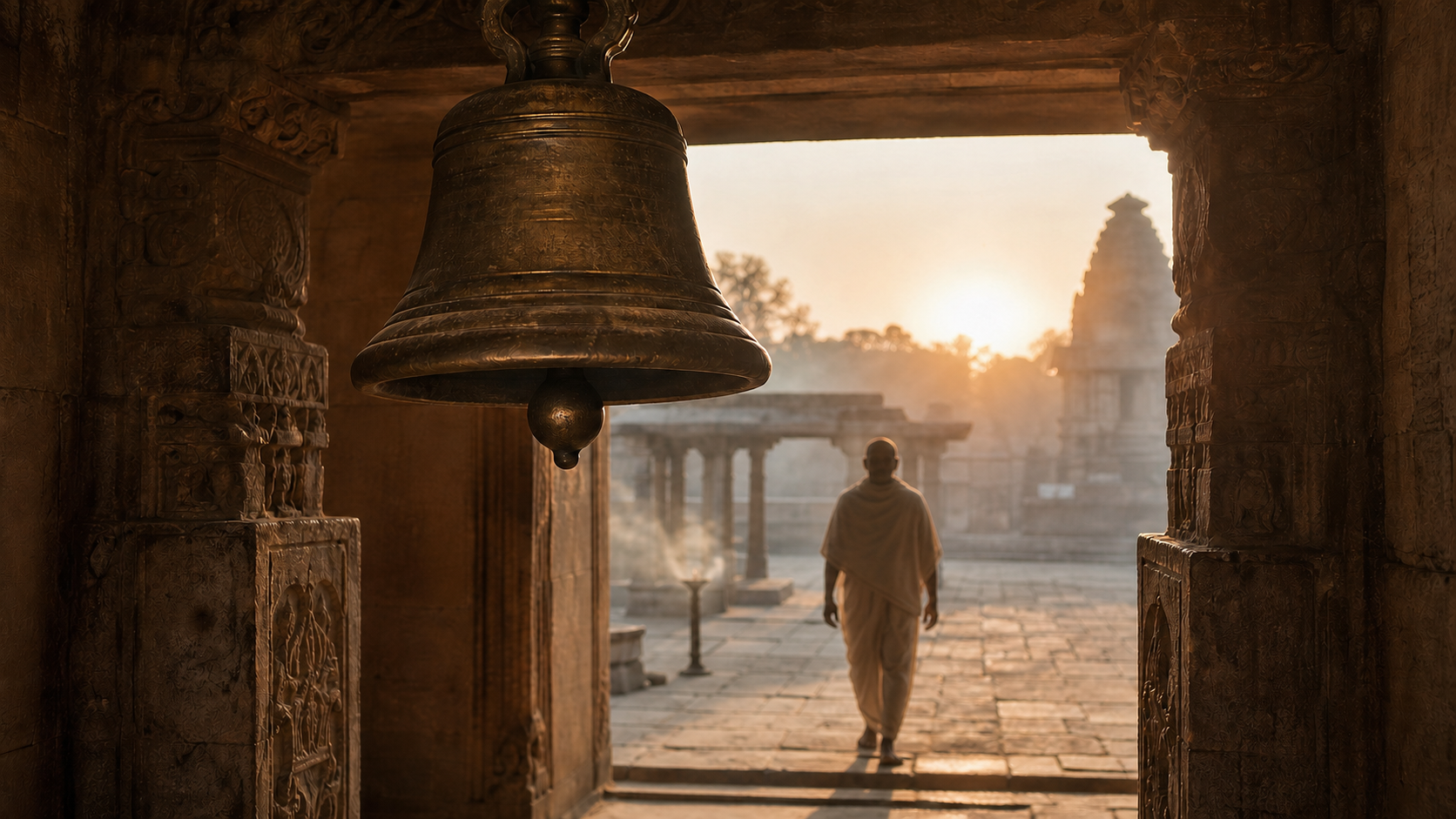
You arrive at a temple carrying unfinished conversations, plans, worries, and whatever was on your phone a moment earlier. A bell hangs near the entrance. Should you ring it, how should you ring it, and what are you meant to do with the sound?
The useful answer is simple: where temple custom invites you to ring, do it with restraint and then listen. The practical purpose traditionally given for ringing the bell in a mandir is to interrupt the many thoughts moving through the mind and gather your attention for worship. The sound is not a noisy preliminary to darshan. Properly approached, it begins the transition into darshan.
The bell marks a threshold for the mind
Your feet can cross the temple threshold while your mind remains in the street. Ghantanaad, the resonant sound of a bell, gives the mind an immediate event to meet. For a moment, you are no longer following every thought. You are hearing.
That makes the bell a practical discipline of attention. Its sequence is worth noticing:
- Before the sound, notice the concerns and mental chatter you have carried to the entrance.
- As the bell sounds, give the tone your full attention instead of continuing an inner conversation.
- As the resonance fades, remain present for the silence that follows.
- Enter with a clear intention: darshan, prayer, gratitude, surrender, remembrance, or simply attentive presence.
The bell does not perform this inward movement on your behalf. You can strike it forcefully and remain distracted. You can also hear a bell rung by someone else and become recollected. The decisive question is not whether your hand touched the bell, but whether you allowed the sound to change the quality of your attention.
This distinction also protects a Dharmic practice from unnecessary pseudo-scientific decoration. A bell can serve as a powerful ritual and attentional cue without every bell having identical acoustic properties or producing a guaranteed physical result. If someone attaches an exact frequency, a universal bodily effect, or a health promise to temple bells, treat that as a separate empirical claim requiring evidence. Sacred meaning does not become stronger when it is covered with unsupported scientific language.
How to ring a temple bell without making it a performance
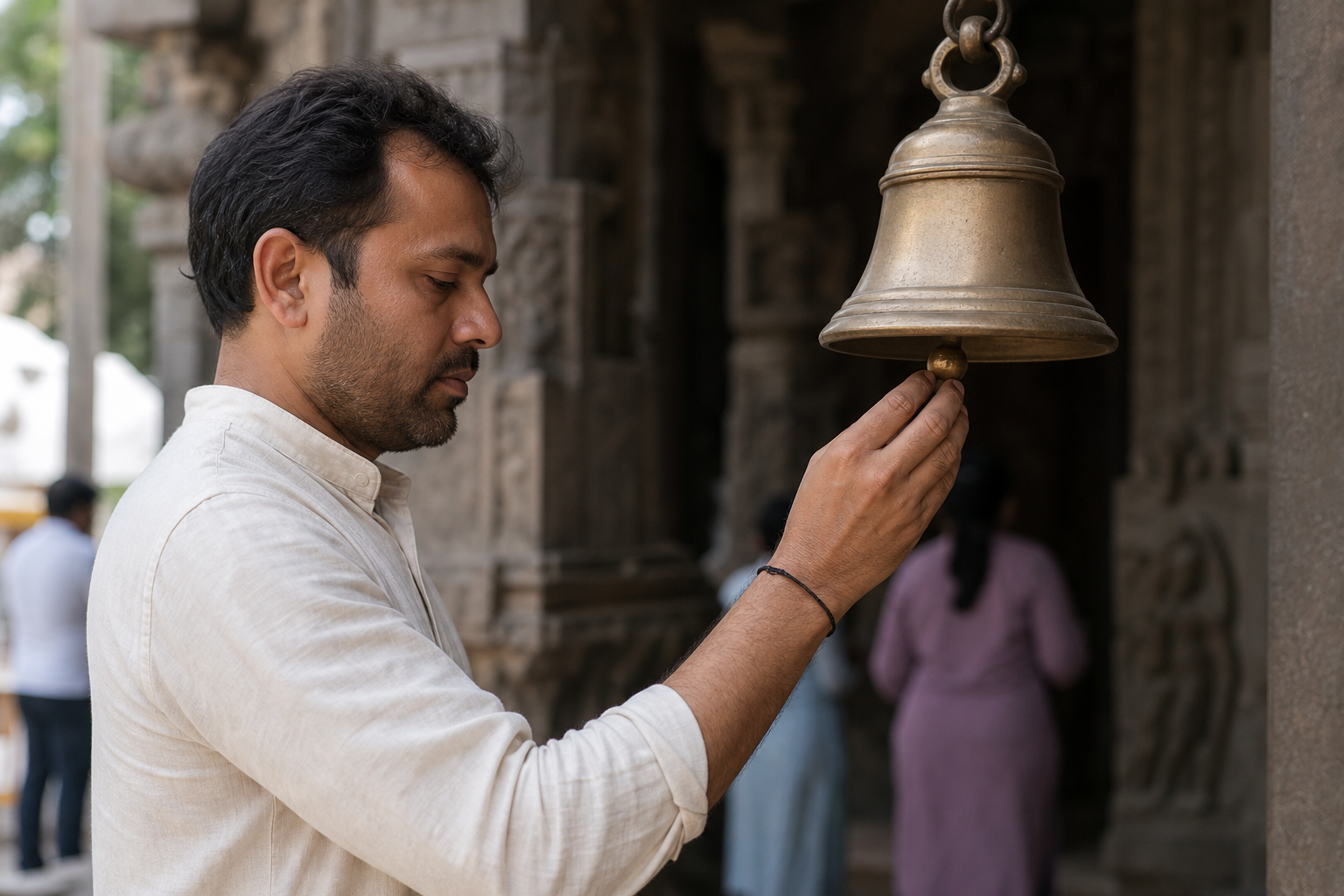
There is no need to turn a simple act into a display of enthusiasm. The appropriate practice is shaped by the temple, the ritual in progress, and the people sharing the space. Use this sequence when visitors are permitted to ring the bell:
- Observe before acting. Notice whether other devotees ring the bell, whether it is accessible, and whether a ceremony or recitation is underway.
- Pause at the threshold. Let your body become still rather than reaching for the bell while walking or talking.
- Make a measured strike that produces a clear tone. Loudness is not a measure of bhakti.
- Keep quiet after striking it. Follow the resonance until it passes instead of immediately speaking, checking your surroundings, or reaching for something else.
- Bring forward your chosen name, mantra, prayer, or intention, and then approach the deity.
The simplest test comes after the sound: is your attention less scattered than it was before? If the answer is yes, the practice has done useful work. If not, there is no reason to ring repeatedly. Pause, steady yourself, and proceed with greater awareness.
In a crowded temple, do not block the entrance while trying to create a private contemplative moment. If the bell is roped off, placed beyond visitors’ reach, or reserved for temple personnel, leave it untouched. If a sudden loud sound is uncomfortable for you, stand farther away and use the sound already present as your cue. Attention does not require you to produce the sound yourself.
Ghantanaad, Shankhanaad, mantra, and the silence after them
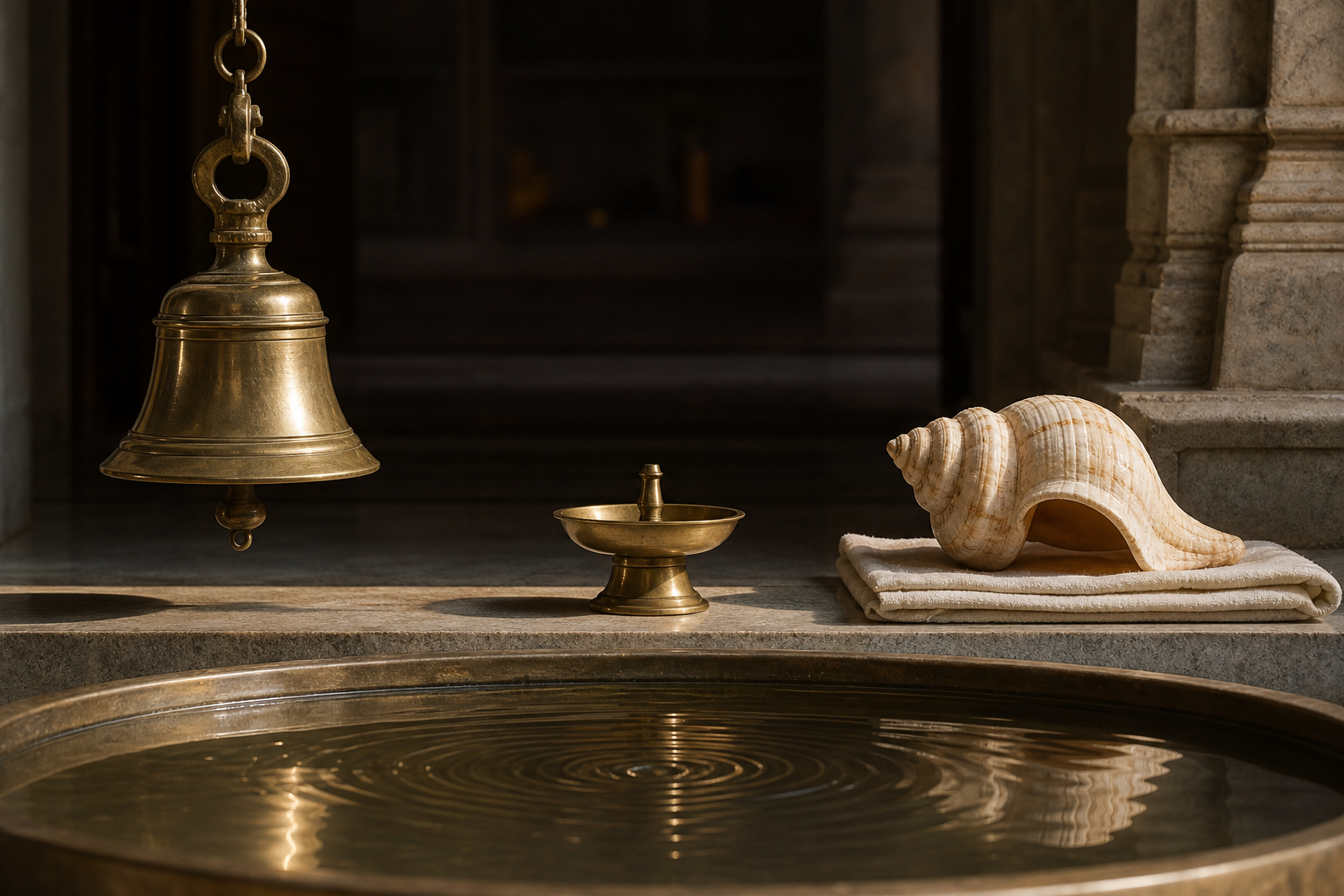
Ghantanaad refers to the sound of the ghanta, or bell. Shankhanaad refers to the sounding of the shankha, or conch. Both belong to the broad Dharmic understanding that sound can orient a gathering, mark a ritual moment, and draw attention away from ordinary mental preoccupation. They should not, however, be treated as interchangeable objects with identical rules.
- A bell offers a resonant tone that a worshipper may encounter at the threshold or within puja, depending on temple custom.
- A conch produces a ceremonial call through breath and normally belongs to a defined ritual context. Do not assume that a visitor may sound it merely because it is visible.
- A mantra works through articulated sacred syllables or words, while bell and conch sounds can gather attention without carrying a spoken sentence.
- Silence is not the absence of the practice. Listening to the sound disappear is part of what allows mental agitation to settle.
The sound-and-silence relationship matters. If you pay attention only to the strike, you may experience the bell as an interruption. If you follow the whole arc of its resonance, the fading tone reveals how much noise the mind was producing before it sounded. That recognition is something you can carry into mantra-japa, meditation, and darshan.
Temple traditions vary, so let the living practice of the mandir determine when each sound is appropriate. A visitor’s task is not to impose a private theory on the ritual. It is to observe, participate respectfully, and receive the discipline the space is offering.
Respect is audible at the temple and at home

In a mandir
- Watch what the temple community does before touching a ritual object.
- Follow posted instructions and requests from priests or volunteers without argument.
- Do not compete with another bell, a conch, a mantra recitation, an announcement, or a period of silence.
- Keep the threshold clear for devotees entering behind you.
- When guiding children, show them how to ring gently and listen. The lesson is reverent attention, not fear of making a mistake.
In a home shrine
A household bell is most useful when it marks a consistent change of activity. Place it securely, pause conversation and devices, sound it with care, listen, and begin puja. This creates a recognisable boundary between the momentum of household life and the attention offered in worship.
Consider the household as well as the ritual. A needlessly loud or repeated sound can disturb someone who is sleeping, studying, working, or unwell. Bhakti does not require disregard for others. Choose a manner and moment that preserve both devotion and consideration.
A bell at home should not become an automatic gesture that lets the rest of the puja run on mental autopilot. Let it pose a quiet question each time: have you actually arrived? If you have not, remain still for a moment before continuing.
Key takeaways
- Temple bells help mark the inward crossing from ordinary distraction to attentive worship.
- Where local custom permits ringing, use a measured strike and listen to the resonance rather than chasing volume.
- The physical act is not the whole practice; the change in attention is what gives the act practical meaning.
- Ghantanaad, Shankhanaad, and mantra all involve sacred sound, but each has its own ritual form and context.
- Precise scientific or health claims about bells need independent evidence; they are not required to honour the spiritual practice.
- Temple custom, consideration for others, and the ritual already underway take priority over personal preference.
On your next temple visit, put away the distraction before you reach the threshold. Observe the local practice. If the bell is offered for devotees, ring it gently, remain still as its sound passes, and then approach darshan with the mind you actually brought to the temple—no longer denied or scattered, but gathered.