

If one calendar calls the August dark moon Ashadha Amavasya while another calls it Shravana or Hariyali Amavasya, you are not necessarily looking at conflicting dates. You are seeing one lunar threshold through different regional calendars and inherited traditions.
Your task is not to find one name that overrules all the others. It is to identify the panchanga, region and family practice that apply to you. In 2026, the observances discussed here converge on 12 August, but their devotional meanings should not be collapsed into a single generic festival.
Why the same Amavasya carries two month names

Amavasya is the dark-moon tithi that closes one lunar cycle and opens the next. Regional calendars do not always attach that boundary to the same month name. That is why the observance may appear under Ashadha in one household and Shravana in another without the households necessarily worshipping on different civil dates.
Maharashtra provides the clearest example. Gatari Amavasya falls on Ashadh Amavasya and marks the approach of the holy Shravan month. In North India, the corresponding monsoon observance is identified as Hariyali Amavasya in Shravan. The apparent disagreement is largely about calendar context and regional usage.
This distinction matters when you search for a vrata, ask a temple about a puja or coordinate relatives in different states. Start with the place and tradition, not the English month printed beside the date. A local panchanga or temple calendar should settle the tithi timing; the civil date alone cannot tell you which inherited procedure your household follows.
A regional map of the Amavasya traditions

| Region or setting | Traditional name | Distinctive focus | What you should preserve |
|---|---|---|---|
| Maharashtra | Gatari Amavasya | Ashadh Amavasya is observed with happiness and joy as the holy Shravan month begins. | Treat Gatari as a Maharashtrian threshold into Shravan, not as the universal name for every observance on the date. |
| North India | Hariyali Amavasya | Lord Shiva is worshipped for prosperity and a favourable agricultural season; fairs and melas form part of the public celebration. | Keep its monsoon, agricultural and communal dimensions visible rather than reducing it to a date on a fasting calendar. |
| Andhra Pradesh and Telangana, with observance in parts of Karnataka | Chukkala Amavasya Vratam | The Ashadha Amavasya vrata is dedicated to Goddess Gauri, and Gauri Puja is performed. | If your family calls the day Chukkala Amavasya, follow its Gauri-centered identity instead of replacing it with an unrelated generic ritual. |
| Karnataka | Nagara Amavasya | The Ashadha Amavasya observance points forward to Nagara Panchami on the fifth day after Amavasya. | Keep Amavasya and Panchami in their proper sequence. The first date prepares the ritual calendar; it does not erase the significance of the fifth day. |
| Vrata tradition rather than one stated region | Pathi Sanjeevani Vrata | The Ashadha Amavasya vrata is dedicated to Lord Shiva and Goddess Parvati, and its katha is associated with the Skanda Purana. | Treat it as a named vrata with its own lineage and katha. Do not infer a complete procedure merely from the fact that it shares the date with other traditions. |
The table is a map, not a menu. These observances coexist because Dharma has long been expressed through local calendars, languages, deities, agricultural rhythms and family lineages. You do not honour that plurality by combining every available name into one improvised ceremony.
What is shared, and what should remain distinct
The common frame is Amavasya during the monsoon transition. Darkness in the lunar cycle becomes a point of preparation: for Shravan, for a vrata, for worship connected with the agricultural season or for a festival that follows. That shared frame explains why the traditions feel related.
The devotional centers are nevertheless different. Hariyali Amavasya gives prominence to Shiva and the hoped-for well-being of the agricultural season. Chukkala Amavasya is centered on Gauri. Pathi Sanjeevani joins Shiva and Parvati through a specific vrata tradition. Nagara Amavasya belongs within the approach to Nagara Panchami. Gatari marks a distinctly Maharashtrian passage into Shravan.
This is a useful way to understand unity within Dharmic civilization. Unity does not require identical rites in every state. The continuity lies in a shared lunar framework and a habit of aligning devotion with season, place, household duty and sacred sequence. The regional form is not an obstacle to that continuity; it is how the continuity has remained alive.
When speaking with someone from another region, ask, “What does your family call this Amavasya?” That question reveals more than asking which name is correct. It makes room for the household’s calendar, chosen deity and ritual memory without turning difference into error.
Key takeaways
- Ashadha Amavasya and Shravana Amavasya can refer to the same 2026 lunar threshold under different regional calendar conventions.
- The shared date does not make Gatari, Hariyali, Chukkala, Nagara and Pathi Sanjeevani interchangeable names.
- Your region, family lineage and local panchanga should determine the name and procedure you follow.
- Preserve each tradition’s center: Shiva and the agricultural season for Hariyali, Gauri for Chukkala, Shiva-Parvati and the vrata katha for Pathi Sanjeevani, and the approach to Nagara Panchami for Nagara Amavasya.
- Use 12 August 2026 as the planning date, then verify local tithi timings before fixing a puja or vrata schedule.
How to prepare without mixing unrelated rites
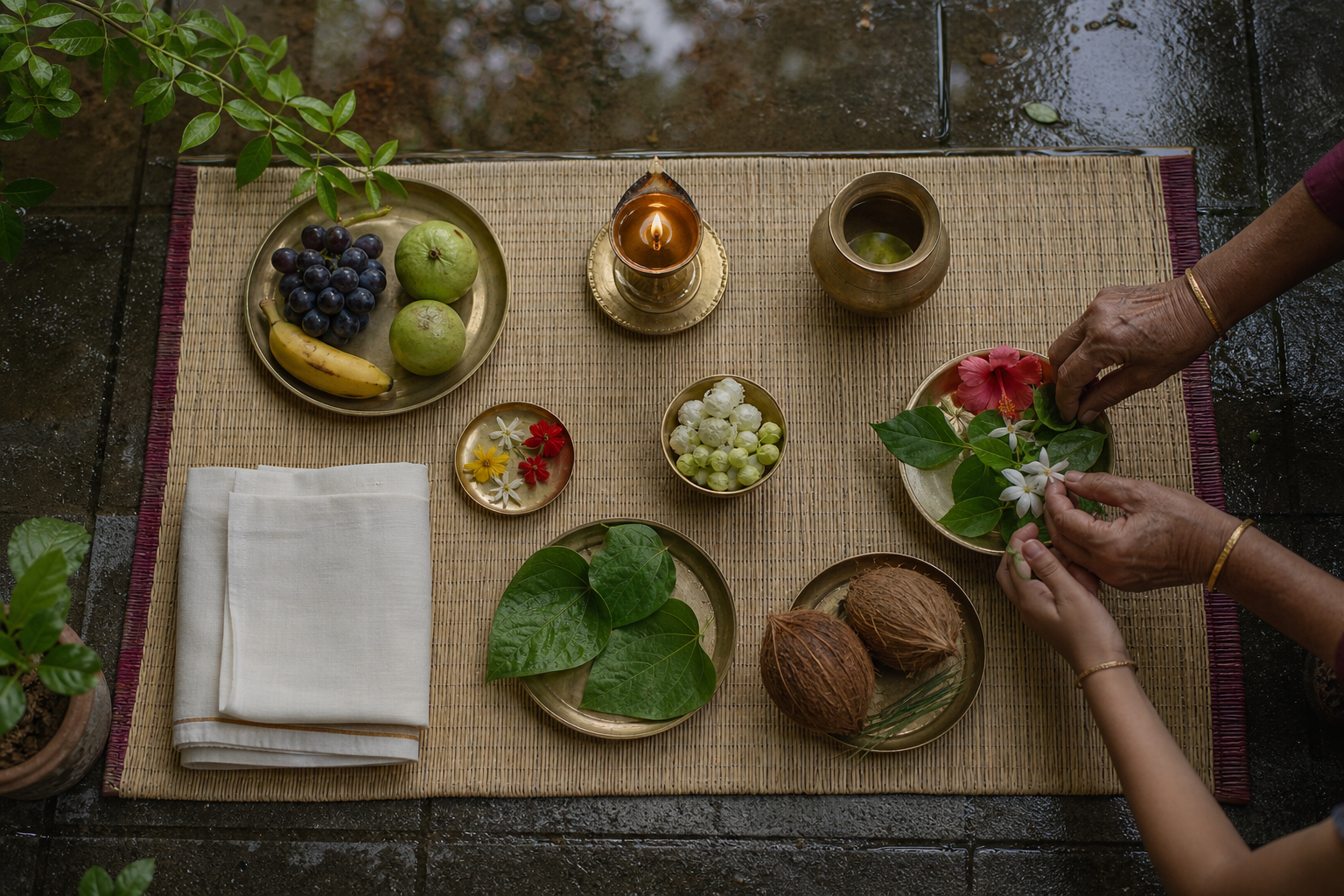
- Choose the governing calendar. Use the panchanga followed by your household, sampradaya or temple. Do this before searching by festival name, because the month label itself may vary.
- Name the observance precisely. Write down whether your family follows Gatari, Hariyali, Chukkala, Nagara, Pathi Sanjeevani or a simpler Amavasya practice. A regional name carries information about what the day means.
- Confirm the local tithi timing. Mark 12 August 2026 for planning, but obtain the applicable start, end and puja guidance from a trusted local calendar or temple. Do not assume that a date-only listing supplies a complete vrata schedule.
- Keep the deity and sequence intact. A Gauri-centered Chukkala observance should remain Gauri-centered. Nagara Amavasya should be understood in relation to Nagara Panchami five days later. A Pathi Sanjeevani vrata should retain its Shiva-Parvati identity and katha rather than becoming a substitute for every other Amavasya practice.
- Ask before reconstructing a detailed vrata. If the procedure was not transmitted in your household, consult someone who actually maintains that tradition. A modest observance honestly performed is better than claiming completion of a named vrata assembled from fragments.
- Make room for the public dimension where it belongs. In a Hariyali Amavasya setting, a local fair or mela may be part of the observance alongside Shiva worship and prayers for the agricultural season. That public expression need not be copied into traditions whose emphasis is different.
This approach also helps families living away from their region of origin. You can observe according to an Andhra, Telangana, Kannada, Maharashtrian or North Indian family calendar without pretending that the surrounding locality uses the same name. State the tradition clearly, verify the date locally and preserve the practice you actually received.
For 2026, pencil in 12 August and then ask one exact question of your family or temple: “Which panchanga and named Amavasya tradition do we follow?” Once that is answered, the rest of your preparation becomes much clearer.
References
- Hindu Pad – Pathi Sanjeevani Vrata
- Hindu Pad – Significance of Gatari Amavasya
- Hindu Pad – Hariyali Amavasya 2026 | Haryali Amavas
- Hindu Pad – Chukkala Amavasya 2026 | Chukkala Amavasya Vratam in Andhra Pradesh & Telangana
- Hindu Pad – Nagara Amavasya 2026