

You’ve read scripture, heard illuminating discourses, and felt sincere devotion. Yet the day still ends without practice, or your practice happens mechanically while what you learned remains in a separate mental compartment. The difficulty is usually not lack of interest. Knowledge, devotion, and discipline have been asked to compete when they should be doing different parts of the same work.
You don’t need to choose between the thinking path and the devotional path. You need a repeatable loop in which sound knowledge directs practice, practice makes devotion less dependent on mood, and devotion gives knowledge an ethical purpose. Here is how to build that loop without turning your household life into a monastery or reducing sadhana to a habit-tracking exercise.
Give knowledge, devotion, and discipline separate jobs
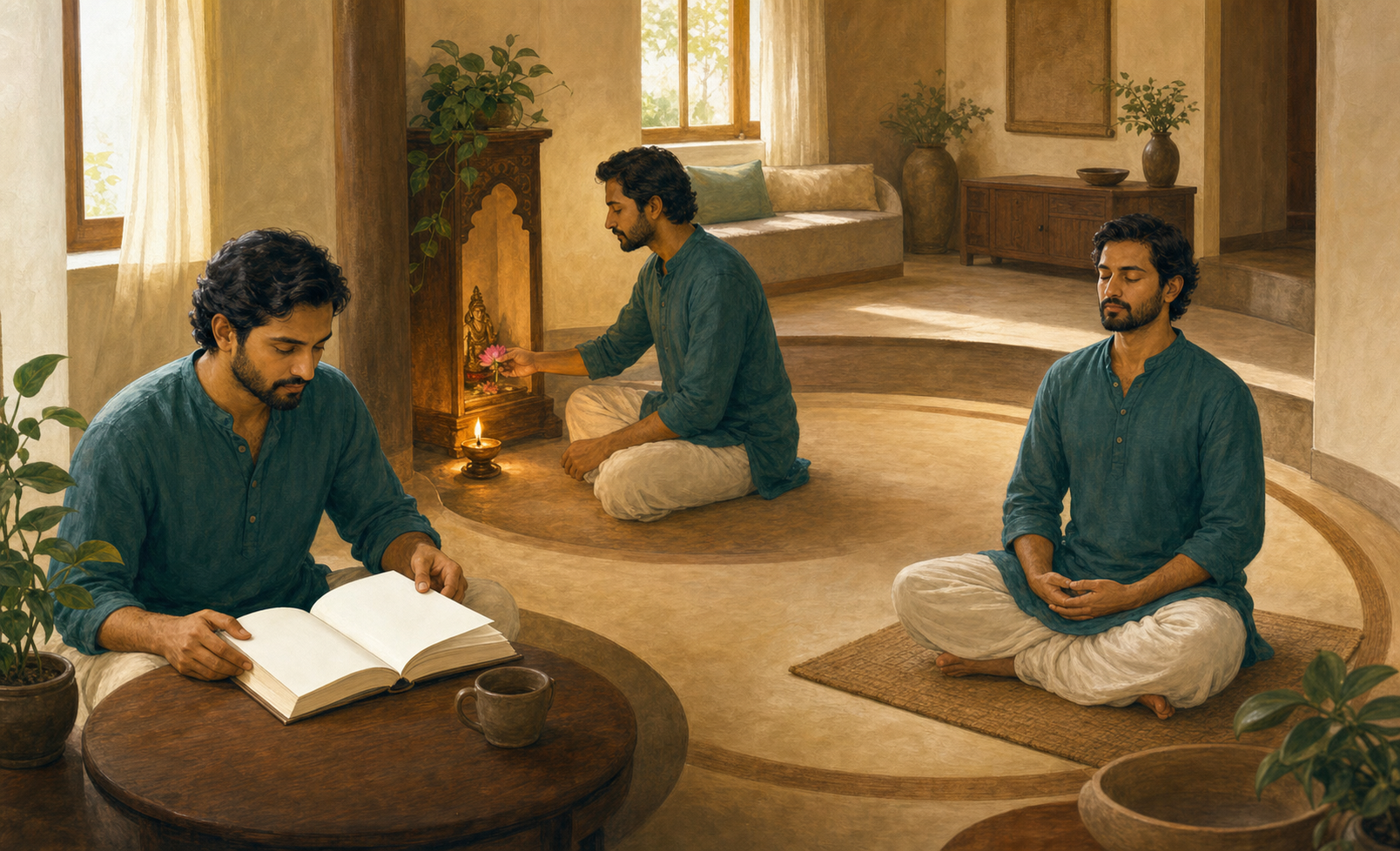
Begin by distinguishing three functions that are often blurred together. Knowledge tells you what is real, what the path is for, and how a particular method is supposed to work. Devotion directs love, trust, reverence, and intention toward the highest. Disciplined sadhana places both into the body and the calendar through repeated action.
Each function corrects a predictable weakness in the other two:
- Knowledge without devotion can become endless comparison. You learn the vocabulary of several schools, detect everyone else’s errors, and keep postponing the surrender or ethical change the teaching requires.
- Devotion without knowledge can become dependent on atmosphere, personality, or emotion. A powerful kirtan carries you for an evening, but you have no tested method for the morning after.
- Discipline without knowledge or devotion can become rigid bookkeeping. The count is completed, but impatience, pride, or harsh speech remains untouched.
You can detect the imbalance with three questions. After study, ask, What will I do differently because this is true? After worship or meditation, ask, What quality of conduct should this devotion produce? During a routine practice, ask, What truth am I training myself to remember? If you cannot answer, the three parts have separated.
Different dharmic traditions organize this relationship in distinct ways. Hindu bhakti joins remembrance, japa, scriptural hearing, and seva. Buddhist cultivation employs right effort, mindfulness, ethical observance, and compassionate action. Jain discipline uses vows, self-review, austerity, and non-violence to refine vision and conduct. Sikh practice joins hukam and grace with simran, Nitnem, sangat, and seva. These are not interchangeable doctrines, but they share a practical grammar: inspiration opens a possibility, while chosen practice gives it continuity.
That distinction protects both commitment and pluralism. You can remain rooted in your sampradaya, Guru tradition, or chosen form of the Divine without pretending that every path teaches the same metaphysics. Respect does not require dilution. It requires recognizing that disciplined transformation, rather than mere religious self-description, is a serious test within the dharmic family.
Turn what you hear into knowledge you can live

Information becomes spiritually useful when it survives three tests: trustworthy transmission, careful reasoning, and lived verification. Dharmic epistemology names these modes as shabda, anumana, and pratyaksha. They are not rival ways of knowing. Used together, they prevent both blind acceptance and self-sufficient speculation.
Shabda asks whether a teaching comes through accountable testimony: scripture, lineage, and a teacher whose conduct supports the instruction. Anumana asks whether you have understood it coherently, including its conditions and apparent tensions. Pratyaksha asks what becomes observable when the method is actually practiced. Immediate pleasure is not the same as verification, however. A flattering doctrine can feel pleasant, and a corrective practice can initially feel uncomfortable. Look for stable changes in attention, conduct, and responsibility rather than treating every passing state as a verdict.
The Bhagavad Gita 4.34 places humility, inquiry, and service together. Humility without inquiry can become passive credulity. Inquiry without humility can become argument performed to defend an existing identity. Service without either can become activity without understanding. Held together, the three create a learner who is receptive but not careless.
Use the following learning loop whenever a teaching matters enough to influence your life:
- Hear narrowly. Choose a specific teaching you can understand and apply instead of collecting many disconnected ideas.
- Restate it plainly. If you cannot explain the claim without relying on impressive Sanskrit terms, you may not yet know what it asks of you.
- Name the practice implied by it. A teaching on non-attachment might require completing a duty without making praise the condition of effort. A teaching on remembrance might require returning to mantra at a stable daily cue.
- Observe the fruit. Notice whether repetition produces greater clarity, restraint, compassion, steadiness, and willingness to serve. Do not evaluate only the mood of the practice session.
- Bring unresolved tension to accountable guidance. Consult scripture, Guru, a mature practitioner, or the appropriate sangha rather than privately revising the path every time it challenges you.
This is experiential verification, not homemade theology. Your experience matters, but it is not the sole authority. Fatigue, expectation, ego, and prior preference can all shape what seems obvious. A trustworthy teacher combines recognizable character, clarity, fidelity to tradition, and room for disciplined questions. You should be able to inquire without turning every exchange into a contest, and to respect a teacher without suspending discernment.
Keep a compact record if your learning tends to remain abstract. Write the teaching, the practice it requires, and the change you are watching for. This exposes a common evasive pattern: reading another explanation when the previous explanation already gave you enough to begin.
Build a daily rule that survives household life

A durable daily rule needs three anchors: sankalpa, abhyasa, and accountability. Sankalpa names why you practice. Abhyasa gives that intention a stable form through repetition. Accountability connects your private effort to scripture, guidance, and community, where self-deception is easier to detect.
Your sankalpa should be short enough to recall before practice and concrete enough to govern conduct. You might undertake remembrance so that your work, speech, and relationships align more closely with Dharma. That is more useful than a vague wish to become spiritual because it tells you where the fruit should appear.
For abhyasa, build both a full form and a floor. The full form is what you do when time, energy, and duties permit. The floor is the version you keep on an ordinary day. A twelve-minute period of japa or quiet meditation, joined to brief scriptural reading and deliberate seva, is a workable household example. Twelve minutes is not a sacred formula. Its value is that the commitment is clear enough to schedule and modest enough to survive a day when no dramatic inspiration appears.
Use this sequence for your floor:
- Attach practice to a reliable cue, such as waking, the close of household duties, or the period before sleep. Use the same place when possible.
- Recall your sankalpa before beginning. This prevents the method from becoming detached from its purpose.
- Give most of the period to the core practice recognized in your lineage: japa, meditation, simran, samayika, attentive recitation, or another prescribed discipline.
- Read or recall a short teaching that clarifies what you are doing. Do not use the reading portion to escape the practice portion.
- Close by naming a specific expression of Dharma for the day: restrained speech, an act of dana, necessary service, patient listening, or the repair of a neglected duty.
Mark whether you kept the floor, but do not turn the mark into the goal. The record answers a narrow question: did the practice occur? It cannot tell you whether attention was honest, whether devotion was present, or whether your conduct changed. Those require a different review.
Choose your method from within a coherent path. A Vaishnava may center the rule on nama-japa, hearing from the Bhagavad Gita or Bhagavata tradition, and seva. A Buddhist practitioner may work with anapanasati or metta alongside right effort and ethical observance. A Jain may organize practice around samayika, pratikraman, vows, and ahimsa. A Sikh may center remembrance on simran and Nitnem, sustained by sangat and expressed through seva. Do not assemble an attractive fragment from every tradition and then wonder why the parts provide no shared direction.
If you have received a formal vow or prescribed practice, a compact household floor does not silently replace it. Discuss genuine constraints with the teacher or community responsible for that commitment. The floor is meant to prevent casual disappearance, not to authorize private renegotiation of every demanding observance.
Regulated rest also belongs inside disciplined sadhana. The Bhagavad Gita 6.16-17 warns against both excess and deficiency in sleep, food, recreation, and effort. Srila Prabhupada’s treatment of rest held physiological necessity and spiritual urgency together: rest should restore the capacity for attentive service, while time should not be spent carelessly. If chronic under-resting degrades attention, mood, and discernment, extending your formal practice by stealing from necessary sleep defeats its purpose. Discipline is the wise regulation of energy, not a performance of severity.
Handle dryness, doubt, and failure as different problems
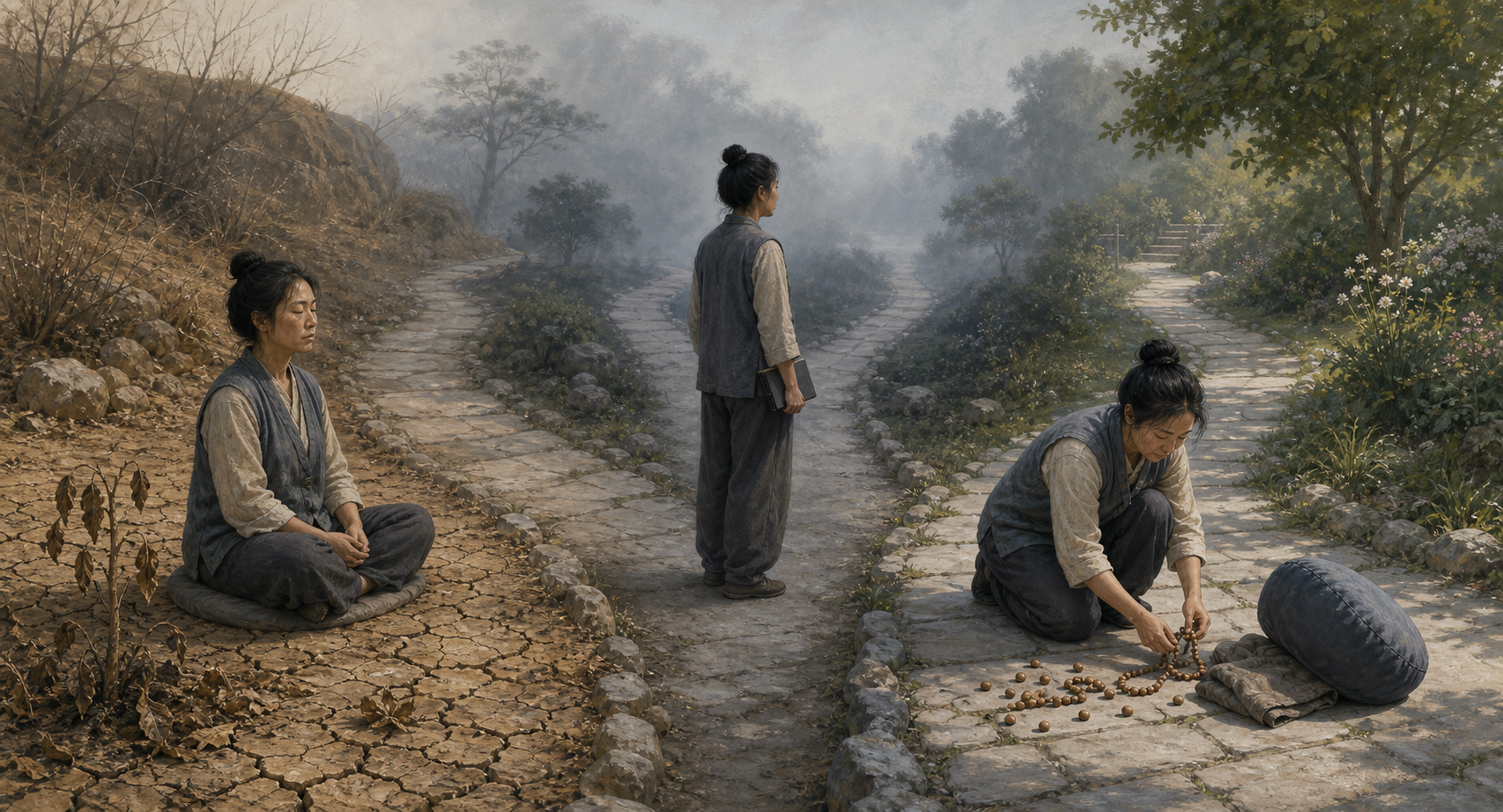
A dry practice period is not automatically evidence that the method has failed. It may be the first time your commitment is no longer being carried by novelty. That is precisely where devotion begins to mature from a favored feeling into a chosen orientation.
Dryness, doubt, distraction, and depletion need different responses. Treating all four as a spiritual emergency creates unnecessary instability:
- If feeling is absent but the practice remains intelligible, keep the floor. Release the demand that every sitting produce sweetness, calm, or insight.
- If you doubt a teaching, write the exact claim you question. Examine it through scripture, reasoning, and accountable guidance. Do not use louder chanting to cover an intellectual problem that requires honest inquiry.
- If attention is repeatedly scattered, simplify the setting. Return to the chosen mantra, breath, passage, or discipline instead of adding novelty in an attempt to overpower restlessness.
- If you are depleted, regulate rest and duties. A tired mind may need recovery rather than a harsher vow. This does not make every reluctance a bodily necessity; it asks you to distinguish incapacity from avoidance.
- If you miss the routine, resume at the next reliable cue. Do not turn guilt into a heroic compensating session unless your vow or teacher specifically requires one. Punishment often makes the routine more fragile.
Watch for spiritual bypassing during these periods. Practice is being misused if it helps you avoid an apology, ignore a necessary duty, excuse unkindness, or refuse a problem that requires practical action. Seva is also distorted when it becomes a respectable reason never to sit, study, pray, or examine yourself.
Peak experiences create the opposite danger. A powerful state can encourage you to chase the setting that produced it, compare your experience with others, or assume that intensity proves realization. Receive such moments with gratitude, then return to the method. Non-attachment protects devotion from becoming a search for spiritual sensation.
Also notice whether discipline is producing superiority. If your count, diet, schedule, learning, or austerity mainly gives you reasons to despise less-regulated people, the external rule has outrun its purpose. Bring that discrepancy into self-review, satsanga, or Guru guidance. More intensity is not an automatic cure for misdirected intensity.
Judge progress by the fruit that enters daily conduct
Sadhana should be evaluated with gentle rigor. Do not make visions, emotional warmth, intellectual novelty, or public recognition your main scorecard. More dependable indicators include consistency, steadier attention, ethical congruence, and greater self-regulation under stress.
At a regular review, ask questions that expose conduct rather than flatter identity:
- Did I keep some form of practice when inspiration was absent?
- When attention wandered, did I return sooner and with less agitation?
- Is there less distance between the values I recite and the way I speak, spend, work, and respond at home?
- Under pressure, am I more able to pause before acting from anger, fear, or vanity?
- Who besides me has benefited from this practice through ahimsa, daya, dana, reliability, or seva?
Ethical fruit is the decisive safeguard. Devotion that never enters conduct is incomplete, and learning that only sharpens debate has not yet become wisdom. Ahimsa tests how power is used. Dana tests attachment. Daya tests whether another being’s difficulty can enter your field of concern. Seva tests whether remembrance can become useful action. The Bhagavad Gita’s ideal of lokasangraha widens the test further: spiritual maturity should help sustain the welfare and order of the world you actually inhabit.
Your treatment of other paths is also evidence. Ishta philosophy permits committed devotion to a chosen form without requiring contempt for other authentic approaches. Unity in spiritual diversity does not mean that Hinduism, Buddhism, Jainism, and Sikhism are doctrinally identical. It means rooted practitioners can recognize disciplined truth-seeking and ethical transformation across real differences. If practice makes you more sectarian in the sense of being needlessly hostile, examine whether loyalty has been confused with insecurity.
Practical FAQ
- Must I finish studying before I begin sadhana? No. Learn enough to understand the aim, method, and accountability of the practice, then let deeper study continue alongside it. Waiting for complete intellectual certainty can become a refined form of postponement.
- Should I change practices when devotion feels absent? Not for that reason alone. Keep the established floor through ordinary dryness. Consider a change when there is a clear conflict with your vows, lineage, life responsibilities, or well-being, and examine that conflict with qualified guidance rather than acting on boredom.
- Can seva replace formal practice? Selfless work can be a genuine form of spiritual discipline, and the Bhagavad Gita offers graduated modes of engagement when absorption or formal practice is difficult. But service should not become a permanent excuse to avoid remembrance and self-examination. Let formal practice clarify service, and let service test formal practice.
- How do I know whether discipline has become too rigid? Look at its effects. A rule needs correction when maintaining its appearance repeatedly requires dishonesty, neglect of legitimate duties, chronic under-resting, contempt for others, or concealment from accountable guidance.
At your next reliable cue, write a plain sankalpa, set aside twelve minutes, choose the core practice of your path, and name the ethical action that will carry it into the day. Return at the same cue whether devotion feels vivid or quiet. Let knowledge correct practice, practice steady devotion, and devotion make knowledge visible in your conduct.
References
- DharmaRenaissance Blog — Devotion as Calling and Choice: A Transformative Cross-Dharmic Framework for Daily Sadhana
- DharmaRenaissance Blog — Srila Prabhupada on Sleep: Timeless Humility, Disciplined Rest, and the Sacred Economy of Time
- DharmaRenaissance Blog — From Skepticism to Insight: Srila Prabhupada’s 1971 Mumbai Pandal and Real Knowledge