
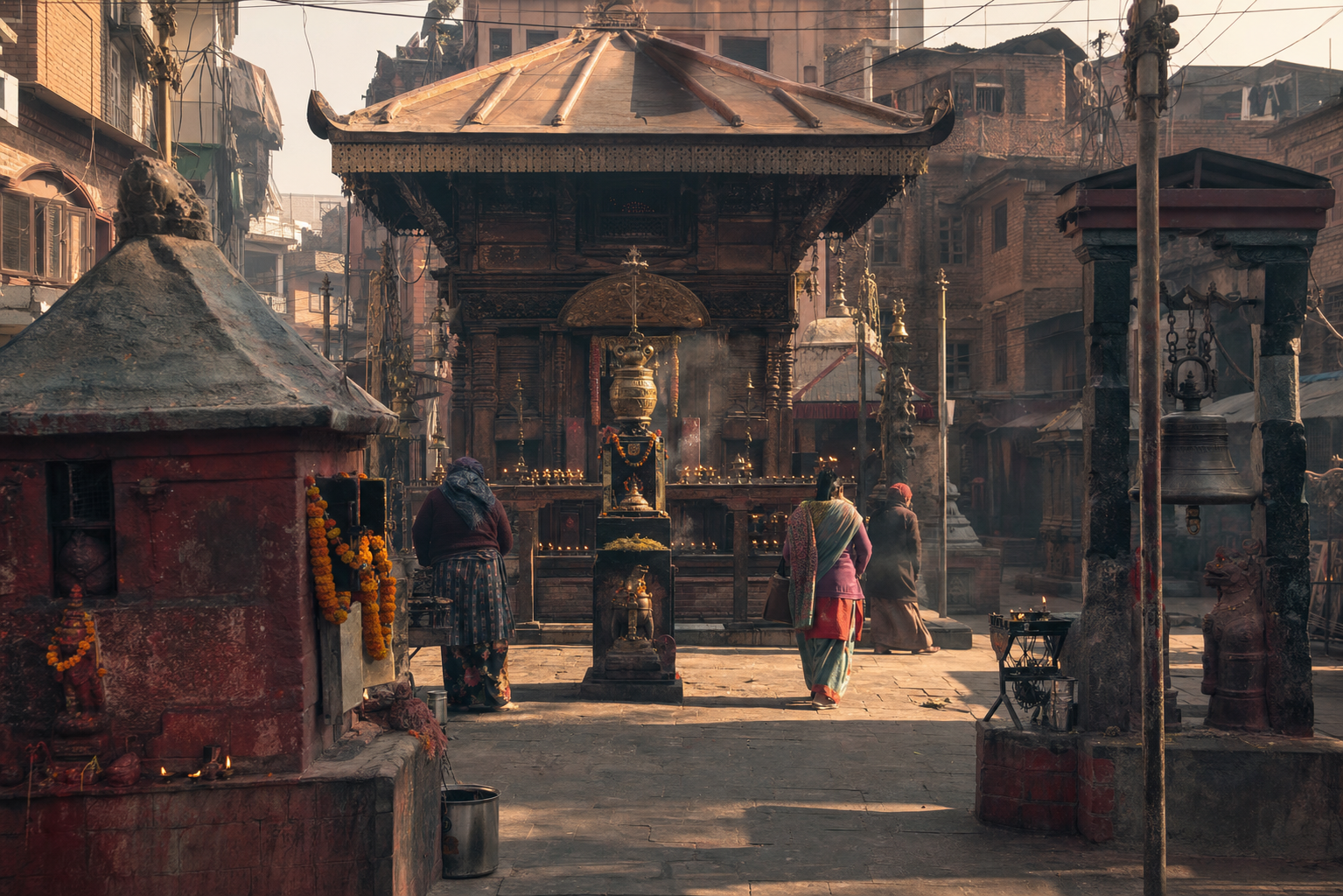
You may reach Maitidevi expecting one neighborhood temple and leave wondering why it belongs in the same sacred conversation as Guhyeshwari, Pashupatinath, and Kathmandu’s many Matrika and Ajima shrines. The answer is not that every shrine has the same function. It is that each helps make the valley spiritually legible.
To understand Maitidevi, look beyond the sanctum without looking away from it. Notice what the temple connects, how worship activates those connections, and what your own movement through the neighborhood asks you to protect.
Start with the network, not the monument

Kathmandu’s Shakta geography works as a distributed network of sacred places. Guhyeshwari near Pashupatinath serves as a principal Shakti focus, while Maitidevi and other neighborhood Goddesses localize protection, courage, care, and ritual responsibility. Matrika and Ajima shrines extend this presence through the city’s inhabited spaces. Bhairava principles provide complementary guardianship within the wider Tantric scheme.
This is what it means to approach the valley as a mandala. The term does not require you to force every shrine into a perfectly symmetrical tourist map. It asks you to recognize relationships among deities, waterways, routes, neighborhoods, and repeated acts of worship. Sacred geography is therefore encountered on foot as much as it is understood intellectually.
The Dhobi Khola is part of that reading. Its course gives the Maitidevi area a natural axis for neighborhood movement, seasonal blessings, and devotional routes. The river is not merely scenery behind the shrine. It links divine presence to the health and conduct of the surrounding community. A useful sketch of the area would therefore mark the temple, the water, nearby Goddess or Bhairava shrines, and the paths devotees actually use.
Keep historical precision separate from a general pattern. Malla-era chronicles and inscriptions record extensive patronage of Shakta shrines across the Kathmandu Valley, but the specific documentary trail for Maitidevi varies. Valley-wide history supplies context; it does not by itself establish a date or patron for every feature at the temple.
Notice how the temple teaches before you enter
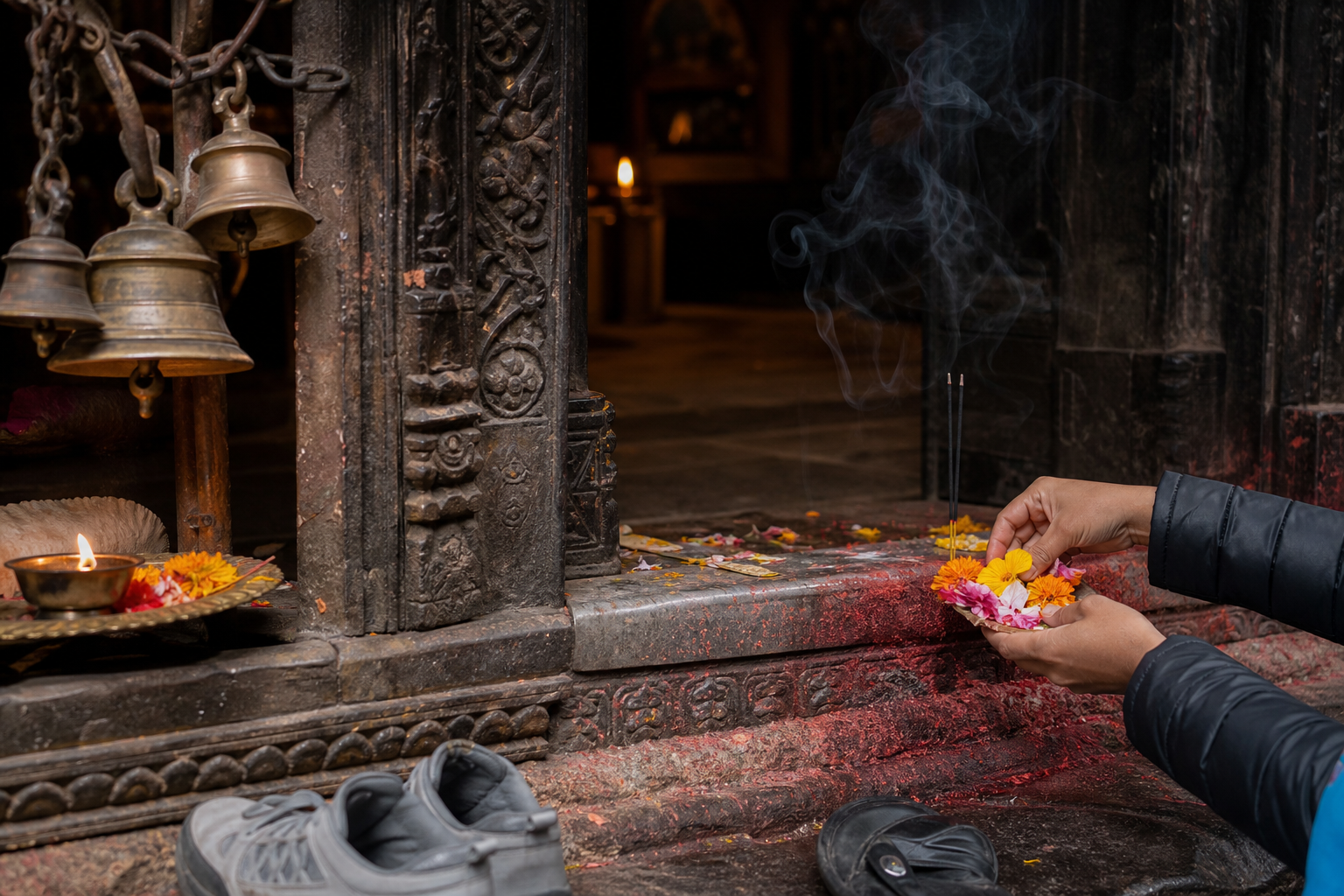
Pause at the courtyard and threshold instead of heading immediately toward the sanctum. Maitidevi’s Newar architectural vocabulary includes a tiered pagoda form, carved struts with guardian imagery, a torana framing the entrance, and brass or copper ornamentation. The plinth and courtyard create a transition between ordinary movement and ritual movement. They accommodate circumambulation, shared worship, and the exchange of prasad while preparing your attention for darshan.
The Goddess is worshipped through the visual language of Mahishasuramardini Durga. The lion, trident, discus, and other attributes present Shakti as the power that confronts adharma and restores order. Vermilion, red cloth, metalwork, bells, lamps, and incense do more than decorate the setting. Together they direct the senses toward alertness, strength, and presence.
Local oral memory adds another layer. Maitidevi is remembered as a celestial radiance that appeared above the valley and came to rest beside the Dhobi Khola. Treat this as sacred memory rather than a dated historical report. Its meaning lies in the movement it describes: a power that arrives from beyond ordinary space and becomes an intimate guardian of one riverside community.
The Nepali word maiti evokes a woman’s natal or maternal home. Read culturally, the name allows devotees to meet Maitidevi as a Goddess of refuge, familiarity, and restorative care. This interpretation is valuable without being turned into an unquestionable claim about the name’s earliest linguistic origin. It explains why a formidable Durga can also be approached as a nearby maternal presence.
These layers should remain distinguishable: architectural and historical context, oral memory, and living practice. Holding all three together prevents two common mistakes – dismissing devotion because it cannot always be dated, or presenting every remembered detail as archival fact.
Ritual turns a location into sacred geography
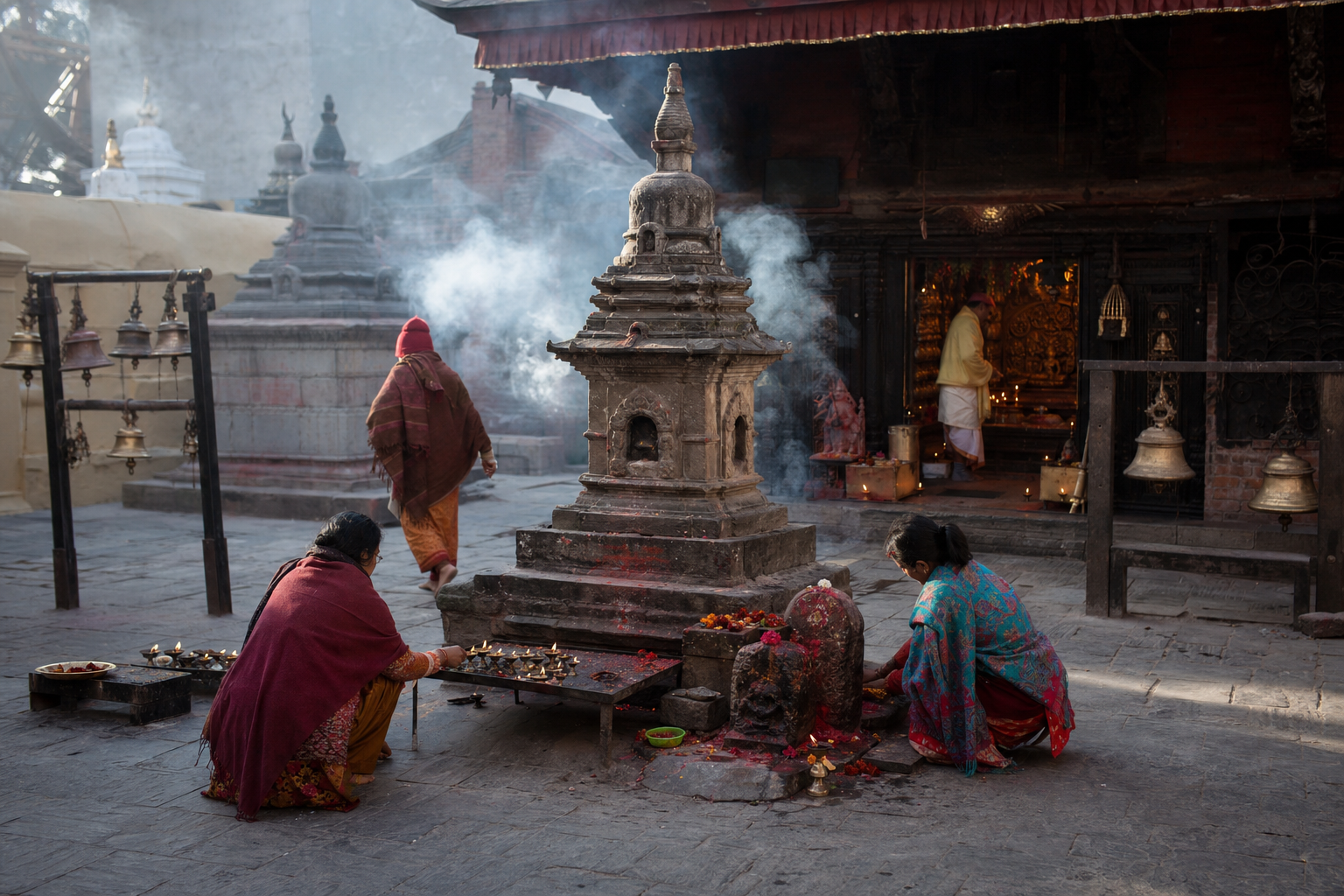
Maitidevi becomes a living node through repetition. A morning darshan before work, a vow connected with a child’s examination, and an offering of gratitude after illness bind household life to the temple. These modest acts matter as much to sacred geography as a large procession. They make the Goddess part of the neighborhood’s practical rhythm rather than a distant theological idea.
Navaratri and Dashain intensify that rhythm. Recitation of the Devi Mahatmya, Kumari puja, collective arti, household vows, hospitality, and blessings for artisans’ tools align local life with the larger Shakta calendar. Participation by Buddhist Newars also reflects Kathmandu’s longstanding Hindu-Buddhist complementarity. The shrine belongs to a religious environment in which traditions can retain distinct identities while sharing sacred space and community observance.
Tantric worship explains this activation through mantra, mudra, yantra, and mandala. Panchopachara and shodashopachara puja arrange offerings so that sound, form, intention, and presence converge. Bija sounds such as hrim and dum belong to this devotional vocabulary. If you have received a practice through family or a teacher, follow that discipline. If you have not, a sincere namaskar and attentive silence are more appropriate than imitating an esoteric rite you do not understand.
Ethical adaptation is also part of living tradition. Some Kathmandu households use pumpkins or sugar offerings as symbolic substitutes where older ritual forms included bali. This preserves ritual meaning while giving ahimsa greater practical expression. Do not assume that one household’s practice represents a universal temple rule; observe local custom and ask respectfully when uncertain.
You can carry the temple’s discipline into a simple personal practice without trying to reproduce its entire ritual world. At morning or evening sandhya, settle the breath, offer a lamp or flower, and repeat Om Dum Durgayai Namah if that mantra accords with your tradition. A short meditation at the heart center can then turn the idea of maternal refuge into steadiness, gratitude, and responsible action.
Make your visit a small, complete pilgrimage
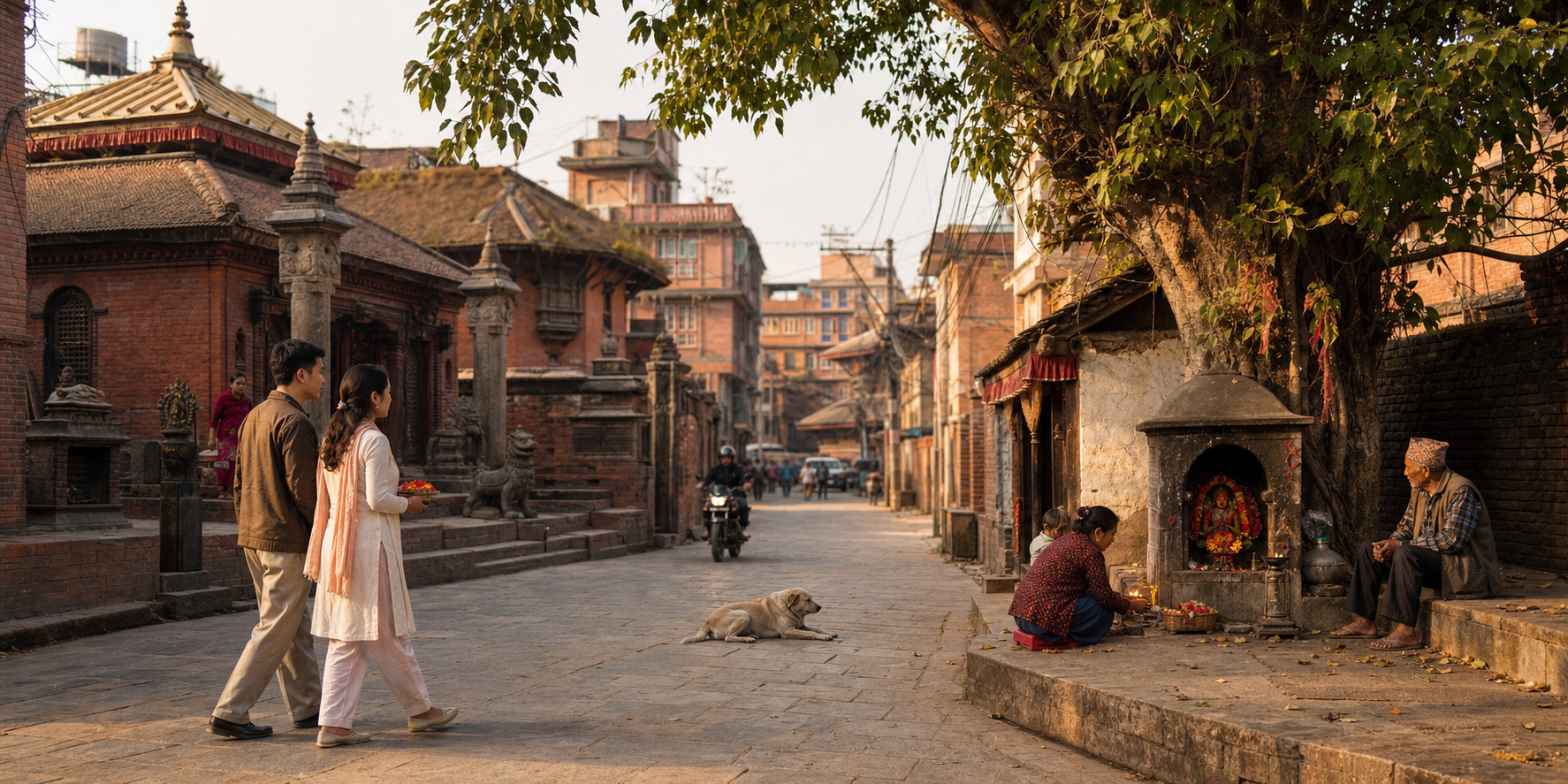
Choose your purpose before you arrive. An ordinary morning can show you Maitidevi’s daily devotional register. Navaratri or Dashain places you within a more intensive communal cycle. Neither is inherently superior. The better choice depends on whether you need quiet observation, festival participation, personal prayer, or an introduction to the neighborhood’s collective life.
Approach with clean hands and a composed mind. Pause at the threshold, watch how local devotees move, and follow any directions given by temple custodians. Where the path permits, circumambulate clockwise. Keep photography discreet and seek permission rather than treating the sanctum, worshippers, or ritual actions as visual material available by default. If communal arti is underway and visitors are welcome, participation can teach more than hurried observation.
For a wider circuit, connect Maitidevi with Guhyeshwari and a locally recognized Bhairava, Matrika, or Ajima shrine. Confirm the route with someone who knows the area’s practice. A map can show proximity, but it cannot establish ritual relationships on its own. Let each stop reveal a different expression of Shakti instead of reducing the circuit to a collection of temple names.
Complete the visit by acknowledging the Dhobi Khola. Use biodegradable offerings, leave nothing in or beside the water, and support a cleanup effort if one is available. In a riverside sacred geography, ecological care is not an optional civic add-on. It is the outward form of the respect shown inside the temple.
Key takeaways
- Read Maitidevi as one active node in Kathmandu’s distributed Shakta mandala, not as an isolated monument.
- Notice the relationship among the sanctum, courtyard, neighborhood routes, nearby shrines, and Dhobi Khola.
- Keep oral memory, broad historical context, and present-day worship distinct without dismissing any of them.
- Let local practice guide your conduct, especially around Tantric rites, photography, and circumambulation.
- Treat care for the river and responsible offerings as part of pilgrimage itself.
Begin with one unhurried circuit: Maitidevi darshan, one locally confirmed neighboring shrine, and a quiet pause near the Dhobi Khola. Let the route teach you how sacred relationships are maintained, then leave the place cleaner and your own practice steadier.