
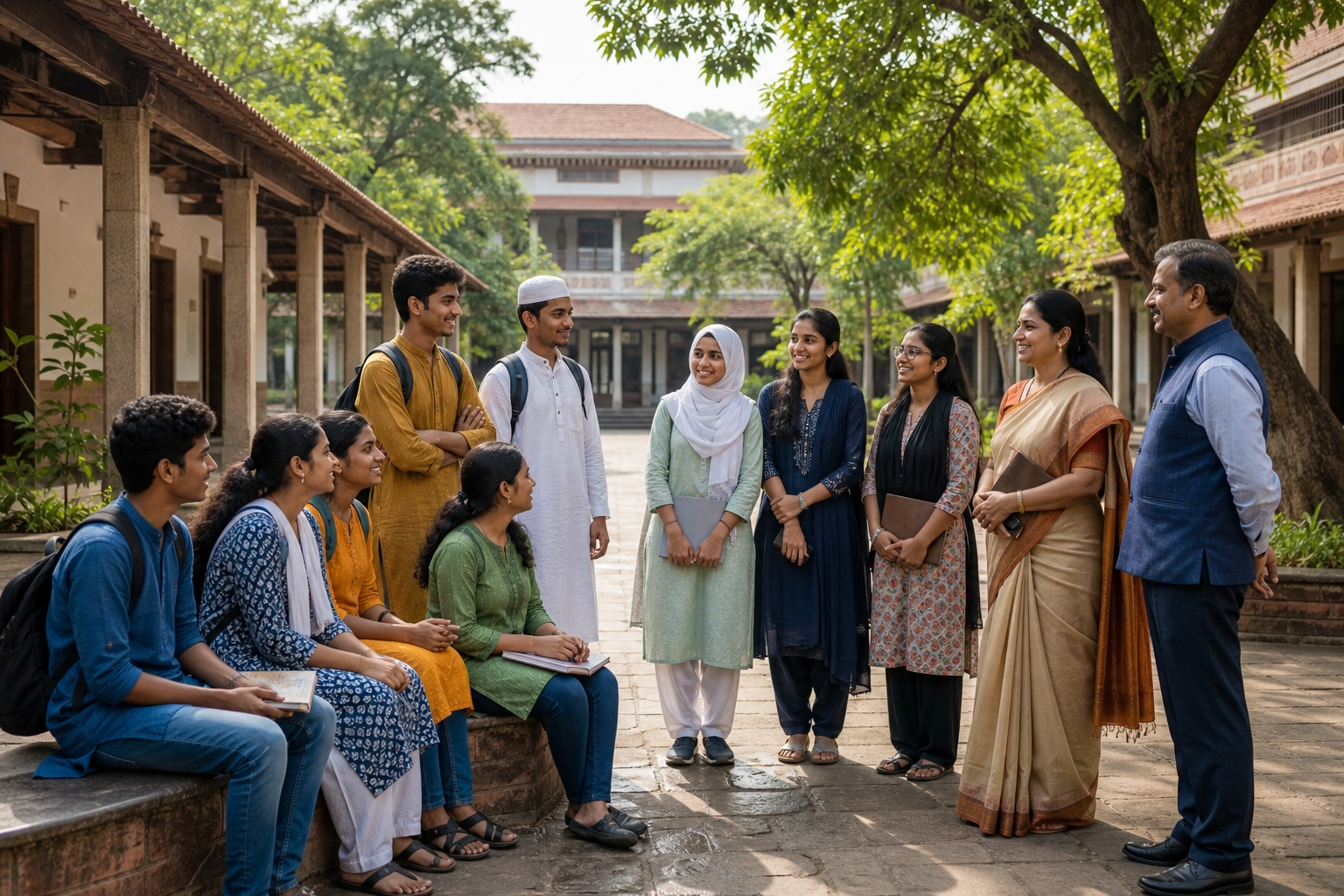
Two reported controversies in Maharashtra education show how religiously sensitive conduct can become a student-safety issue through very different institutional pathways. One concerns allegations of harassment inside a women’s vocational institute; the other concerns violent, ideologically charged material reportedly presented during a school event.
Read together, the accounts offer a practical framework for educational authorities: protect people immediately, establish facts without communal generalization, apply neutral standards to conduct, and build separate safeguards for interpersonal complaints and public-facing content.
Different incidents expose a common governance problem
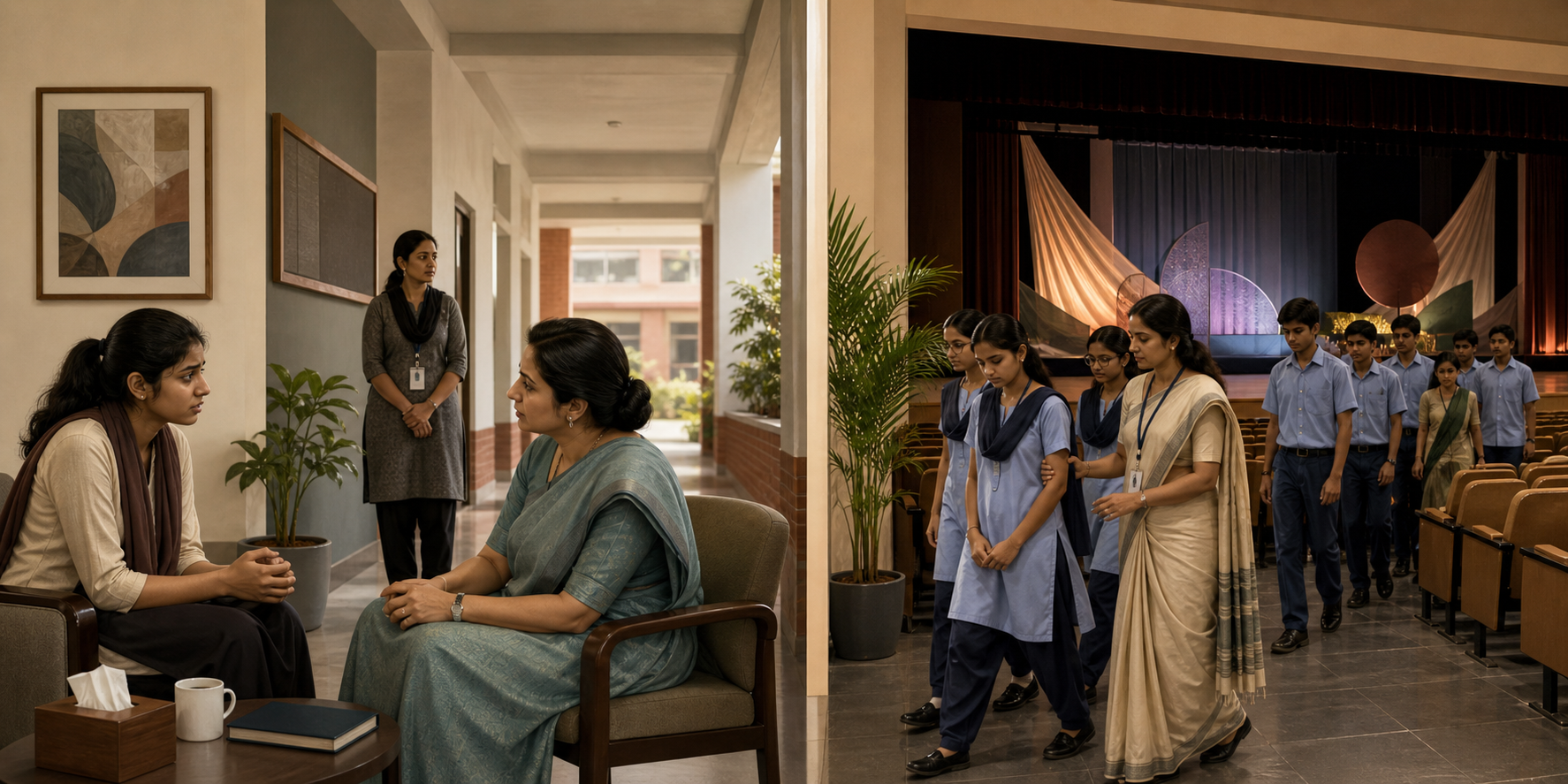
The Solapur article reports that a formal complaint alleged physical, mental, and religious harassment affecting approximately 150 female trainees and nine staff members at a Government Women’s Industrial Training Institute. It also says the complaint raised possible irregularities in appointments and staff misconduct, and that an official inquiry was reportedly initiated. These remain allegations to be tested by the competent authorities.
The Jalna article addresses a different setting and a different kind of risk. It describes a widely circulated video that appears to show students performing to ‘Sar Tan Se Juda’ while an image identified in the report as Mumtaz Qadri appeared on stage. The source characterizes the phrase as associated with violent extremist exhortations and calls for an investigation into how the audio and imagery entered a school program. The account does not establish whether the material was deliberately selected by school personnel, insufficiently reviewed, or introduced through an external service provider.
The two reports therefore do not corroborate the same event. Their convergence lies in the governance questions they raise. Solapur tests whether an institution can receive and investigate complaints about the conduct of people in authority. Jalna tests whether a school can review what reaches students before it becomes part of an official event. One requires a trusted redressal system; the other requires preventive content control. Both depend on accountable leadership, reliable evidence, and protection from retaliation or scapegoating.
Neutral rules must protect conscience and reject intimidation
Religious freedom in education should not be confused with permission for coercion, denigration, or threatening expression. The Solapur source describes religious harassment as potentially including disparaging remarks about beliefs, pressure to participate in or abstain from a practice, punitive treatment based on identity, or unreasonable refusal of an accommodation that could be provided without compromising safety or academic requirements. This is principally a question of how individuals are treated.
The Jalna concern sits on another side of the same boundary. The issue presented by that account is not the mere presence of religion or culture in a school program, but the reported use of material associated with violence and extremist valorization. Educational neutrality does not require institutions to erase religious identities. It requires them to distinguish cultural or devotional expression from content that threatens, humiliates, coerces, or glorifies harm.
That distinction should be applied consistently across communities. A response focused on the specific conduct, the decision process, and the resulting risk is more defensible than one that assigns collective blame. It protects Hindu, Buddhist, Jain, Sikh, and other students without treating any community as presumptively responsible for an individual’s act or an institution’s lapse. It also gives administrators a workable test: examine what happened, who controlled it, whom it affected, and whether the same rule would be enforced regardless of identity.
The sources also point to a shared ethical vocabulary. Dignity, non-violence, compassion, discipline, and respect for plurality can inform campus culture while remaining compatible with constitutional governance. These values become meaningful only when translated into fair procedures rather than invoked selectively after controversy arises.
An inquiry should separate urgent protection from final judgment

A credible response begins with two tracks operating at once. The protective track asks whether anyone faces an immediate risk and whether temporary measures are needed. The fact-finding track determines what occurred, who was responsible, and which institutional controls failed. Keeping the tracks distinct permits proportionate safeguards without presenting interim action as a finding of guilt.
In the Solapur matter, the source recommends an independent and gender-sensitive inquiry, confidentiality, non-retaliation assurances, trauma-informed interviews, and preservation of documents, CCTV footage, access records, and digital communications. If timetable changes, supervised spaces, or limits on contact are considered necessary, they should protect complainants and witnesses without unnecessarily disrupting their education. The reported appointment concerns require a related but separate administrative audit of recruitment and service records; they should neither be ignored nor allowed to obscure the harassment allegations.
For Jalna, the evidence map would be different. Investigators would need the original audiovisual file rather than only a viral copy, the approved program and run-of-show, the chain through which songs and images were submitted, and communications with teachers, administrators, and audiovisual providers. Interviews should clarify who selected, reviewed, approved, loaded, and had authority to stop the segment. That sequence matters because a deliberate choice, a negligent review, and an unauthorized insertion would call for different findings and remedies.
The Solapur article identifies the Internal Complaints Committee required under the workplace sexual-harassment framework, a broader grievance mechanism, constitutional protections under Articles 14, 15, 21, and 25, and vocational-education oversight as relevant parts of the institutional architecture. The practical lesson is that different allegations may need coordinated channels rather than being forced into a single committee. Responsibility for student protection, workplace conduct, administrative appointments, and any potentially unlawful act should be clearly allocated while evidence is shared only through appropriate, confidential processes.
Public communication should be narrower than the inquiry itself. Authorities can confirm the scope of review, protective arrangements, expected process, and eventual outcome without identifying complainants, circulating unverified accusations, or speculating about motive. This balance protects natural justice while denying rumor the information vacuum in which it thrives.
Key takeaways
A practical decision framework emerges when the two cases are considered together:
- Protect before concluding: assess immediate risk and prevent retaliation, but do not portray temporary safeguards as a verdict.
- Follow the evidence path: harassment allegations require records and protected testimony, while event-content incidents require original media, approval trails, and vendor records.
- Regulate conduct neutrally: protect religious conscience and cultural expression while excluding coercion, denigration, threats, and glorification of violence.
- Maintain two prevention systems: accessible complaint handling cannot replace advance content review, and content review cannot replace a trusted grievance channel.
- Combine institutional transparency with personal confidentiality: report what the institution is doing without exposing students or prejudging individuals.
Prevention must operate before, during, and after an incident

Complaint systems that people can safely use
A committee that exists only in institutional records offers little protection. The Solapur source argues for publicized contact details, clear procedures, confidential case management, anonymous reporting options, multilingual forms, understandable escalation routes, and predictable timelines. Access to trauma-informed counseling can help affected students remain engaged in their education. Regular training should also teach instructors and administrators how to receive a disclosure without dismissing it, spreading it unnecessarily, or retaliating against the person who raised it.
Institutions can test whether these arrangements work by tracking resolution times, recurring patterns, post-complaint retention, and perceptions of safety through confidential climate surveys. Such indicators do not determine whether an individual allegation is true; they reveal whether the surrounding system is accessible, trusted, and capable of learning.
Event controls that function before stage time
The Jalna source supports a written event-content policy, review of lyrics and visuals, documented briefings for outside providers, an approved run-of-show, and an escalation route for stopping or changing a segment. These controls should identify both the person responsible for final approval and the person empowered to intervene during the event. Without those assignments, every participant may assume that someone else completed the review.
Age appropriateness, non-violence, inclusion, and constitutional values provide clearer review criteria than vague appeals to taste. Media-literacy preparation can also help teachers and students recognize how images, slogans, and music acquire meanings beyond their immediate presentation. Parent and student participation can improve judgment, but responsibility for official programming must remain with the institution.
Oversight that outlasts the controversy
The sources propose system-level support as well as campus action. Common documentation templates, safety and inclusion indicators, periodic audits, helplines, and ombudsperson-style escalation could reduce uneven practice across vocational institutes and schools. Authorities should also distinguish a completed inquiry from completed reform: corrective action needs an owner, a timetable, and a later check that the control actually changed.
Maharashtra’s educational institutions will build durable trust by demonstrating that a complaint can be raised without fear, that a program cannot bypass meaningful review, and that religious identity neither excuses harmful conduct nor becomes a pretext for collective suspicion. If those standards become routine rather than crisis measures, safety and pluralism can reinforce each other across classrooms, workshops, and school stages.
References
- DharmaRenaissance Blog – Solapur Women’s ITI harassment claims: Maharashtra orders probe to protect students’ rights
- DharmaRenaissance Blog – Jalna School Row: Students Danced to ‘Sar Tan Se Juda’; Probe Sought, Safety Reforms Urged