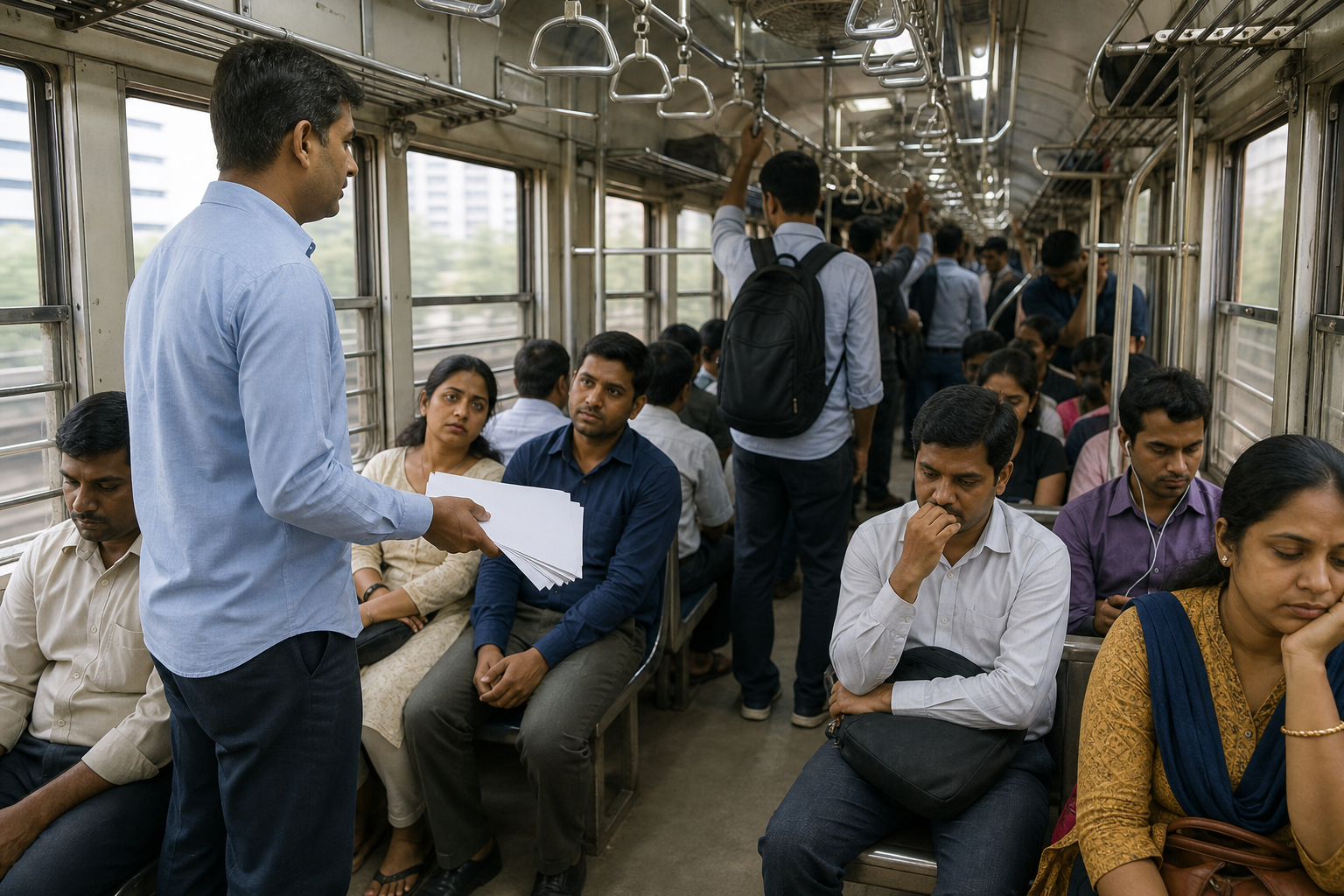
Allegations of organised religious-conversion outreach inside Mumbai suburban trains raise three distinct questions: what occurred, whether any conduct was unlawful, and how passenger comfort should be protected. The available source reports concerns raised by the Hindu Janajagruti Samiti (HJS), but it does not present the outcome of an official investigation.
Keeping allegation, evidence and legal judgment separate is essential. Religious advocacy, coercive conversion and unauthorised solicitation are not interchangeable, even when they arise from the same reported encounter.
Key takeaways
- The supplied account establishes that HJS raised an allegation and requested official action; it does not establish that an organised conversion operation has been proven.
- Any inquiry must separately examine possible coercion or deception, compliance with railway rules, and the effect of the conduct on passenger safety.
- The decisive evidence would include the leaflets themselves, first-hand complaints, locations and circumstances, relevant permissions, and any indication of coordination.
- Responses should focus on verifiable conduct rather than assigning collective guilt to a religious community.
What the available report establishes – and leaves unresolved
The source article says HJS reported that commuters were being approached in local-train compartments with emotionally framed leaflets allegedly intended to influence vulnerable passengers. It also reports that the organisation sought a prompt, lawful inquiry and action if coercive or misleading practices were substantiated.
The material supplied does not include copies of the leaflets, first-hand passenger accounts, identified routes or stations, complaint records, findings from railway authorities, or an official determination that the alleged activity was coordinated. It therefore cannot show how frequently the encounters occurred, who organised them, whether passengers participated voluntarily, or whether any prohibited inducement, threat or misrepresentation was involved.
The word “organised” consequently remains part of the allegation rather than an established description. Repetition across several journeys might indicate coordination, but similar messages appearing in public spaces would not prove a common organiser without evidence connecting the people, materials and distribution method.
Belief, conversion and railway conduct require different tests
The source frames the constitutional issue through Article 25, which protects the freedom to profess, practise and propagate religion. It also cites the Supreme Court’s 1977 decision in Rev. Stanislaus v. State of Madhya Pradesh for the distinction between propagation and conversion secured through force, fraud or allurement. As presented in the source, peaceful communication is protected in principle, while coercive or deceptive methods fall outside that protection.
That constitutional distinction does not settle the railway question by itself. The article reports that unauthorised pamphlet distribution, solicitation or conduct inconveniencing passengers may be addressed under the Railways Act, 1989 and associated rules. A distribution activity could therefore violate transit regulations without proving coercive conversion. Conversely, the religious character of a consensual conversation does not by itself establish either coercion or a railway offence.
The source identifies the Government Railway Police (GRP) as responsible for law and order on trains and at stations, while describing the Railway Protection Force (RPF) as focused on railway property and support for passenger security. Complaints should allow the competent authorities to determine which issue is actually presented: criminal conduct, a regulatory breach, a passenger-safety concern, or lawful expression.
Why the train environment changes the consent analysis
A crowded compartment is a constrained setting. A passenger may have limited ability to move away, avoid repeated contact or consider an emotionally charged message without social pressure. This does not make every unsolicited religious approach coercive, but it makes manner, persistence and context especially important.
The source identifies several possible warning signs: material benefits offered as inducements, misleading claims about other traditions, denigration of community identities, and exploitation of minors or people in distress. These are criteria for investigation, not findings about what occurred on Mumbai trains. Other relevant questions include whether an approach ended after a refusal, whether movement was obstructed, and whether the recipient was singled out because of visible vulnerability.
A conduct-based standard protects everyone more consistently than a community-based response. Persistent pressure, fraud and intimidation should be examined regardless of the belief being promoted. The same standard also protects respectful, voluntary religious discussion from being treated as inherently suspect.
From a public allegation to a defensible finding
The source proposes a time-bound and impartial inquiry using first-hand complaints, available CCTV footage, the leaflets concerned and records of any distribution permission. Together, those materials could establish where an encounter happened, what was communicated, whether the material was authentic, whether distributors acted together, and whether passengers were pressured or inconvenienced.
Investigators would also need to distinguish the message from the method. A leaflet’s religious content may explain the purpose of an approach, but evidence of coercion depends on the surrounding conduct. Railway compliance is a separate evidentiary question involving permission, location and the manner of distribution.
For commuters, the source recommends disengaging politely, moving away when feasible and reporting an uncomfortable encounter to GRP or RPF personnel or through officially publicised channels. A photograph of the leaflet may preserve useful evidence, while confrontation, covert recording of individuals and unverified social-media accusations can create further risks.
If evidence demonstrates prohibited conduct, authorities can choose a proportionate response under the applicable rules and laws. If the activity proves sporadic, consensual and compliant, an official clarification would be equally valuable. Clear railway guidance and a documented disposition of complaints would protect both commuter dignity and religious liberty more effectively than speculation or communal generalisation.