
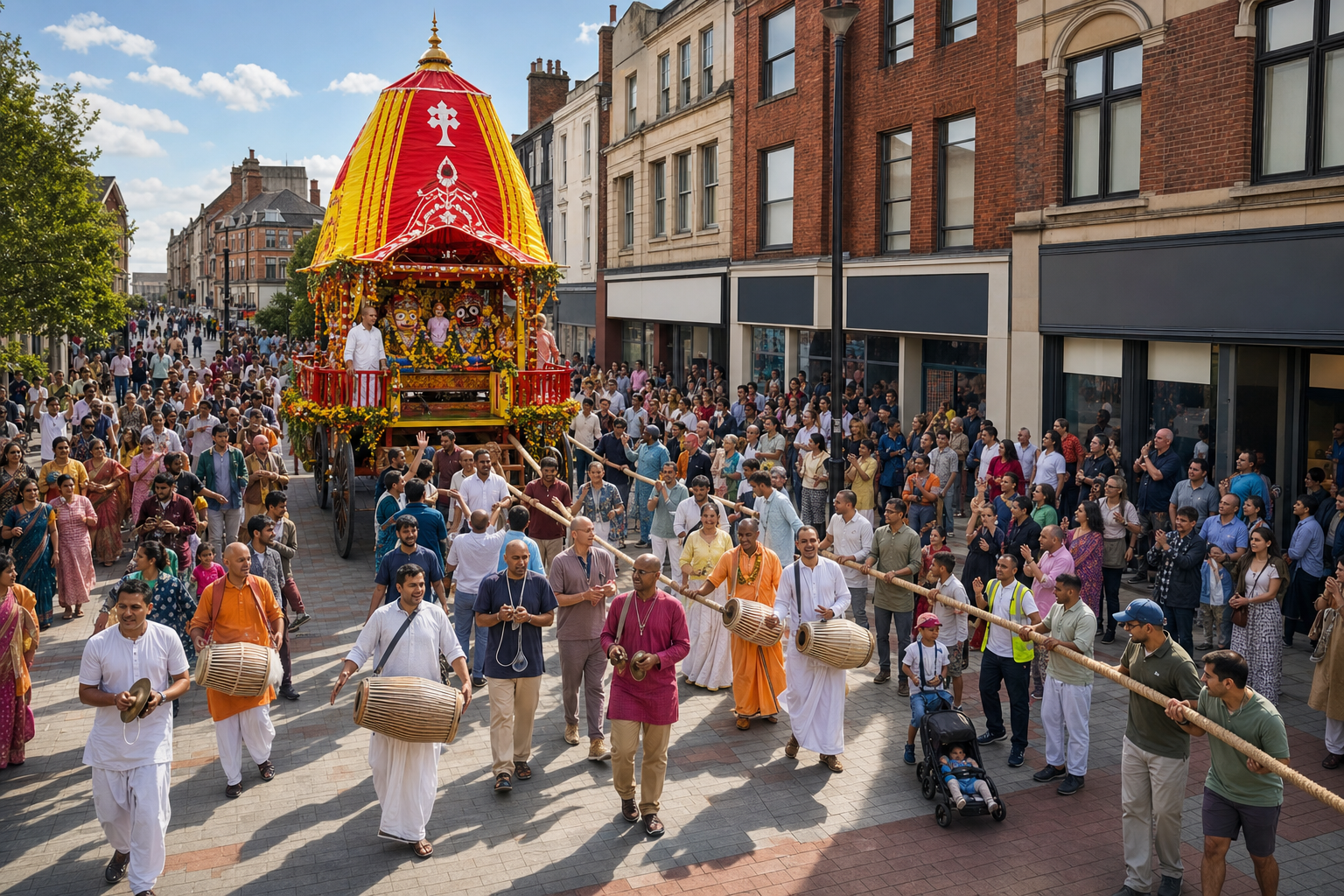
On Sunday, 14 June 2026, Chelmsford’s second annual Rathayatra reportedly entered the High Street for the first time. The supplied DharmaRenaissance Blog account estimates that the chariot procession drew about 1,200 participants and onlookers, placing a devotional tradition in the centre of the city’s everyday public life.
The event’s significance lies in more than its reported scale. Civic participation, congregational singing, accessible procession management, cultural interpretation and free food worked together to turn a moving ceremony into an open community festival. Because only one source article was supplied, its attendance and impact claims should be read as reported observations rather than independently corroborated findings.
Why the High Street route mattered
Rathayatra originates in the Jagannath tradition of Puri, Odisha, where Jagannath, Balabhadra and Subhadra are ceremonially conveyed on chariots. The Hare Krishna movement, or ISKCON, has helped carry this form of public devotion into cities around the world. Chelmsford’s reported High Street debut therefore joined an established pattern of adapting a rooted Vaishnava festival to a contemporary urban setting.
A central route changes who can encounter such a tradition. Instead of requiring prior knowledge, an invitation or a visit to a religious venue, the procession meets residents where they already walk, shop and socialise. Passers-by can watch briefly, follow the chariot or join the singing without making a formal commitment. The route thus becomes part of the festival’s meaning: public visibility creates an opportunity for participation as well as observation.
According to the account, Chelmsford’s mayor and her husband joined MP Marie Goldman and her husband, Simon Goldman, in opening the festival by breaking a coconut. The report interprets the customary gesture as an invocation of auspiciousness and a symbol of purification and surrender of ego. In this civic setting, the ceremony also communicated cooperation between organisers and public representatives without requiring every attendee to share the same religious commitments.
Key takeaways
- The supplied report identifies the 2026 procession as Chelmsford Rathayatra’s first appearance on the High Street and estimates a combined audience and participant count of about 1,200.
- Participation was encouraged through call-and-response kirtan, dancing and a measured procession pace rather than through spectacle alone.
- Stewarding, signage, marshalling points and traffic coordination were essential parts of making a devotional event workable in a busy public space.
- Free prasadam, performances and activity tents extended engagement beyond the chariot route and gave newcomers several ways to approach the tradition.
- Meal totals, steward estimates and observations of visitor dwell time provide useful planning evidence, but they are not equivalent to an independently verified attendance count or impact study.
Participation depended on both kirtan and practical design
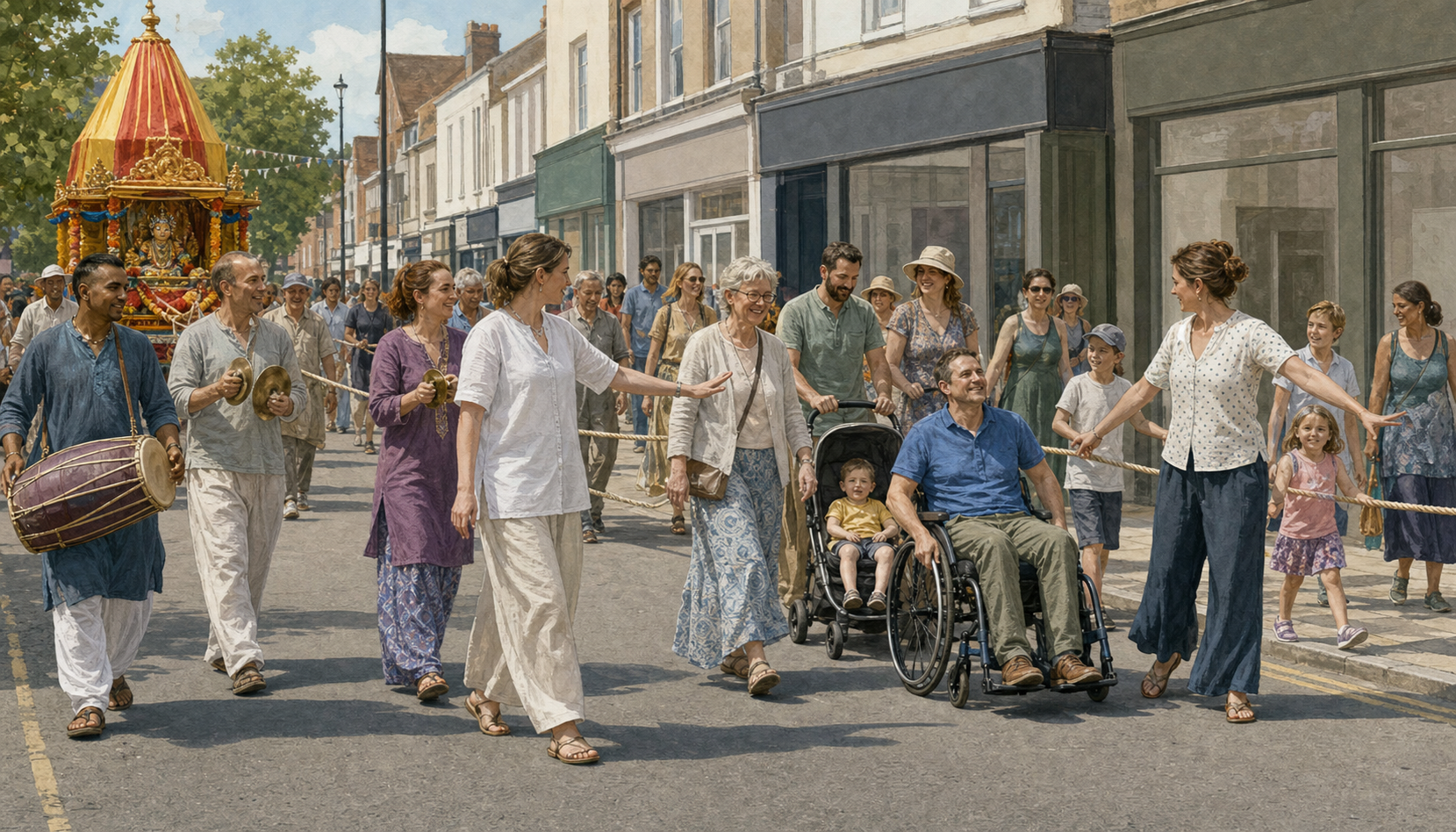
The report describes congregational kirtan as the procession’s central participatory practice. Sacred names were sung in a call-and-response form accompanied by drums, hand cymbals and other melodic instruments. This structure makes participation relatively intuitive: a newcomer can listen for a phrase, repeat it and enter the collective rhythm without first mastering a long text or formal choreography.
That accessibility was reinforced by practical decisions. Organisers reportedly used visible volunteer teams, signage, staggered movement and defined marshalling points while coordinating timed traffic management. A measured walking pace accommodated families with prams, older people and participants with limited mobility. These arrangements show that inclusion at a street festival is not only an ideal; it is produced through route planning, pacing and attentive stewardship.
The programme also offered different levels of engagement after or alongside the procession. Traditional dances, dramatic items and cultural presentations were accompanied by short explanations connecting performance to devotional narratives and ethical ideas. Tents offered henna, face painting, snacks, mantra meditation and Vedic literature. Together, these elements created a progression from casual encounter to conversation and guided practice, although the report does not describe a formal accessibility audit or educational assessment.
Hospitality turned an audience into a temporary community
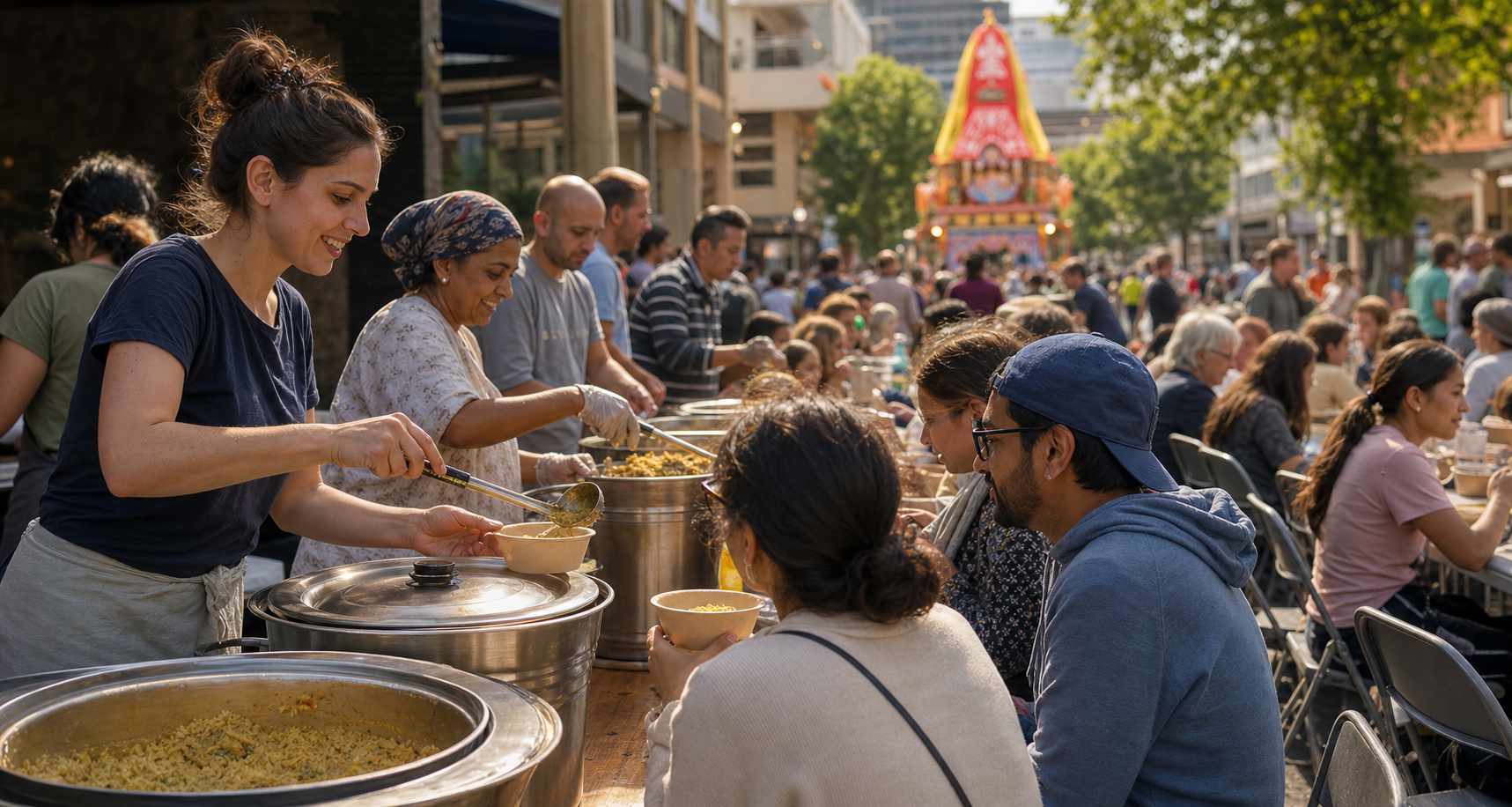
Food service appears to have been one of the day’s most substantial forms of seva. The source reports that more than 1,200 visitors received free vegetarian prasadam. In Vaishnava practice, prasadam is food offered in devotion before it is shared, so distribution combines nourishment with a theological understanding of hospitality. The absence of a price or membership requirement also gives the practice a clear civic dimension: strangers are received as guests.
Nannari juice added a specific regional note to the hospitality. The report describes it as a cooling drink made traditionally with syrup from Indian sarsaparilla, or Hemidesmus indicus. Such details matter because cultural continuity is often carried through taste and service as much as through formal explanation. For diaspora communities, preparing and sharing familiar foods can transmit memory while allowing neighbours to experience the tradition directly.
The article characterises attendance as culturally, religiously and generationally diverse. It connects the festival with values including seva, ahimsa and community, while presenting the event as open to people of every belief. Those concepts have distinct meanings in different traditions and should not be treated as interchangeable, but the festival format demonstrated a practical point of contact: people could sing, eat, learn or simply share public space without erasing their differences.
What the evidence supports, and what future editions can learn
Counting people along an open procession route is inherently difficult. The source labels its figure of roughly 1,200 participants and onlookers as an estimate and points to steward counts and meal-distribution records as practical proxies. It also refers to observations of dwell time at the procession, stage and activity tents. These indicators support a picture of sustained engagement, but meal servings cannot automatically be converted into a count of unique visitors, nor can route observations establish a precise total.
The same distinction applies to broader effects. The report records positive attendee responses, acknowledgement from Chelmsford City Council, informal indications of increased activity around shops and cafes, and impressions that singing and dancing felt both energising and restorative. These observations are valuable qualitative evidence. They do not, by themselves, quantify economic gains, demonstrate a health outcome or establish how representative the feedback was.
The environmental case also deserves careful framing. Vegetarian catering generally supports a lower-impact model of mass hospitality, while a city-centre event can encourage walking and public transport. The supplied account, however, does not present an event-specific assessment of travel, waste or emissions. Future reporting could strengthen this dimension by separating general sustainability principles from measured local results.
A useful next step would be to distinguish route footfall, procession participation, meals served, stage audiences and tent engagement in future records, supported by voluntary and anonymised feedback. Clear measures would help organisers plan capacity and accessibility while giving civic partners a more reliable account of cultural, social and commercial effects. If Chelmsford preserves the festival’s devotional centre while improving this evidence base, the High Street debut can become the foundation for a durable and accountable city tradition.