
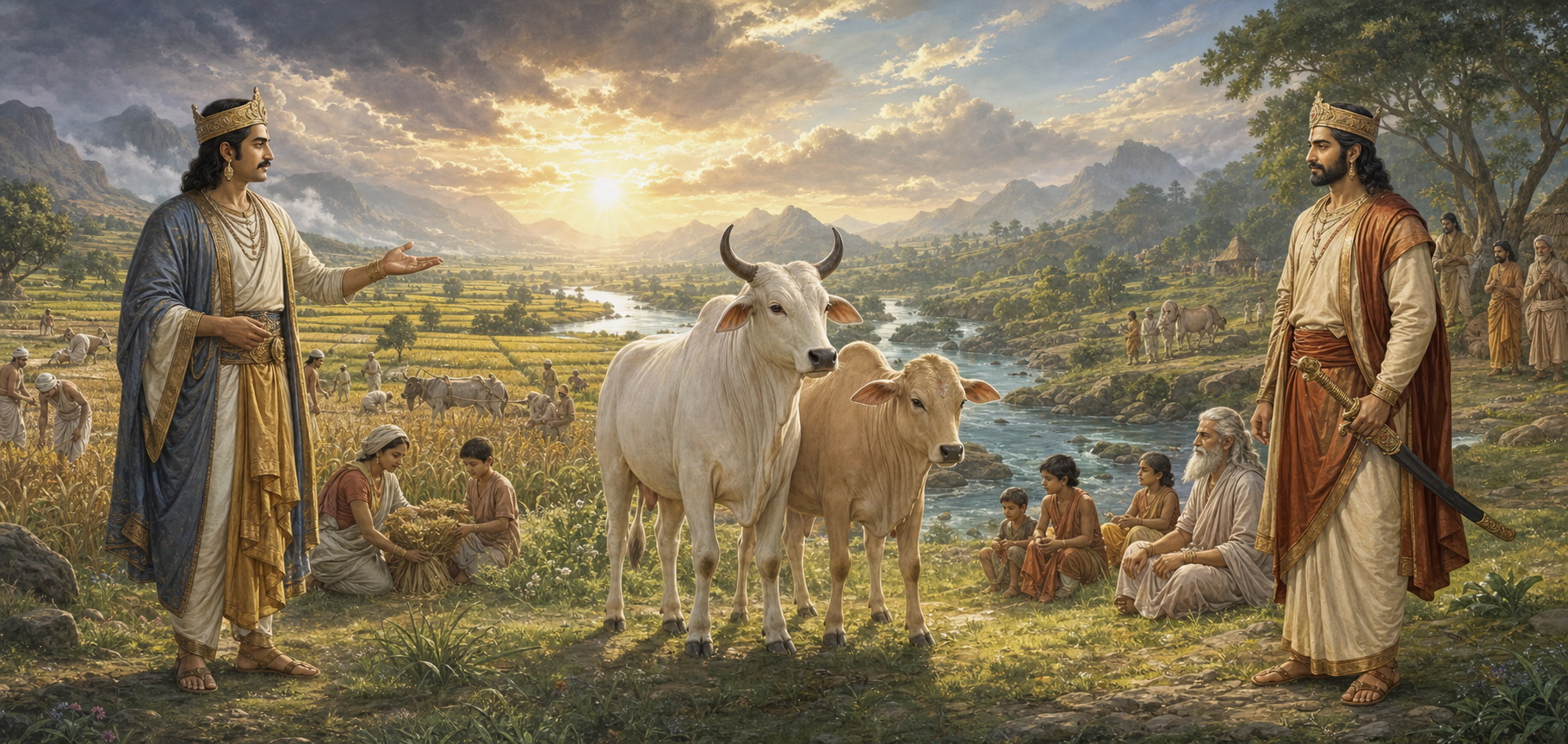
The Bhagavatam’s ideal king is not defined by a single posture. He must sometimes intervene, sometimes relinquish a contest, and always govern his own motives before governing others. Three source studies illuminate these demands through Maharaja Prithu’s public teaching, Prithu’s conflict with Indra, and Maharaja Parikshit’s encounter with the injured figures of Dharma and Earth.
Read together, the episodes offer more than a portrait of exemplary rulers. They provide a framework for evaluating authority: diagnose the condition of society, protect what sustains life, distinguish justice from rivalry, test sacred appearances against ethical substance, and submit power to a discipline deeper than prestige.
One royal office, three tests of legitimacy
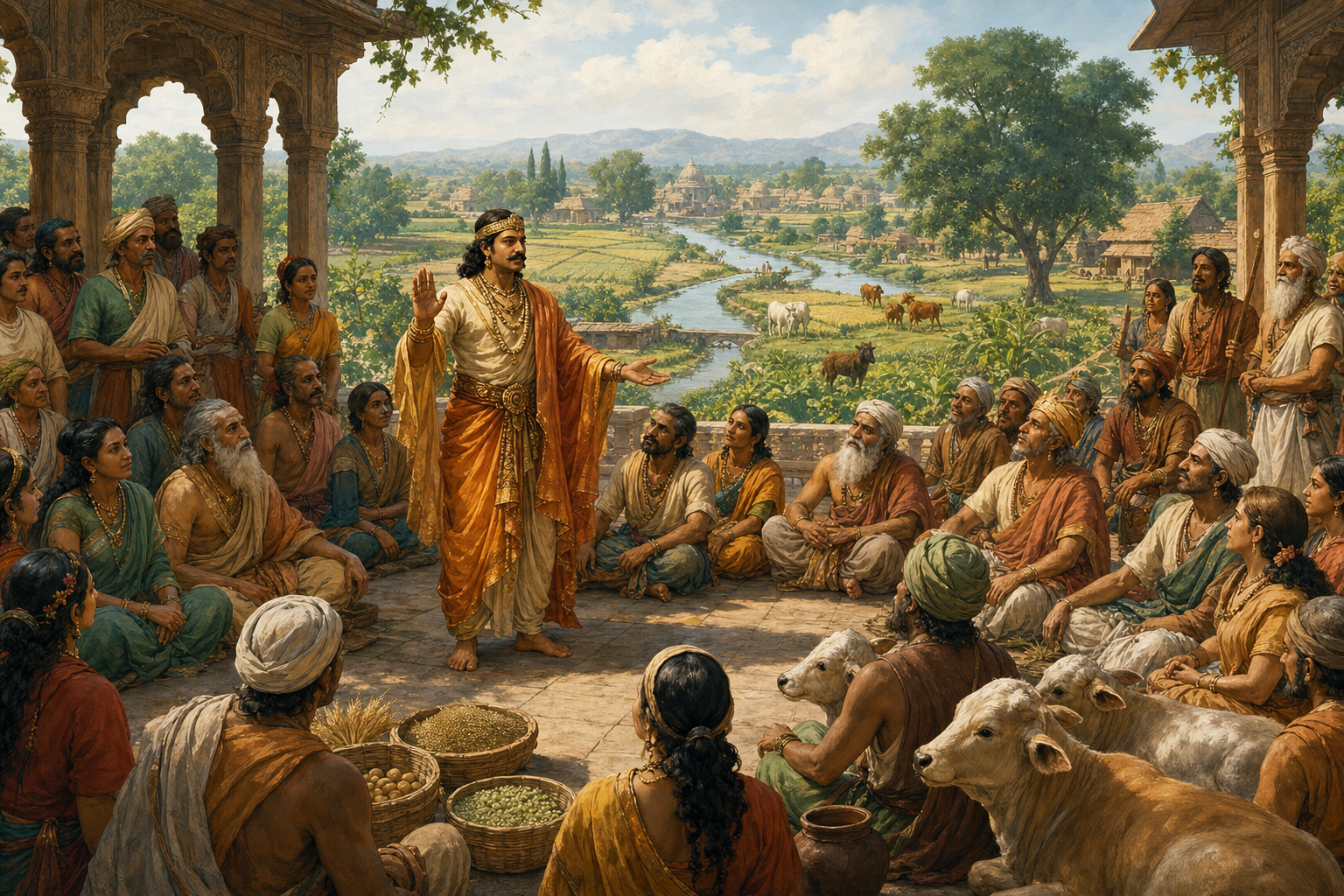
The three articles approach kingship at different moments in the exercise of power. The study of Srimad-Bhagavatam 4.21.37-52 presents Prithu giving public instructions after the theophany of Lord Vishnu described in the preceding chapter. Its emphasis is constructive: the ruler protects beings, resources, justice, and education while citizens perform their responsibilities with a devotional orientation.
The article on Srimad-Bhagavatam 4.19.14-22 examines Prithu under provocation. Indra, reportedly disturbed by the possibility that Prithu would equal his prestige through a hundred horse sacrifices, repeatedly interferes with the final rite and adopts ascetic signs as disguises. The episode tests whether a ruler can defend order without allowing a legitimate grievance to become a contest for glory.
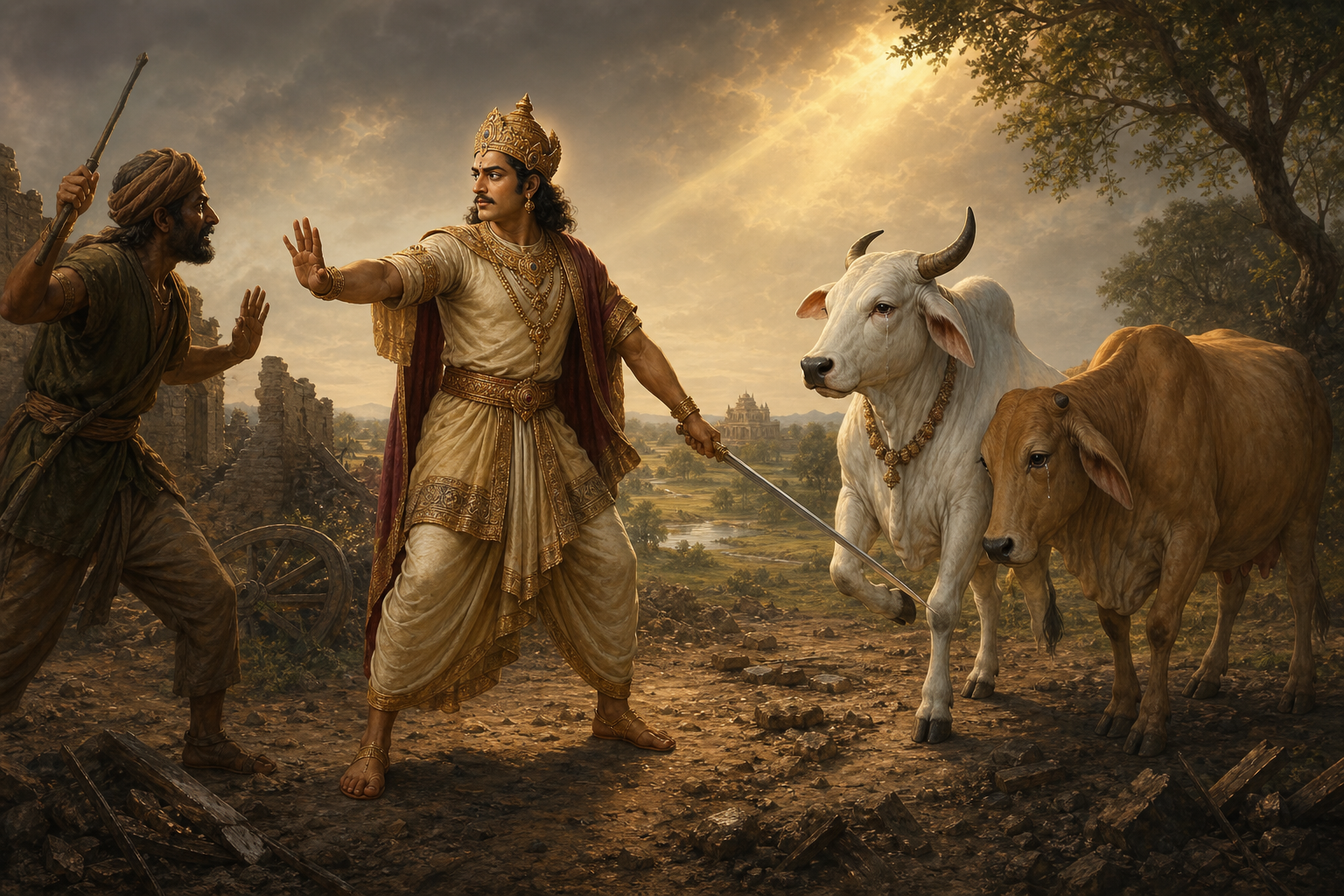
The discussion of Srimad-Bhagavatam 1.16.5, drawing on teachings attributed to A. C. Bhaktivedanta Swami Prabhupada, places Parikshit in a diagnostic role. The king tours his realm, encounters Dharma as a bull and Earth as a cow under attack, and prepares to restrain the assailant. Legitimate sovereignty is therefore represented not as rule from a distance but as vigilance toward concrete suffering.
These scenes yield a three-part standard. Prithu the teacher shows that authority must cultivate a just order; Prithu the provoked sovereign shows that it must limit itself; and Parikshit shows that it must notice and confront injury. Titles, ceremonies, and force are secondary. The decisive question is whether power sustains dharma without becoming captive to the ruler’s appetite for recognition.
Dharma is a social condition that rulers must learn to read
The Parikshit article provides the clearest diagnostic vocabulary. It reports the traditional interpretation of the Dharma-bull’s four legs as satya, truthfulness; sauca, cleanliness; daya, mercy; and tapas, disciplined restraint. Their weakening is associated in that source with false public discourse, environmental and personal neglect, institutionalized cruelty, addiction, and uncontrolled consumption. The injured Earth-cow connects this moral deterioration with ecological and material insecurity.
Prithu’s public teaching broadens the same diagnosis. The 4.21 article describes stewardship of agriculture, animals, resources, education, law, and social cooperation as parts of one ethical ecology. It interprets social functions as responsibilities ordered toward service and competence rather than as grounds for pride or unequal human worth. Prosperity becomes dharmic only when it protects beings and remains governed by restraint.
Together, the accounts depict a feedback system. Truth supports trust; cleanliness supports personal and environmental health; mercy restrains exploitation; and austerity checks the desires that can overwhelm all three. Conversely, deception, cruelty, pollution, and excess weaken both moral order and the material basis of collective life. The king’s task is thus not limited to punishing isolated offences. It includes preserving the conditions under which ethical conduct remains possible.
This model also distributes responsibility. The ruler supplies protection, fair administration, and institutional guardrails, but citizens, households, teachers, and occupational communities must sustain the virtues that law alone cannot manufacture. Dharmic kingship is neither passive moral example nor total control; it coordinates public authority with cultivated self-government.
Protection and restraint answer different kinds of disorder
At first glance, Parikshit’s readiness to enforce order and Prithu’s eventual de-escalation can appear to recommend opposite policies. The distinction becomes clearer when attention shifts from the amount of force used to the object being protected.
In the Parikshit account, the vulnerable embodiments of Dharma and Earth are being struck. The source reads the king’s intervention as swift and proportionate danda-niti: authority restrains conduct that destroys the foundations of shared life. It also stresses that vice is to be constrained without turning enforcement into persecution of people. Protection is warranted because non-intervention would abandon both the victim and the moral order represented by the victim.
In Prithu’s sacrificial crisis, redress is also initially justified: the horse is recovered and sabotage is challenged. Yet the source explains that the wider episode ultimately validates relinquishing the symbolic completion of the hundredth sacrifice. Once the dispute becomes entangled with prestige, retaliation risks multiplying the confusion it is supposed to end. Yielding a ceremonial distinction can therefore preserve more dharma than winning it.
The synthesis is a principle of proportionality. Firmness is appropriate when vulnerable beings or the supports of social order face direct harm. De-escalation is appropriate when further struggle chiefly serves status, revenge, or symbolic victory. Dharmic restraint does not mean indifference to wrongdoing, and enforcement does not authorize unlimited retaliation. Both are instruments whose legitimacy depends on their purpose, measure, and likely moral effects.
Sacred appearance cannot substitute for ethical substance
The Indra episode adds a problem that neither benevolent policy nor force can solve by itself: counterfeit religiosity. According to the 4.19 article, Indra uses ascetic insignia to conceal conduct driven by envy. The source highlights the difference between linga, an external sign, and the defining qualities of genuine renunciation, such as detachment, truthfulness, compassion, and equipoise. Religious costume becomes dangerous when it shields transgression or manufactures unearned trust.
Prithu’s public teaching supplies the positive counterpart. The 4.21 article presents hearing, chanting, and remembering the Supreme as practices that clarify intention, regulate the senses, and nurture compassion. It also invokes awareness of the Lord within all beings as a reason to curb envy and honor others. Bhakti, in this presentation, is not branding attached to government; it is an inward discipline meant to make the exercise of authority less self-serving.
The two Prithu studies therefore establish a crucial boundary. Spiritual formation may steady public judgment, but public displays of spirituality do not prove that judgment is sound. Claims of sanctity must be tested by conduct, the coherence of means and ends, openness to accountable counsel, and willingness to surrender personal advantage. Without those tests, religious symbolism can become another instrument of political competition.
Key takeaways for evaluating dharmic leadership
- Look for direct moral attention. Parikshit’s tour of the realm models leadership that observes conditions rather than relying only on abstraction or ceremony.
- Judge prosperity by what it sustains. Prithu’s teaching connects sound rule with care for beings, agriculture, resources, education, and long-term social cooperation.
- Distinguish protection from retaliation. Enforcement should defend the vulnerable and the supports of dharma; it should not become a vehicle for anger or prestige.
- Test sacred signs by ethical qualities. Titles, robes, rituals, and public piety remain unreliable when truthfulness, compassion, restraint, and integrity are absent.
- Require rulers to renounce something. Prithu’s abandoned ceremonial distinction suggests that the capacity to forgo glory is evidence that service outranks self-image.
- Treat inner discipline as a public safeguard. Devotional remembrance matters politically when it reduces envy, clarifies intention, and strengthens responsibility toward others.
The source articles propose several modern translations of these standards, including transparent administration, audit integrity, fair resource allocation, animal welfare, environmental protection, responsible consumption, and rehabilitative rather than cruel enforcement. These are contemporary applications offered by the authors, not policies stated verbatim in the ancient passages. Their common logic is nevertheless clear: institutions should be evaluated by whether they strengthen truth, cleanliness, mercy, restraint, and trust.
From royal archetype to a shared civic standard
The Bhagavatam models considered here do not reduce good rule to the personality of an unusually virtuous monarch. Their deeper usefulness lies in the standards they make visible. Officials can be assessed by stewardship and restraint; religious authorities by the relation between signs and character; institutions by their treatment of life and resources; and citizens by the disciplines through which they contribute to social trust.
Applied carefully, this framework directs attention away from nostalgia for royal power and toward the moral architecture that any form of governance requires. Its future-facing question is not who can most convincingly perform righteousness, but which leaders and communities can protect the conditions in which truth, mercy, discipline, devotion, and the living world flourish together.

References
- DharmaRenaissance Blog – Bhagavatam 4.21.37-52: Maharaja Prithu’s Transformative Dharma of Leadership, Bhakti, and Unity
- DharmaRenaissance Blog – SB 4.19.14-22 decoded: Prithu’s Asvamedha, Indra’s Envy, and the Ethics of Dharma
- DharmaRenaissance Blog – Decoding SB 1.16.5: Dharma-Bull, Mother Earth, and Kali-yuga in Srila Prabhupada’s Teachings