
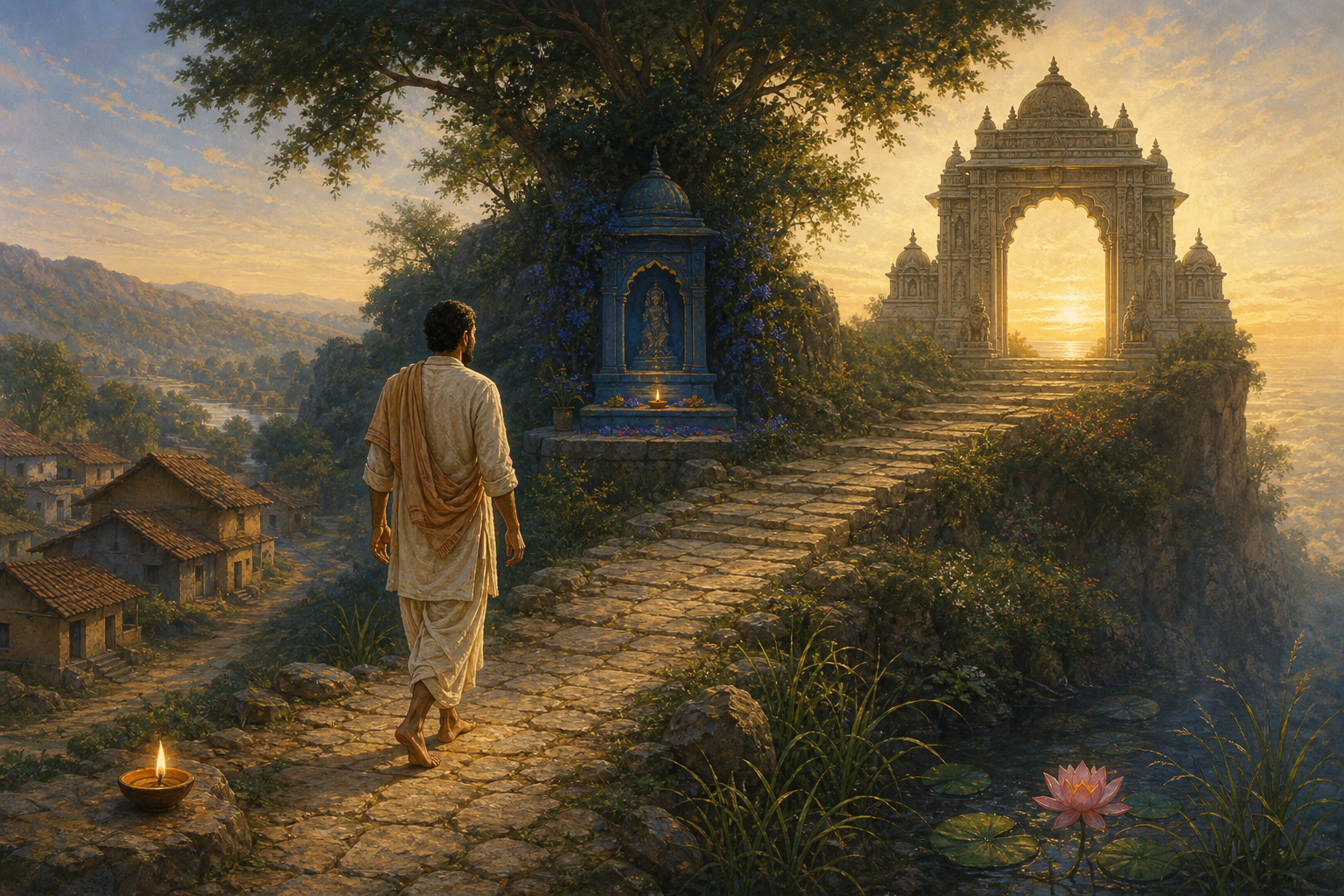
Dharma, devotion, and liberation are sometimes treated as separate concerns: ethical conduct for ordinary life, worship for the religious heart, and moksha for the spiritual specialist. Read together, the two source essays offer a more integrated account. Dharma disciplines how life is lived, devotion redirects the self toward the Divine, and liberation gives both their ultimate horizon.
That integration does not eliminate philosophical differences. The broader account of Dharma accommodates multiple Dharmic paths, while the essay on Madhvacharya presents a specifically Dvaita understanding in which the soul remains distinct from God and liberation depends decisively on divine grace.
Dharma begins in conduct but points beyond it
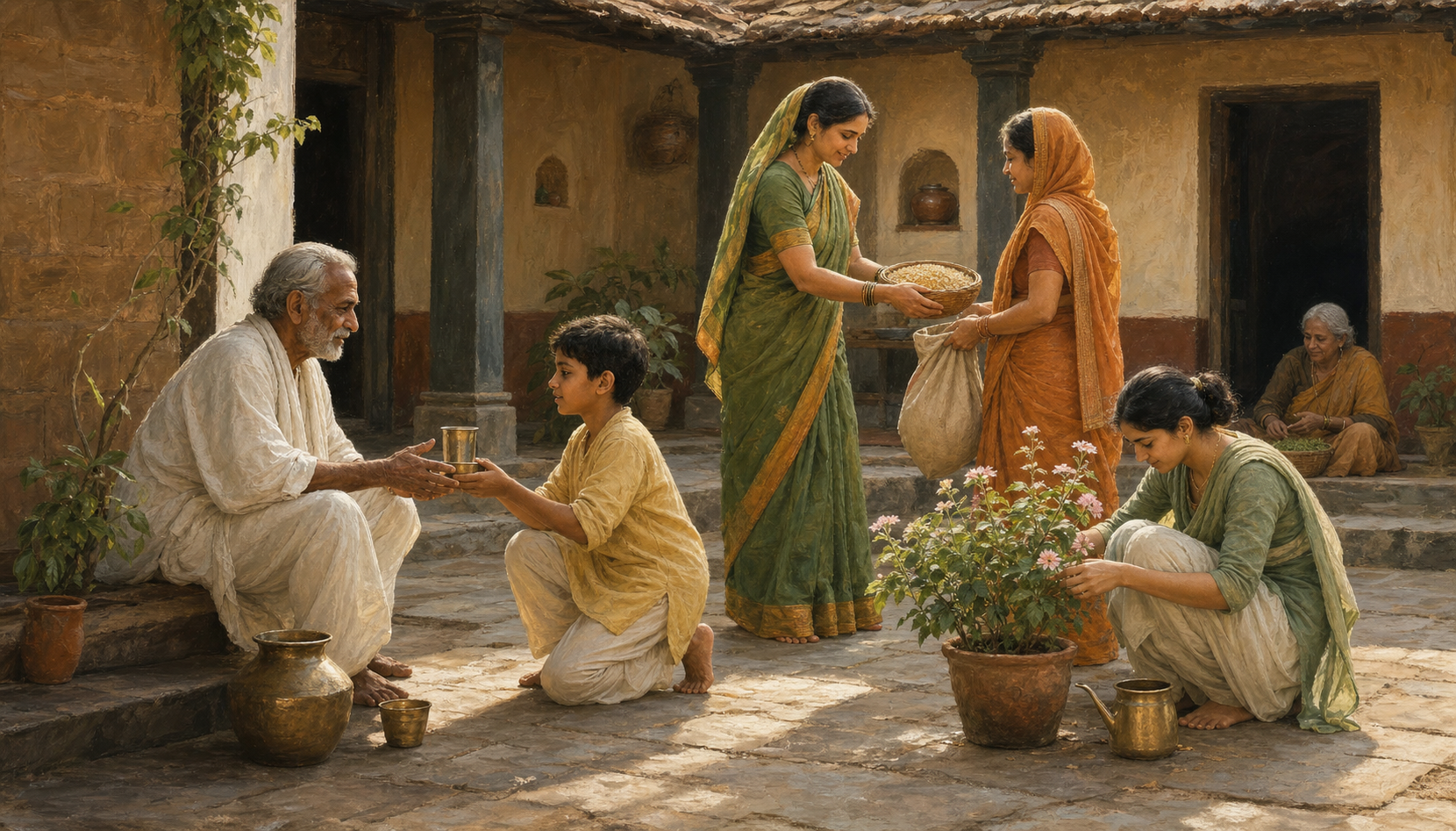
The essay on Dharma describes it as the principle that sustains coherence across thought, speech, action, livelihood, relationships, and spiritual aspiration. Its central concern is not mere compliance with rules, but alignment: knowledge should produce humility, prosperity should support welfare, and freedom should remain answerable to truth, restraint, and compassion.
This account places ordinary responsibilities inside a larger spiritual movement from transient satisfactions toward enduring wisdom. Artha, or material prosperity, and kama, or legitimate enjoyment, are not rejected; the source situates them within Dharma and ultimately orients the classical aims of life toward moksha. Liberation therefore does not begin by abandoning life. It begins by refusing to let desire, status, or possession define life’s highest purpose.
The Madhvacharya essay gives this ethical seriousness a realist foundation. It reports that Dvaita regards God, individual souls, and the material world as real rather than dissolving them into an undifferentiated identity. Actions matter because the world is morally significant, bondage and suffering are real, and the individual soul is a genuine participant in spiritual life. On this view, Dharma is not simply a temporary social arrangement to be discarded on the way to transcendence; it is the field in which character becomes fit for devotion.
Devotion makes dependence a spiritual strength
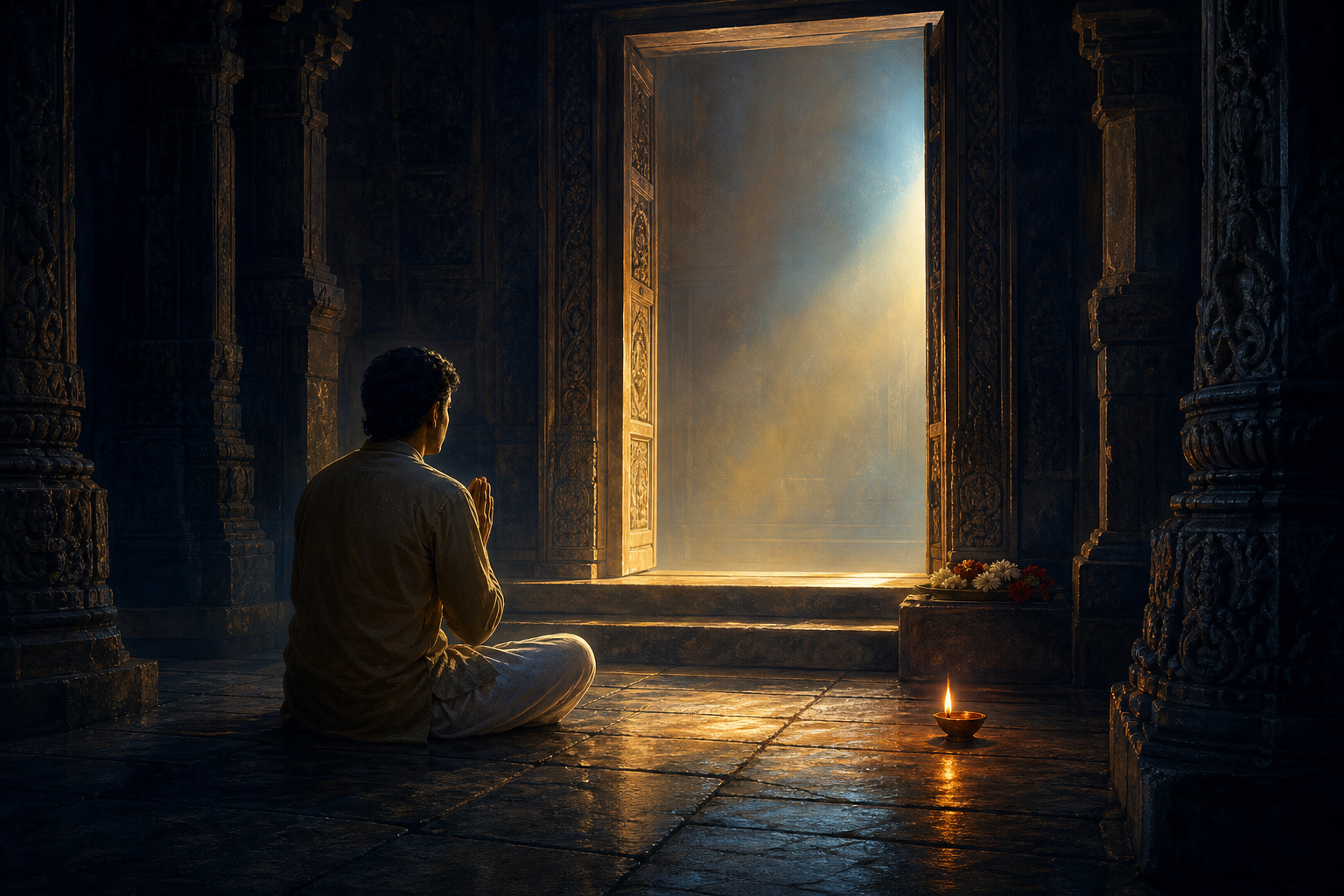
The Madhvacharya article presents the Supreme Lord, especially Vishnu or Krishna in the Madhva tradition, as eternally distinct from the individual soul. That distinction makes a reciprocal devotional relationship intelligible: the devotee can worship, remember, serve, and seek refuge because God is understood as personal, independent, and compassionate.
Dependence, in this framework, is not helplessness. It is an accurate recognition of the soul’s place in relation to the Divine. The devotee may still experience fatigue, fear, disappointment, and moral struggle, but hardship need not be interpreted as spiritual abandonment. Trust in divine protection provides a stable orientation without promising that worldly difficulty will disappear.
The wider Dharma essay does not present personal devotion as the sole language of every Dharmic tradition. Its comparative discussion points instead to shared concerns such as restraint, compassion, truthful living, service, mindfulness, and freedom from ego-centered existence, while acknowledging differences among Hindu, Buddhist, Jain, and Sikh frameworks. The synthesis must therefore preserve an important distinction: ethical discipline may be widely shared, but Madhva bhakti gives it a particular theological center in a personal Supreme Being.
Dharma and devotion consequently perform related but different work. Dharma supplies standards by which desire and action can be judged; devotion transforms the motive for following them. Responsibility ceases to be only self-management and becomes an offering, while humility ceases to be merely a social virtue and becomes recognition of dependence on the Divine.
Effort, purification, and grace form one path

Both source essays reject a spirituality detached from character. The Dharma article uses Karma Yoga to explain how action can be purified through discipline, competence, dedication, and reduced attachment to results. It also presents the ethical restraints and observances of Yoga – including non-violence, truthfulness, moderation, purity, contentment, study, and surrender to the Divine – as means of reorganizing the personality.
The Madhvacharya essay focuses the same demand on inner enemies such as anger, pride, greed, jealousy, and uncontrolled desire. Devotion is incomplete when worship leaves habitual hostility or ego untouched. The decisive spiritual tests therefore arise not only during ritual, but in reactions to insult, frustration, success, and failure.
Yet the Madhva account does not turn purification into a technique that mechanically produces moksha. Study, ethical conduct, worship, and self-discipline matter, but the source identifies divine grace as decisive for release from repeated birth and death. This establishes a careful relationship between agency and dependence: human effort prepares, clarifies, and reorients the person, while liberation is received rather than claimed as an achievement.
This balance guards against two opposite errors. An appeal to grace cannot justify passivity, because devotion requires disciplined transformation. At the same time, ethical or intellectual accomplishment cannot justify spiritual pride, because no accumulation of learning, austerity, or status can compel the Divine to grant liberation.
The Madhvacharya article also shows how this relationship enters daily practice. It reports that the Dwadasastotra, a hymn understood to carry the essence of Madhva philosophy, has traditionally been recited in Madhwa households during worship when food is offered. Philosophy is thereby carried through memory, melody, ritual, and domestic routine rather than confined to abstract debate. Repeated practice gives ethical intention and theological conviction a durable form.
Liberation does not erase philosophical difference
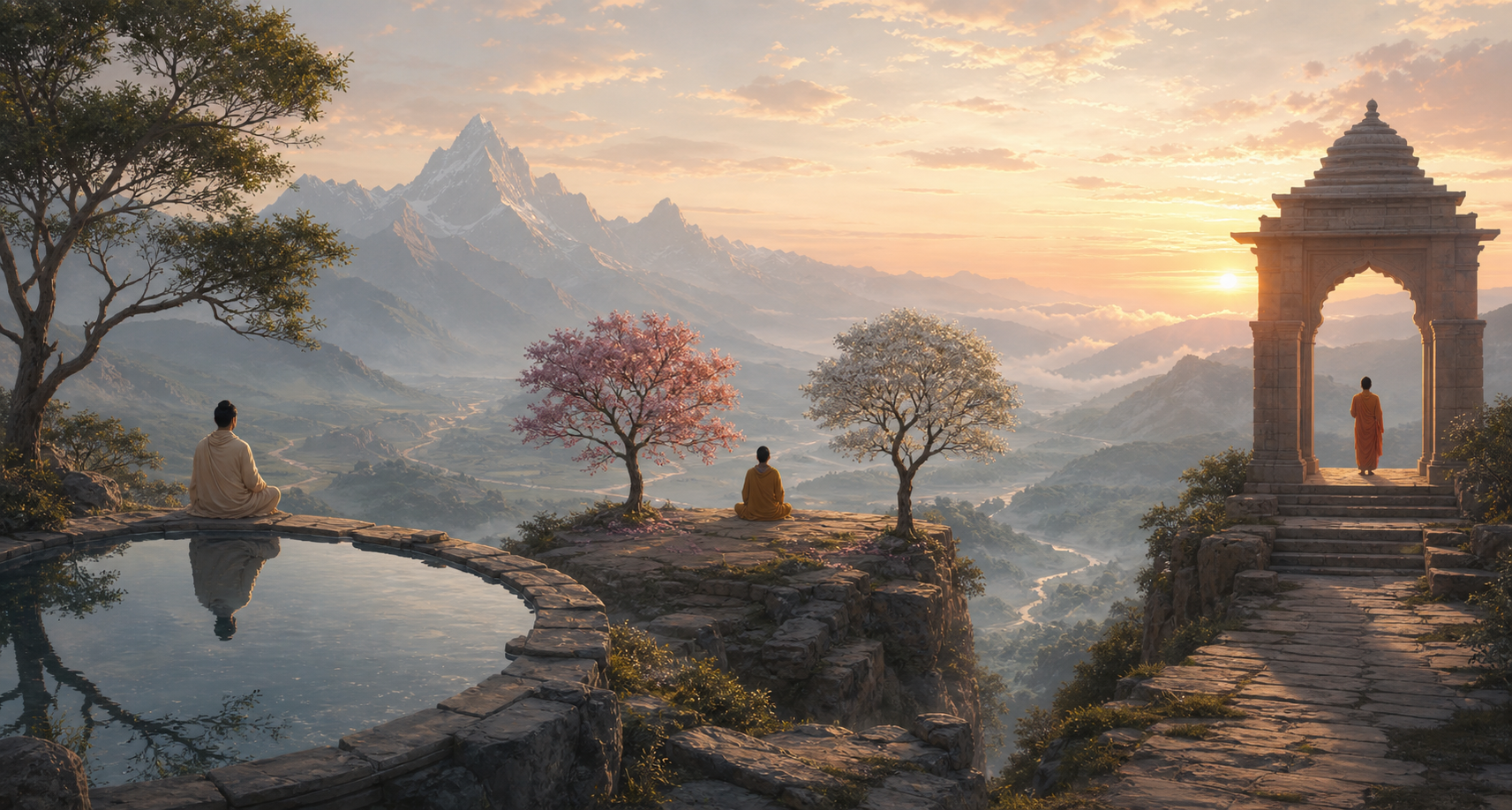
The Dharma essay presents liberation as the ultimate orientation that prevents practical success from becoming life’s final measure. It emphasizes movement from ignorance to wisdom, from fragmentation to integration, and from identification with transient experience toward awareness of a deeper dimension of existence. This broad framework explains why Dharma can regulate work, desire, wealth, and relationships without treating any of them as the ultimate end.
The Madhvacharya essay offers a more precise account of what that end means within Dvaita Vedanta. Liberation is not the discovery that the individual soul was identical with God all along. According to the source, the fulfillment of the soul lies in correctly understanding its enduring difference from and dependence upon the Supreme, then serving the Lord with knowledge, devotion, and humility.
This matters because the words Dharma, devotion, and liberation do not automatically settle the metaphysical questions behind them. Traditions may agree that ego, craving, anger, and false identification bind human beings while differing about the nature of the self, ultimate reality, and release. Responsible synthesis finds genuine convergence in ethical and spiritual discipline without converting distinct teachings into interchangeable versions of one doctrine.
Key takeaways
- Dharma integrates outward responsibility with inward development, preventing spirituality from becoming detached from conduct.
- In Madhvacharya’s Dvaita framework, devotion is a real relationship between a dependent soul and a distinct, personal Supreme Lord.
- Purification and disciplined action are necessary forms of preparation, but the Madhva account presents liberation as dependent on divine grace.
- Shared ethical commitments across Dharmic traditions should not be mistaken for agreement about the nature of God, the self, or moksha.
The continuing value of this synthesis lies in practice: Dharma can be tested in the integrity of daily choices, devotion in the transformation of motive and emotion, and the aspiration for liberation in a humility that neither dismisses effort nor mistakes effort for ultimate control.
References
- DharmaRenaissance Blog – Madhvacharya’s Powerful Pathway to God: Devotion, Grace, and Liberation
- DharmaRenaissance Blog – Dharma as the Powerful Key to an Integrated, Ethical and Meaningful Life