
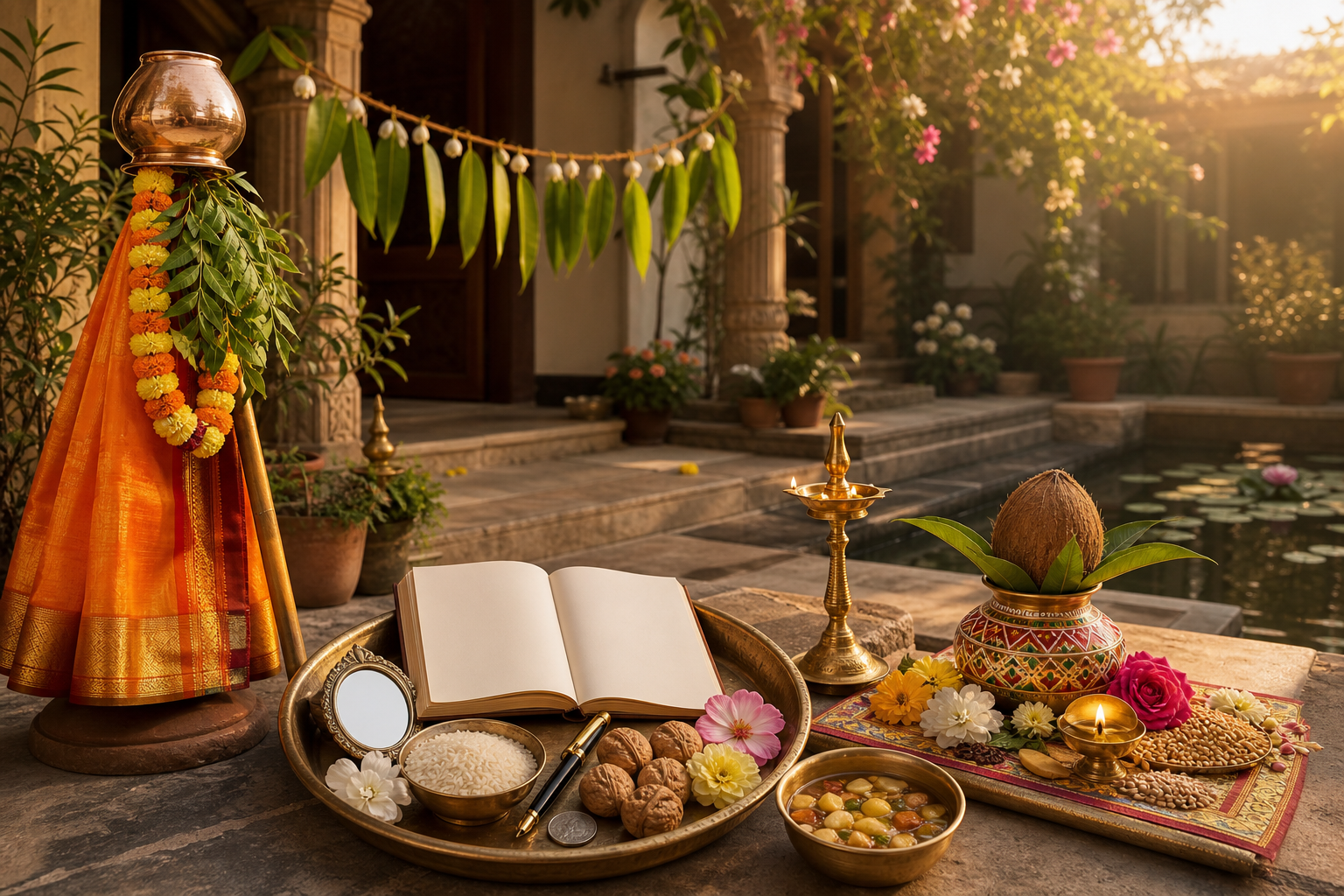
Hindu New Year is best understood not as one festival replicated across India, but as a family of regional ways of entering sacred time. The calendar establishes a threshold; households then give that threshold meaning through worship, food, auspicious sight, public symbols, sacred geography and community memory.
Read together, the source reports reveal a shared architecture beneath Navreh, Gudi Padwa, Ugadi or Yugadi and Cheti Chand. They also explain why regional difference is not a departure from a common tradition: the same civilizational understanding of renewal can be expressed through a Kashmiri platter, a Maharashtrian gudi, a South Indian mixture of tastes or a Sindhi offering carried toward water.
A new year begins with a relationship, not a timestamp
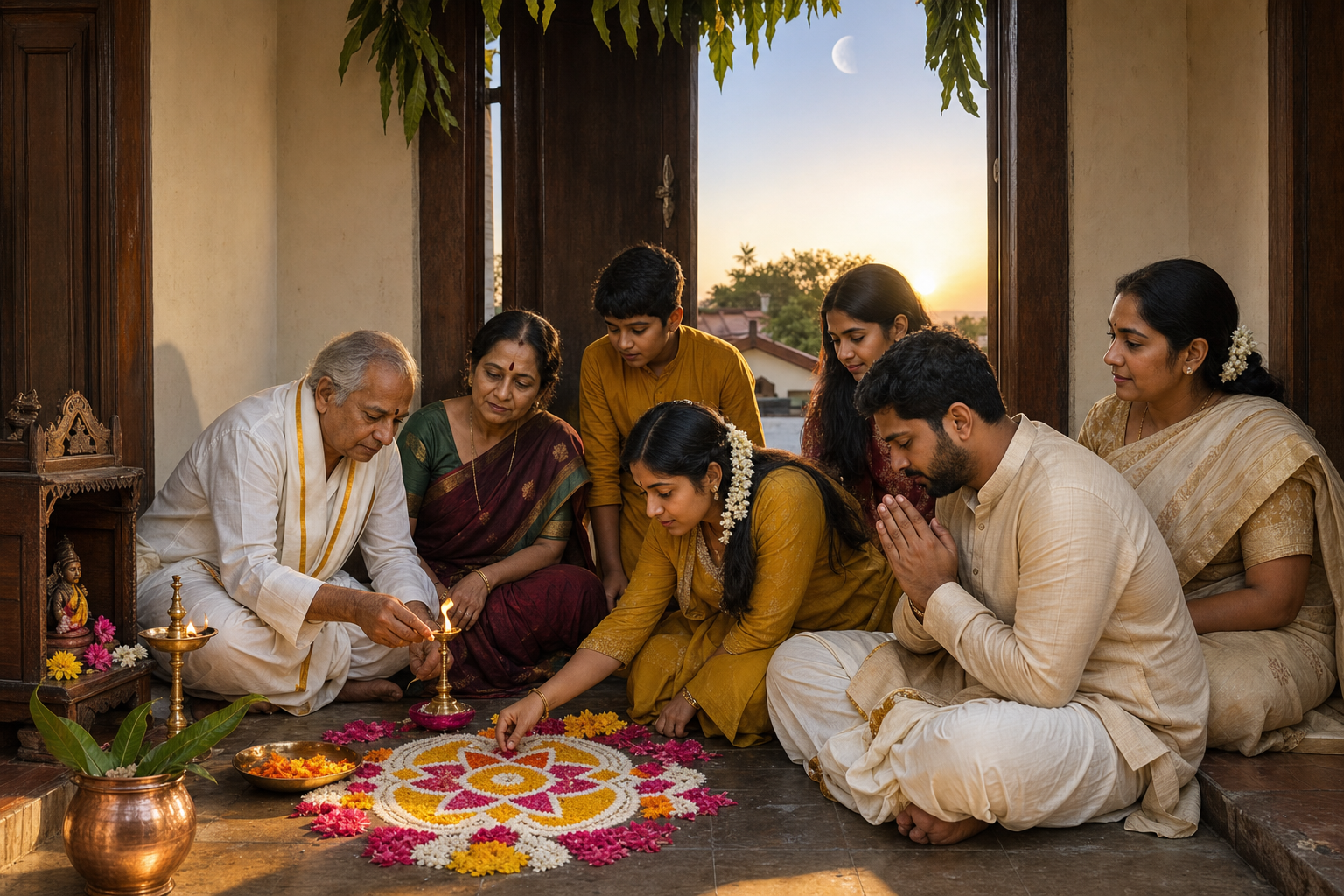
The Panchangam report describes Hindu timekeeping through five limbs: tithi, vara, nakshatra, yoga and karana. Tithi measures the changing angular relationship between the Sun and Moon; vara identifies the weekday; nakshatra follows the Moon through the lunar mansions; yoga is calculated from the combined longitudes of the Sun and Moon; and karana divides a tithi in half. A ritual day is therefore more than a civil date running from midnight to midnight.
This distinction matters at New Year. The reports on Hindu New Year and Ugadi identify Chaitra Shukla Pratipada, the first tithi of the bright fortnight of Chaitra, as the calendrical beginning observed by Ugadi and Gudi Padwa communities. The Navreh report places the Kashmiri Hindu New Year on the same tithi. For 2026, those reports dated Navreh, Ugadi, Gudi Padwa and the opening of Chaitra Navratri to March 19 in the communities and calendars they discussed.
The two daily Panchang reports make the underlying principle concrete. The March 17 guide reported that Trayodashi ended at 7:51 AM and Chaturdashi then began, while the February 20 guide placed the transition from Tritiya to Chaturthi at 2:38 PM. The latter also showed how a favorable interval can overlap a cautionary one. These examples illustrate why a printed civil date cannot, by itself, communicate the full ritual character of a day.
Location adds another layer. The Panchangam sources emphasize that sunrise, longitude, calculation method and regional convention can affect timings or even the civil date selected for an observance. The broad calendrical framework is shared, but local Panchang and temple guidance remain important. The Ugadi report adds another scale of reckoning by identifying the 2026 observance with Sri Parabhava nama Samvatsara in a repeating sixty-year cycle. Time is consequently recognized through a date, a tithi, a season and a named year at once.
One spring season, four regional languages of renewal
The traditions covered by the reports are not an exhaustive catalogue of Hindu New Years. They do, however, show how a related season of renewal acquires distinct regional form without losing its wider calendrical and ethical setting.
| Tradition | Regional or community setting reported by the sources | Characteristic focus |
|---|---|---|
| Navreh | Kashmiri Pandit communities | An auspicious first sight of the prepared thaal, remembrance of Kashmir and devotion associated with Sharika Devi |
| Gudi Padwa | Marathi and Konkani communities | A raised gudi at the home, interpreted as a sign of auspiciousness, victory, prosperity and protection |
| Ugadi or Yugadi | Telugu and Kannada communities, especially in Andhra Pradesh, Telangana and Karnataka | Ugadi Pachadi or Bevu Bella, household renewal and ceremonial listening to the Panchangam |
| Cheti Chand | Sindhi Hindu communities in South Asia and the diaspora | Devotion to Jhulelal, Behrana Sahib, water-associated observance and public community continuity |
The comparison reveals several kinds of beginning. Navreh is contemplative and memory-centered; the gudi makes renewal publicly visible at the threshold; Ugadi places the year’s varied possibilities on the tongue; and Cheti Chand carries renewal into collective devotion. None is merely a regional name for an otherwise identical event. Each tradition selects a different ritual language for making time present.
Objects and tastes turn calendar knowledge into lived ethics
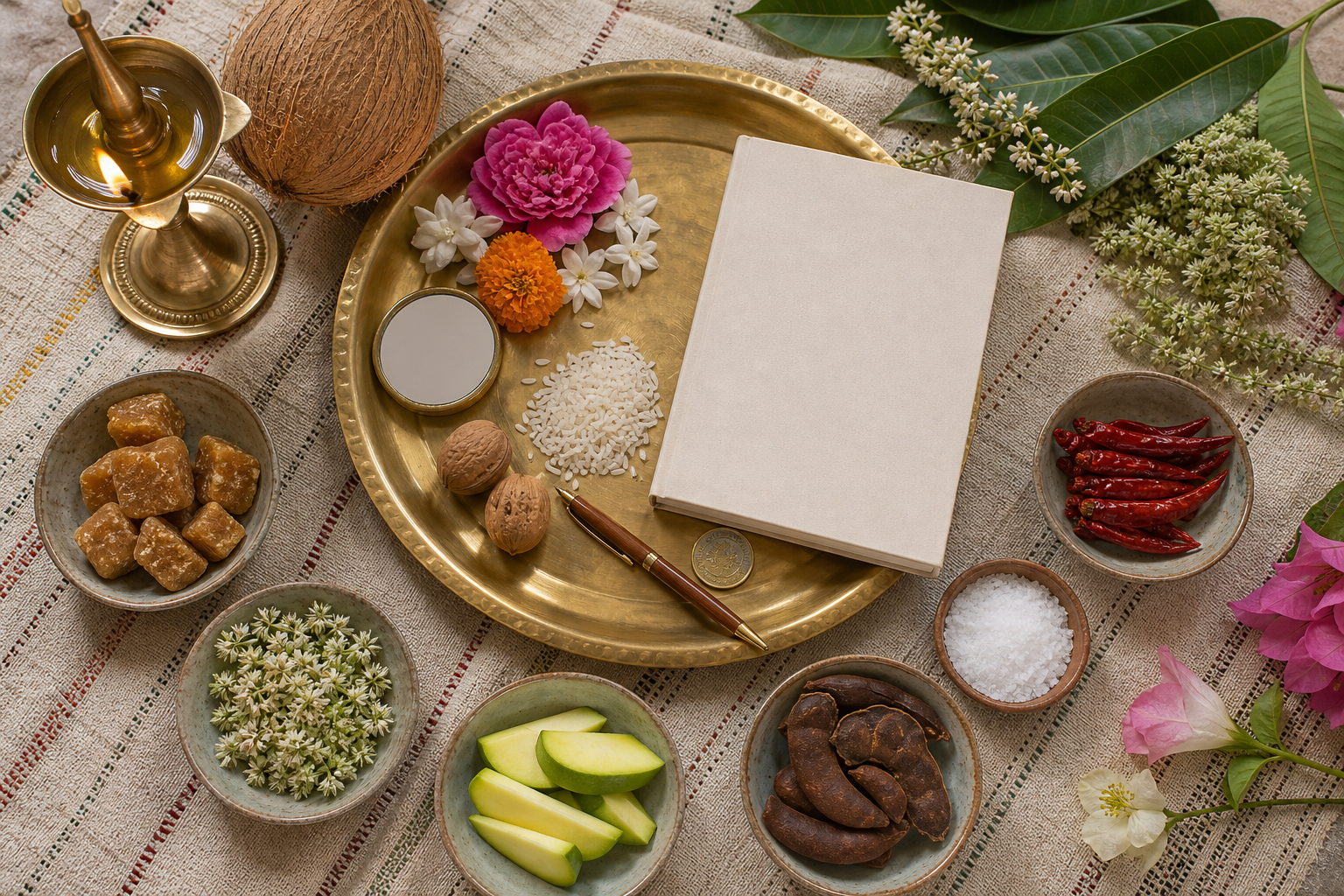
The Navreh report says that families traditionally arrange a thaal on the previous evening and view it at the beginning of the New Year. Its reported contents can include rice, bread, curd, salt, sugar candy, nuts, a coin, a pen, a mirror, flowers and a new Panchang. The arrangement brings sustenance, learning, prosperity, self-examination, beauty and cosmic time into one field of vision. The first act of the year is thus an exercise in attention: the household considers what should orient the cycle ahead.
Gudi Padwa directs that attention outward. The Hindu New Year overview describes a bright cloth fastened to a staff, decorated with leaves, flowers and a sugar garland, and crowned with an inverted metal vessel. Raised near an entrance, window or balcony, the gudi marks the household boundary as a place where auspicious time is actively welcomed. The report also describes neem and jaggery as an acknowledgement that the coming year will contain both bitterness and sweetness.
The Ugadi sources develop that teaching through Ugadi Pachadi and, in Kannada households, Bevu Bella. The reported combination of sweet, bitter, sour, salty, spicy and astringent or tangy tastes is interpreted as a compact lesson about changing human experience. The ritual does not promise uninterrupted comfort. It teaches steadiness before pleasure, disappointment, surprise and difficulty, turning a festival food into ethical instruction that children can encounter before they can explain its philosophy abstractly.
Cheti Chand uses yet another medium. The Hindu New Year overview reports that Behrana Sahib can include a lamp, cardamom, sugar, fruit and Akho, with the offering taken toward a river, lake or other body of water in connection with Jhulelal. Processions, devotional singing and communal gathering make continuity a shared public act. Across these traditions, sight, taste, display and movement perform comparable work: they translate a complex calendar into practices that can be remembered bodily and transmitted within families.
Renewal joins celebration to discipline and memory
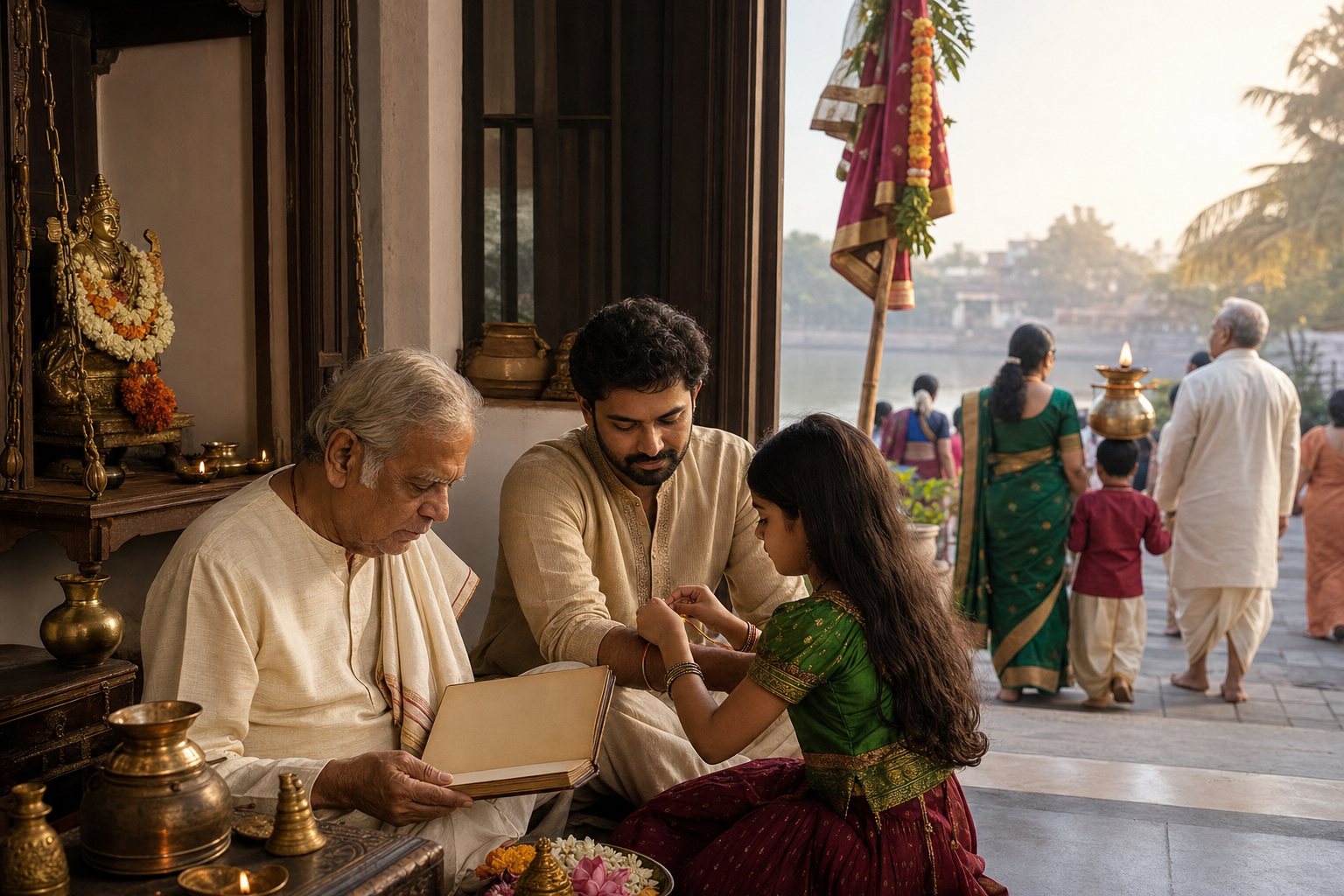
The overlap with Chaitra Navratri prevents the New Year from being reduced to festive optimism. The Kashmiri Pandit report dated the 2026 Navratri observance from March 19 through March 27, concluding with Ram Navami, and described its worship of Devi, fasting, mantra recitation, ritual purity and temple practice. The Hindu New Year and Ugadi reports likewise present the coincidence of Chaitra New Year and Vasant Navratri as meaningful. A new cycle opens through celebration, but also through restraint, purification and renewed dharmic orientation.
For Kashmiri Pandits, this discipline is inseparable from sacred geography. The Navreh report associates the festival with Sharika Devi and Hari Parbat in Srinagar, and situates Chaitra Navratri within a wider devotional network that includes Kheer Bhavani and Vaishno Devi. It interprets the Navreh thaal in displaced or distant households as a way of preserving connection with Kashmir when direct access to the homeland has changed. A domestic ritual can therefore function as a portable sacred landscape.
The Sindhi account presents a parallel without collapsing the two histories into one. Cheti Chand, it reports, sustains devotion to Jhulelal and connects younger generations with Sindhi language, food and collective memory across migration and historical disruption. The Ugadi report adds that recipes, greetings and shared celebrations continue to connect relatives living in different places and time zones. Regional New Year traditions are consequently not static survivals; they are repeatable structures through which dispersed communities renew belonging.
The social dimension is equally important. The Ugadi sources associate the festival with charity, gifts, temple visits and shared meals, framing prosperity as incomplete when separated from responsibility toward others. This places New Year prayer within an ethical field: personal hopes for health or success are joined to generosity, hospitality, self-control and community care.
Key takeaways
- Hindu New Year is a family of regional observances rather than a single uniform festival.
- The Panchang connects New Year observance to lunar motion, solar and seasonal rhythms, local sunrise and inherited ritual rules.
- Navreh, Gudi Padwa, Ugadi and Cheti Chand use different ritual media while sharing an emphasis on conscious renewal.
- Household objects and festival foods teach reflection, resilience and acceptance rather than promising an effortless year.
- Chaitra Navratri adds worship and discipline, while regional sacred geography and diaspora practice give renewal a strong dimension of cultural memory.
As Hindu communities continue to live across regions and time zones, the tradition’s vitality will depend on preserving both sides of this inheritance: careful attention to local sacred time and confident transmission of the meanings carried by regional practice. The calendar supplies the threshold, but each community must continue teaching how and why it is crossed.
References
- DharmaRenaissance Blog – Powerful Navreh Traditions: How Kashmiri Pandits Celebrate Chaitra Navratri
- DharmaRenaissance Blog – Hindu New Year Explained: Powerful Traditions of Renewal Across India and Diaspora
- DharmaRenaissance Blog – Panchangam Explained: The Powerful Hindu Almanac Behind Sacred Timekeeping
- DharmaRenaissance Blog – Ugadi 2026: Powerful Guide to Telugu and Kannada New Year Traditions
- DharmaRenaissance Blog – March 17 2026 Panchang: Powerful Tithi, Nakshatra and Muhurat Guide
- DharmaRenaissance Blog – 20 February 2026 Panchang: Powerful Muhurat, Tithi and Prosperity Timings