
Modern Dharma outreach is often discussed as transmission: placing teachings before more people, inviting participation, and keeping inherited practices visible. Youth formation raises a harder question: what knowledge, habits, judgment, and sense of responsibility should an encounter with tradition actually cultivate?
Two contrasting reports illuminate that question. One describes ISKCON’s international literature-distribution network; the other examines a Hindu Janajagruti Samiti youth self-defence camp in Chiplun. One emphasizes wide circulation of sacred knowledge, while the other emphasizes concentrated physical and ethical training. Read together, they suggest that durable outreach must connect access to ideas with disciplined practice, capable mentorship, and service to others.
Two pathways from public contact to personal formation
The account of the May 2026 World Sankirtan Newsletter presents book distribution as an organized form of devotional service. It reports that more than 490,000 pieces of literature were distributed during the month and that the cumulative total since 1965 had passed 620 million. These figures are reported by the source and have not been independently verified here, but they portray a long-running system capable of translating spiritual conviction into coordinated public outreach.
The same account reports strong results from large centers in Mayapur, Mumbai-Juhu, and Vrindavan, alongside activity in settings as different as London-Soho, Bengaluru-South, Bharuch, Surat, Ypsilanti, Baltimore, Birmingham, Kishinev, and a padayatra based in Proddatur. The significance for youth formation is not the ranking itself. It is the demonstration that a shared mission can be expressed through pilgrimage centers, metropolitan temples, regional communities, walking outreach, and relatively small congregations.
The World Sankirtan report also supplies an intergenerational dimension. It describes an annual points competition involving Bhrgupati Prabhu, Paramesvara Prabhu, and Mahotsaha Prabhu, with 74-year-old Bhrgupati Prabhu leading at the time covered. Within the source’s devotional interpretation, the competition encourages greater service rather than personal rivalry. For younger participants, the more consequential lesson may be that commitment is modeled across a lifetime: senior practitioners make sustained discipline visible rather than merely recommending it.
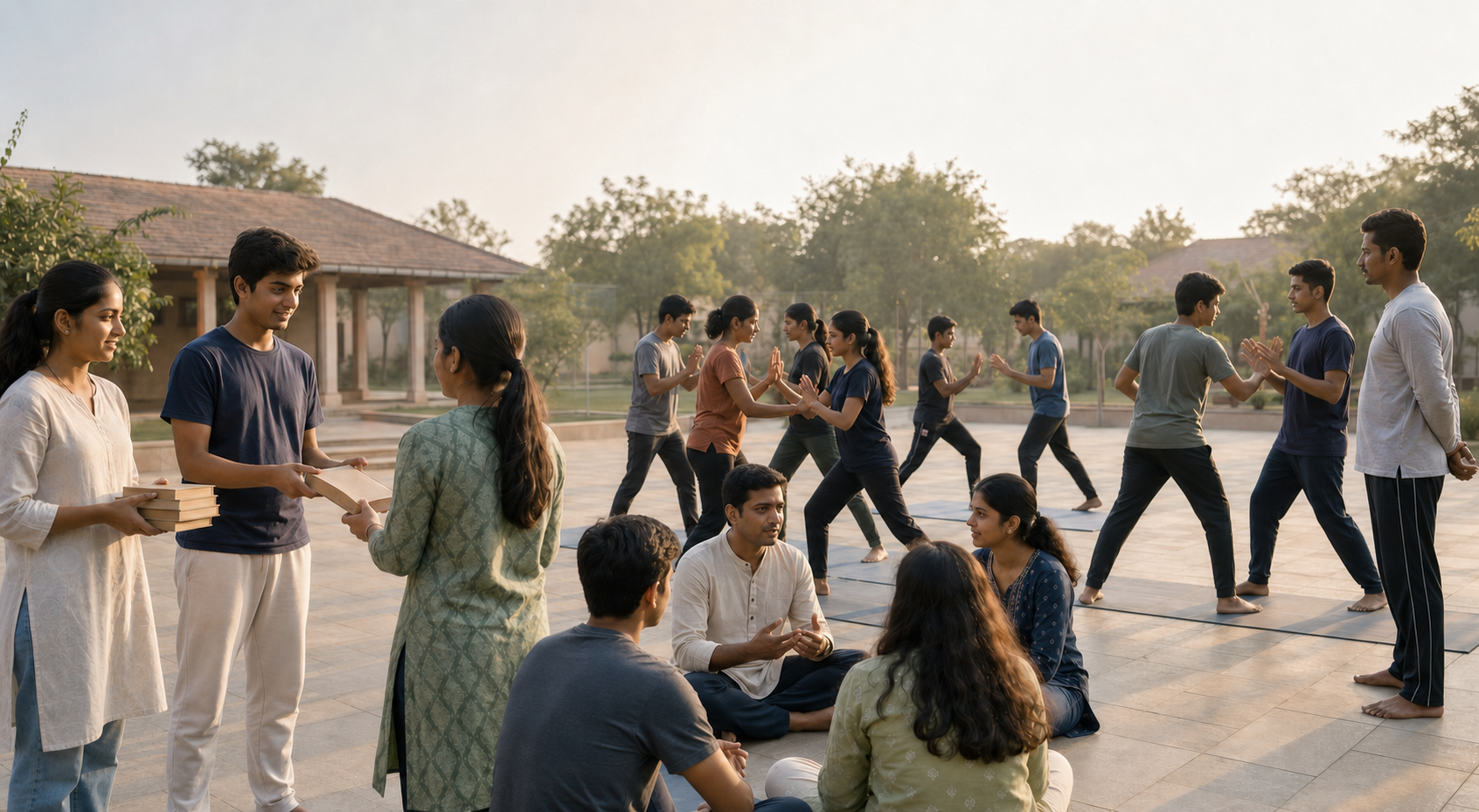
The Chiplun report presents a different kind of encounter. It says the Hindu Janajagruti Samiti’s ‘Har Ghar Yoddha’ camp combined practical martial training with guidance on vigilance, spiritual practice, and personal safety. Its interpretation of a yoddha, or warrior, centers on alertness, restraint, duty, and protection rather than aggression. The event therefore represents an intensive formation model in which participants are asked to embody values under pressure, not only encounter them in textual form.
The Chiplun article further argues that sound self-defence begins before physical confrontation. Awareness, distance, verbal assertiveness, avoidance, de-escalation, and timely help are presented as more fundamental than dramatic techniques. It also broadens the educational question to include emotional resilience, personal boundaries, and digital caution, although these broader elements should not automatically be treated as confirmed parts of the camp curriculum.
Formation needs knowledge, agency, and ethical limits
These outreach models operate at different scales. Literature distribution can create a large number of initial encounters with philosophy and devotional practice. A training camp can provide fewer participants with repeated instruction, correction, and embodied experience. Neither reach nor intensity is sufficient on its own. A book placed in someone’s hands does not establish that it was studied, while a completed physical exercise does not establish that courage will be governed by sound judgment.
Effective youth formation therefore requires a pathway between exposure and application. Sacred literature can supply vocabulary, narratives, ethical questions, and a framework for reflection. Guided practice can turn principles such as self-control, vigilance, steadiness, and service into observable habits. Mentors help participants interpret both: they can connect a teaching to a decision, correct unsafe conduct, and distinguish principled courage from impulsive action.
The two sources also converge at the level of disciplined service, even though their activities differ. The sankirtan account frames distribution as an offering meant to share spiritual knowledge. The Chiplun account frames strength as a capacity for protection and responsible conduct. In both cases, ability is directed toward a purpose beyond individual recognition. That orientation is important for youth programs because knowledge without responsibility can remain abstract, while confidence without restraint can become harmful.
There is also a useful caution in the sources’ broader Dharmic framing. Their discussions invoke values such as devotion, self-mastery, non-aggression, protection, and service, with references to Hindu, Buddhist, Jain, and Sikh ethical perspectives. Shared themes can support constructive dialogue, but distinct traditions should not be flattened into a single formula. Youth formation is strengthened when common principles are explored with accuracy and when differences in theology, practice, and historical experience are respected.
Key takeaways
- Reach and formation are related but different: distribution counts public contact, while sustained learning requires follow-up, practice, and mentorship.
- Text and training can reinforce one another when philosophical reflection is connected to concrete habits and responsible choices.
- Courage should be taught together with restraint, situational awareness, de-escalation, and lawful help-seeking.
- Service metrics can motivate volunteers, but output totals should not be mistaken for evidence of comprehension or character development.
- Senior practitioners can give young people a credible picture of Dharma as a lifelong discipline rather than a temporary enthusiasm.
A practical architecture for responsible youth outreach
A useful program architecture can be inferred from the strengths and limitations of both reports. It begins with an accessible encounter, continues through guided understanding, moves into repeated practice, and eventually gives participants an age-appropriate opportunity to serve. A distributed book, public kirtan, introductory session, or safety workshop can open the door, but a clear next step is needed if the encounter is to become formative.
For literature-centered outreach, that next step might be an optional reading circle, a facilitated question session, or contact with a trained mentor. The aim would not be to maximize follow-up messages but to make comprehension possible. For physical training, reflection on purpose should accompany technique. Participants should understand when to disengage, how to seek assistance, why proportionality matters, and how spiritual composure differs from passivity.
Measurement should likewise follow the full pathway. Distribution totals and attendance remain useful operational indicators, as the sankirtan network illustrates. Formation, however, calls for additional questions: Do participants return voluntarily? Can they explain the ethical purpose of a practice? Do they demonstrate safer judgment? Are they connected to trustworthy adults and constructive service? Such questions need not produce intrusive data collection; they can guide observation, conversation, and program review.
Safeguarding is especially important when spirituality, authority, and physical instruction meet. Youth programs should use competent instructors, age-appropriate exercises, clear behavioral boundaries, and established channels for reporting concerns. Self-defence education should prioritize avoidance and de-escalation, while outreach should avoid treating emotional pressure as spiritual commitment. Cultural confidence is more credible when participation is informed, dignity is protected, and neighboring communities are not portrayed as threats.
Local adaptation completes the model. The sankirtan account indicates that a common mission can function across institutions of very different sizes and social settings. The Chiplun report highlights the value of training rooted in the concerns of a particular community. A strong network can provide principles, educational resources, and accountability, while local leaders decide which languages, schedules, teaching methods, and safety priorities fit the people they actually serve.
The next measure of success
The next phase of Dharma outreach need not choose between sharing teachings and building practical capacity. Its more demanding task is to connect the two through ethical instruction, sustained relationships, and meaningful service. If institutions begin evaluating not only how many people were reached but also what kinds of people their programs help form, public visibility can become the beginning of durable responsibility.



References
- Dandavats – Powerful WSN May 2026 Insights: ISKCON’s Global Sankirtan Milestone Inspires Devotion
- Hindu Janajagruti Samiti – Chiplun’s ‘Har Ghar Yoddha’ Camp: Powerful Youth Safety and Dharma Training