
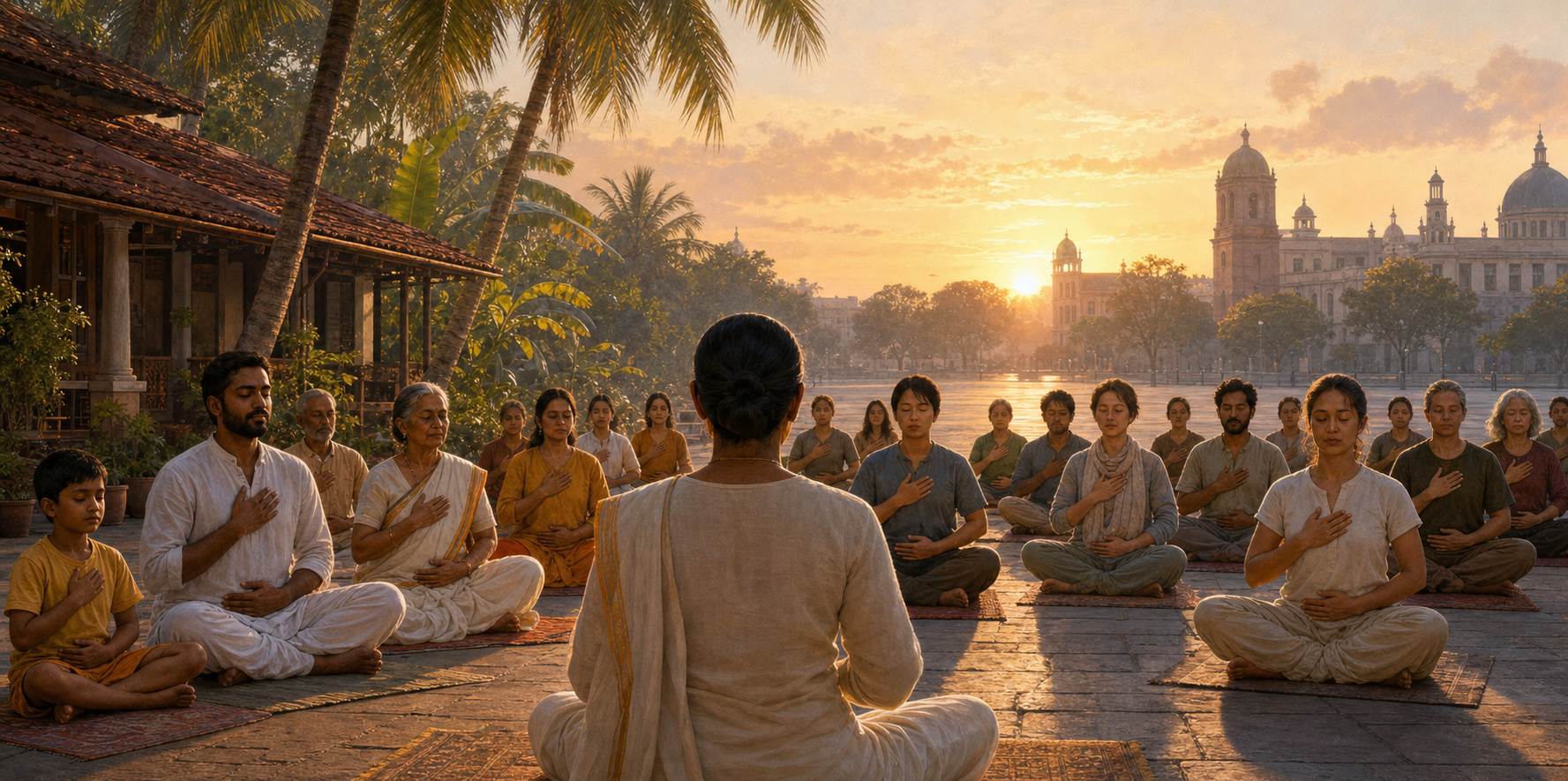
International Yoga Day is usually explained through a United Nations resolution and the public observances held each June. The profiles of Dileep Kumar Thangappan, widely known as Yogi Dileep or Guruji, illuminate a less visible part of that history: the patient teaching, cultural translation and relationship-building that can prepare an ancient discipline for international recognition.
Read together, the articles offer neither a lone-founder story nor a purely diplomatic chronology. They present Yogi Dileep as one contributor within a much larger ecosystem linking household practice in Kerala, traditional lineages, interfaith engagement, grassroots instruction and advocacy associated with the United Nations. The HinduPost article explicitly says that it draws on the Indica Today conversation, however, so their shared biographical details should be treated as related reported testimony rather than independent verification.
From a United Nations resolution to its enabling culture
The formal milestone is reported most precisely by HinduPost: the United Nations General Assembly adopted Resolution A/RES/69/131 on December 11, 2014, proclaiming June 21 as the International Day of Yoga, and the first observance followed on June 21, 2015. Indica Today adds that Prime Minister Narendra Modi proposed the observance at the General Assembly in 2014 and reports that the resolution received support from 177 countries.
Those institutional facts establish how the observance acquired a date and international standing. They do not, by themselves, explain why yoga had become sufficiently intelligible and acceptable across national and religious boundaries. Both profiles place Yogi Dileep’s reported contribution in that preparatory field: years of teaching, dialogue and advocacy that helped people encounter yoga as a practical discipline before it became the subject of a prominent annual event.
This distinction guards against two misleading narratives. International Yoga Day was not simply the spontaneous result of dispersed local activity; a formal diplomatic initiative and multilateral decision were necessary. But it was not created in a cultural vacuum either. Teachers and institutions had already spent years explaining yoga to audiences who might otherwise have regarded it as unfamiliar, sectarian or limited to physical performance. Yogi Dileep’s story is useful because it connects these institutional and social layers without collapsing one into the other.
A Kerala biography shaped by plural belonging and hardship
Both accounts describe an interfaith family background. Yogi Dileep’s father came from a Christian family and his mother from a Hindu family; their marriage reportedly encountered opposition from both communities. The profiles say that he grew up moving between church and temple without treating either as an enemy space. This does not imply that religious traditions are doctrinally interchangeable. It shows how repeated, respectful contact can make difference familiar rather than threatening.
The same theme appears in the accounts of his childhood community. With his parents working, neighbours, relatives and friends reportedly shared responsibility for his care. The later use of Vasudhaiva Kutumbakam, the idea of the world as one family, therefore appears in these profiles as more than an abstract slogan. It is connected to an early experience of dependence on people beyond the immediate household.
A much darker memory also shaped the biography. According to Yogi Dileep’s recollection as relayed by both articles, he was about three and a half when a rented building caught fire amid a property dispute. He was initially left inside during the panic before his sister returned and rescued him. The profiles interpret the episode as a source of enduring questions about greed, violence, vulnerability and survival. Whatever conclusions are drawn from it, the event is presented as remembered personal testimony, not as independently established reporting about the alleged cause of the fire.
His family’s account of yoga likewise begins with vulnerability. Both profiles report that his mother had a serious heart condition and that his father encouraged a regimen involving yoga, dietary restrictions and homeopathic support. Indica Today reports that she lived for another 27 years and that Dileep was born after this change in family life. The sequence helps explain why he encountered yoga as household care rather than recreational exercise. It should not, however, be treated as clinical proof that the regimen caused the reported outcome or as medical guidance for others.
How household discipline became a public teaching method
The training described in the profiles is broad rather than confined to one institution. They report engagement with magnetotherapy and nature-cure traditions, Vivekananda Kendra in Kanyakumari, Sivananda Ashram programmes and Dr. H.R. Nagendra. Indica Today also emphasizes practical service: working in centres, teaching and helping with the physical and administrative labour through which institutions function. HinduPost separately reports that Swami Bua gave him formal sanyasa initiation in New York in 2008.
Taken together, these details reveal a model of formation based on study, service, experimentation and lineage rather than credentials alone. The profiles attribute to Yogi Dileep the expansive view that the universe can serve as guru. In context, that idea does not eliminate the teacher-student tradition; it widens the range of experiences from which a disciplined student may learn while preserving the importance of acknowledged teachers.
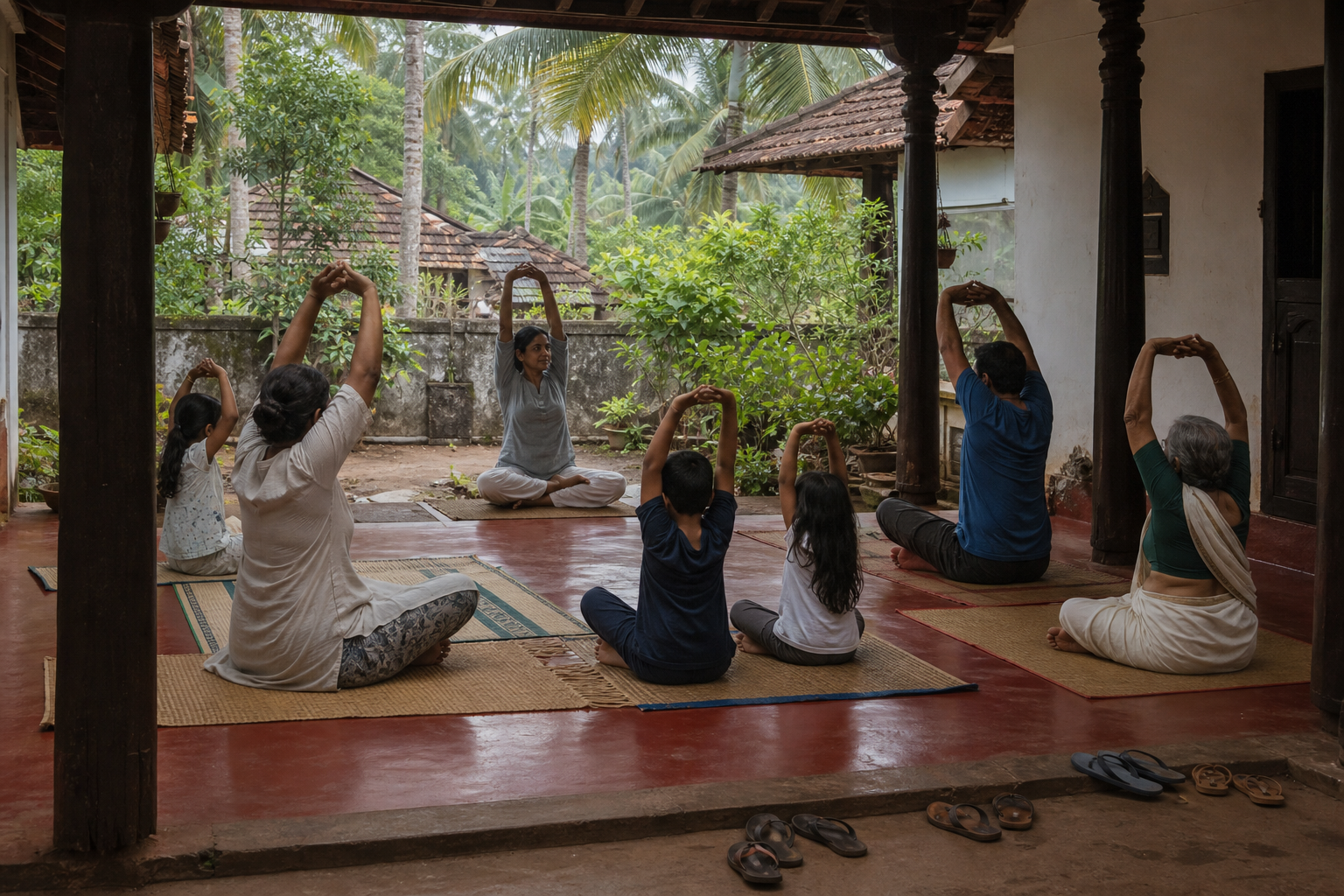
The reports of his early classes show why pedagogy mattered. In the late 1980s and early 1990s, he reportedly put up handwritten notices in Tripunithura, only to have them torn down. His response was pragmatic: introduce people to accessible practices and health benefits, let them observe their experience, and allow philosophical questions to arise later. This approach made yoga approachable without requiring newcomers to accept an unfamiliar metaphysical vocabulary at the outset.
Accessibility did not mean reducing yoga permanently to fitness. HinduPost places his approach beside Patanjali’s eightfold framework of yama, niyama, asana, pranayama, pratyahara, dharana, dhyana and samadhi. In that framework, posture is one component within a discipline also concerned with conduct, breath, sensory restraint, attention and meditation. Physical well-being can be an entry point, but it is not the full destination.
What Yogi Dileep’s story adds to the meaning of Yoga Day
The sources are strongest when they are read as an account of enabling work, not as proof that one person was solely responsible for International Yoga Day. They support a more precise understanding of how cultural practices move from local settings into global institutions.
Key takeaways
- The United Nations decision supplied the observance’s formal date and international status, while earlier teaching helped create an audience capable of understanding the proposal.
- Yogi Dileep is best situated within an ecosystem of practitioners, lineages, institutions, diplomats and public leaders, rather than presented as a solitary originator.
- His interfaith upbringing helps explain the inclusive vocabulary used in his public work, while his training keeps that vocabulary connected to yoga’s Indic and dharmic roots.
- His reported teaching method distinguishes an accessible doorway from the whole tradition: health may attract newcomers, but ethics, attention, breath and self-discipline give yoga its wider purpose.
This synthesis also exposes an important tension within global cultural exchange. A practice needs intelligible language if it is to cross social and national boundaries, yet excessive simplification can detach it from the ethical and philosophical structure that gives it coherence. The profiles present Yogi Dileep’s response as a sequence: begin with experience, build trust and then invite deeper inquiry. That is cultural translation without requiring cultural amnesia.
The work that remains after international recognition
An annual observance can attract attention, but attention alone cannot sustain a discipline. The standard suggested by this biography is whether Yoga Day encourages practice beyond public postures: steadier habits, responsible claims about health, ethical self-examination, serious study and respectful engagement across communities.
International Yoga Day’s future credibility will depend on joining reach with depth. If its public institutions continue to acknowledge the local teachers, household disciplines and philosophical traditions that made global recognition possible, the observance can remain a living bridge rather than a ceremonial endpoint.

References
- HinduPost — Yogi Dileep’s Quiet Power: From Kerala Roots to the Global Rise of Yoga Day
- Indica Today — Kerala’s Quiet Yoga Pioneer: Powerful Journey from Fire to the United Nations