

Krishna’s bamboo flute gives devotional surrender a concrete form: an ordinary reed becomes capable of music when it is open, responsive, and properly shaped. The image therefore speaks not only to mystical longing, but also to the demanding work of preparing character for a purpose larger than self-display.
Read carefully, the symbol brings together several dimensions of bhakti: receptivity without passivity, discipline without rigidity, and action without possessive claims over its results. It offers a practical way to ask what surrender changes in thought, conduct, relationships, and service.
Why emptiness signifies readiness rather than absence

A flute contributes no independent breath and cannot perform its own melody. Yet it is not useless or inert. Its open interior enables the musician’s breath to become a distinct voice. In the DharmaRenaissance source article, this physical dependence becomes an image of the devotee who relinquishes the demand to control every outcome while remaining available for meaningful action.
Such emptiness does not require the erasure of personality. It points instead to the clearing of inner obstructions: pride that refuses correction, resentment that distorts judgment, fear that makes control seem indispensable, and desire that turns service into a search for recognition. The aim is not a vacant person, but a less obstructed one.
This distinction protects the metaphor from a common misunderstanding. Devotional humility is not self-contempt. The source presents the ego as something to be educated until it no longer claims the central place in every deed. Individual capacities remain, but their orientation changes. Talent becomes an offering; responsibility becomes service; accomplishment no longer needs to be treated as private possession.
Surrender still requires judgment, duty, and action

The flute can sound like an emblem of total passivity if separated from the wider ethical setting of dharma. The source explicitly resists that reading. Drawing on its interpretation of the Bhagavad Gita, it presents surrender as alignment with the Divine while continuing to act responsibly. Devotion, understanding, disciplined action, and attention to duty belong together.
This makes the difference between resignation and surrender especially important. Resignation abandons agency because effort appears pointless. Devotional surrender uses agency while releasing the fantasy of absolute control. A person must still deliberate, choose, work, repair mistakes, and accept consequences. What is surrendered is the insistence that the actor alone authors the entire melody or owns every result.
Discernment is therefore part of receptivity. Openness to a larger purpose cannot mean obedience to every impulse, authority, or demand presented in sacred language. The metaphor becomes ethically sound only when joined to truthfulness, self-examination, scriptural reflection, responsible guidance, and concern for the effects of conduct. A well-formed instrument responds precisely; it does not merely yield indiscriminately.
How breath, openings, and tuning become an ethical map
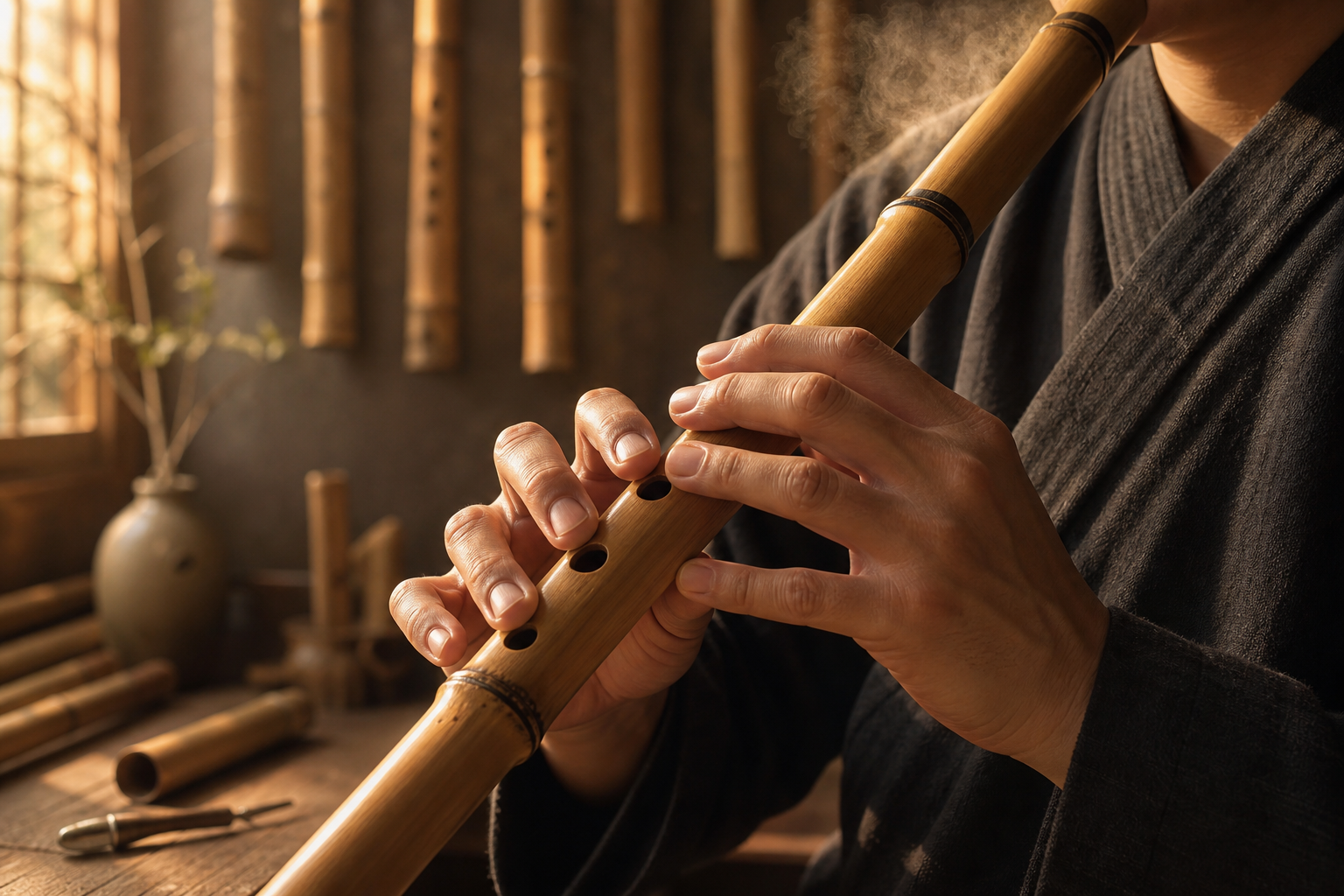
The source connects the flute’s acoustics with spiritual formation. Breath directed across an opening sets the air within the hollow tube in motion, while the finger holes alter the effective vibrating length and therefore the pitch. In the devotional analogy, breath can suggest grace, prana, or divine movement; the hollow passage suggests receptivity; and the carefully placed openings suggest the disciplines through which a life becomes responsive.
The value of this comparison lies in the cooperation of its parts. Openness alone does not make music. A flute also needs proportion, tuning, and skilled handling. Similarly, surrender detached from practice can remain a comforting idea. The source identifies prayer, japa, kirtan, meditation, self-study, service, and ethical restraint as ways of refining the inner instrument. These practices do not manufacture grace; they cultivate readiness to receive and express it.
Tuning also explains why difficulty can contribute to formation without making suffering desirable in itself. Bamboo must undergo alteration before it functions as a flute. In human life, experience, correction, and honest reflection can expose attachments and reshape habitual reactions. The relevant question is not whether hardship automatically ennobles a person, but whether it is met in a way that deepens wisdom, compassion, and steadiness.
The resulting music is ethical before it is spectacular. According to the source’s interpretation, a clearer inner passage should become visible in less harmful speech, more patient relationships, less performative service, and work less governed by ego. Devotional surrender is thus tested by character. If claimed openness produces carelessness, vanity, or indifference to suffering, the metaphor has been admired without being embodied.
Key takeaways
- Emptiness in the flute symbolizes freedom from inner obstruction, not the destruction of personality or intelligence.
- Surrender means responsible action without absolute claims of control, authorship, or entitlement to results.
- Spiritual disciplines function like tuning: they prepare a person to express devotion coherently through conduct.
- The credibility of bhakti appears in truthful speech, patient relationships, humble service, and greater attentiveness to suffering.
Bringing the symbol into ordinary decisions

The flute becomes practically useful when it is applied to moments in which the ego seeks to dominate the performance. Before speaking, a person can examine whether the intended words serve truth and understanding or merely defend status. During work, attention can move from securing praise to performing the task conscientiously. In relationships, surrender can mean loosening possessiveness while becoming more dependable, not less involved.
Prayer also changes under this model. Petition may remain part of devotion, but it is accompanied by a willingness to have motives refined. Instead of asking only for a preferred outcome, the devotee also seeks clarity, courage, and usefulness. This preserves human longing while placing it within a wider horizon of dharma.
The source further presents Krishna’s music as attraction rather than coercion: the call of the flute draws through beauty. Applied socially, this suggests that spiritual conviction is most persuasive when expressed through compassion, wisdom, and lived integrity. Devotion should make the devotee more careful with power and more capable of harmony.
In a culture of constant reaction and self-presentation, the flute leaves a demanding future-facing question: what must be cleared, practiced, or retuned so that the next action carries less noise and more service?