
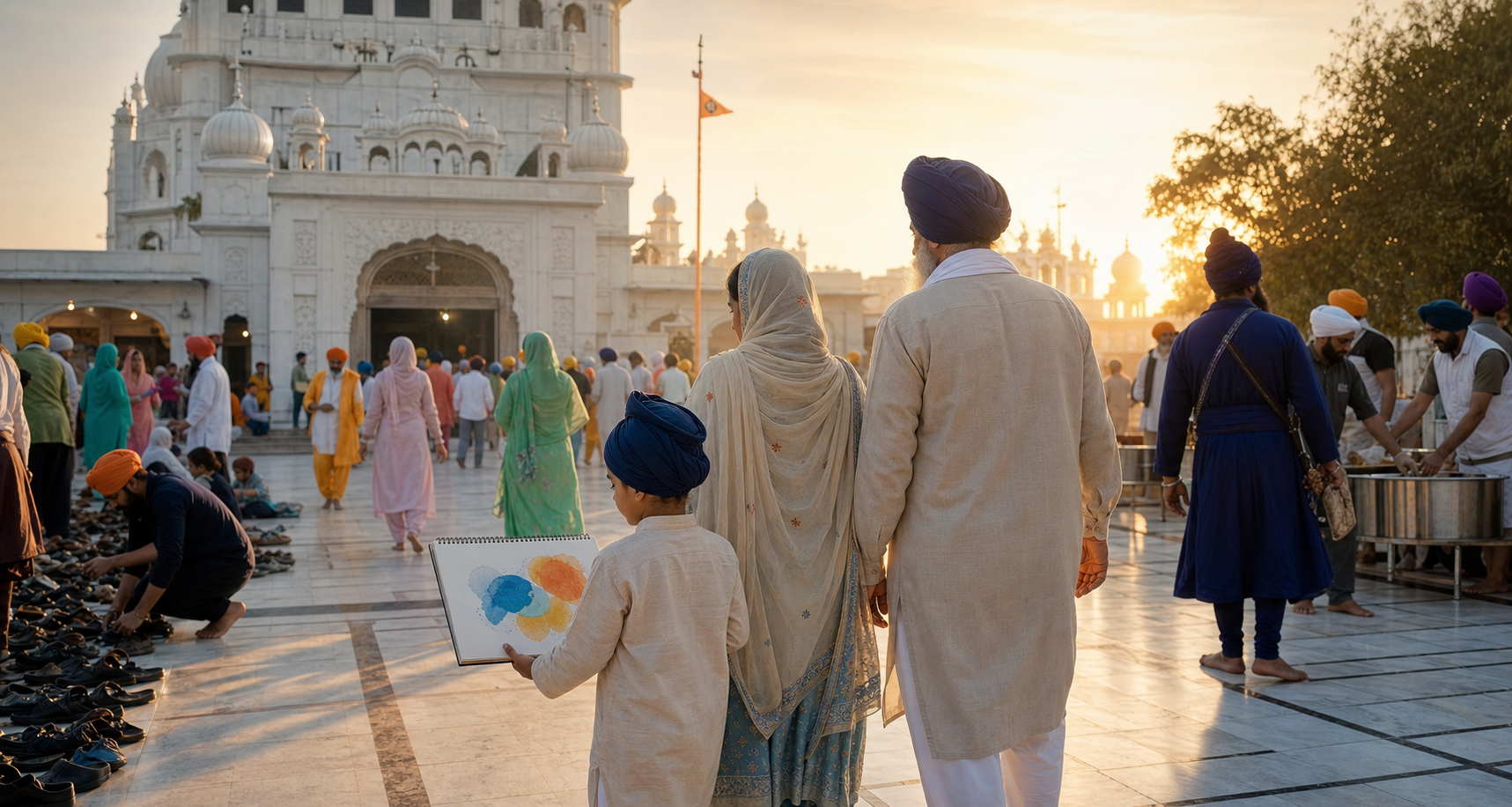
A Sikh child creating a work about daya, a seeker confronting haumai, a Nihang Singh wearing the visible discipline of the Khalsa, and a community demanding answers after a historic gurdwara is reportedly demolished may appear to represent separate concerns. Together, however, they reveal a single chain: Sikh identity is interpreted inwardly, embodied in daily life, sustained through institutions, and protected through religious freedom.
The five source articles approach that chain from different directions. Their synthesis shows why identity cannot be reduced to ancestry, appearance, private belief, or possession of historic buildings. It remains living only when people can learn it, practise it, express it publicly, gather around it, and transmit its material and spiritual inheritance without coercion or erasure.
Key takeaways
- Sikh identity is formed through interpretation as well as inheritance; creative expression can help young people connect received vocabulary with moral experience.
- Guru Nanak’s teachings locate freedom within disciplined remembrance, truthful conduct, humility and service rather than withdrawal from society.
- Khalsa and Nihang symbols carry obligations of restraint, equality, readiness and protection; treating them as costume or generic weaponry obscures their religious meaning.
- Gurdwaras and sacred places are both places of worship and archives of collective memory, making heritage protection part of meaningful religious freedom.
- Restoration after damage is necessary but insufficient unless it is joined to investigation, documentation, community consultation and safeguards against recurrence.
Identity is learned through interpretation and discipline
The source on the SikhNet Creative Competition 2026 begins with cultural transmission at its most intimate point: the developing voice of a child. It reports that the competition invites participants ages 5-19 to explore daya, or compassion, through media including art, writing, music, audio and video. Its larger educational argument is that children do not make an inheritance their own simply by memorizing names and events. They need opportunities to ask what concepts such as seva, courage, humility and remembrance mean within experiences they recognize.
This approach complements the account of Guru Nanak’s teachings in the review of Living Awake. That source presents inner freedom as a loosening of haumai, the ego-centred orientation that turns status, possession, fear and even devotion into forms of self-enclosure. Naam is described not as mechanical speech alone but as an enduring orientation toward Divine Reality, while hukam is presented as participation in an order larger than the ego rather than passive submission to injustice. In that framework, remembrance, honest work, humility, service and moral courage test whether spiritual awareness has entered conduct.
Read together, the two articles clarify the difference between identity as information and identity as formation. A young person can know the vocabulary of Sikhi without yet knowing how it guides attention, speech or action. Creative work supplies a bridge: a story about telling the truth, an image of service or a reflection on compassion asks the creator to convert a received principle into an intelligible moral choice. The resulting work need not resemble an adult production. Its formative value lies in the child’s movement from intuition to expression and from expression to reflection.
The sources also imply an important boundary for adult assistance. Families and educators can ask open questions, help with technical requirements and encourage revision, but the central idea and emotional voice should remain the child’s own. This is particularly relevant when templates, filters, stock material and artificial intelligence can make a polished submission easier to produce than an honest one. Ethical cultural education depends upon truthful effort, not merely an attractive result.
The inward and educational accounts therefore converge on a practical principle: Sikh continuity requires agency. A tradition becomes resilient when each generation can examine its teachings seriously, articulate them in its own circumstances and submit its conduct to their demands. The relevant sources are the SikhNet competition article and the review of Living Awake.
Visible identity carries public obligations
Inner discipline does not remain invisible in Sikh life. The articles on Punjab and the Nihang tradition both connect Sikh identity to the Khalsa, which they report was formed by Guru Gobind Singh at Anandpur Sahib in 1699. They describe this development not merely as military organization but as the institutional joining of devotion, equality, discipline, collective responsibility and resistance to oppression.
The Nihang article makes that integration legible through the body. Blue bana, the dumalla, iron rings, the farla, the kamarkassa and carried shastar are presented as parts of a disciplined public identity rather than independent ornaments. The Five Ks likewise form an interconnected practice: kes signifies fidelity to the Khalsa form; the kanga, order and care; the kara, restraint and accountability; the kachera, moral discipline; and the kirpan, a duty of protection governed by ethics.
This distinction matters for religious freedom. Protection of belief becomes incomplete when it does not account for the forms through which belief is ordinarily lived. For Sikhs whose discipline includes visible articles of faith, the boundary between private conviction and public practice cannot be drawn by treating the body as religiously neutral. Nor can martial symbols be interpreted responsibly when detached from the source-described disciplines of prayer, seva, training and self-control.
The kirpan illustrates the point. In the Nihang account, its purpose is protective rather than aggressive and restrained rather than impulsive. The source distinguishes a weapon governed by moral discipline from violence driven by domination. This does not remove the need for careful civic understanding; it identifies the religious meaning that such understanding must consider. The same applies to the saint-soldier ideal: courage is not an alternative to spirituality but an obligation shaped and limited by it.
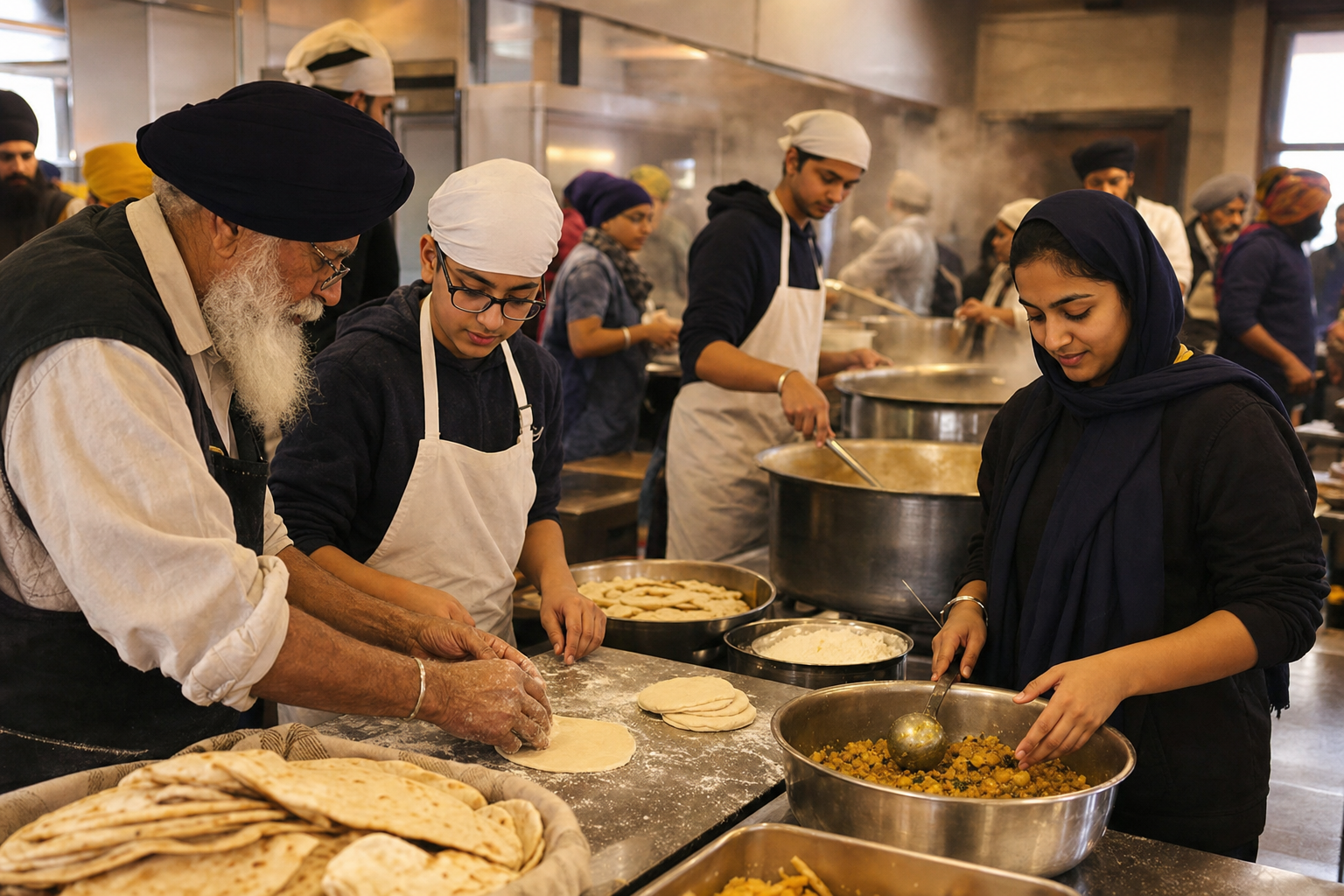
The Punjab article expands the embodied principle into collective institutions. It describes gurdwaras as places of prayer, kirtan, langar, learning, memory and equality. The Harmandir Sahib in Amritsar is presented not only as a revered destination but also as a public demonstration of seva through langar. Gurmukhi, shabad and kirtan further show how language and sound carry identity across generations. The Punjab overview and the Nihang study thus agree that Sikh distinctiveness is not a decorative boundary around belief. It is a structured way of making responsibility visible.
Sacred geography connects worship, history and belonging
Punjab’s importance in the sources is geographical, devotional and institutional at once. The Punjab article traces a sacred landscape through places associated with the Gurus, including Kartarpur, Goindwal, Amritsar, Tarn Taran and Anandpur Sahib. It also places Sikh development within the agrarian world of fields, villages, seasonal work and communal food. This setting helps explain why honest labour, shared responsibility and the gurdwara became social realities rather than abstract ideals.
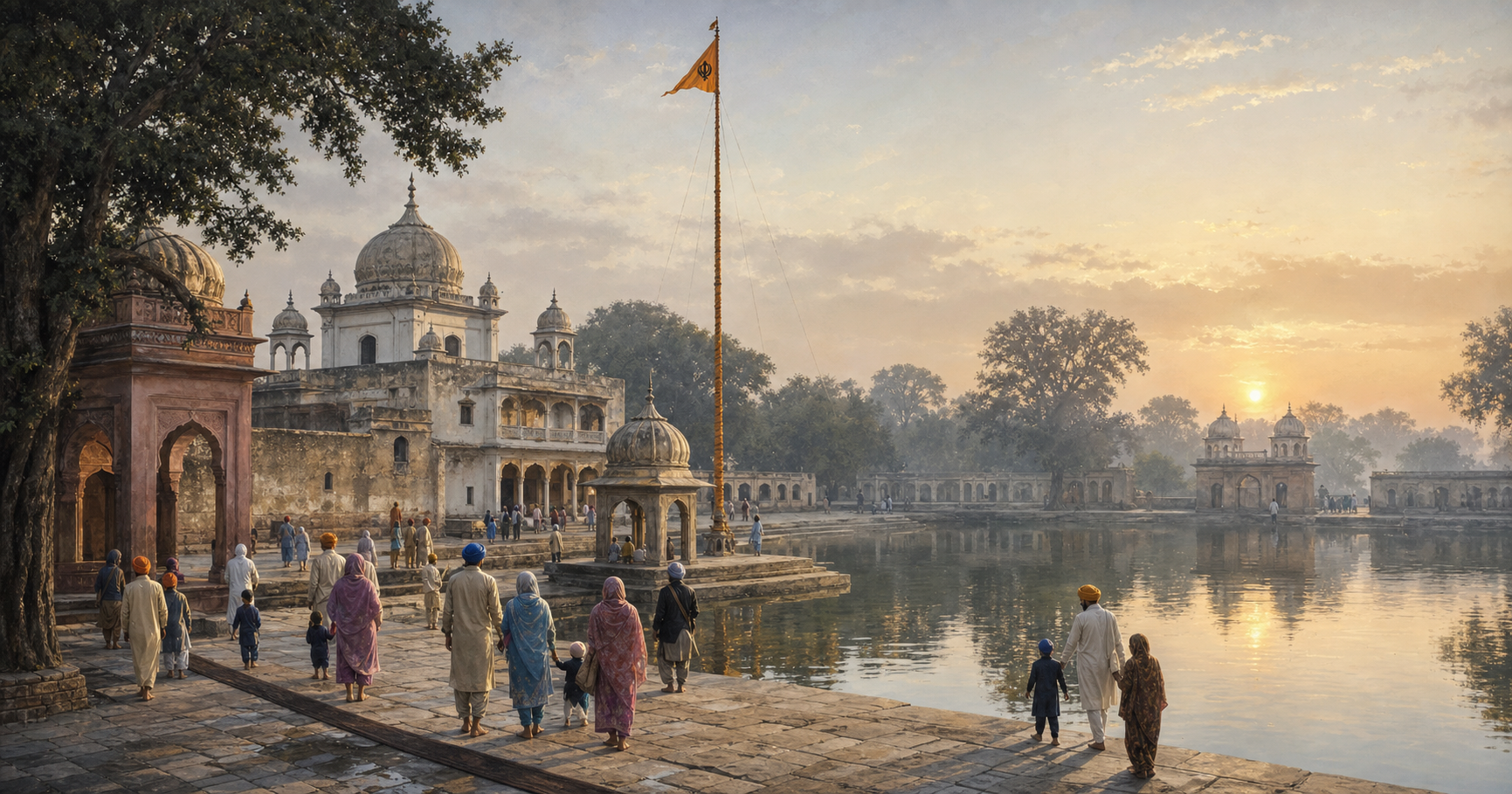
Yet Sikh sacred geography extends across modern political borders. The article about Gurdwara Sri Guru Singh Sabha Sahib reports an alleged demolition in Farooqabad, also identified there as Mandi Chuharkana, in Pakistan. According to that source, the 125-year-old shrine stood near Gurdwara Sacha Sauda and was connected to the wider history of Sikh organization before Partition. The source further reports an association with Singh Sabha memory, noting that the reform movement began in Amritsar in 1873 and was formally established in Lahore in 1879.
These reported associations give the dispute significance beyond the condition of one structure. A historic gurdwara can retain inscriptions, architectural evidence, local memory and links to communities separated from ancestral landscapes. Demolition can therefore remove evidence that reconstruction cannot fully reproduce. A new building may restore space for use, but it does not automatically recover original materials, inscriptions or the accumulated relationship between a place and those who remember it.
The Farooqabad article reports that unidentified persons allegedly carried out the demolition during the night of June 24-25, 2026. It says India’s Ministry of External Affairs characterized the episode as targeted vandalism and sought a prompt investigation, accountability and restoration. The same source reports that Ramesh Singh Arora, Punjab’s provincial minister for minority affairs and president of the Pakistan Sikh Gurdwara Prabandhak Committee, acknowledged that part of the site had been demolished and promised reconstruction and action concerning alleged land-mafia involvement.
Those details should be read with the uncertainty preserved by the source. The supplied material does not independently establish who carried out or authorized the demolition. It also presents competing accounts of the building’s earlier condition: Arora reportedly said it had been closed because it was dilapidated, while activists and local Sikh voices alleged that important architecture had remained intact until recent years. This disagreement strengthens the case for a documented conservation assessment rather than supporting an unqualified conclusion about the site’s prior safety.
The episode exposes a broader relationship between heritage and religious liberty. A community’s freedom can be weakened even when personal belief is nominally permitted if its places of assembly deteriorate, its land is insecure, or its historic evidence disappears. Conversely, treating minority shrines as part of a country’s shared heritage can align preservation with equal citizenship rather than portraying it as a concession to an isolated group. The specific claims and official responses are reported in the article on the Farooqabad gurdwara.
Protection must unite transmission, access and accountability
The sources collectively suggest that Sikh religious freedom operates as an ecosystem. Its first requirement is transmission: children need language, stories, music, trustworthy guidance and room to respond in their own voices. Its second is lived access: individuals must be able to practise remembrance, service and visible discipline, while congregations require functioning spaces in which those commitments can become communal. Its third is continuity: historic buildings, inscriptions, land records and oral memories need documentation before damage makes recovery impossible.
Accountability joins these elements when a site is threatened or harmed. In the reported Farooqabad case, rebuilding alone would address only physical utility. The source argues for an investigation into the sequence of events, identification of responsible actors, preservation of remaining evidence, review of possible official failures and consultation with Sikh representatives. It also emphasizes the custodial role attributed to the Evacuee Trust Property Board, including active maintenance, heritage mapping, boundary protection and transparent oversight rather than reliance on ownership records alone.
The same logic applies before a crisis. Heritage protection is strongest when communities and institutions know what exists, why it matters, who is responsible for it and what lawful process applies if a structure becomes unsafe. Dilapidation, underuse and conservation are different conditions; none should be allowed to merge into administrative ambiguity. Documentation and technical assessment can protect both public safety and the integrity of a contested site.
The articles also situate Sikh tradition in a wider Indic and Dharmic environment while insisting upon its distinct theology, scripture and institutions. Their most defensible model of civilizational relationship is neither isolation nor absorption. Shared concerns such as disciplined conduct, liberation from ego, compassion, service and reverence for sacred places can support cooperation, but meaningful solidarity requires differences to remain intelligible. Religious freedom protects that combination: the right to participate in a shared civic world without surrendering a tradition’s particular form.
Future resilience will depend on connecting these responsibilities before they are separated by crisis: youth expression with spiritual literacy, visible identity with civic understanding, and restoration promises with verifiable preservation. When those links are maintained, heritage remains a field of living participation rather than a record consulted only after loss.


References
- SikhNet – SikhNet Creative Competition 2026: A Powerful Summer Platform for Young Voices
- SikhNet – Living Awake Review: Guru Nanak’s Powerful Science of Inner Freedom
- Hindu Existence – India’s Alarm Over Razed Sikh Shrine in Pakistan: A Powerful Call for Justice
- SikhNet – Punjab’s Sikh Heartland: Powerful History, Sacred Geography, and Living Heritage
- SikhNet – Anatomy of a Nihang Singh: Powerful Symbols, Sacred Identity, Martial Legacy