

Arguments about Mughal rule concern more than the reputation of a medieval dynasty. They also raise questions about whose experiences enter public memory, how cultural achievement should be weighed against imperial coercion, and whether remembering historical injury can be separated from blaming communities in the present.
A useful approach must hold several truths in view at once: Mughal courts shaped parts of the subcontinent’s material culture, imperial power was not morally neutral, Bharatiya traditions retained memories that official narratives could neglect, and no living community should inherit collective guilt for a former regime.
What the dispute over Mughal memory is actually about
Historical study and civilizational memory perform related but different tasks. Historical study examines evidence about institutions, policies, conflicts, cultural production and social life. Civilizational memory asks how those experiences are transmitted through education, monuments, rituals, family narratives and sacred geography. Disagreement becomes especially intense when an empire occupies a prominent place in the first domain while conquered communities believe their experiences have been diminished in the second.
The supplied DharmaRenaissance article frames this problem through its criticism of The Economist’s reported treatment of the Mughal legacy. According to the article’s account, the publication expressed concern about India’s failure to commemorate a quincentenary of Mughal rule. Because the underlying Economist article was not included among the supplied materials, that characterization should be understood as the DharmaRenaissance article’s reported account rather than as an independently verified description.
The deeper issue raised by the source is nevertheless clear: studying an empire, conserving its monuments and acknowledging its influence are not the same as celebrating its conquest. A society can preserve an imperial archive without turning political subordination into an anniversary of gratitude. That distinction also clarifies why reducing attention to an imperial dynasty is not automatically historical erasure. It may represent an attempt to widen the field of remembrance, although any such correction must remain open to evidence and avoid replacing one selective narrative with another.
Cultural achievement and coercive power belong in one frame
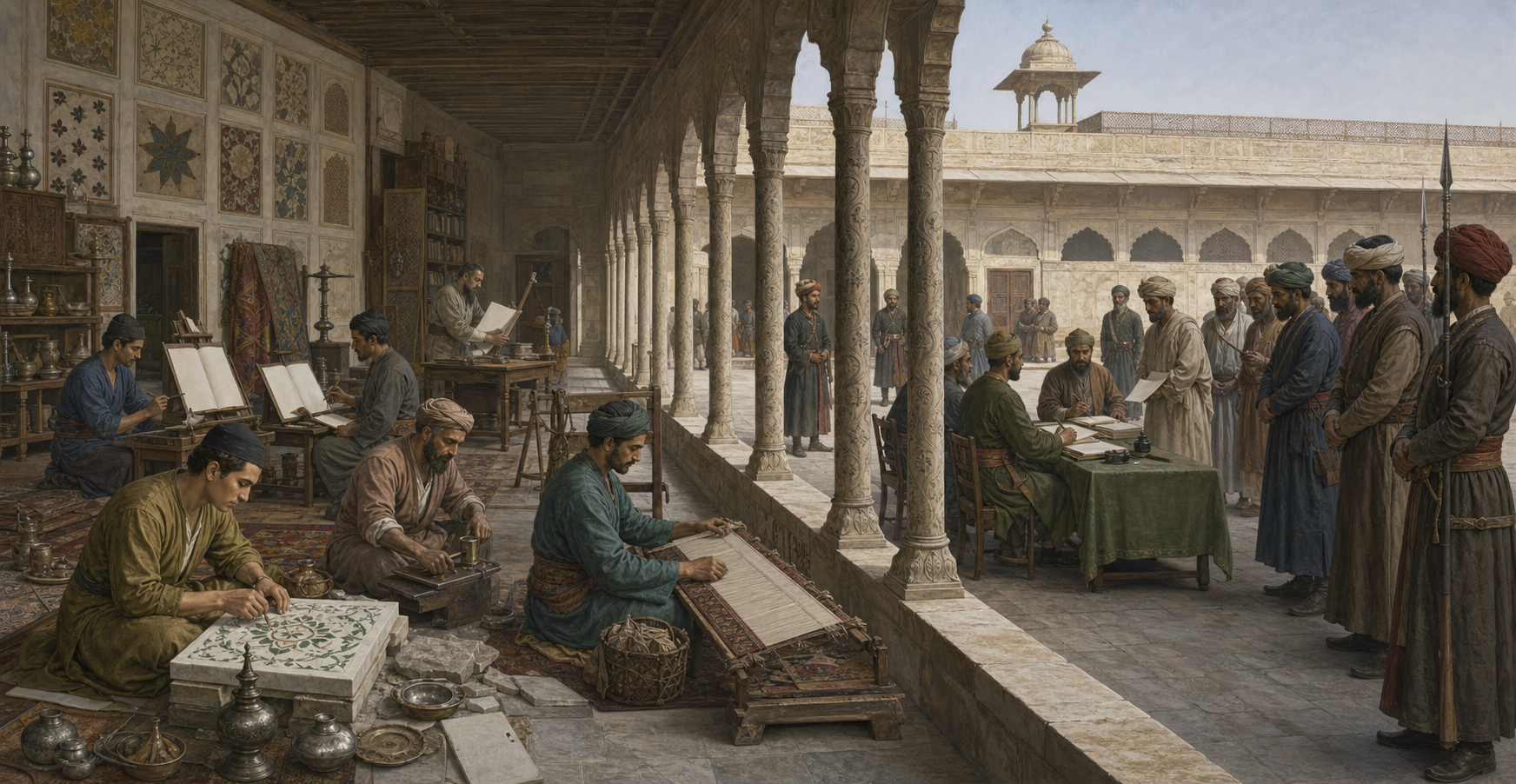
The source identifies architecture, cuisine, painting, language, music, textiles and administration as achievements commonly invoked in favorable accounts of Mughal rule. It does not argue that these influences should be denied. Its objection is to treating them as sufficient answers to questions about conquest, taxation, religious coercion, iconoclasm and the political subordination of indigenous institutions.
This suggests a more disciplined standard of judgment. Cultural production should neither absolve a regime of coercion nor be dismissed merely because it arose under imperial patronage. Objects, buildings and artistic forms can possess enduring value while the political order that sponsored them remains subject to moral scrutiny. Preservation need not imply veneration.
The same distinction helps interpret the idea of “Ganga-Jamuni Tehzeeb.” The source accepts that the term can describe linguistic exchange, shared artistic forms and everyday coexistence. It argues, however, that cultural mixture formed under unequal power cannot be understood exactly like exchange between politically equal communities. Both dimensions matter: hybridity may be socially real, while the conditions under which it developed may still include hierarchy and coercion.
Nor should “Mughal rule” be treated as a single, unchanging policy. The article calls for differentiating Babur’s conquests, Akbar’s experiments in statecraft and religion, Jahangir’s court culture, Shah Jahan’s monumental patronage and Aurangzeb’s long reign. In discussing Aurangzeb, it specifically identifies temple destruction, the reimposition of jizya, conflicts with Hindu rulers and actions against Sikh Gurus as matters that a polished narrative of courtly refinement must not marginalize. The broader methodological point is sound: comparison among rulers is necessary, but differentiation must not become a device for excluding difficult evidence.
Sacred institutions carry more than architectural value
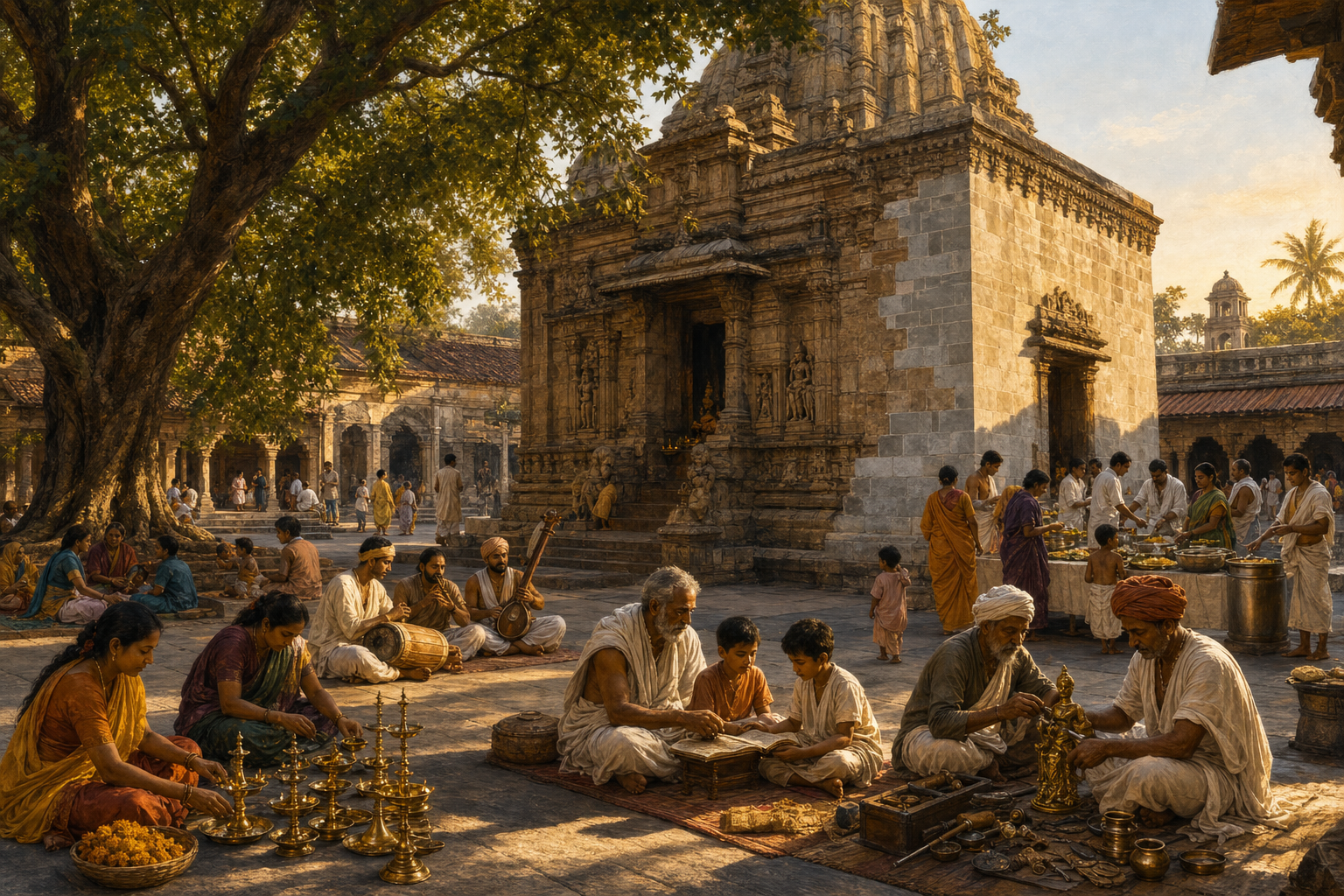
The meaning assigned to temple destruction depends partly on what a temple is understood to be. The supplied article presents temples not merely as buildings used for worship but as institutions connected with learning, artistic practice, charity, land management, communal gathering and local sovereignty. On that account, an attack on a temple could injure a community’s political standing, social infrastructure and sacred world at the same time.
The source extends this civilizational perspective beyond Hindu temples to monasteries, gurudwaras, Jain temples, pilgrimage centers and sacred libraries. That extension is important because it prevents memory from becoming narrowly sectarian. It treats harm to the institutions of one Dharmic tradition as damage to a wider ecology of learning, worship and inherited belonging.
Ram Janmabhoomi appears in the article as an example of memory surviving beyond official recognition. The source describes the site through devotional continuity, legal contestation and archaeological inquiry, and interprets its judicial resolution as restoring public legitimacy to a sacred memory. That interpretation is the source’s stated perspective. Its broader relevance is that communities may preserve a sense of historical injury through practices and places even when educational or administrative institutions do not give that memory equal weight.
Such memory still requires careful handling. Sacred attachment can explain why an issue remains alive without determining every historical or legal question by itself. Evidence, worship, law and public policy operate according to different standards. Responsible remembrance acknowledges their interaction while resisting the temptation to use inherited pain as permission for present-day hostility.
A practical standard for education and public history
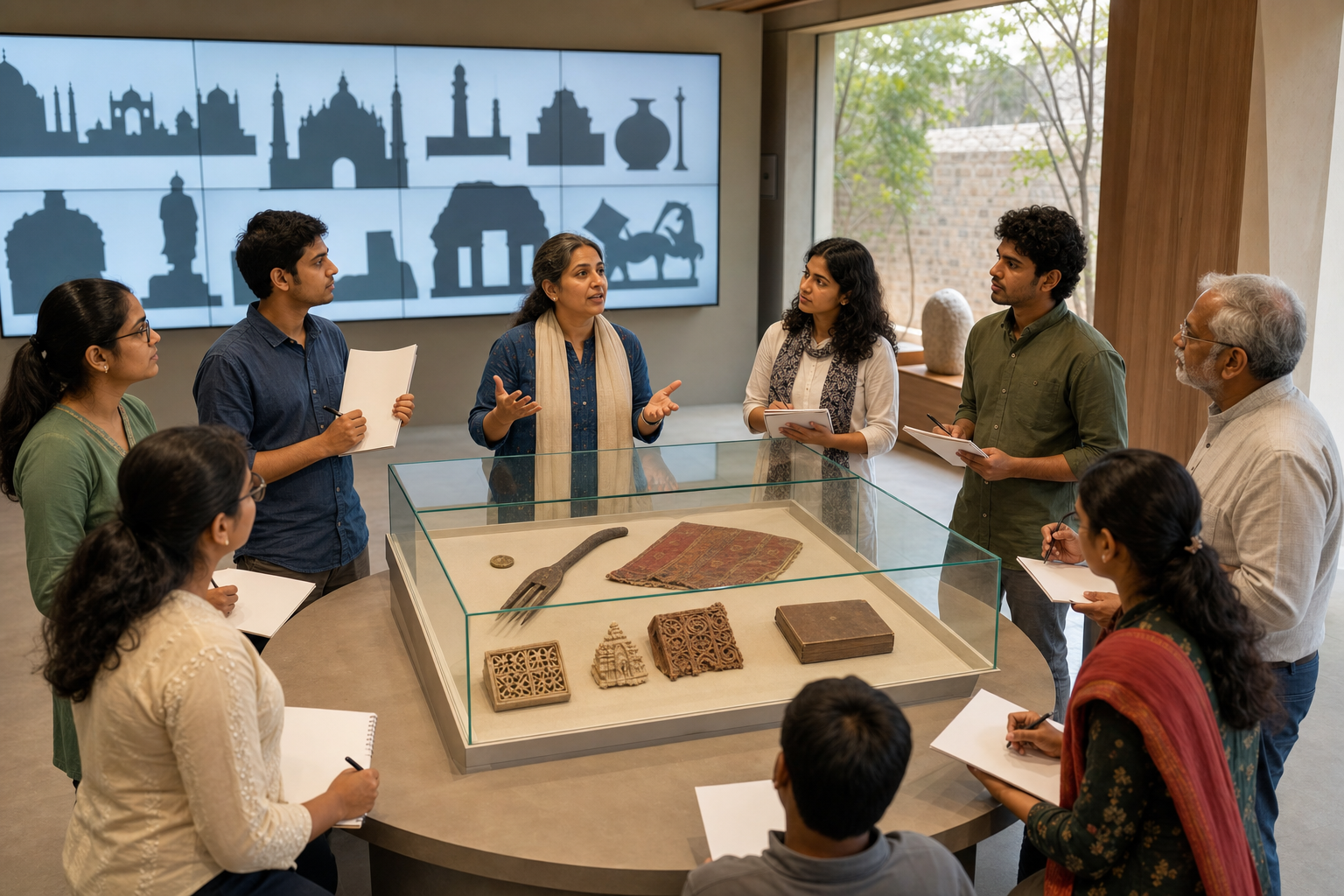
The source emphasizes that historical memory is formed through textbooks, school visits, museums, monuments, films and television as well as through scholarship. Its concern is that repeated emphasis on Mughal courtly refinement, combined with limited treatment of older and regional civilizations, may give students a distorted understanding of where Bharat’s intellectual, artistic and spiritual histories begin.
In that context, the article interprets renewed attention to the Cholas, Guptas, Vijayanagara, Marathas, Ahilyabai Holkar, Maharana Pratap, Guru Gobind Singh, Nalanda and major sacred centers as a redistribution of historical attention rather than an erasure of Mughal history. That claim offers a useful test for curriculum reform: revision broadens understanding when it adds neglected evidence, regions and experiences; it becomes another distortion if it simply exchanges imperial romanticism for indiscriminate counter-glorification.
A balanced curriculum would therefore examine administration and cultural production alongside military campaigns, religious policy, regional resistance, economic change and the experiences of ordinary communities. It would also make its interpretive choices visible. Students should be able to distinguish an archival claim from a moral judgment, a ruler from a population, and cultural influence from political legitimacy.
Key takeaways
- Preserving Mughal monuments and studying imperial institutions do not require celebrating conquest.
- Courtly art, architecture and cultural exchange should be examined together with coercive policies and unequal power.
- Individual rulers, periods and policies require differentiation, but difficult evidence should not be minimized for the sake of a harmonious narrative.
- Expanding attention to Bharatiya kingdoms, sacred institutions and resistance traditions is corrective only when it increases historical completeness.
- Responsibility belongs to documented actors and regimes; it must not be transferred to present-day religious communities.
From competing nostalgia to accountable remembrance
The most consequential principle in the supplied article is its explicit separation of medieval regimes from present-day Indian Muslims. It rejects assigning ordinary families responsibility for the deeds of former rulers and distinguishes living neighbors, religious practice and imperial state power. That boundary is essential if civilizational memory is to support historical understanding rather than collective suspicion.
The same ethical discipline should apply in the other direction. Concern for social peace should not require silence about conquest, religious humiliation or damage to sacred institutions. Historical clarity and civic responsibility are not competing goals when claims are attributed carefully, rulers are differentiated, evidence remains open to scrutiny and descendants are not treated as proxies for empires.
Future scholarship, museums and curricula can move the debate forward by widening the archive instead of policing which memories may be voiced. A mature civilizational memory should be capable of conserving monuments without venerating empire, teaching cultural exchange without concealing unequal power, and acknowledging inherited wounds without manufacturing inherited guilt.