
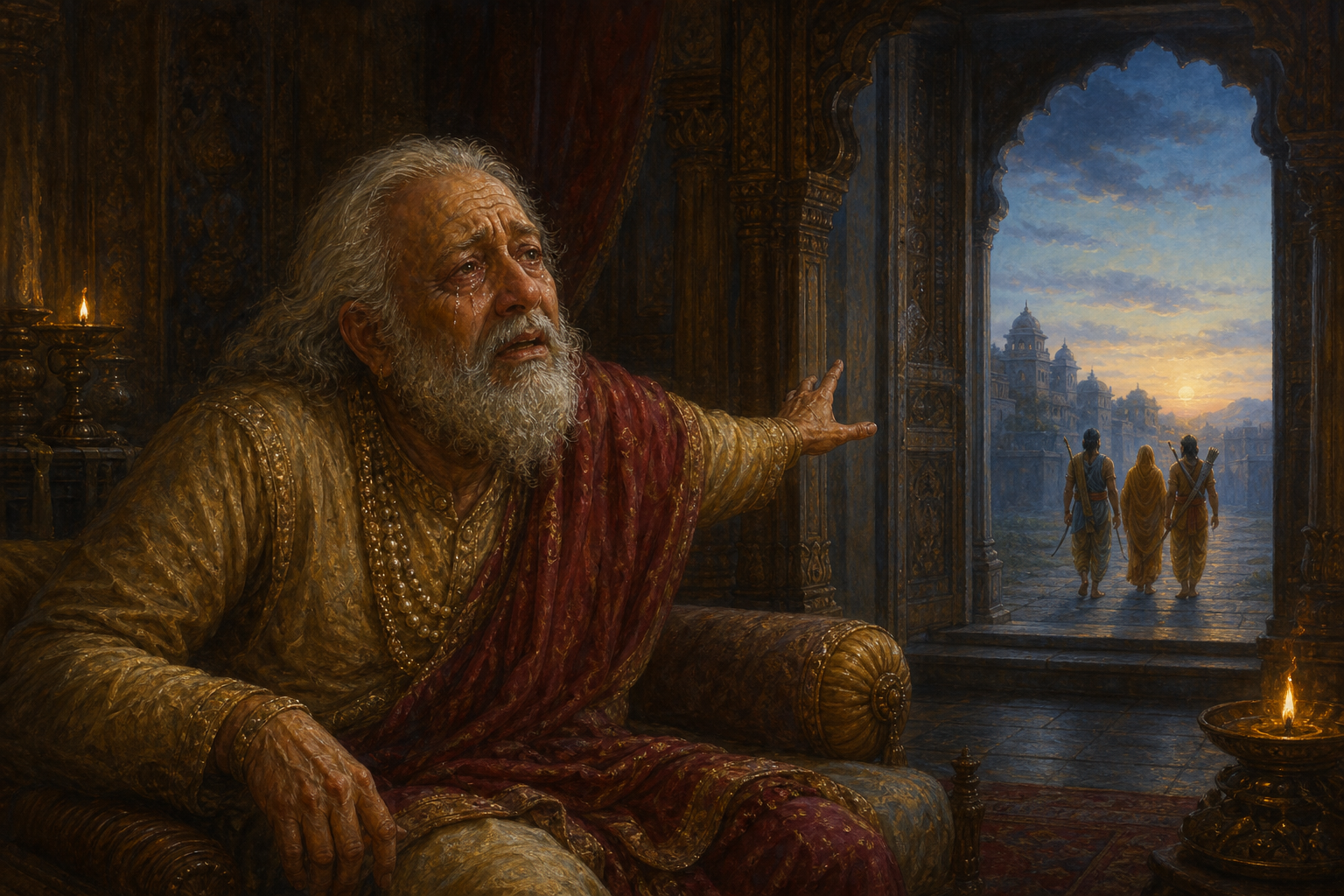
The Kashmiri telling of Rama’s exile sharpens Dasharatha’s response into a striking image: grief so consuming that the king’s tears deprive him of sight. As presented by DharmaRenaissance, this detail gathers the story’s central pressures – promise, paternal love, royal authority and karma – into a single bodily crisis.
Reading the blindness alongside Kaikeyi’s demands, Rama’s composure and the earlier death of Shravana Kumara clarifies why the episode is more than a dramatic feature of regional storytelling. It asks how suffering should be understood when duty remains binding, love is genuine and consequences emerge from an action long past.
A tragedy created by duties that cannot all be satisfied
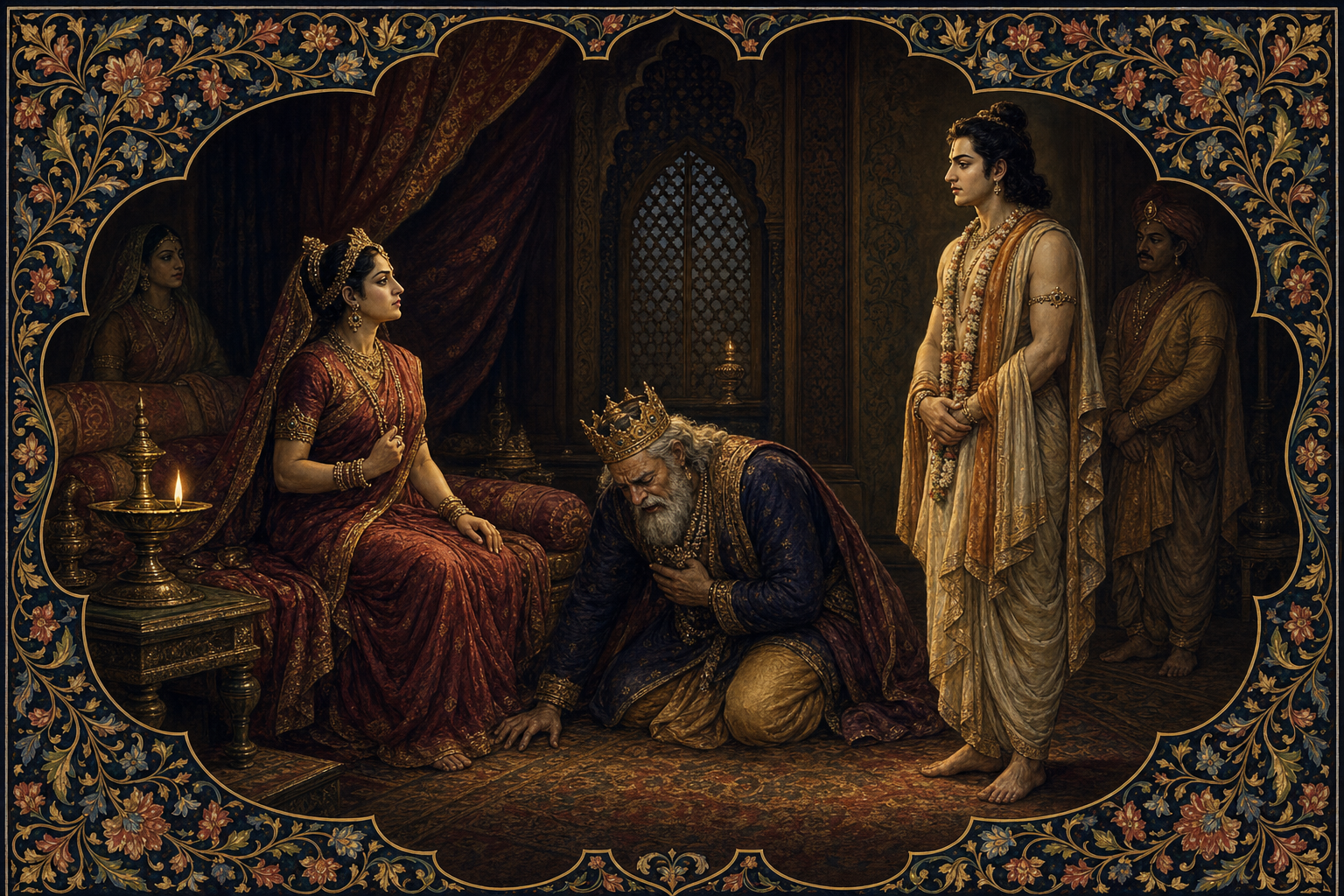
The immediate crisis begins with the boons Dasharatha had granted Kaikeyi. According to the source article, she invokes them to demand Rama’s exile and Bharata’s installation as heir. Dasharatha cannot simply withdraw his word without compromising the royal commitment on which his authority rests, yet fulfilling it means losing the presence of the son he most deeply loves.
This makes the episode a collision of legitimate obligations rather than a simple contest between affection and cruelty. Truthfulness requires the king to honor his promise. Parental love makes its consequence almost unbearable. Kingship gives him enormous worldly power but no moral exemption from the word he has given. His authority cannot release him from the very standard that makes authority trustworthy.
The Kashmiri emphasis on Dasharatha’s collapse places the cost of this collision at the center. Dharma does not guarantee emotional comfort, and knowing one’s duty does not automatically produce the inner steadiness needed to carry it. Dasharatha recognizes the force of his obligation, but recognition and readiness are not the same. The episode therefore presents moral understanding as incomplete unless it is supported by disciplined perception and emotional resilience.
Why tears become blindness
In the source’s reading, Dasharatha’s blindness gives visible form to an inward loss of orientation. His grief is no longer only an emotion; it overtakes the faculty through which he encounters the world. The king cannot bear to see Rama leave, and his eyes cease to provide sight. The body thus expresses what the mind cannot reconcile.
The image also carries a political meaning. A ruler is expected to perceive circumstances clearly, weigh competing obligations and preserve order. Dasharatha can command a kingdom, but he cannot command the conditions created by his promise. When tears obscure his vision, royal power is shown to have a limit: it cannot substitute for discernment, reverse an obligation or insulate its holder from sorrow.
The article further relates physical sight to the wider Indic association between seeing and understanding. On that interpretive level, blindness signifies more than the failure of the eyes. It suggests consciousness clouded by attachment. This does not make Dasharatha’s love false or his grief contemptible. It distinguishes compassionate sorrow from a form of dependence in which separation makes the world itself seem impossible to accept.
That distinction matters because the episode does not condemn feeling. Its concern is what happens when feeling overwhelms the capacity to remain aligned with reality and duty. Dasharatha’s tears command compassion precisely because they reveal both the depth of his love and the vulnerability produced by his attachment.
The Shravana episode gives grief a karmic history
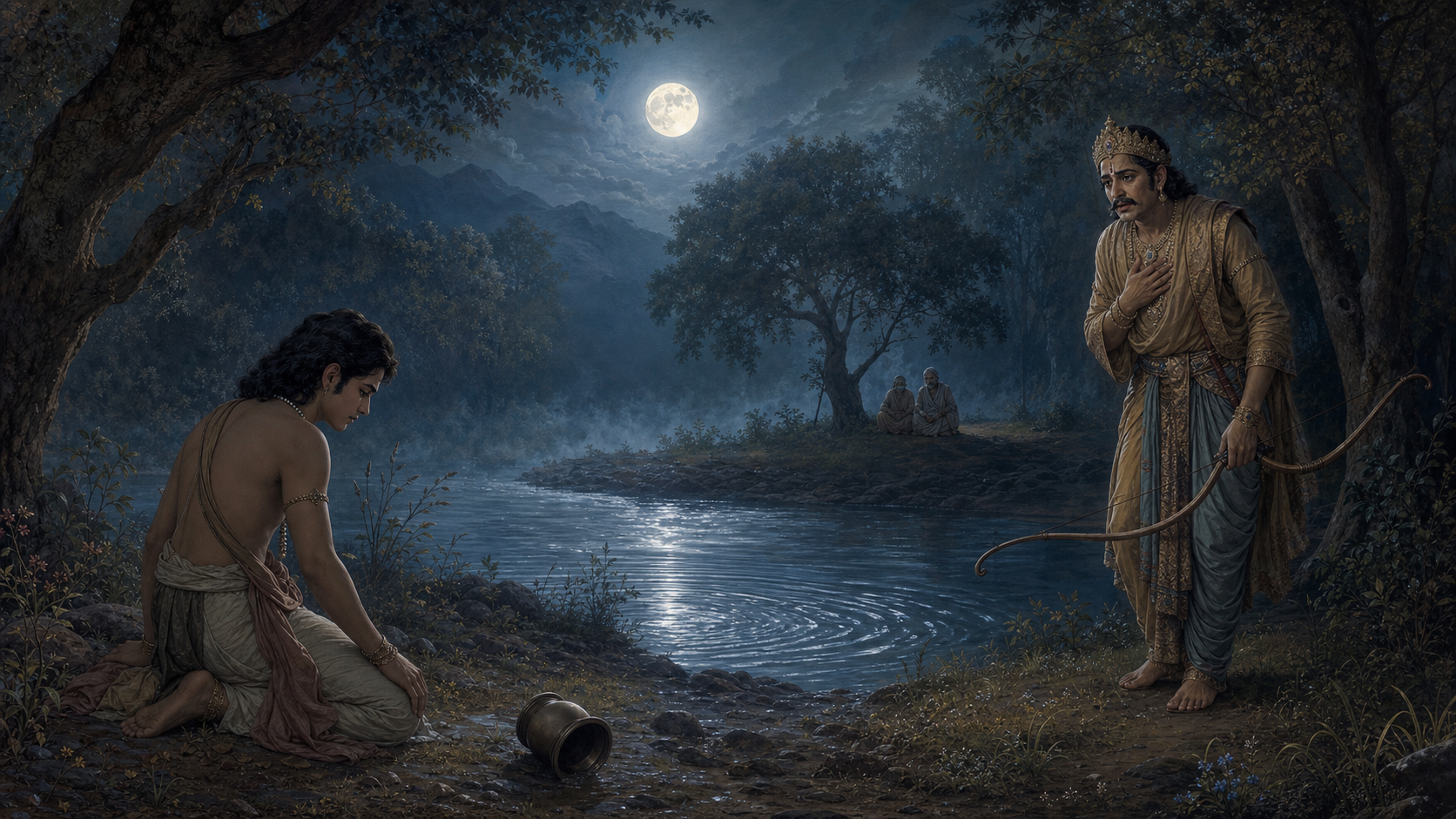
Kaikeyi’s demands explain the occasion of Dasharatha’s suffering, but the earlier story of Shravana Kumara supplies its karmic horizon. The DharmaRenaissance article recounts the tradition in which Dasharatha, while hunting, mistakes the sound of water for an animal and accidentally kills Shravana. The young man’s blind parents, devastated by the loss of their devoted son, curse Dasharatha to die in grief caused by separation from his own son.
The later exile consequently does not appear as an isolated misfortune. Dasharatha once brought bereavement to parents who could not see; he later suffers a separation that is itself associated with the loss of sight. The correspondence between the two episodes makes blindness part of the story’s moral architecture rather than an incidental symptom.
This structure also clarifies how the article understands karma. Dasharatha did not intend to kill Shravana, but the absence of malicious intent did not undo the death or the parents’ anguish. Intention remains ethically important, yet consequences also belong to the moral significance of an act. Karma, in this reading, preserves continuity between harm caused and suffering eventually encountered without reducing that continuity to crude revenge.
The distinction guards against two opposite errors. One would treat every painful event as arbitrary, disconnected from prior action. The other would treat suffering as proof that its recipient deserves contempt. Dasharatha fits neither view. He bears a consequence related to an earlier act, but the narrative still presents him as a dignified and tragic person whose present love and pain are real. Accountability does not require the erasure of compassion.
Rama and Dasharatha embody different responses to necessity
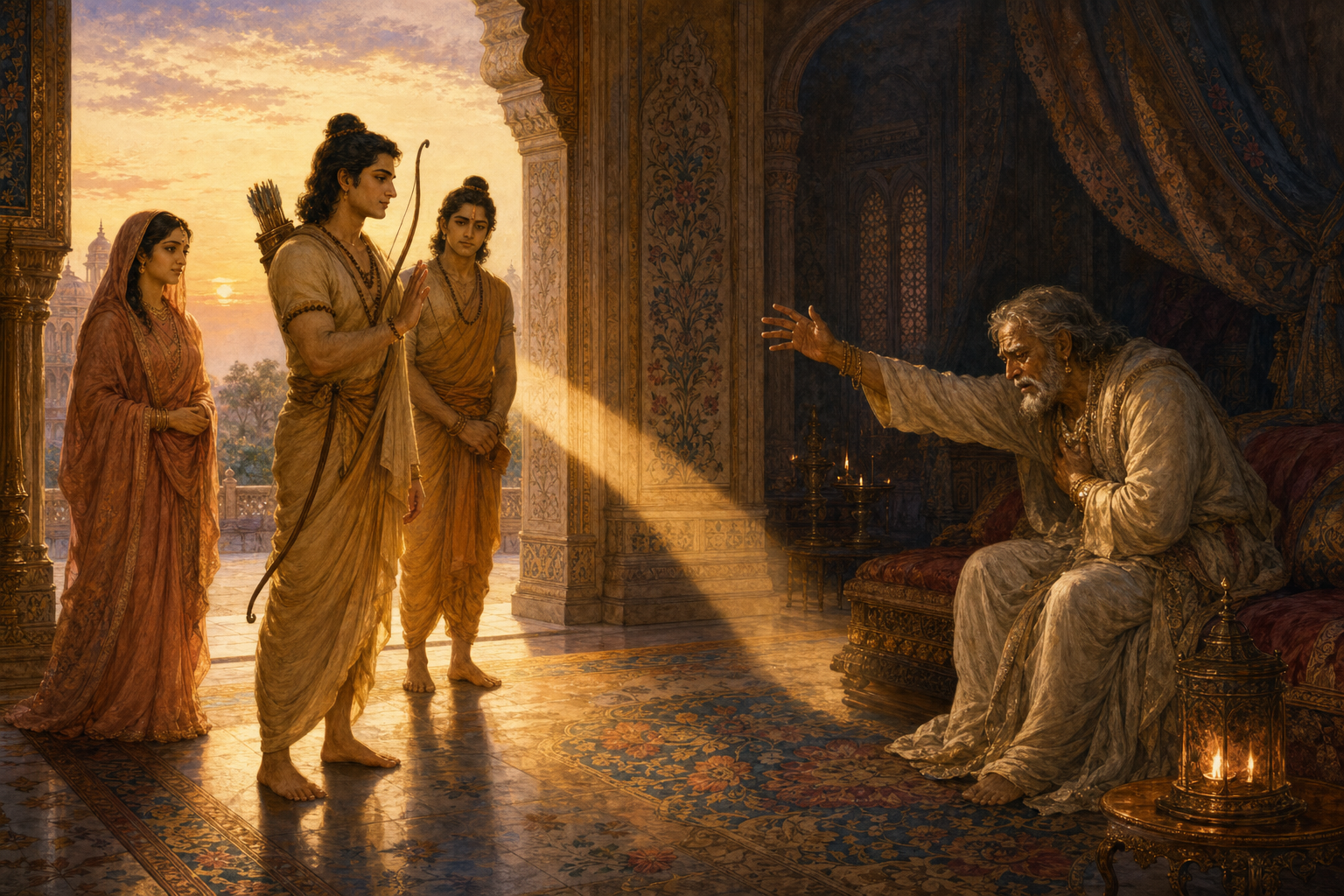
The contrast between father and son completes the episode’s ethical design. As the source describes it, Rama accepts exile without resentment, public accusation or an attempt to humiliate Kaikeyi. Dasharatha, meanwhile, knows that his promise binds him but cannot emotionally endure its result. Both confront the same event, yet only Rama retains the freedom to act without being governed by resistance to what duty requires.
Rama’s composure should not be confused with emotional coldness. His response represents love ordered by dharma: he honors his father even when that honor leads away from palace and family. Dasharatha’s response represents love entangled with the need to retain its object. The comparison is therefore not between feeling and its absence, but between feeling that can accompany right action and attachment that makes right action feel like personal annihilation.
Karma and dharma meet at this point without becoming interchangeable. Karma gives the present crisis a history: Dasharatha encounters consequences connected to the suffering of Shravana’s parents. Dharma concerns the action demanded now: the royal promise must be honored, and Rama chooses to uphold it. The past shapes the field of action, but the characters are still revealed through the manner in which they respond.
The Kashmiri episode consequently offers a demanding account of freedom. Freedom is not the power to cancel every painful condition. It is the capacity to meet conditions without surrendering discernment. Dasharatha possesses the greater formal authority, while Rama displays the greater inward liberty.
Key takeaways
- Dasharatha’s tears unite psychology and ethics: sorrow becomes a loss of the vision needed for judgment and rule.
- Kaikeyi’s demands trigger the exile, while the death of Shravana Kumara gives Dasharatha’s suffering its karmic background.
- The episode treats intention and consequence together: an unintended act can still create harm that remains morally significant.
- The contrast with Rama distinguishes disciplined love from attachment that seeks escape from an unavoidable duty.
- Karmic accountability and compassion coexist; Dasharatha is neither excused from consequence nor reduced to his past error.
The episode’s continuing value lies in the discipline it asks readers to cultivate before crisis arrives. Promises, attachments and unresolved consequences become easier to face when discernment is strengthened while the eyes are still clear.