
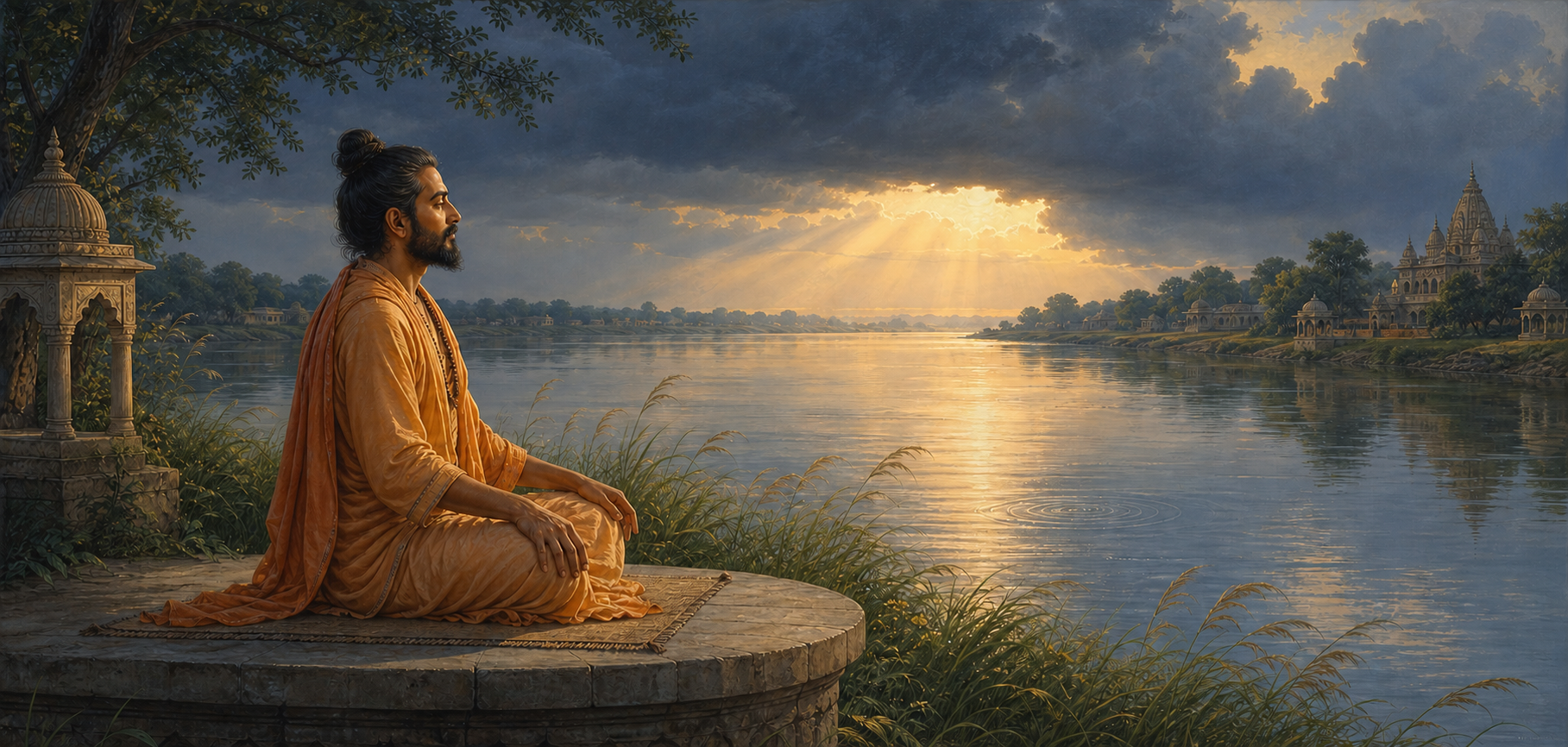
Hindu wisdom presents inner steadiness not as emotional numbness, social withdrawal, or control over every circumstance, but as the capacity to remain ethically and spiritually oriented when circumstances become unstable. The accounts of Rama’s exile and the Yoga Vasishta’s inquiry into belonging illuminate two sides of this discipline: governing one’s response to an external crisis and ceasing to make inner security dependent on the external world.
Read together, these perspectives offer a practical understanding of self-mastery. A steady person does not stop feeling grief, anger, loneliness, or disappointment. Instead, such feelings are prevented from becoming unquestioned authorities over identity, speech, and action.
Two movements of inner sovereignty
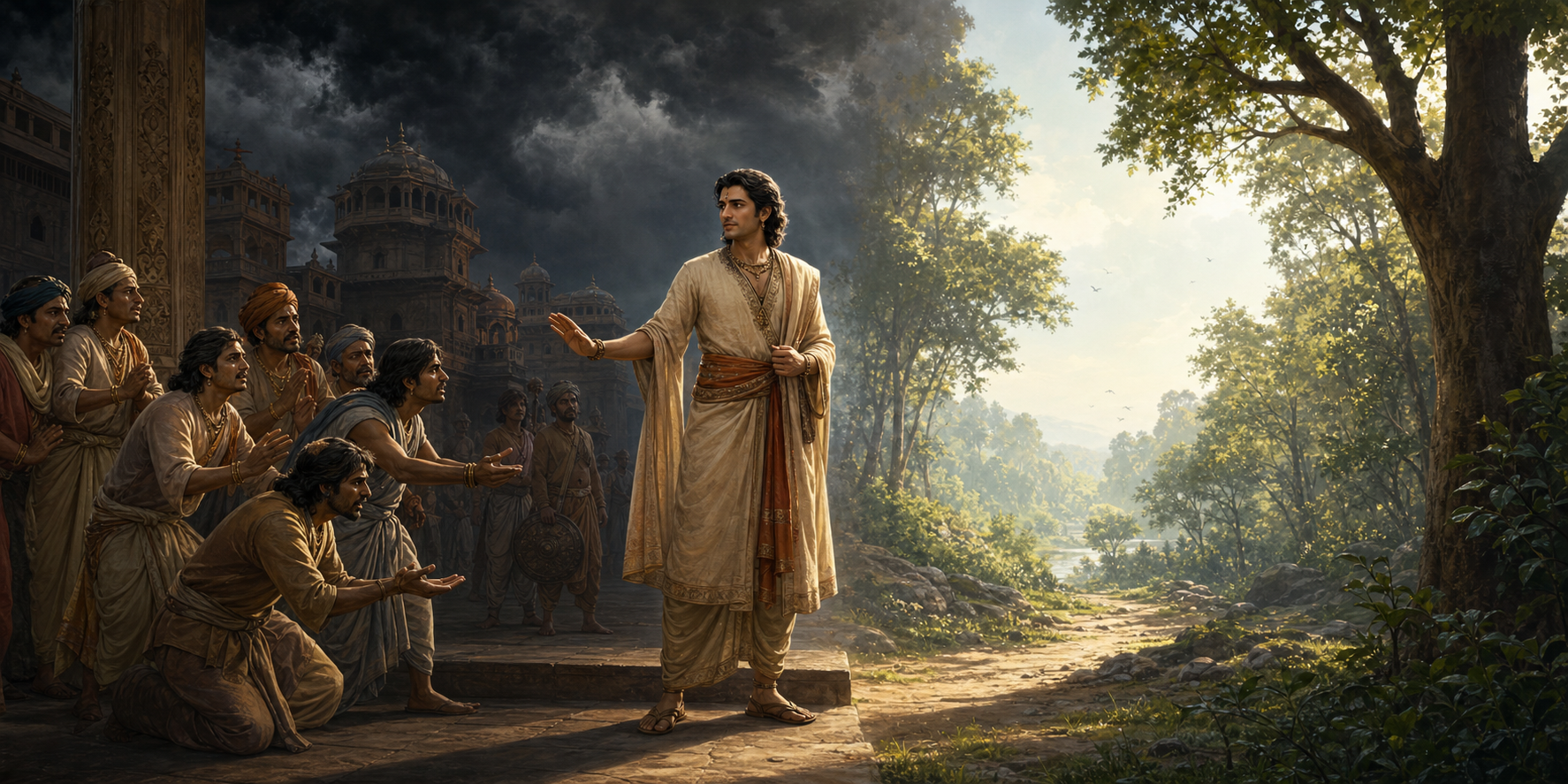
The article on Rama’s departure from Ayodhya examines steadiness in the face of an imposed loss. Rama is prepared for coronation, but King Dasharatha’s earlier promises to Kaikeyi result in a fourteen-year exile and the installation of Bharata as heir. According to the source’s reading of the Valmiki Ramayana, Rama understands the cost of this reversal yet refuses to turn personal injury into political or familial disorder. His attention remains fixed on preserving his father’s word and acting according to dharma.
The Yoga Vasishta article addresses a quieter but equally consequential instability: the feeling that identity and belonging depend on approval, status, community, place, or recognition. It argues that relationships and social participation have genuine value, but cannot bear the entire weight of spiritual identity. If a person’s sense of self expands with praise and contracts with rejection, external conditions still govern the inner life.
These are complementary movements rather than competing ideals. Rama’s example concerns disciplined action within relationship and duty; the Yoga Vasishta discussion concerns inquiry into the mind’s attachment to changing supports. The first asks, “What is the right action when life becomes painful?” The second asks, “What within the mind makes changing circumstances capable of defining the self?” Self-mastery requires attention to both questions.
Calm is moral clarity, not suppressed emotion
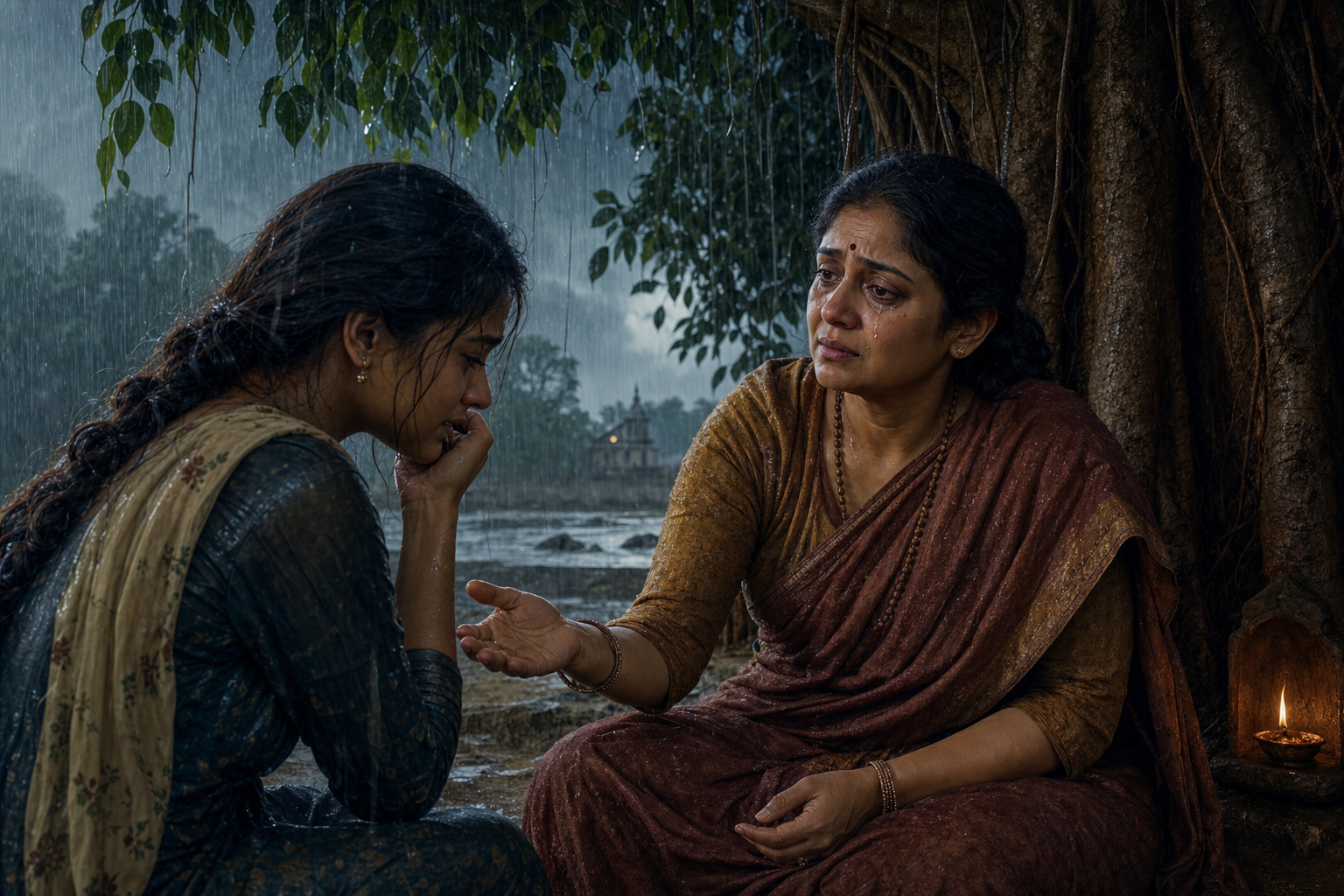
The account of Rama’s exile emphasizes that his composure should not be mistaken for coldness. He recognizes the grief of Dasharatha, Kausalya, Sita, Lakshmana, and Ayodhya’s citizens. What distinguishes him is not an absence of feeling but an unwillingness to let pain authorize adharma.
This distinction is central to a mature understanding of restraint. Suppression refuses to acknowledge an emotion; self-command acknowledges it without automatically obeying it. Passivity avoids responsible action; disciplined calm selects action according to a principle greater than immediate relief. Rama does not deny that Kaikeyi’s demand is harsh, but he also does not mobilize public affection, condemn her before the kingdom, or treat the throne as a possession that must be retained at any cost.
The source interprets this response as a form of self-governance involving clear moral judgment, regulation of anger, concern for social stability, and acceptance of exile as a field of duty. His restraint therefore has public consequences. In a palace filled with grief and indignation, one person’s refusal to intensify conflict helps prevent a family crisis from becoming a wider rupture.
This also refines the meaning of strength. Outward power can compel others, while inner sovereignty governs the impulse to retaliate, dramatize injury, or grasp at status. Rama loses immediate access to royal authority but retains authority over his conduct. In the source’s interpretation of maryada, ethical boundaries and rightful limits are not obstacles to greatness; honoring them is how greatness becomes visible.
Belonging becomes freer when it no longer defines the Self
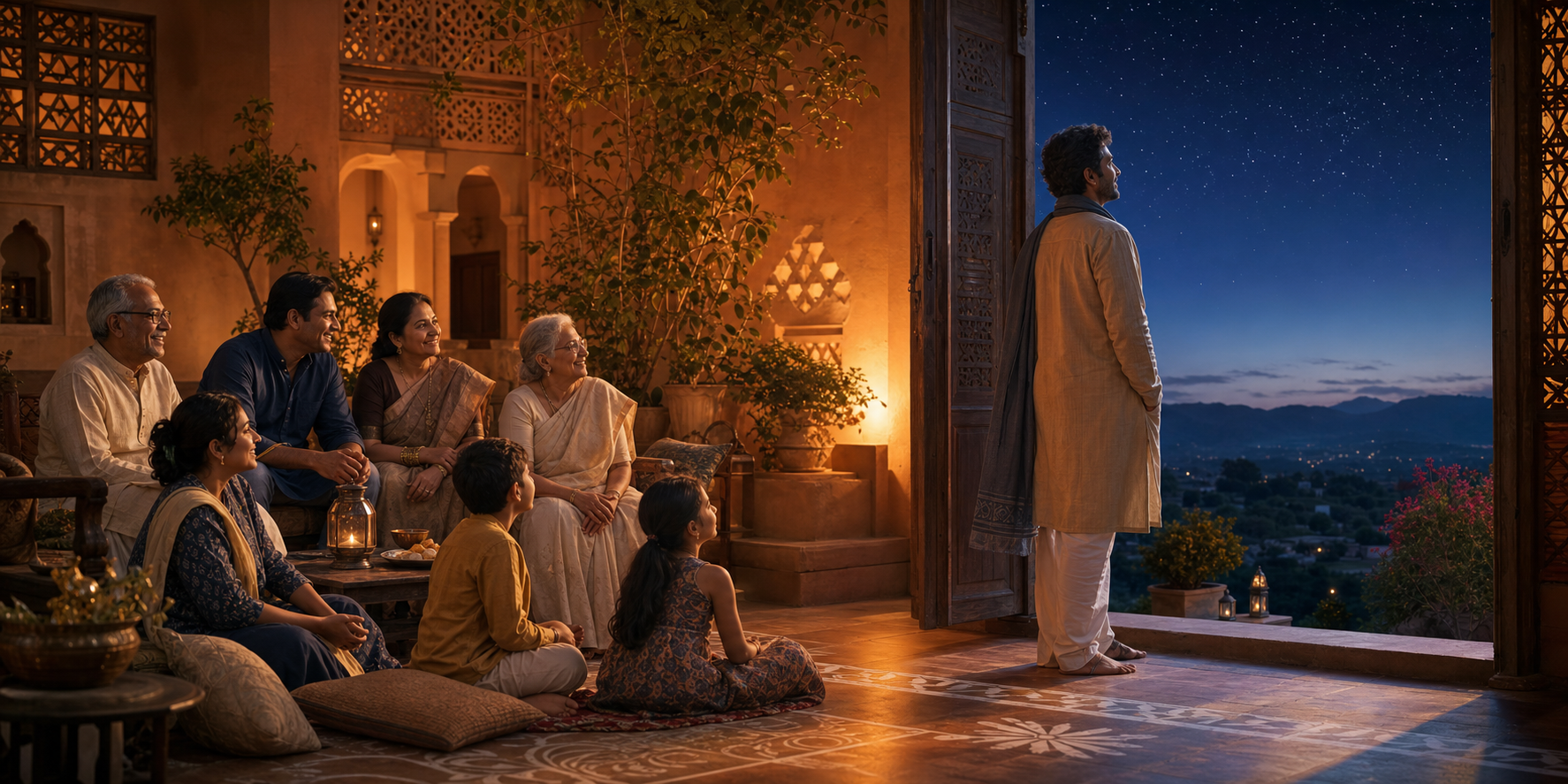
The Yoga Vasishta discussion approaches self-mastery through vichara, or disciplined inquiry, and vairagya, understood there as freedom from expecting transient conditions to provide permanent fulfilment. Its concern is not that family, community, profession, or spiritual fellowship are meaningless. The problem arises when participation becomes dependence: love is required to certify worth, a role must provide identity, or inclusion must silence every inner doubt.
According to the source, the mind can carry the same alienation through successive changes of city, career, circle, label, or spiritual affiliation. A new setting may briefly soothe insecurity without examining it. The unresolved pattern then returns because the sought-after “home” has been projected onto another changing condition.
The proposed inward turn is therefore diagnostic, not escapist. It asks what a person is demanding from approval, what self-image is threatened by exclusion, and which repeated narrative makes peace appear conditional. Recognizing a thought as a mental event creates space between experience and identity. Rejection may still hurt, but it need not become proof that the Self has been diminished.
This inward grounding can improve rather than weaken relationships. When another person or institution is no longer expected to supply permanent existential security, belonging can become participation without possession. The source connects this stability with greater patience, compassion, service, and respectful coexistence. Self-knowledge, in this account, does not culminate in an isolated ego; it loosens the insecurity that makes the ego defensive.
Key takeaways for practising steadiness
- Name the disturbance accurately. Separate the external event from the mind’s interpretation of it. Loss, criticism, exclusion, and disappointment are experiences; they do not automatically determine identity or duty.
- Identify the governing principle. Before reacting, ask which obligation, truth, or ethical boundary should guide conduct. Rama’s example shows how clarity about duty can organize a response amid conflicting emotions.
- Allow emotion without granting it command. Grief and anger can be acknowledged while harmful speech, retaliation, and impulsive decisions are restrained. This is regulation rather than denial.
- Examine the demand beneath attachment. When peace appears to depend on a role, community, or another person’s approval, inquiry can reveal what the mind expects that condition to prove.
- Return to responsible participation. Inner grounding is tested in conduct. Its fruits include steadier relationships, less reactive speech, ethical action, and the ability to serve without making status or validation the measure of the Self.
Steadiness must remain responsive to context

Neither source supports a simplistic command to endure every situation silently. Rama’s restraint is presented within a particular network of promises, familial obligations, royal responsibility, and concern for social order. The Yoga Vasishta discussion likewise describes discernment about mental dependence, not the dismissal of real suffering or the abandonment of community. Their shared lesson is that an impulse should be examined before it is elevated into a moral rule.
This guards against two distortions. One is using spirituality to avoid feeling, conflict, or necessary judgment. The other is treating every intense feeling as self-validating and every personal desire as a duty. Dharma requires discernment because outwardly similar acts can arise from very different motives: silence may express wisdom or fear, departure may express duty or avoidance, and detachment may express freedom or indifference.
The synthesis of the two teachings is therefore neither “control everything” nor “withdraw from everything.” It is to cultivate a center from which changing circumstances can be met without surrendering ethical clarity or spiritual identity. Continued practice begins wherever reaction is strongest: in the pause before speech, the inquiry beneath insecurity, and the next action chosen without making pain the master of conduct.
References
- DharmaRenaissance Blog – Rama’s Unshaken Exile: Powerful Lessons in Dharma, Restraint, and Inner Calm
- DharmaRenaissance Blog – Powerful Yoga Vasishta Wisdom for Finding True Belonging Within the Self