
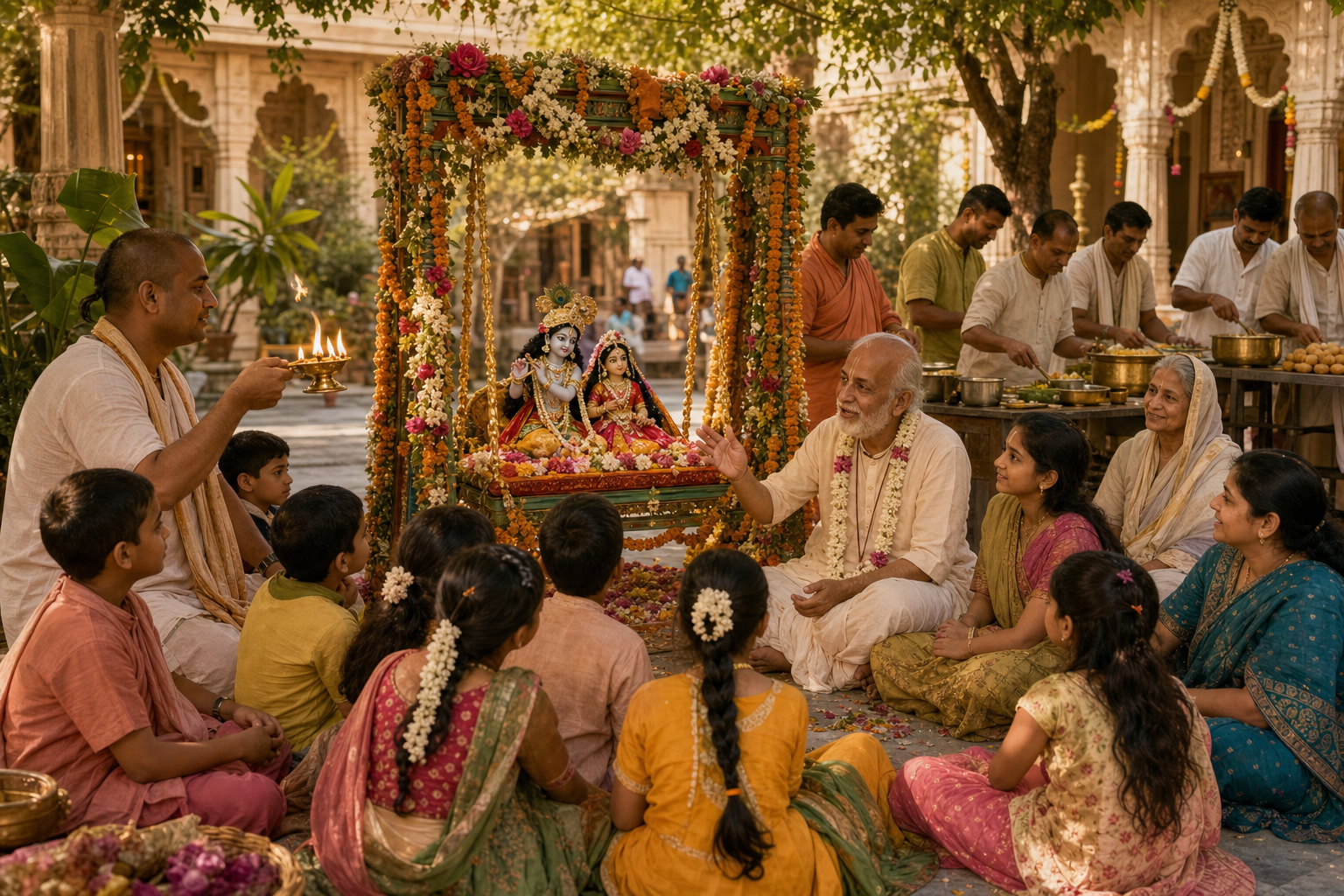
In Vaishnava communities, a festival can function simultaneously as worship, social gathering, ethical practice, and lesson. A decorated swing, a day of fasting, a Bhagavatam class, a shared feast, or a child’s turn at arati teaches through participation rather than explanation alone.
Read together, four reports on folk culture, Jhulan Yatra and Balarama Purnima, early Krishna Consciousness education, and Nirjala Ekadashi reveal a coherent educational model. Devotional knowledge becomes durable when the sacred calendar gives it rhythm, ritual gives it bodily form, teachers give it interpretation, and the community gives learners meaningful roles.
The sacred calendar provides a recurring curriculum
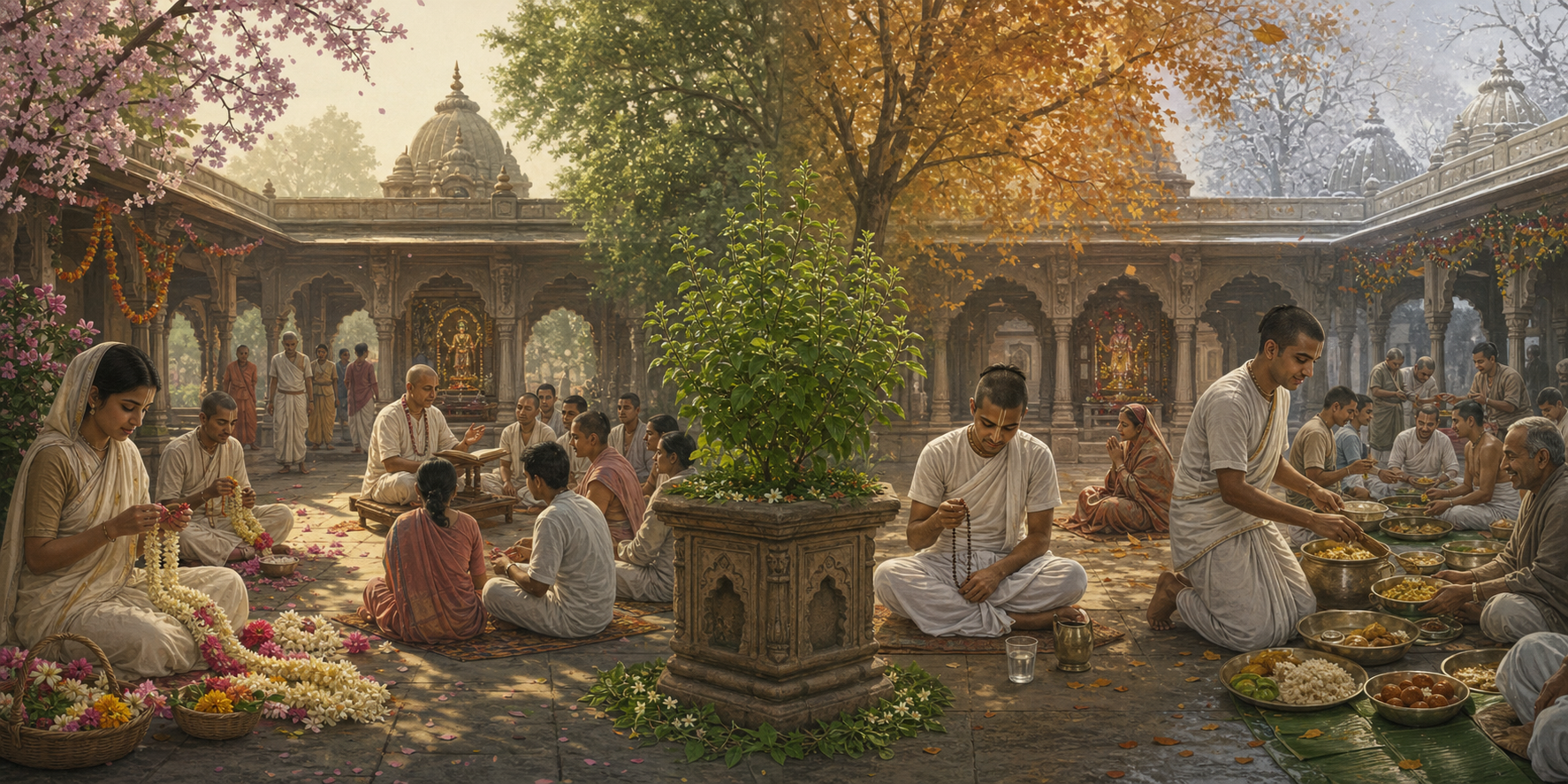
The report associated with Aniruddha Dasa explicitly acknowledges that its underlying program was not accessible beyond a title and thumbnail. It therefore offers a cautious interpretive framework rather than attributing unverified statements to the speaker. Within that framework, festivals are forms of public pedagogy: they bring theology, seasonal memory, music, food, service, and social responsibility into a shared setting.
The early-childhood education report supplies an institutional example of this approach. It describes a Faith and Nurture curriculum organized around Vaishnava celebrations and themes such as the Holy Name, Srila Prabhupada, Krishna, Chaitanya, Rama, the avatars, the Deities, and devotees. Instead of isolating religion in an occasional lesson, the calendar connects stories and practices to recurring periods of preparation, celebration, and remembrance.
The Nirjala Ekadashi report adds the importance of calendrical precision. It places the observance on an Ekadashi tithi in the waxing fortnight of Jyeshtha and notes that practice may involve preparation on Dashami and regulated breaking of the fast on Dwadashi. It also reports variations among lineages, regions, families, and temple calendars. Festival education therefore includes learning how sacred time is determined, not merely memorizing a civil date.
Repetition is central to this model. A recurring observance allows a beginner to encounter the outward form, a child to assume a simple role, and an experienced practitioner to revisit its theology. The curriculum grows with the participant even when the festival name remains the same.
Beauty, restraint, hearing, and service teach differently
The sources describe complementary modes of devotional learning. The Jhulan Yatra report presents the swing festival as a sensory and relational observance associated with Radha and Krishna. A decorated swing, flowers, lamps, offerings, kirtan, and devotional singing focus attention through movement, sound, fragrance, and beauty. These elements make participation accessible even to visitors who have not received extensive prior instruction.
Nirjala Ekadashi operates through a contrasting discipline. According to the report on Vraj Vihari dasa’s morning Bhagavatam class, fasting is intended to redirect attention from habitual consumption toward hearing, chanting, remembrance, worship, charity, and service. The report’s most useful educational distinction is that physical difficulty is not the goal by itself. A severe fast can foster pride if separated from humility, while a responsibly adapted observance can retain devotional meaning when health, age, climate, pregnancy, medical needs, or work make full abstention unsafe or inappropriate.
Scriptural hearing prevents austerity from becoming an unexplained test of endurance. The Nirjala account treats the morning Bhagavatam class as an oral and communal extension of scriptural study: bodily discipline creates space, while sacred hearing gives that space direction. Participants learn not only a rule but also the theological purpose that should govern it.
The Balarama Purnima report emphasizes another mode: strength expressed through service. It connects Lord Balarama with strength, protection, humility, and spiritual support, then locates those values in the work of cooks, singers, cleaners, organizers, and other volunteers. Its account of prasadam similarly interprets a shared feast as more than social refreshment. Offering, gratitude, distribution, and hospitality carry teaching from the altar into relationships among participants.
Together, these observances show why no single teaching method is sufficient. Jhulan Yatra educates through beauty and affectionate service; Ekadashi through restraint and attention; Bhagavatam class through hearing and interpretation; Balarama Purnima and prasadam through service and hospitality. Their shared subject is bhakti, but each engages a different human capacity.
Children learn devotion through relationship and imitation
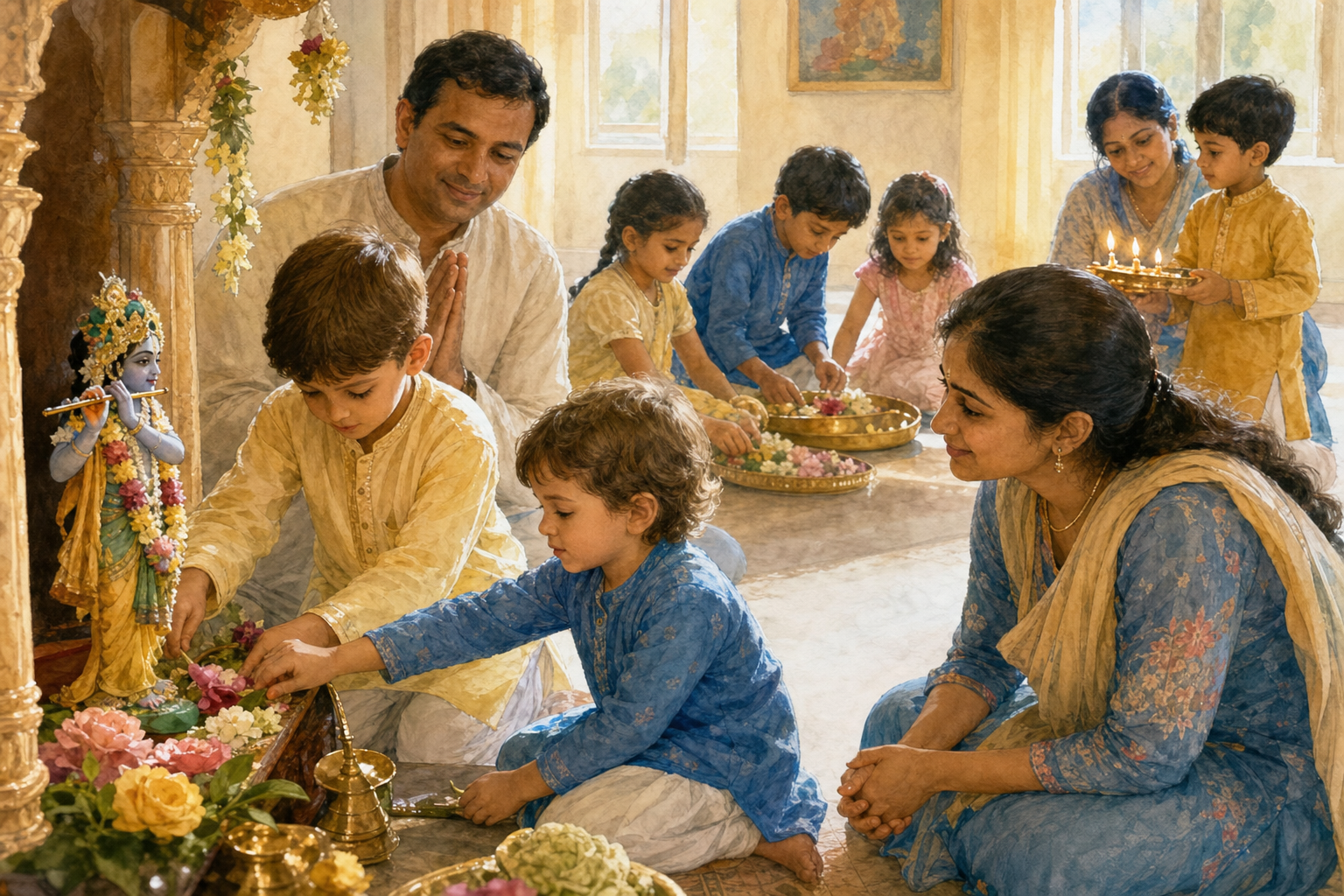
The early-education report argues that childhood devotion is meaningful in the present, not merely preparation for religious life in adulthood. Drawing on Srila Prabhupada’s discussion of devotee association in a purport to Srimad-Bhagavatam 3.25.25, it places responsibility on parents, teachers, and communities because young children cannot independently select the associations that shape them.
That responsibility changes the form of instruction. The report recommends the natural languages of childhood: play, song, story, rhythm, touch, repetition, imitation, and beauty. Pretend food offerings, the care of Radha-Krishna or Gaura-Nitai dolls, bowing, singing, and decorating can give children manageable forms of seva. The educational value lies not in demanding adult theological fluency, but in joining affection, action, and sacred meaning.
The Gurukula of Bhaktivedanta Manor is presented as a practical example. The report describes daily worship of classroom Deities, children taking turns with worship articles, simple instruction in acamana and arati, kirtan with devotional instruments, and visits to the Goshala. These activities connect devotional identity with order, cooperation, care for animals, and collective joy. They also show how spiritual learning can support language, creativity, physical development, and knowledge of the world rather than competing with those domains.
Adult conduct remains part of the curriculum. Children observe how teachers handle sacred objects, correct behavior, sing, serve, and respond to difficulty. A festival may therefore communicate patience and welcome, or their opposites, before a formal explanation begins. Age-appropriate participation, emotional warmth, and responsible limits are not secondary presentation choices; they shape the child’s first understanding of devotion itself.
Community reporting can turn attendance into understanding
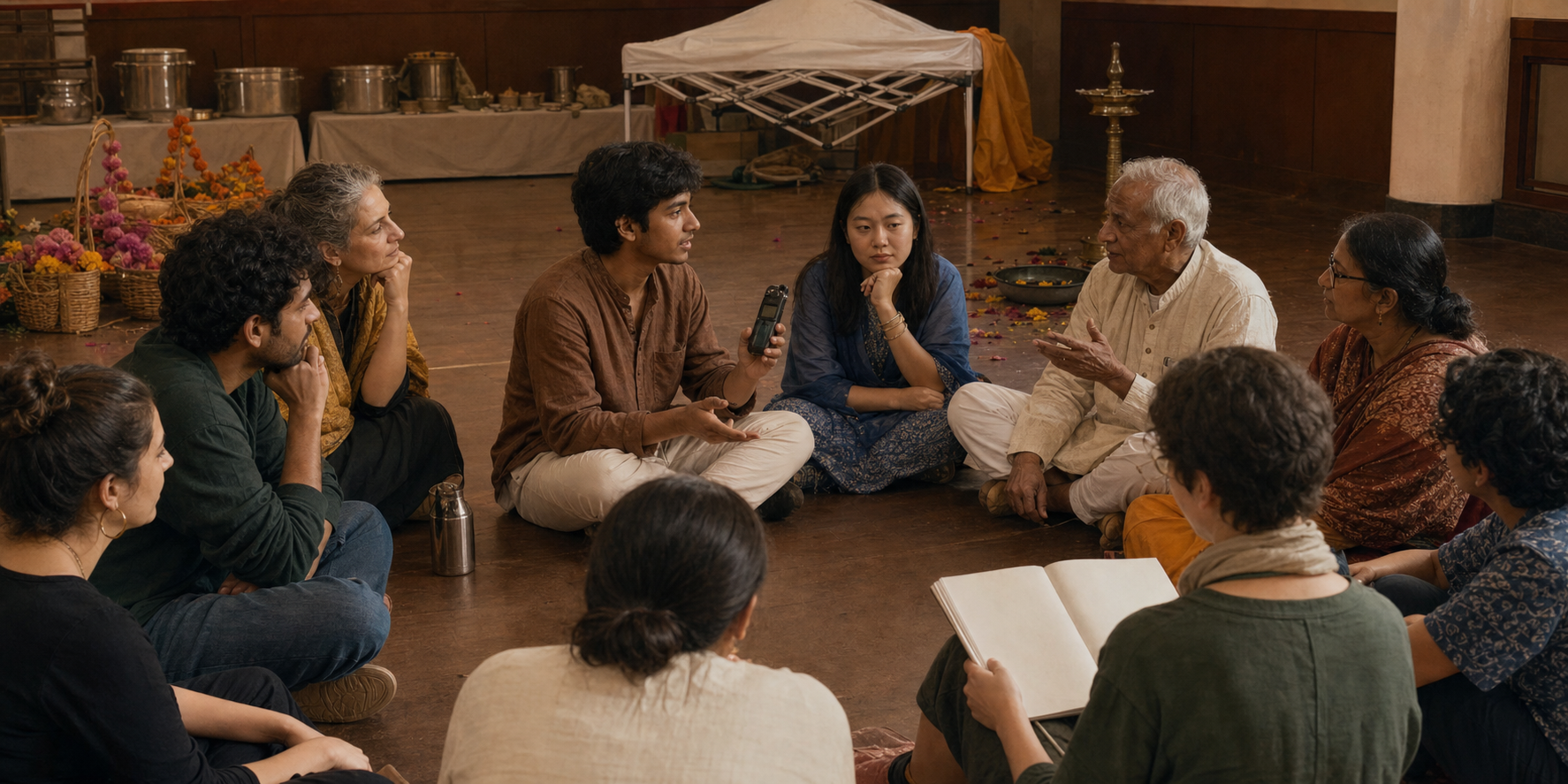
The folk-culture report distinguishes community knowledge from news organized mainly around conflict or spectacle. Temple announcements, pilgrimage updates, local service, devotional performances, and the work of tradition-bearers can preserve continuity when they explain what practices mean. On this account, reporting becomes educational when it connects an event to sacred time, narrative memory, ethics, or local history.
The Jhulan Yatra and Balarama Purnima report illustrates the practical reach of such communication. It reported a temple observance with a special feast as well as gatherings at Casey and Werribee. The article interprets these suburban celebrations as local points of access for a diaspora community, especially where travel, work, or time can make participation in one central venue difficult. This is adaptation through distribution rather than abandonment of the festival’s devotional center.
An effective festival notice should therefore do more than publish a schedule. It should identify what is being observed, explain the meaning of its central actions, show how newcomers and children can participate, and state any practical limits that require care. The sources repeatedly suggest that continuity depends on repetition with understanding: a ritual survives most fully when participants know both what to do and what the action is intended to cultivate.
Key takeaways
- Use the festival calendar as a curriculum: introduce the story and purpose before the event, embody them during it, and revisit them afterward.
- Combine several modes of learning, including sacred hearing, music, visual beauty, bodily practice, service, hospitality, and reflection.
- Give children genuine but age-appropriate roles so that devotion is experienced through relationship, imitation, and responsibility.
- Explain discipline without glorifying severity; health-sensitive adaptation and humility remain compatible with meaningful observance.
- Extend access through local gatherings and informative community reporting while preserving the theological meaning of the celebration.
The next step for temples, families, and educators is to plan festivals as connected learning environments rather than isolated annual events. When explanation, participation, care, and follow-through are designed together, each observance can deepen both devotional practice and intergenerational belonging.
References
- DharmaRenaissance Blog – In the Loop with Aniruddha Dasa: Powerful Lessons from Folk Culture and Festivals
- DharmaRenaissance Blog – Jhulan Yatra and Balarama Purnima: A Powerful Guide to Sacred Celebration
- DharmaRenaissance Blog – Powerful Krishna Consciousness Education: Nurturing Devotion from Childhood
- DharmaRenaissance Blog – Nirjala Ekadashi Bhagavatam Class: A Powerful Study in Devotion and Discipline